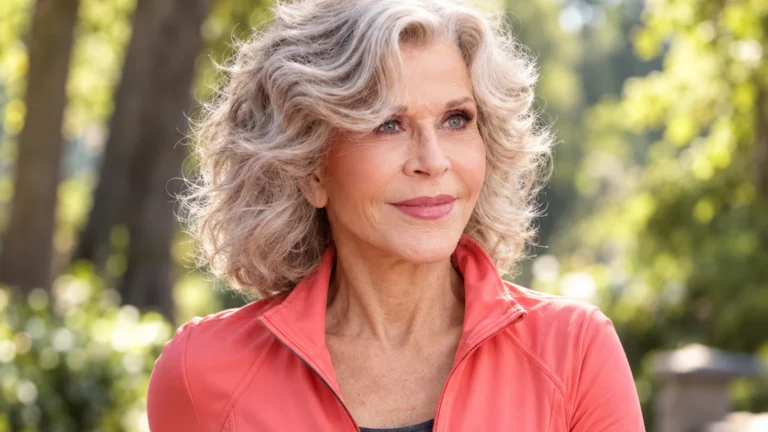

Ben Mulroney says walking got him into the best shape of his life.
The Canadian broadcaster shared his routine on his own show.
Mulroney is a longtime television host, best known for years on etalk and Your Morning.
His story taps into a bigger idea called social prescribing.
Social prescribing connects people with community support alongside any medical care they need.
Walking sounds too easy to actually work.
So we checked what the real science says.
What the Video Claims
“The Ben Mulroney Show” posted a segment about Ben’s health journey.
In it, Ben Mulroney says walking helped him reach his best physical shape.
The segment frames walking as an accessible, low cost path to better health.
It also touches on walking as a form of health support.
Related community referrals are often called social prescribing.
The show does not present itself as a clinical study.
It is one man’s account of what worked for him.
That makes it a good starting point, not proof on its own.
We wanted to know what actual peer reviewed research says about walking and health.
We also wanted to know if social prescribing holds up under scrutiny.
So we treat the video as a personal story, not a settled fact.
The rest of this article separates that story from the actual evidence.
What the Research Actually Shows About Walking and Daily Steps
Walking is one of the most studied forms of exercise on earth.
Researchers have tracked hundreds of thousands of people for years.
One major review combined data from many long term cohort studies.
It found regular walkers had a lower risk of heart disease than inactive people.
That gap held up even after researchers adjusted for other health factors (Hamer & Chida, 2008).
A newer analysis looked at daily step counts instead of just “walker or not.”
It pooled data from people whose steps were tracked with wearable devices.
Getting more steps each day was linked to a lower risk of death from any cause (Banach et al., 2023).
The drop in risk was steepest in the first few thousand steps a day.
Going from almost no steps to a moderate daily total mattered the most.
We covered that exact pattern in our piece on daily steps and mortality.
People do not need marathon numbers to see a benefit.
Even a modest daily walk moved the needle across these studies.
If you want a specific target, we answer that in how many miles you should walk a day.
Across large population studies, people who walked the most consistently had meaningfully lower rates of heart disease and early death than people who walked the least.
How Walking Protects Your Heart
Walking is not magic, it works through ordinary body mechanisms.
Each step asks your heart to pump a little harder.
Over time, that steady demand makes your heart more efficient.
Walking also helps blood vessels relax and widen more easily.
Doctors call that improved endothelial function.
Better blood vessel function tends to lower resting blood pressure.
Walking helps your muscles pull more sugar out of the blood.
That improves insulin sensitivity over weeks of consistent activity.
Regular walking is also linked to lower markers of inflammation.
Chronic inflammation is tied to heart disease and several other illnesses.
None of these changes happen after one single walk.
They build gradually with consistent weekly activity over months.
Does Pace Matter, or Just the Steps?
Ben Mulroney’s segment does not spell out an exact pace.
The research offers a useful clue on this question anyway.
Cohort studies that grouped people by activity level saw the biggest gains at moderate to brisk paces.
A slow stroll still counts as movement and still beats sitting still.
It just tends to raise your heart rate less than a brisk walk does.
A simple test is whether you can talk but not sing while walking.
That pace is a rough, practical stand in for “moderate intensity.”
You do not need a lab or a heart rate monitor to use it.
Mixing in a few brisker stretches inside a longer, easier walk works too.
That approach fits naturally into a normal day without a formal workout.
Walking and Mental Health: What the Evidence Shows
Ben Mulroney’s story is also about feeling better, not just looking fit.
Mood is a real, measurable part of the walking research.
A large 2024 review pooled 75 randomized trials on walking (Xu et al., 2024).
It found walking reduced symptoms of both depression and anxiety.
The effect held across different walking styles, indoors and outdoors.
It held for group walks and solo walks alike.
People who already had depression saw the biggest improvements.
Researchers said the benefits were comparable to other active treatments in the trials.
That does not mean walking replaces therapy or medication for everyone.
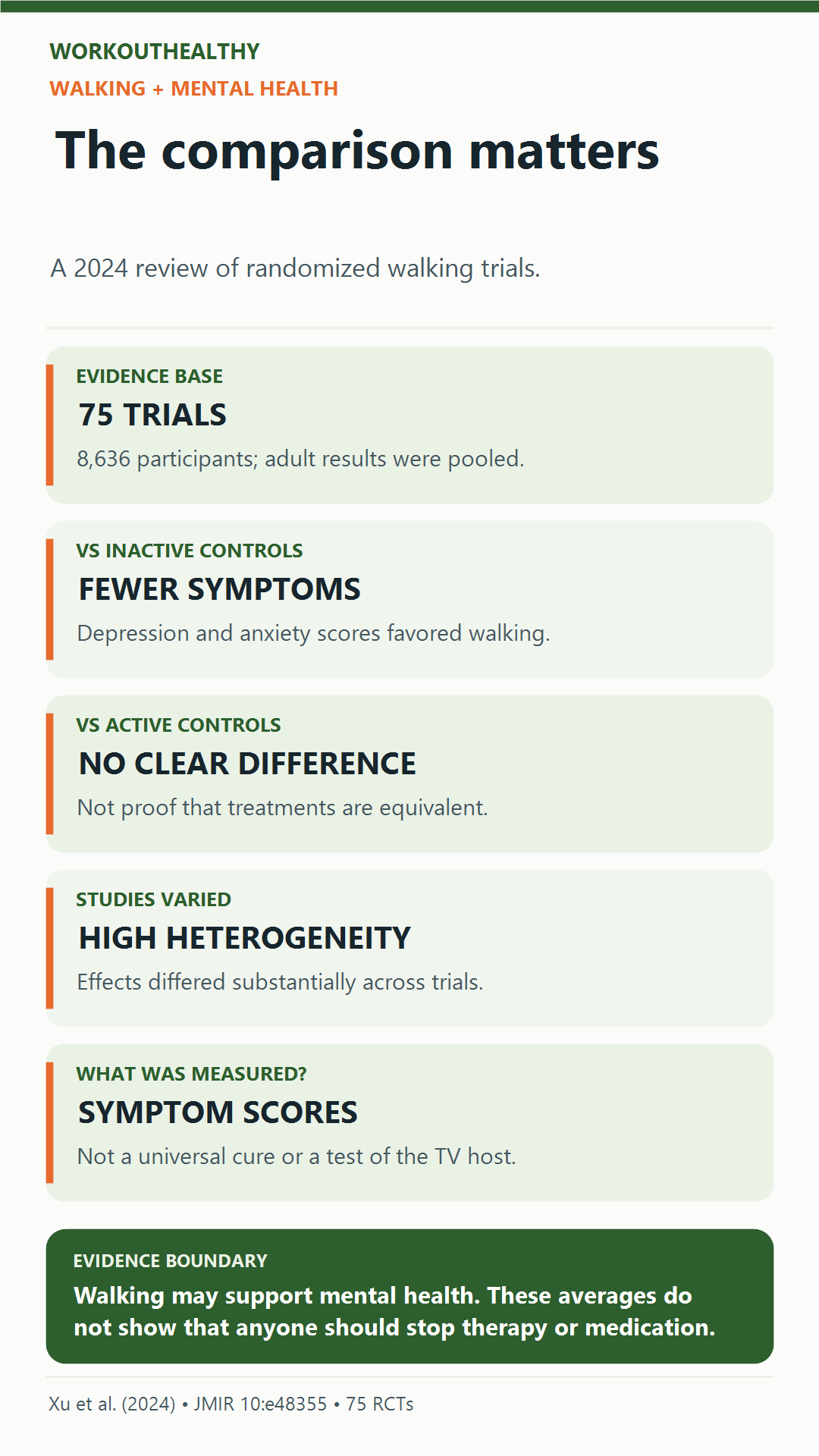
It means walking is a legitimate tool, not just a feel good myth.
What Is Social Prescribing, and Does It Hold Up?
Social prescribing is a related community-support approach, not a synonym for prescribing a walk.
NHS England describes a structured referral and support process.
A GP or another local agency can refer someone to a link worker.
The link worker may connect them with a walking group or other community service alongside medical treatment.
The idea is that connection and activity can address some things medicine cannot.
A widely cited 2017 review looked hard at the evidence behind it (Bickerdike et al., 2017).
Researchers found the concept was promising but still under tested.
Many of the original program evaluations had weak designs.
Few of them used control groups or long follow up periods.
That does not mean social prescribing fails.
It means the evidence has not caught up to the enthusiasm yet.
The same review found most individual programs reported positive outcomes.
It just could not say for certain why, or how much credit walking deserves.
Social prescribing sounds intuitive: connect people with community support alongside medical care. The research so far says the idea is promising, not proven.
What This Evidence Does Not Prove
None of this research proves walking cures any specific disease.
It also cannot say walking will work exactly the way it did for Ben Mulroney.
Every body responds a little differently to a new habit.
Most walking studies compare groups, they do not guarantee an individual result.
Many studies also rely on people accurately reporting their own activity.
Self reported step counts can run higher than what actually happened.
Genetics, sleep, diet, and stress all shape health outcomes too.
Walking is one input among many, not the entire equation.
The link between walking and better outcomes is strong and consistent.
It is still not a personal guarantee for any single reader.
The social prescribing evidence has an extra layer of uncertainty on top of that.
Most of it comes from programs run inside the United Kingdom’s health system.
A program built around that system may not translate cleanly to another country.
Local culture, cost of care, and access to walking groups all vary by place.
Common Mistakes People Make When They Start Walking for Health
The first mistake is doing too much, too soon.
A new walker jumps from almost no activity to 10,000 steps overnight.
Sore joints and quick burnout usually follow that kind of jump.
The second mistake is ignoring worn out shoes.
Old shoes change how force moves through your ankles and knees.
The third mistake is walking so slowly it barely raises your heart rate.
Gentle strolling still has value, but brisker paces showed stronger results in the research.
The fourth mistake is skipping strength work entirely.
Walking builds cardiovascular fitness, it does not replace muscle training.
Most people who walk regularly still benefit from two short strength sessions a week.
The fifth mistake is treating one big walk as a free pass.
One long Sunday walk does not offset six sedentary days.
Consistency mattered more than any single session in the research reviewed here.
Who Should Check With a Doctor First
Most healthy adults can start walking without any special clearance.
Some people should still talk to a doctor before ramping up.
That includes anyone with diagnosed heart disease.
It includes people with uncontrolled high blood pressure.
Anyone with joint replacements or recent surgery should ask first too.
People with diabetes should ask about blood sugar monitoring during exercise.
Anyone who gets chest pain, dizziness, or shortness of breath should stop and get checked.
Pregnant readers should also confirm a safe activity level with their provider.
A quick checkup before starting is cheap insurance against a bad outcome.
How to Build a Walking Habit That Actually Sticks
Start with a number of minutes you can hit every single day.
Even 15 minutes counts as a real starting point.
Add distance gradually, in one to two week blocks.
You can check your current baseline with our guide to the four flights stair test.
Pick a consistent time of day and protect it like an appointment.
Morning walks tend to stick better because fewer things interrupt them.
Track your steps with a phone or a cheap pedometer.
Walking with another person raises the odds you will stick with it.
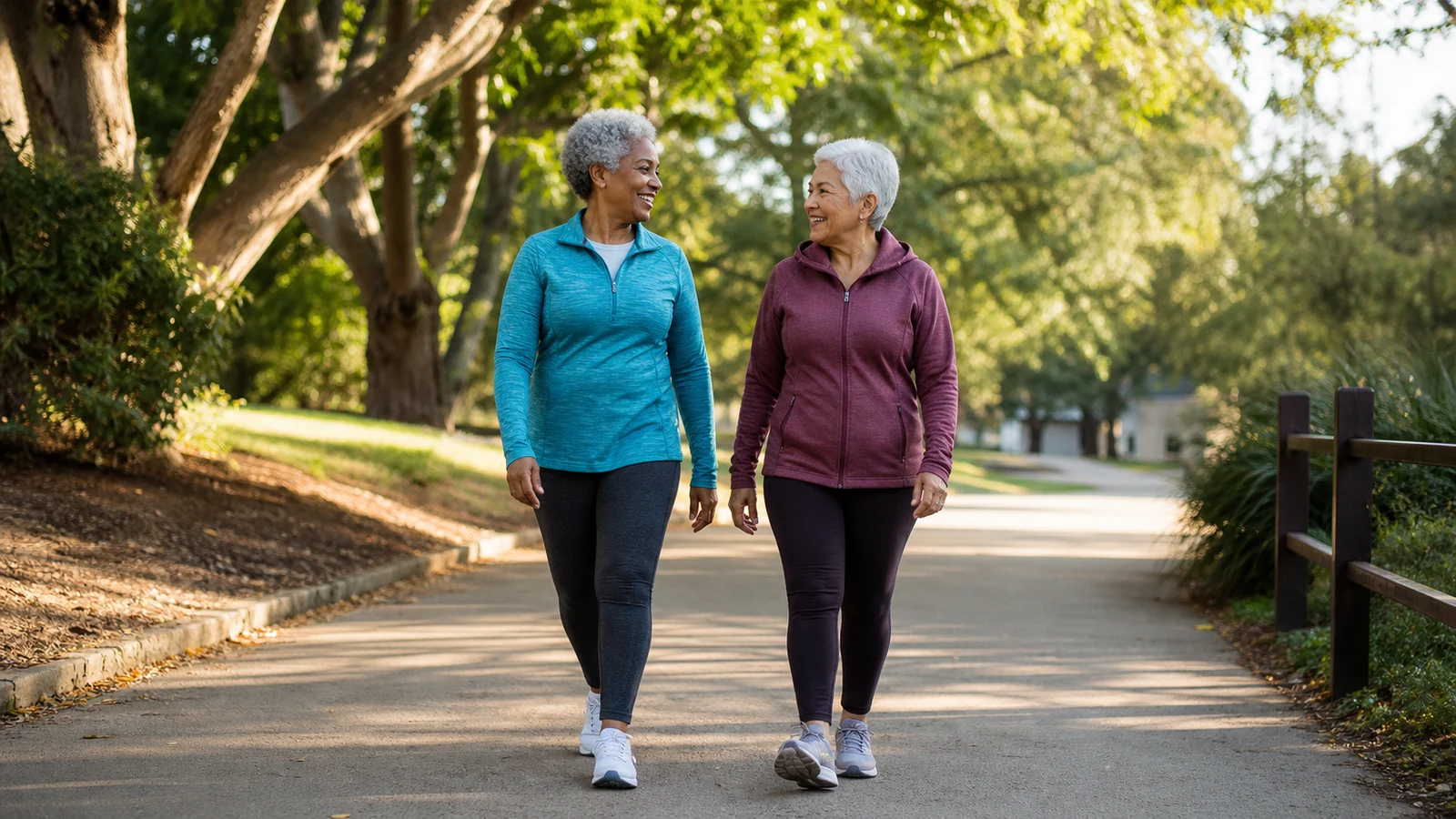
A walking group is one community option a link worker might suggest.
Add short bursts of faster walking once the habit feels easy.
Faster intervals raise the cardiovascular benefit without adding much time.
Pair walking with strength training twice a week for a more complete routine.
Some readers pair walking days with heat exposure, a habit covered in sauna use and heart health.
Rest days still count if they include light movement like stretching.
Track how you feel, not just the number on a screen.
Energy and sleep quality often improve before the scale does.
A simple four week starting plan makes the habit easier to hold onto.
In week one, aim for a flat 15 minute walk most days.
In week two, stretch that same walk out to 20 or 25 minutes.
In week three, add one or two short brisk sections inside the walk.
In week four, try adding a single extra walking day to your week.
Keep the plan boring and repeatable rather than exciting and unsustainable.
A habit you actually keep beats a perfect plan you quit after two weeks.
Watch the Original Video
Want more like this? Subscribe to WorkoutHealthy Insider for practical explanations behind popular fitness claims.
References
Banach, M., Lewek, J., Surma, S., Penson, P. E., Sahebkar, A., Martin, S. S., Bajraktari, G., Henein, M. Y., Reiner, Ž., Bielecka-Dąbrowa, A., & Bytyçi, I. (2023). The association between daily step count and all-cause and cardiovascular mortality: A meta-analysis. European Journal of Preventive Cardiology, 30(18), 1975 to 1985. https://doi.org/10.1093/eurjpc/zwad229
Bickerdike, L., Booth, A., Wilson, P. M., Farley, K., & Wright, K. (2017). Social prescribing: Less rhetoric and more reality. A systematic review of the evidence. BMJ Open, 7(4), e013384. https://doi.org/10.1136/bmjopen-2016-013384
Hamer, M., & Chida, Y. (2008). Walking and primary prevention: A meta-analysis of prospective cohort studies. British Journal of Sports Medicine, 42(4), 238 to 243. https://doi.org/10.1136/bjsm.2007.039974
Xu, Z., Zheng, X., Ding, H., Zhang, D., Cheung, P. M., Yang, Z., Tam, K. W., Zhou, W., Chan, D. C., Wang, W., & Wong, S. Y. (2024). The effect of walking on depressive and anxiety symptoms: Systematic review and meta-analysis. JMIR Public Health and Surveillance, 10, e48355. https://doi.org/10.2196/48355
This article is for general information only and is not medical advice. If you have an injury, ongoing pain, or a medical condition, talk to a doctor or physical therapist before you change how you train or eat.