

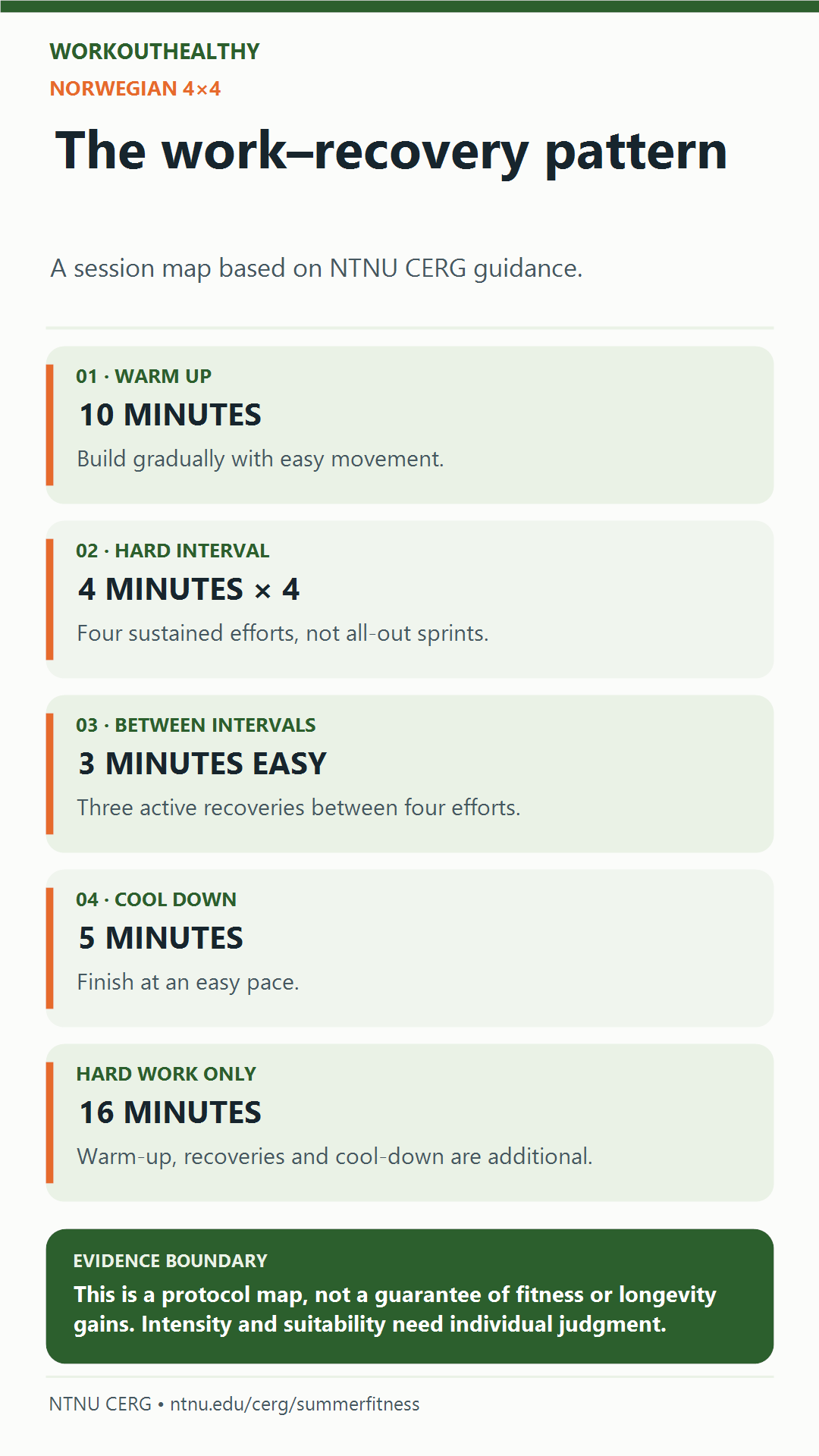
Norwegian 4×4 interval training means four four-minute hard aerobic efforts with three minutes of easier movement between them. Add a warm-up and cool-down, and the illustrated session below takes about 40 minutes, with 16 minutes spent in the hard blocks.
A video from Dr. Stacy Sims helped popularize the method, but the original trial and the workout’s practical limits matter more than its viral promise. This guide separates the studied running protocol from an easier editorial starting option.
The full Norwegian 4×4 session
| Clock | What to do | Effort cue |
|---|---|---|
| 0:00 to 10:00 | Warm up gradually | Easy, then steadily more purposeful. |
| 10:00 to 14:00 | Hard interval 1 | Very hard, but repeatable for the full four minutes. |
| 14:00 to 17:00 | Easy recovery 1 | Keep moving at a genuinely easier pace. |
| 17:00 to 21:00 | Hard interval 2 | Try to match the first interval’s sustainable effort. |
| 21:00 to 24:00 | Easy recovery 2 | Let breathing settle enough to repeat the work. |
| 24:00 to 28:00 | Hard interval 3 | Keep movement controlled rather than sprinting out. |
| 28:00 to 31:00 | Easy recovery 3 | Use the same easy mode as before. |
| 31:00 to 35:00 | Hard interval 4 | Finish with an effort you can maintain, not an all-out dash. |
| 35:00 to 40:00 | Cool down | Ease down gradually. |
The arithmetic is 10 minutes warming up, 16 minutes hard, nine minutes of recovery and five minutes cooling down. The Norwegian University of Science and Technology research group’s public guide uses this same warm-up, work, recovery and cool-down structure.
How hard are the four-minute blocks?
The 2007 Helgerud trial assigned its 4×4 running group to work at 90% to 95% of measured maximum heart rate, with active recovery near 70%. NTNU’s general public guide gives a wider 85% to 95% work range, so these numbers describe protocols rather than a precise personal safety threshold.
| If you use… | Practical check | Limit |
|---|---|---|
| A heart-rate monitor | Use it to see whether effort rises during the hard blocks and settles during recovery. | An age formula or wrist reading may not equal your measured maximum; medications can change heart-rate response. |
| Breathing and speech | The hard block feels strenuous and allows only brief words, while recovery allows easier breathing. | Effort cues are personal and do not certify a specific research heart-rate zone. |
| Pace, resistance or incline | Choose a setting you can repeat across four blocks without losing control. | Faster is not always better if the first block makes the remaining ones impossible. |
Running was the actual mode in the 2007 comparison. Cycling, rowing or incline walking can make the timing practical, but changing the mode does not reproduce that study’s exact result.
What the original trial actually measured
The 2007 study randomly assigned 40 healthy, nonsmoking, moderately trained men to four running programs for eight weeks, three sessions per week. They were not competitive distance runners, and the trial did not include a sedentary beginner group.
| Study group | Assigned intensity and format | Reported VO2 max finding |
|---|---|---|
| Long, slow distance | Continuous work near 70% of maximum heart rate | Smaller change than the interval groups in the reported comparison. |
| Lactate-threshold running | Continuous work near 85% of maximum heart rate | Smaller change than the interval groups in the reported comparison. |
| 15/15 intervals | 15 seconds hard, 15 seconds active recovery | VO2 max increased 5.5% on average. |
| Four by four minutes | Four minutes hard, three minutes active recovery | VO2 max increased 7.2% on average. |
The paper reports that the interval approaches improved VO2 max significantly more than the two continuous-training approaches under its matched-work conditions. The 7.2% versus 5.5% figures are group averages, not a promise of a personal gain or proof that 4×4 beats 15/15 for every person.
Both interval groups also showed an approximately 10% rise in measured stroke volume in the paper’s summary. That result should not be attributed exclusively to the four-minute format.
A gentler bridge before the full session
If you are currently inactive, begin with comfortable walking or cycling and build a repeatable aerobic routine before attempting sustained hard intervals. The American Heart Association’s scientific guidance recommends that inactive people start slowly and raise intensity as tolerance permits when they remain symptom-free.
One editorial example is a 10-minute easy warm-up, two two-minute controlled hard efforts separated by three easy minutes, then a five-minute cool-down. That is a 22-minute session, but it is not the Helgerud 4×4 protocol and the 2007 trial does not tell us what outcome it would produce.
From there, you could try two four-minute blocks before considering four blocks, allowing recovery between harder days. There is no fixed number of weeks that makes the next step appropriate for everyone, and an easier interval session is a valid choice if the full protocol is unsuitable.

What about VO2 max and longevity?
VO2 max measures the highest rate of oxygen use during intense exercise and is one marker of aerobic fitness. A 2009 pooled analysis and a 2018 treadmill cohort link higher cardiorespiratory fitness with lower mortality, but those studies do not show that this exact workout extends an individual’s life.
Changing fitness can also be worthwhile for reasons besides a lab number, including being able to do more activity comfortably. The 2007 trial measured fitness and related physiology across eight weeks, not long-term survival, brain health or heart-rate variability.
When to seek individual guidance
Near-maximal intervals deserve more care if you are new to vigorous exercise or have cardiovascular disease, diabetes, uncontrolled blood pressure or symptoms during exertion. Ask a qualified clinician how to approach vigorous training in those circumstances instead of using the study’s heart-rate target as a prescription.
Stop exercise and seek medical review for chest pressure, unusual breathlessness, lightheadedness or a fast or irregular heartbeat during or after the session. The American Heart Association’s activity guidance lists those warning signs.
Watch the source video
Dr. Stacy Sims discusses the Norwegian approach in the video below. Read its 16-minute figure as the hard-work subtotal, not the length of the entire workout.
Want more like this? Subscribe to WorkoutHealthy Insider for practical explanations behind popular fitness claims.
Sources
- Helgerud and colleagues, 2007: four-arm randomized running comparison in 40 moderately trained men, including measured VO2 max and stroke volume.
- NTNU Cardiac Exercise Research Group guidance: public 4×4 timing and intensity description.
- Kodama and colleagues, 2009, and Mandsager and colleagues, 2018: fitness and mortality associations, separate from the 4×4 intervention.
- American Heart Association scientific statement summary: gradual entry for inactive people and the importance of exertional symptoms.
- American Heart Association activity-plan guidance: exertional warning signs.
This article provides general fitness information, not a personal exercise prescription or medical advice. Ask a qualified health professional for individual guidance if you have a condition, symptoms or uncertainty about vigorous exercise.