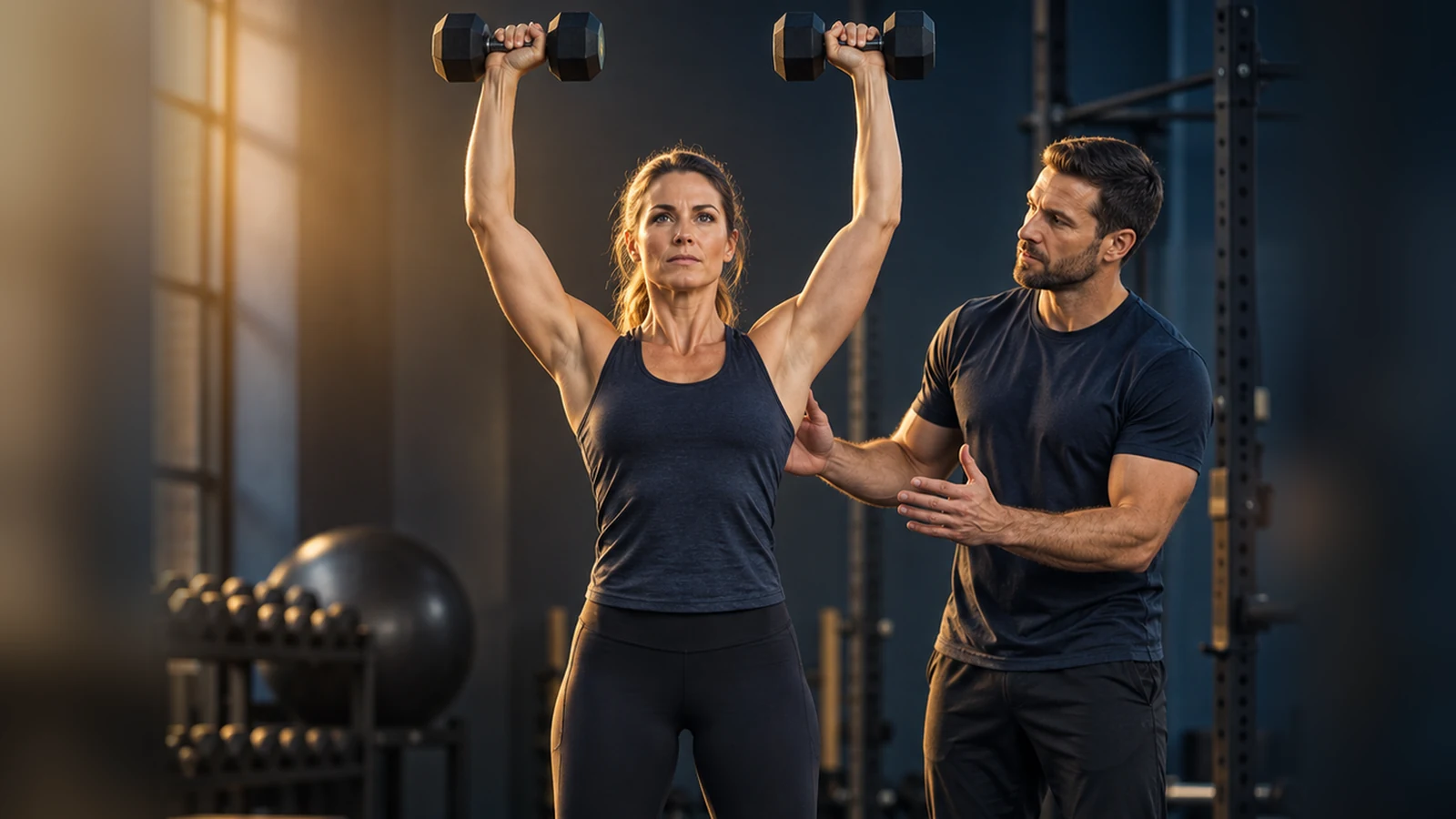

Cardio is good for your heart, your mood, and your waistline.
It is not the best tool you have for your skeleton.
Bone responds to being loaded, not to being tired.
That single fact explains why lifting has a stronger track record for bone density than most cardio does.
Here are seven reasons, plus an honest look at where this claim gets pushed too far, and the specific lifts the research points to.
Why Bone Responds to Load, Not Effort
Bone is living tissue that is constantly being broken down and rebuilt.
The cells that build it respond to mechanical strain.
When a bone is bent or compressed harder than it is used to, the rebuilding process gets a signal to add material.
When nothing strains it, that signal fades.
Hong and Kim reviewed this process in 2018 and describe resistance exercise as a way to apply the kind of strain that drives bone formation.
Effort alone does not do it.
You can finish a cycling session completely exhausted while your hip bones were never meaningfully strained.
This is also why bone loss is so rapid during bed rest or in spaceflight.
Remove the load and the skeleton starts giving material back within weeks.
The body treats bone as expensive tissue and keeps only what it is asked to use.
Reason 1: Muscle Pulling on Bone Is a Direct Signal
Muscles attach to bone by tendon.
When a muscle contracts hard, it pulls on the bone it is attached to.
That pull is one of the largest forces most bones ever experience.
A heavy set of squats sends large forces through the hip and spine on every repetition.
A steady walk sends a much smaller force through the same places.
Both are worth doing, but only one is a strong bone building signal.
There is a useful way to picture the difference.
Walking applies a force close to your body weight with each step.
A heavy squat can apply several times that through the same hip joint.
The number of repetitions does not close that gap, because bone responds mainly to the size of the peak strain rather than how many times a small strain is repeated.
Reason 2: You Can Keep Raising the Load
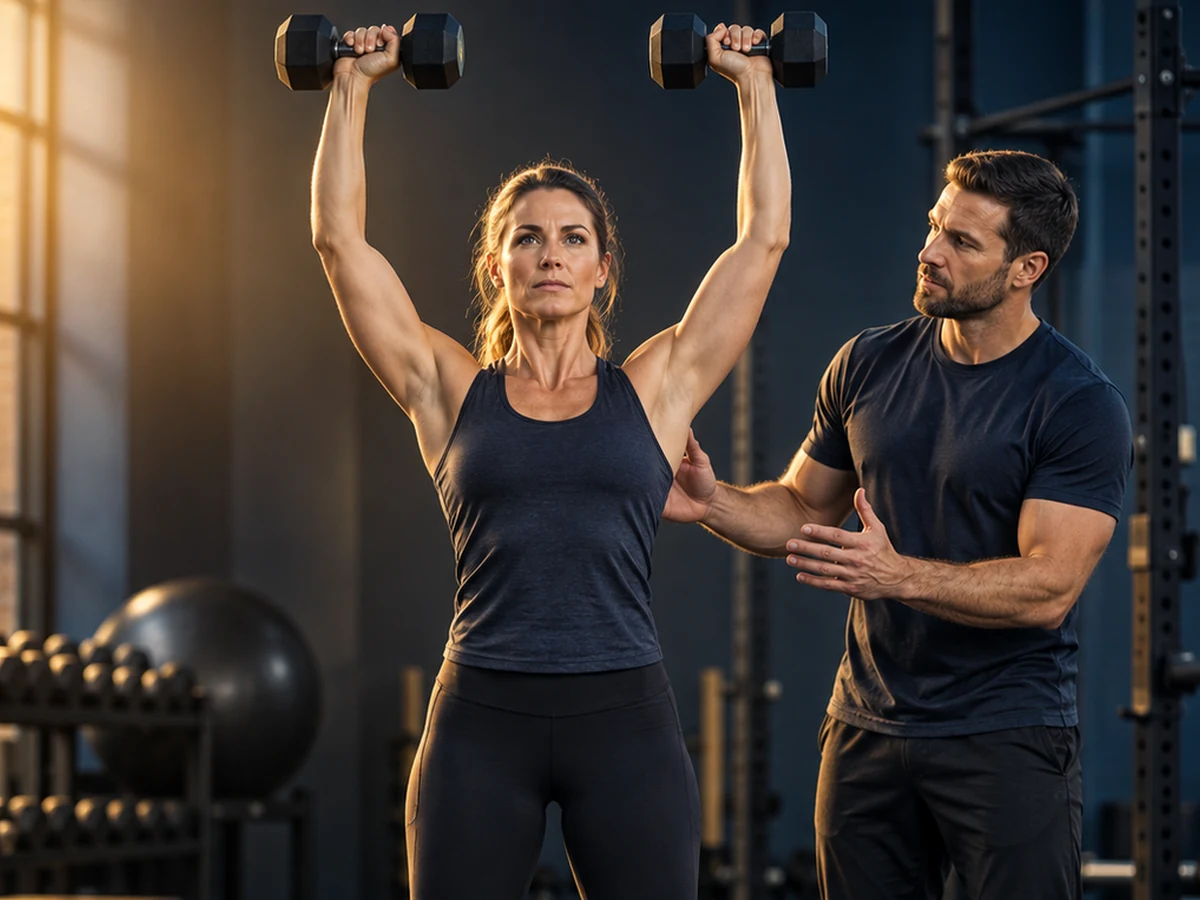
Bone adapts to what it is used to, then stops adapting.
To keep the signal going, the load has to keep climbing.
Lifting is built for exactly that.
You add five or ten pounds and the strain goes up in a measured way.
Cardio is harder to progress in that direction.
Running further mostly adds repetitions of the same modest force rather than raising peak load.
The ability to keep increasing load is a large part of why strength training holds its advantage over years rather than weeks.
Reason 3: The Strongest Bone Trial Used a Barbell
The clearest single piece of evidence here is the LIFTMOR trial.
Watson and colleagues published it in 2018 in the Journal of Bone and Mineral Research.
They studied postmenopausal women with low bone mass, a group usually told to be careful.
The women trained twice a week for eight months using heavy resistance training and impact work.
Bone mineral density improved at the lumbar spine and the femoral neck, which are the two sites that matter most for serious fractures.
Height and physical function improved as well.
Just as importantly, the supervised heavy program was completed safely in a population often steered away from heavy loads.
Bone does not count your steps or your calories. It responds to how hard it was strained, and to whether that strain was greater than what it had already adapted to.
Reason 4: Cardio That Does Not Carry Your Weight Does Little for Bone
This is where the gap is widest.
Cycling and swimming are excellent for cardiovascular fitness.
Neither one loads the skeleton much.
On a bike, the saddle carries your weight and your feet never strike the ground.
In water, buoyancy removes most of the load entirely.
Someone can train seriously for years in those sports and receive almost no bone building stimulus from them.
Weight bearing cardio is a different story, and that distinction matters more than the word cardio itself.
Walking sits in between.
It is weight bearing, which is better than nothing, but the forces involved are close to what the skeleton already handles every day.
That is why daily walking earns its place for heart health, mood, and general mobility, while doing comparatively little to raise bone density on its own.
Reason 5: Lifting Targets the Hip and Spine Specifically
Bone responds where it is loaded, not everywhere at once.
That makes site specific training valuable.
A 2011 Cochrane review by Howe and colleagues looked at exercise for preventing and treating osteoporosis in postmenopausal women.
The reviewers concluded that progressive resistance training for the lower limbs appeared to be the most effective approach for bone density at the neck of the femur.
For the spine, combination programmes that mixed several exercise types came out ahead.
Both conclusions put loaded strength work at the centre rather than steady cardio.
The hip and spine are also where fractures do the most damage to independence later in life.
Reason 6: Strength Training Lowers the Odds of the Fall Itself
A fracture usually needs two ingredients.
Fragile bone, and a fall.
Bone density only addresses the first.
Strength training works on the second at the same time.
Stronger legs, better balance, and faster reactions all reduce the chance of going down in the first place.
The LIFTMOR participants improved functional measures alongside their bone results.
Cardio helps general fitness, but it does not build the leg strength needed to catch yourself on a kerb.
This combination is the practical argument.
Denser bone plus a lower chance of falling protects a person twice over.
For an older adult, the ability to recover a stumble without going down may matter as much as anything a scan can measure.
Reason 7: The Benefit Still Applies After Menopause
Bone loss speeds up sharply in the years around menopause as oestrogen falls.
That is often treated as a reason to be gentle.
The evidence points the other way.
The clearest bone results come from trials in exactly this group, training with real load.
Being older is a reason to be supervised and to progress sensibly, not a reason to stay light forever.
Nutrition matters alongside the training, and protein alone will not carry the load without the training to go with it.
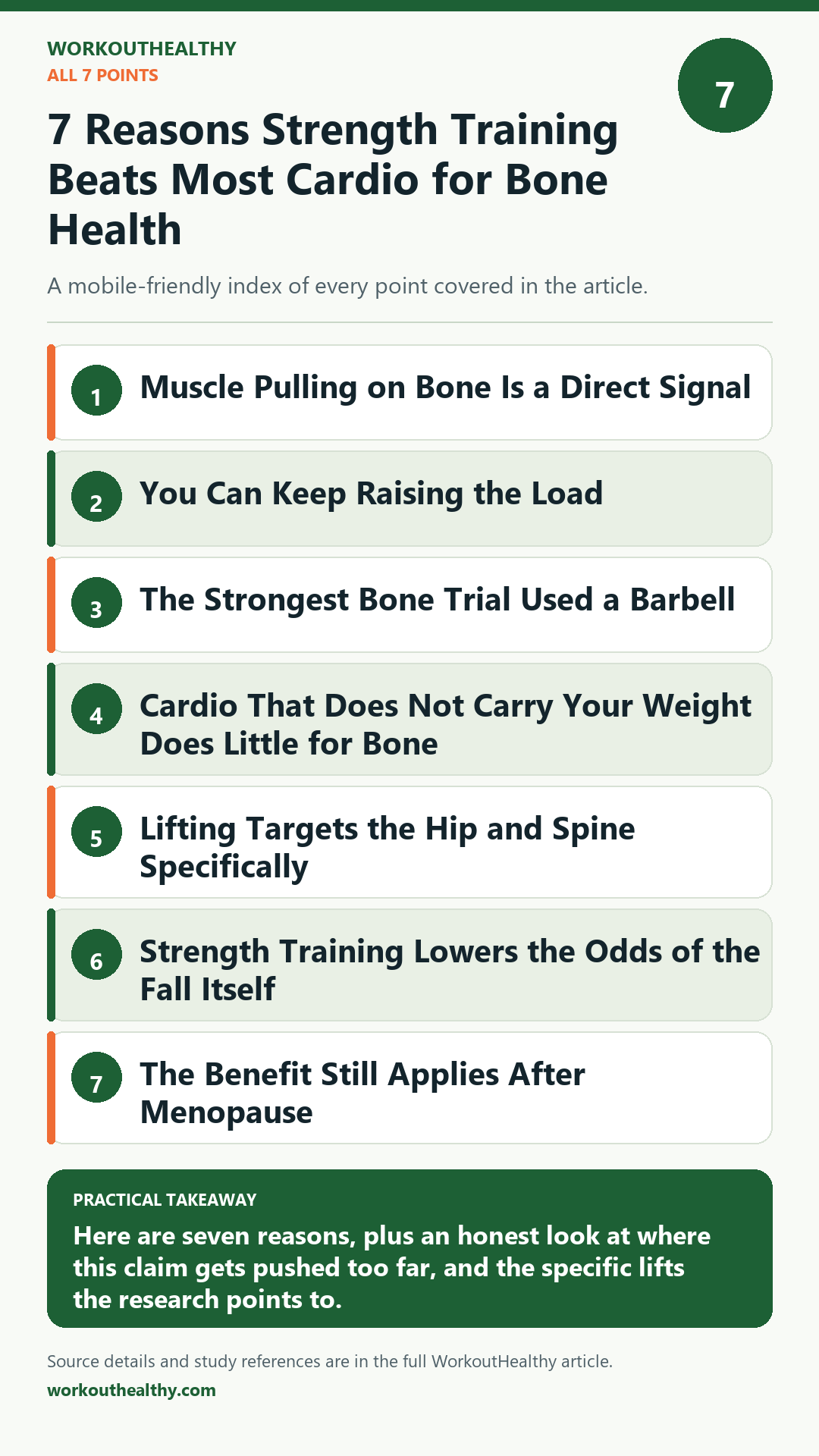
Where This Claim Gets Overstated
An honest article has to mark the limits, and there are several.
First, not all cardio is equal for bone.
Running, jumping rope, and court sports involve impact, and impact does load bone.
Saying strength training beats cardio is fair when the comparison is cycling, swimming, or an easy walk.
It is much less clear against regular running.
Second, the changes are small.
Bone density shifts in these trials are typically a low single digit percentage over many months.
This is a slow protective process, not a dramatic transformation.
Third, bone mineral density is a proxy.
Most exercise trials measure density because measuring fractures requires far larger and longer studies.
Higher density is associated with lower fracture risk, but a density change on a scan is not the same as a fracture prevented.
Fourth, none of this makes cardio optional.
The World Health Organization guidelines published by Bull and colleagues in 2020 recommend both aerobic activity and muscle strengthening on two or more days a week.
The honest position is that they do different jobs, and bone is the job lifting does better.
The Lifts Researchers Link Most Closely to Stronger Bones
The LIFTMOR programme is the most useful template because it was tested and reported in detail.
It centred on three heavy compound lifts.
The deadlift, which loads the hips and the whole spine.
The back squat, which loads the hips, thighs, and spine under compression.
The overhead press, which loads the upper spine and shoulder girdle.
Alongside those, the programme included an impact element, a jumping chin up with a controlled drop landing.
The common thread is straightforward.
These are movements that put substantial load through the hip and the spine, done for low repetitions with heavier weight.
Isolation work such as a leg curl does very little at those sites.
If you are starting later in life, a careful approach to loading a hip hinge is the sensible entry point, and building it into a structured strength plan beats collecting random exercises.
Get coaching for these lifts if you can.
The trials that produced these results were supervised, and that supervision is part of why they were both effective and safe.
Start with load you can control cleanly and add weight slowly across months rather than weeks.
Twice a week was enough in the trial, so this does not require living in the gym.
And if you have diagnosed osteoporosis, a previous fracture, or any spinal condition, get clearance and individual guidance before you start loading a barbell.
Has anyone ever told you to avoid heavy lifting because of your bones? Subscribe to WorkoutHealthy Insider for practical explanations behind popular fitness claims.
References
Bull, F. C., Al-Ansari, S. S., Biddle, S., Borodulin, K., Buman, M. P., Cardon, G., Carty, C., Chaput, J. P., Chastin, S., Chou, R., Dempsey, P. C., DiPietro, L., Ekelund, U., Firth, J., Friedenreich, C. M., Garcia, L., Gichu, M., Jago, R., Katzmarzyk, P. T., … Willumsen, J. F. (2020). World Health Organization 2020 guidelines on physical activity and sedentary behaviour. British Journal of Sports Medicine, 54(24), 1451-1462. https://doi.org/10.1136/bjsports-2020-102955
Hong, A. R., & Kim, S. W. (2018). Effects of resistance exercise on bone health. Endocrinology and Metabolism, 33(4), 435. https://doi.org/10.3803/EnM.2018.33.4.435
Howe, T. E., Shea, B., Dawson, L. J., Downie, F., Murray, A., Ross, C., Harbour, R. T., Caldwell, L. M., & Creed, G. (2011). Exercise for preventing and treating osteoporosis in postmenopausal women. Cochrane Database of Systematic Reviews, (7), CD000333. https://doi.org/10.1002/14651858.CD000333.pub2
Watson, S. L., Weeks, B. K., Weis, L. J., Harding, A. T., Horan, S. A., & Beck, B. R. (2018). High-intensity resistance and impact training improves bone mineral density and physical function in postmenopausal women with osteopenia and osteoporosis: The LIFTMOR randomized controlled trial. Journal of Bone and Mineral Research, 33(2), 211-220. https://doi.org/10.1002/jbmr.3284
This article is for general information only and is not medical advice. If you have an injury, ongoing pain, or a medical condition, talk to a doctor or physical therapist before you change how you train or eat.