

Most successful training plans mix harder sessions with easier ones.
A popular post credits Eugen Sandow with doing this more than a century ago, alternating lighter toning days with harder days.
It is an appealing story, and the principle behind it is sound.
The historical claim, though, is one we could not confirm.
What the Popular Version Says
The widely shared version says Sandow rotated light and heavy days in Strength and How to Obtain It, his 1897 book.
It also calls this an early form of periodization.
Some versions even suggest a set number of easy days for every hard one.
Those are specific claims, so they are worth checking against the book itself.
The book is old enough to be in the public domain, which makes that check possible for anyone.
What Sandow’s Book Actually Says
Strength and How to Obtain It is available free on Project Gutenberg.
In our review of the text, we did not find instructions to alternate lighter and harder training days.
We also did not find a ratio of easy days to hard days.
What the book does contain is a slow, steady progression.
Its tables add repetitions on a set schedule, such as one more every other day or every three days, depending on the exercise and age group.
On timing, Sandow left the choice to the pupil.
He wrote that the best time to train “must depend on the pupil himself,” noting that some prefer mornings and others later in the day.
He also urged caution with load, writing that it is “always better to use bells too light than too heavy.”
A physical culture historian’s summary of his system, by Conor Heffernan, likewise does not mention light and heavy days.
So the light and heavy rotation appears to be a modern reading, not something we could trace to Sandow.
Who Eugen Sandow Was
Sandow was born Friedrich Wilhelm Müller in 1867 in Königsberg, Prussia, and died in London in 1925.
He is often called the father of modern bodybuilding.
In 1901 he ran what is described as the first major bodybuilding competition, at the Royal Albert Hall.
His emphasis on gradual progress and avoiding strain does fit the spirit of easier training days, even if the specific rotation is not documented.
Hard days build fitness. Easier days let you come back and do it again.
What Periodization Means
Periodization means planning changes in training over time.
In a linear model, loads rise steadily across weeks.
In an undulating model, loads and reps change more often, sometimes from one session to the next.
A heavy day followed by a lighter day is one simple form of that variation.
Another common pattern rotates heavy, light, and medium days across a week.
The goal is to train hard often enough to improve, without piling up so much fatigue that performance slides.
The easier days are not wasted time.
They let you practice technique and add useful work while your body recovers from the harder sessions.
What the Research Shows
A 2017 meta analysis by Williams and colleagues pooled 18 studies comparing periodized and non periodized programs.
Periodized training produced greater one rep max strength gains, with a moderate effect size of 0.43.
Undulating models showed better results in that analysis.
The authors wrote that variation in training stimuli “appears to be vital for increasing maximal strength.”
A 2022 meta analysis by Moesgaard and colleagues looked only at programs matched for total volume.
Periodized training still gave a small edge for one rep max strength.
Muscle growth, however, did not differ between periodized and non periodized training.
Undulating plans beat linear plans for strength only in trained lifters, not in untrained people.
What the Evidence Does Not Say
- It does not prove Sandow invented periodization. We could not find that in his 1897 text.
- It does not say variation builds more muscle. When volume was matched, growth was similar.
- It does not set a magic ratio. No single number of easy days per hard day fits everyone.
How to Use Hard and Easy Days
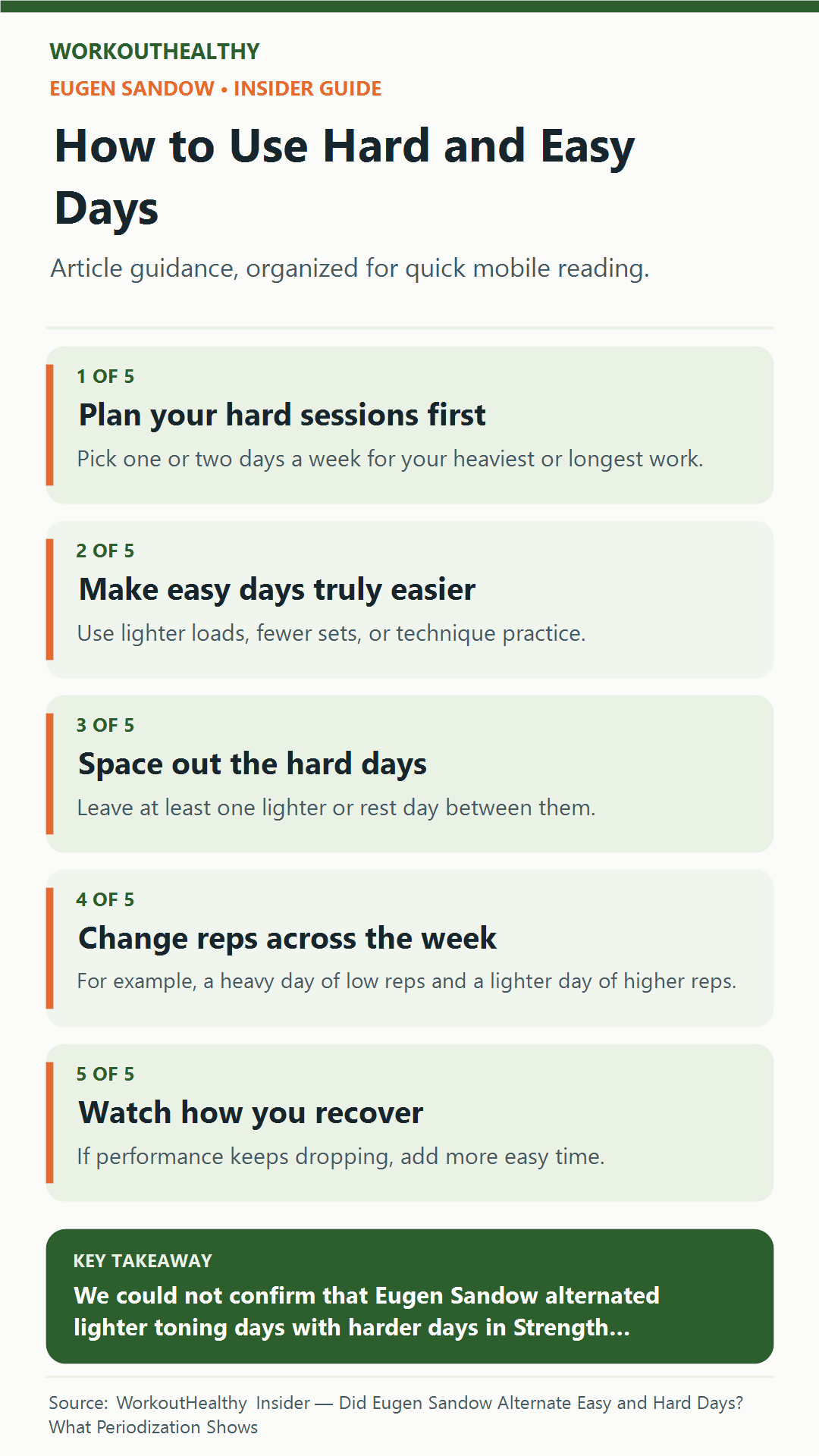
- Plan your hard sessions first. Pick one or two days a week for your heaviest or longest work.
- Make easy days truly easier. Use lighter loads, fewer sets, or technique practice.
- Space out the hard days. Leave at least one lighter or rest day between them.
- Change reps across the week. For example, a heavy day of low reps and a lighter day of higher reps.
- Watch how you recover. If performance keeps dropping, add more easy time.
If you mix lifting with cardio, our guide to concurrent training explains how to arrange hard sessions.
When life gets busy, lighter sessions can keep you on track, as our tips on keeping strength while traveling show.
Common Mistakes
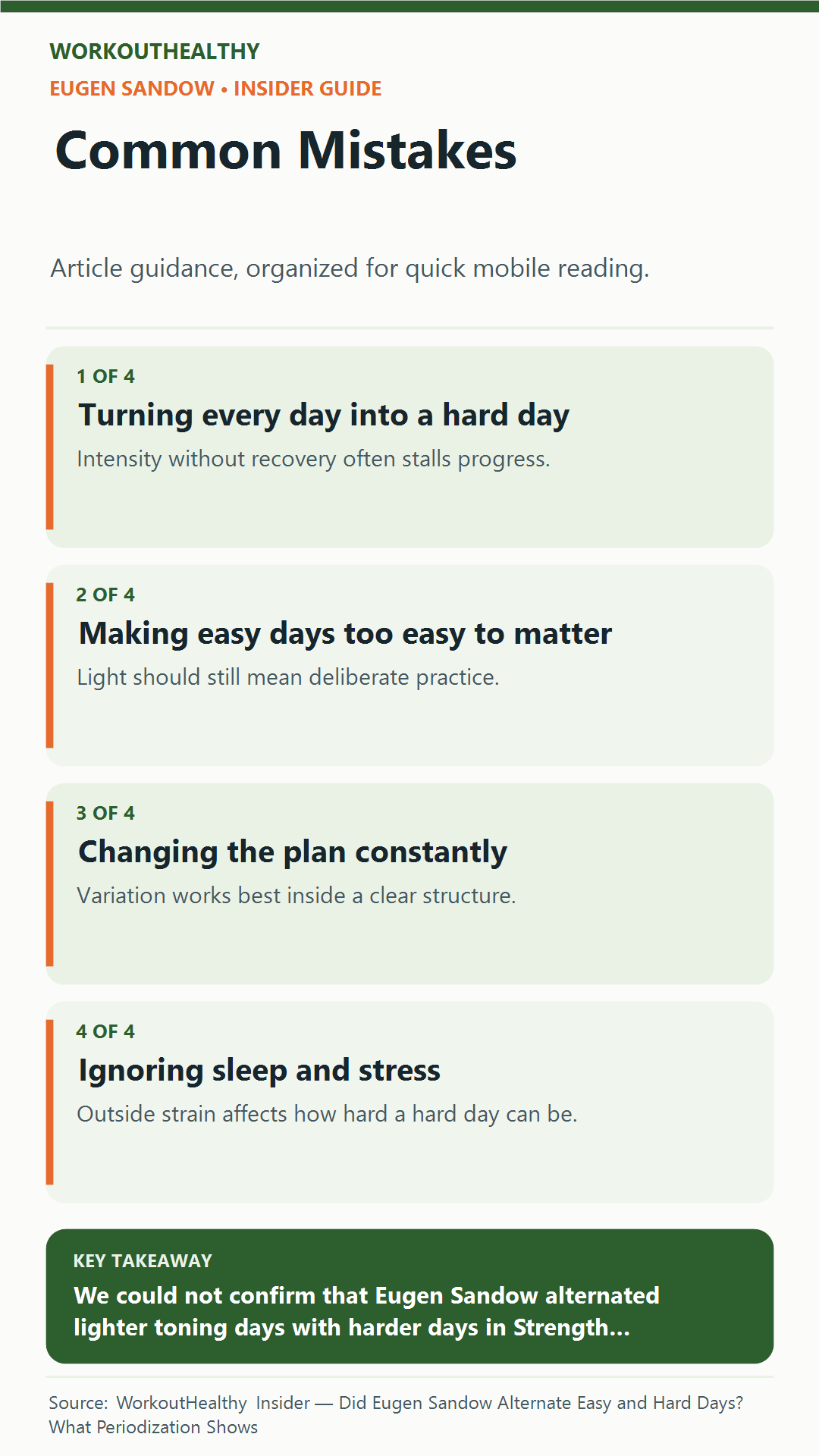
- Turning every day into a hard day. Intensity without recovery often stalls progress.
- Making easy days too easy to matter. Light should still mean deliberate practice.
- Changing the plan constantly. Variation works best inside a clear structure.
- Ignoring sleep and stress. Outside strain affects how hard a hard day can be.
Group classes can push every session to the max, which our look at whether CrossFit is for you discusses.
Who Should Be Careful
Beginners usually progress on simple plans and do not need complex periodization yet.
People with heart conditions, joint problems, or recent injuries should get guidance before adding very heavy days.
Older lifters often benefit from more easy time between hard sessions.
If soreness, poor sleep, or joint aches keep building, that is a sign to lighten the load for a while.
The Bottom Line
We could not confirm that Eugen Sandow alternated lighter toning days with harder days in Strength and How to Obtain It.
His book does teach slow progression and caution with weight.
Modern research supports planned variation for strength, though not clearly for muscle size.
Mixing hard and easier days is a sound approach, whoever deserves credit for it.
Want more stories like this? Subscribe to WorkoutHealthy Insider for practical explanations behind popular fitness claims.
References
- Heffernan, C. (2015, September 8). Train like a Sandow. Physical Culture Study. https://physicalculturestudy.com/2015/09/08/train-like-a-sandow/
- Moesgaard, L., Beck, M. M., Christiansen, L., Aagaard, P., & Lundbye-Jensen, J. (2022). Effects of periodization on strength and muscle hypertrophy in volume-equated resistance training programs: A systematic review and meta-analysis. Sports Medicine, 52(7), 1647 to 1666. https://doi.org/10.1007/s40279-021-01636-1
- Sandow, E. (1897). Strength and how to obtain it. Project Gutenberg. https://www.gutenberg.org/ebooks/65987
- Williams, T. D., Tolusso, D. V., Fedewa, M. V., & Esco, M. R. (2017). Comparison of periodized and non-periodized resistance training on maximal strength: A meta-analysis. Sports Medicine, 47(10), 2083 to 2100. https://doi.org/10.1007/s40279-017-0734-y
This article is for general information only and is not medical advice. If you have an injury, ongoing pain, or a medical condition, talk to a doctor or physical therapist before you change how you train or eat.