
Ask old school bodybuilders to name the most important exercise, and many will give the same answer: the squat.
It has been called the king of exercises for a long time, and Arnold Schwarzenegger’s name is often attached to that idea.
Arnold built one of the most famous physiques in history on basic barbell lifts, and heavy squats were part of that base.
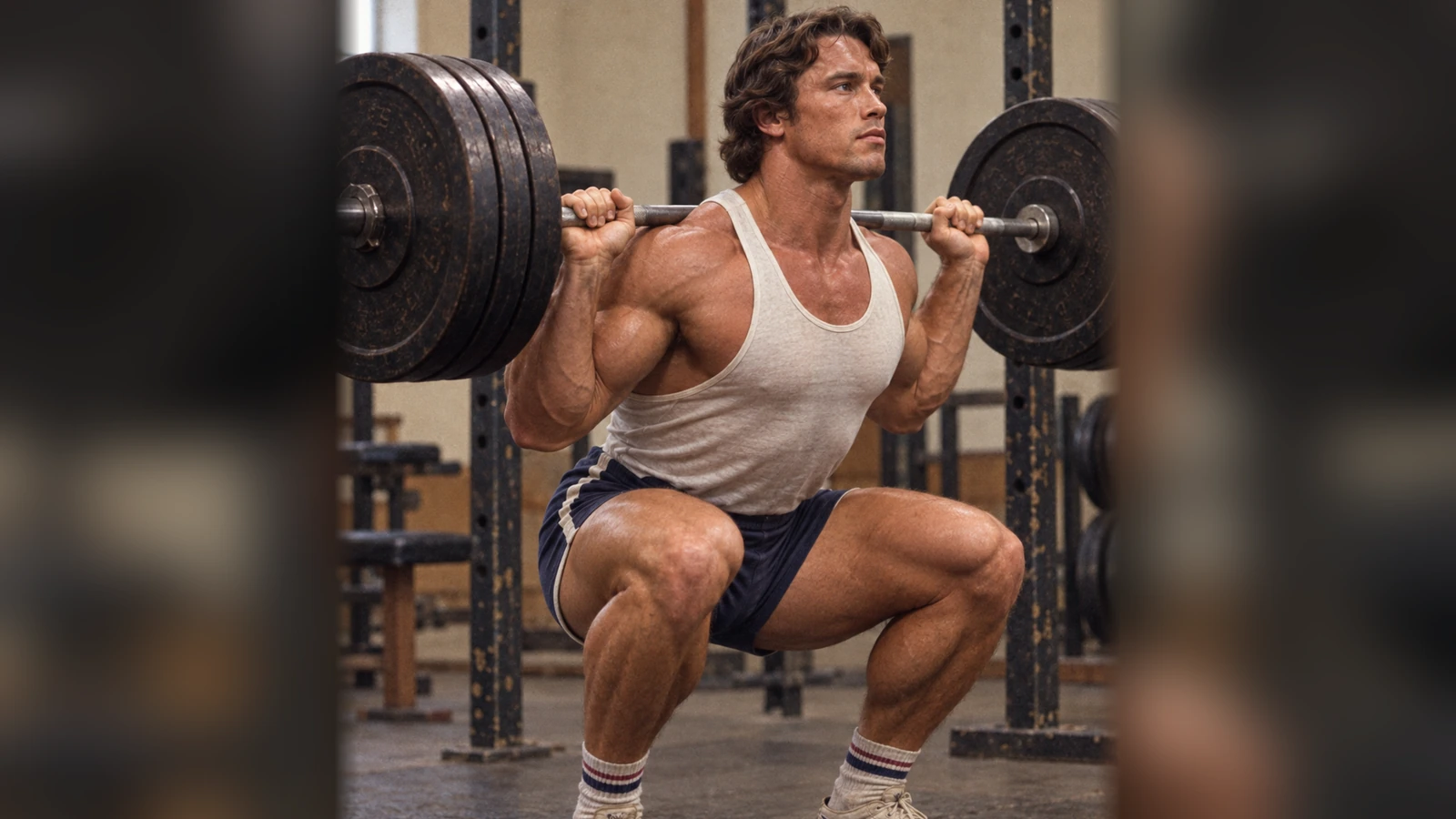
Image note: The featured Arnold scene is an editorial illustration or reconstruction, not evidence of a particular historical lift or a photograph of the quoted moment.
This article looks at where the king of exercises label comes from, what the research says about squats, and how to earn a good one.
Where the Nickname Comes From
Nobody owns the phrase “king of exercises.”
It has been passed around lifting circles for a long time, and no single person can claim it.
Arnold’s own website repeats it.
A 2012 Squat 101 article on schwarzenegger.com opens by noting that squats have been called the king of all exercises, “and for good reason.”
Many social posts credit the exact line to Arnold’s 1985 Encyclopedia of Modern Bodybuilding.
We could not confirm that exact wording in the book, so we are not presenting it as a direct quote from him.
What is not in doubt is that the squat sat at the center of the training culture Arnold came up in.
Who Arnold Schwarzenegger Is
Arnold Schwarzenegger was born in Austria in 1947 and started lifting as a teenager.
He went on to win Mr. Universe titles and seven Mr. Olympia titles before becoming a movie star and later governor of California.
His encyclopedia became one of the best known training books ever written, and it still shapes how many people build a workout.
If you want another side of his story, see our look at how Arnold’s diet has changed since his competition years.
Why Lifters Call It the King
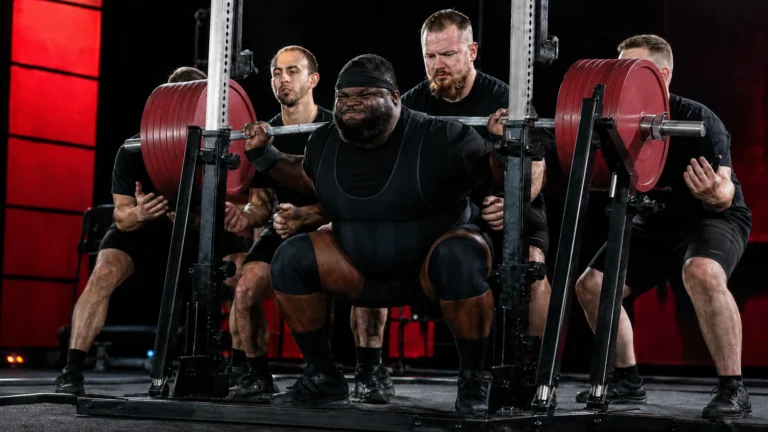
The squat works a lot of muscle at once.
The main movers are the knee-extending quadriceps and hip-extending gluteus maximus, with the inner-thigh adductors assisting hip extension. The spinal erectors and trunk muscles help keep the torso stable; they are not being trained in the same way as the legs. Which muscles are emphasized changes with squat depth, stance, load, and individual build.
Your thighs, glutes, hips, and inner thighs all move the weight, while your back and core work hard to hold your torso steady.
Because so much muscle is involved, lifters can use heavy loads and make steady progress for years.
It also copies real life. Sitting down, standing up, and picking things up all use a similar pattern.
The squat earned its crown by doing a lot of jobs well, not by being the only lift that works.
What the Research Shows
In a 2010 review, exercise scientist Brad Schoenfeld looked at how the squat moves the body and loads the joints.
He described it as one of the most widely used exercises for building lower body strength, with many muscles working together.
The review also pointed out that form details, like how far the knees travel and how much the torso leans, change where the stress lands.
That means good technique is not just about safety. It also decides which muscles do the most work.
Does Squat Depth Matter?
A 2019 study by Keitaro Kubo and colleagues tested this question directly.
For 10 weeks, 17 young men trained in either a full-squat or half-squat group. That small study can inform muscle-growth expectations but cannot determine the best squat depth for every lifter.
Both groups grew their front thigh muscles by a similar amount.
The full squat group, however, gained more size in the glutes and inner thigh muscles.
So deeper squats, done safely, may give you more total lower body muscle for the same effort.
That does not mean everyone has to squat to the floor.
It means depth is worth building over time if your hips and knees allow it.
Our article on the deep resting squat covers mobility work that can help you get there.
What the King Label Gets Wrong
Calling one lift the king can make people think it is required. It is not.
Leg presses, split squats, step ups, and hip hinges can all build strong legs.
Some people have hip, knee, or back issues that make heavy barbell squats a poor choice, at least for now.
If that is you, our guide to squat alternatives matched to your goal lays out good options.
How to Build a Better Squat
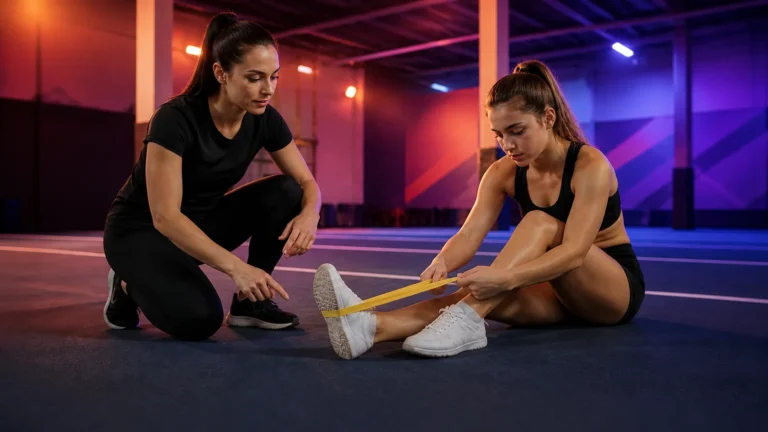
- Start light. Use your bodyweight or a light goblet squat until the pattern feels smooth.
- Set your feet. Most people do well with feet about shoulder width and toes turned out a little.
- Brace first. Take a deep breath into your belly and tighten your core before you lower.
- Sit between your hips. Let your hips and knees bend together rather than folding only at the waist.
- Track your knees. Keep them moving in line with your toes, not caving inward.
- Go as deep as you control. Stop where your back starts to round or your heels lift.
- Add weight slowly. Small jumps each week add up over months.
How to Fit Squats Into Your Week
Most people do well squatting one to three times per week.
Beginners can often squat in two or three full body sessions, using a few sets of 5 to 10 reps.
More experienced lifters may pick one heavier day and one lighter day, so the legs and back can recover between them.
If you also run or play a sport, place your hardest squat day away from your hardest running day.
Lifters over 50 can squat too, with a longer warm up and steadier progress.
Our guide to loading a hip hinge safely after 50 uses the same patient approach.
Common Squat Mistakes
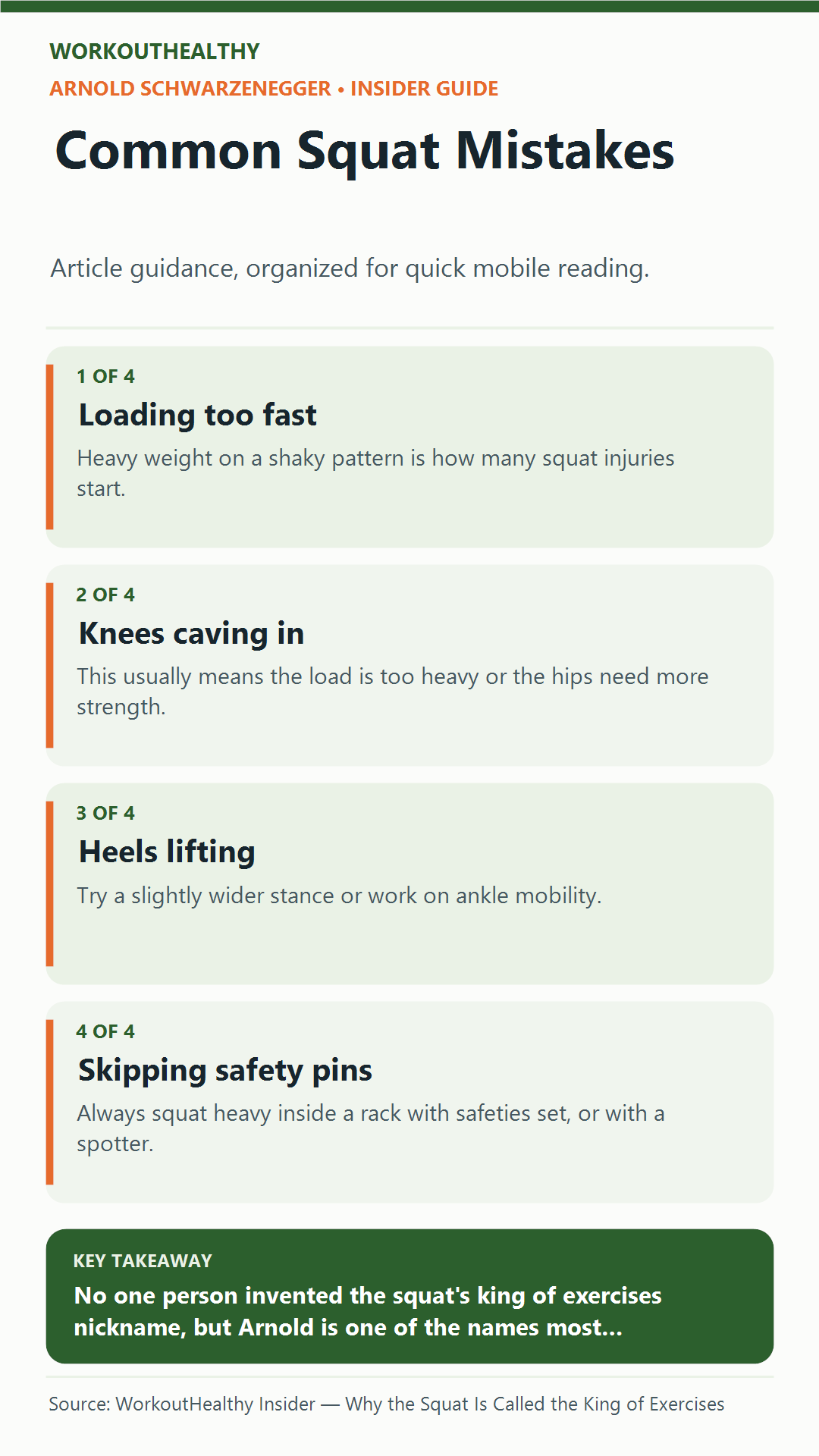
- Loading too fast. Heavy weight on a shaky pattern is how many squat injuries start.
- Knees caving in. This usually means the load is too heavy or the hips need more strength.
- Heels lifting. Try a slightly wider stance or work on ankle mobility.
- Skipping safety pins. Always squat heavy inside a rack with safeties set, or with a spotter.
Who Should Be Careful
People with past knee, hip, or back injuries should get guidance before loading a barbell squat.
The same goes for anyone with pain during the movement, or anyone new to lifting after a long break.
The Bottom Line
No one person invented the squat’s king of exercises nickname, but Arnold is one of the names most often linked to it.
Research backs the idea that squats build a lot of lower body muscle, and that deeper squats can build even more.
Still, no single exercise is mandatory.
Pick the squat if it fits your body, learn it well, and build it slowly.
Want more stories like this? Subscribe to WorkoutHealthy Insider for practical explanations behind popular fitness claims.
References
- Kubo, K., Ikebukuro, T., & Yata, H. (2019). Effects of squat training with different depths on lower limb muscle volumes. European Journal of Applied Physiology, 119(9), 1933 to 1942. https://doi.org/10.1007/s00421-019-04181-y
- Schoenfeld, B. J. (2010). Squatting kinematics and kinetics and their application to exercise performance. Journal of Strength and Conditioning Research, 24(12), 3497 to 3506. https://doi.org/10.1519/JSC.0b013e3181bac2d7
- Schwarzenegger, A., & Dobbins, B. (1985). Encyclopedia of modern bodybuilding. Simon & Schuster.
- Smith, J. (2012, October 17). Squat 101. Schwarzenegger.com. https://www.schwarzenegger.com/fitness/post/squat-101
This article is for general information only and is not medical advice. If you have an injury, ongoing pain, or a medical condition, talk to a doctor or physical therapist before you change how you train or eat.