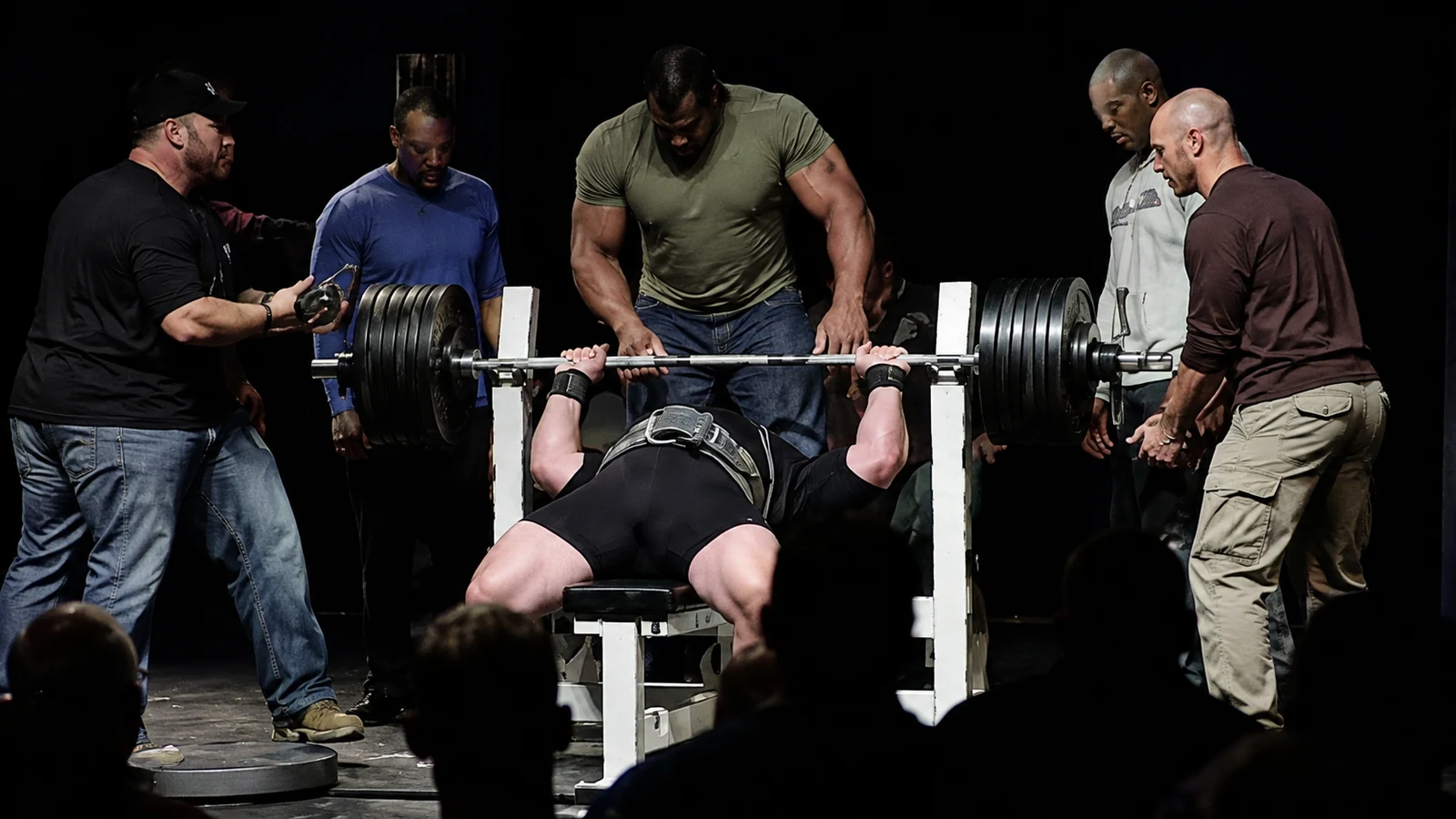

Scot Mendelson lay back on a bench in Worcester, Massachusetts, and pressed a bar loaded to 324 kilograms off his chest.
That converts to 715 pounds.
The date was May 22, 2005.
It stood as the heaviest raw bench press anyone had ever completed in a sanctioned meet.
A YouTube caption built around this lift calls it a world record, which is accurate, and also claims Mendelson was the first lifter ever to raw bench 700 pounds, which is not.
That correction matters, and the real story behind it is more interesting than a single wrong superlative.
Bench press claims from this era travel online constantly, usually stripped of the federation, the date, and the lifter who actually got there first.
This article verifies the 2005 lift itself, traces the raw bench record back through the 1990s to find out who really crossed 700 pounds first, and checks who actually sanctioned the meet.
What Happened at the 2005 Atlantis New England Bench Press
The meet’s full name was the 2005 USA-UA Atlantis New England Bench Press.
It ran in Worcester, Massachusetts, on May 22, 2005, the same date the video’s own caption cites.
OpenPowerlifting, the independent public database that mirrors verified meet results across dozens of federations, lists Mendelson’s winning lift at 324.3 kilograms in the superheavyweight class.
That converts to 715.0 pounds, matching the figure that has circulated for two decades.
He was 36 years old that day, and his lift produced a Wilks score of 180.77, one of the highest recorded at that meet.
Wikipedia’s own progression table for the raw bench press world record independently lists the same lift: “Scot Mendelson presses 715 lb (324 kg) with belt and wrist wraps on May 22, 2005.”
Two independent sources agree on the weight, the date, and the equipment used, one built from raw federation meet data and one built from a public wiki with its own citation trail.
For a lift this old, that is about as solid as verification gets.
The Record He Did Not Actually Set First
The 715-pound lift was not even Mendelson’s own first pass at 700 pounds.
His biography, published today by the International Powerlifting Association, credits him with a 701.1-pound raw bench in the 308-pound class back in 2002.
He broke his own mark again in February 2003, pressing 713 pounds.
Then came the May 2005 lift, two pounds heavier still.
Three separate raw benches over three years, each one a small, earned jump rather than one lucky day.
But none of those three lifts were the first time anyone raw benched 700 pounds in a verified meet, and this is the correction the video’s own caption already makes.
That correction checks out.
Wikipedia’s progression table for the raw bench press world record shows a lifter named James Henderson pressing 320 kilograms, 705 pounds, raw in 1996.
Henderson did that in a T-shirt, without wrist wraps at all, a stricter version of “raw” than the belt-and-wraps standard Mendelson used nine years later.
Henderson broke his own mark again in 1997, at 322.5 kilograms, 711 pounds.
Both lifts predate Mendelson’s first 700-plus press by five and six years.
So the accurate claim is not “Mendelson was first.”
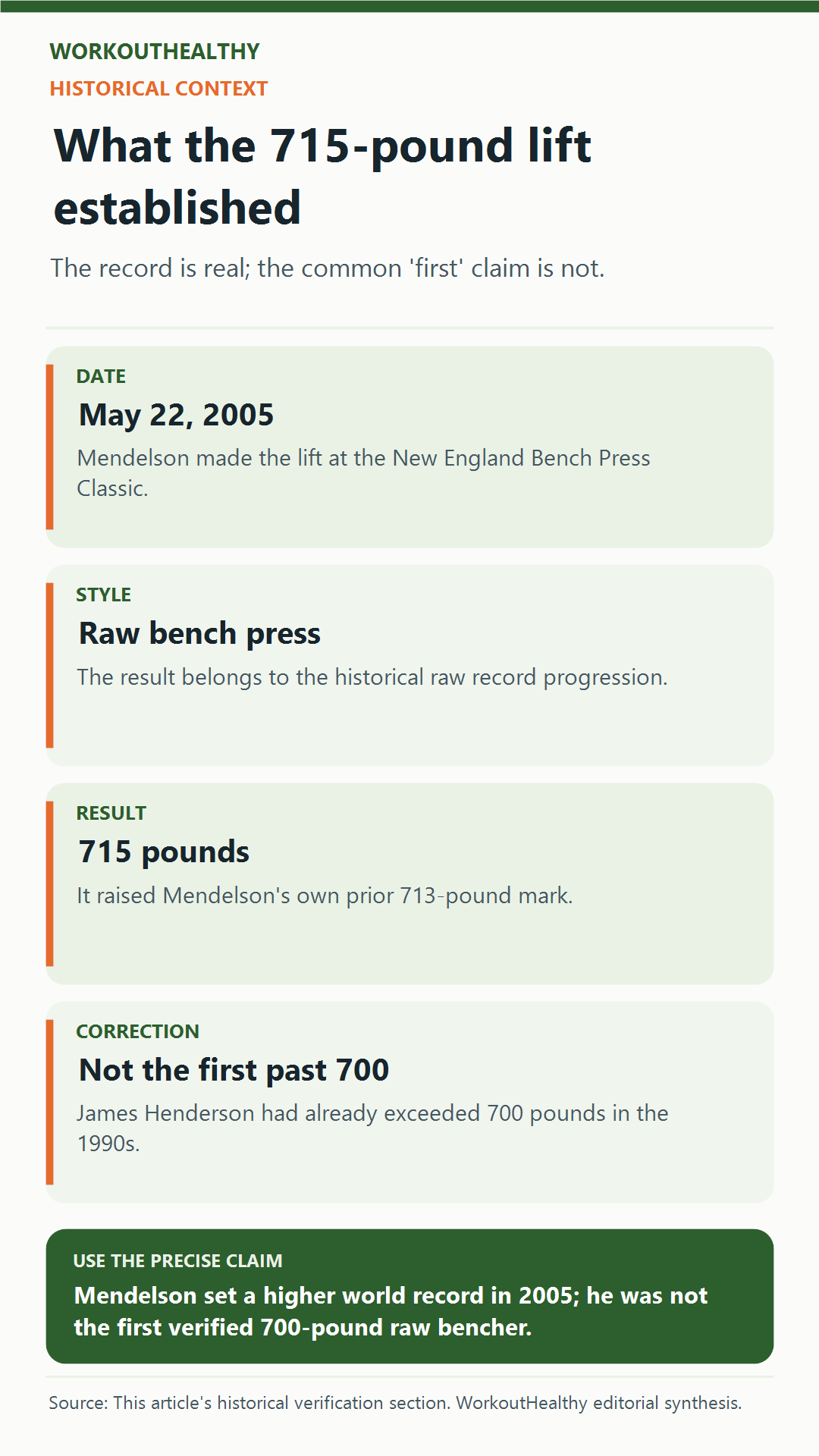
Henderson got there earlier, and did it with less equipment help, which arguably makes his mark the more technically demanding of the two, even though Mendelson’s later number is the bigger one.
“World record” in raw powerlifting has never meant the single heaviest number anyone has ever lifted anywhere. It means a specific lift, judged at a sanctioned meet, that beat every other verified lift in that same narrow category before it.
Who Actually Sanctioned the Lift
Mendelson’s biography lives on the website of the International Powerlifting Association, known as the IPA, where he is listed today holding a California State Chairman role.
That is worth stating plainly, because it would be easy to assume the IPA sanctioned the 2005 meet simply because that is where his biography is hosted now.
It did not.
OpenPowerlifting’s own meet record tags the 2005 Atlantis meet under the federation code “USA-UA.”
The “UA” suffix is OpenPowerlifting’s own shorthand for unaffiliated, the same tag it uses for standalone meets in other countries that were never tied to a national governing federation.
In practice, that means the meet ran independently, most likely organized by a promoter or gym rather than a body like the IPF, USAPL, APF, or WABDL.
Bench-only “classic” meets were common in the mid-2000s, often built around one elite lifter’s attempt at a milestone number rather than a full multi-lift federation championship.
That does not make the lift fake or the record meaningless.
It does mean this specific record is verified today mainly through OpenPowerlifting’s independent database, rather than through any single federation’s still-active record book.
Mendelson competed under several different banners across his career, including a federation called the APC for that early 2002 lift, and later the APF and WPC for his equipped records.
The 2005 raw record itself does not carry any of those federations’ names, and it should not be credited to the IPA without evidence that IPA actually ran it.
A Career Built on Beating His Own Number
Mendelson’s biography credits him as a three-time National and four-time World Champion in the bench press, with more than 60 world records broken across his career.
Most of those were not the 715-pound raw mark.
He also competed in equipped bench press, wearing a supportive bench shirt, a completely different category from raw lifting.
In 2008, he pressed 1,030.7 pounds equipped in the 275-pound class, and 1,025.1 pounds equipped at superheavyweight, both under APF and WPC sanctioning.
Those equipped numbers dwarf his raw ones, and that gap is normal.
A bench shirt stores elastic energy and helps drive the bar back up, which is part of why equipped totals in this sport sit hundreds of pounds above raw ones for the same lifter.
Outside competition, Mendelson runs Next Level Training, a gym in Sherman Oaks, California, where he coaches strength and combat sports athletes.
He built a career across two decades and multiple federations around one specific skill: pressing more weight off his own chest than almost anyone else who ever stepped onto a bench press platform.
The Mechanics Behind an Elite Raw Bench
Pressing over 700 pounds raw is decided well before the bar leaves the chest.
Grip width changes where the “sticking region” falls, the point in a bench press where the bar tends to slow down or stall completely.
A 2016 study in the Journal of Sports Sciences measured how grip width shifted the location and severity of that sticking region in trained lifters, confirming it as a real, measurable mechanical effect rather than a coaching preference (Gomo & Van Den Tillaar, 2016).
Elite raw benchers spend years finding the exact grip width that moves their own sticking region to the spot where they are mechanically strongest.
The shoulders and elbows do not work in isolation either.
A 2025 biomechanics study modeled how shoulder and elbow mechanics interact to produce the bar’s path and its sticking region during heavy pressing, treating the arm as one linked chain rather than a set of separate joints (Evangelista et al., 2025).
That framing helps explain why raw specialists like Mendelson obsess over setup, arch, and bar path as one connected system, not three separate problems.
None of that mechanical advantage is available to a raw lifter the way it is to an equipped one, which is part of why the raw and equipped numbers in Mendelson’s own career sit more than 300 pounds apart.
How Records From This Era Get Verified Today
A lift from 2005 predates most of the tools people now use to fact-check a viral claim.
OpenPowerlifting did not exist yet in any usable form; it launched years later, built by volunteers digitizing old meet results from federation paperwork and public reporting.
Wikipedia’s detailed, citation-tracked progression table for the bench press world record was not a mature resource in 2005 either.
A lift like this survives in verifiable form today because someone entered it into a public database after the fact, cross-checked against whatever paperwork or reporting existed from the meet itself.
That gap also explains how a caption can get one detail exactly right, the weight and the date, while getting another detail wrong, the “first” claim.
Nobody was necessarily lying on purpose.
They likely just did not have an easy way to check the full progression back through the 1990s.
That same gap in easy verification is exactly what let a small factual error travel as far online as it did.
What This Record Does Not Prove
715 pounds raw does not mean Mendelson could out-lift Henderson in some broader sense.
Henderson’s own 1996 press used less supportive gear, no wrist wraps at all, which arguably makes it the harder technical feat even at a lighter weight.
It also does not mean Mendelson’s number stayed the record forever.
Wikipedia’s own progression table shows Eric Spoto passing it in 2013, at 716 pounds, and Kirill Sarychev passing that number in 2015, at 739 pounds.
Raw bench numbers have kept climbing well past that in the years since, the same way most well-tracked strength records eventually get pushed further by someone with better technique, tools, or coaching.
A record like this describes a specific lift on a specific day, not a permanent ceiling.
It is also not proof that unaffiliated meets are somehow less legitimate than federation championships.
It is proof that the word “verified” always means verified against something specific, in this case an independent database and a wiki citation trail, and that specificity matters more than the word “record” on its own.
Common Mistakes People Make Repeating Claims Like This
The single biggest mistake is treating a caption’s superlative as the whole story.
“First to 700 pounds” is a much stronger, much more checkable claim than “set a world record,” and it deserved the same scrutiny the weight itself got.
Another common mistake is assuming a governing body based on where an athlete’s biography happens to live today, rather than what actually sanctioned the specific meet in question.
A third is treating raw and equipped bench numbers as the same category, when a shirt alone can add several hundred pounds to the bar.
Careful readers should ask three questions of any bench press record claim: which federation actually sanctioned it, is this raw or equipped, and has anyone since surpassed it.
All three questions have real, checkable answers, even for a lift old enough to predate most of today’s verification tools.
How Raw Bench Specialists Actually Train for a Number Like This
Nobody needs to chase 715 pounds to train the way a raw bench specialist does.
Start with one consistent setup, the same grip width, shoulder position, and foot placement, on every working set, long before adding serious weight.
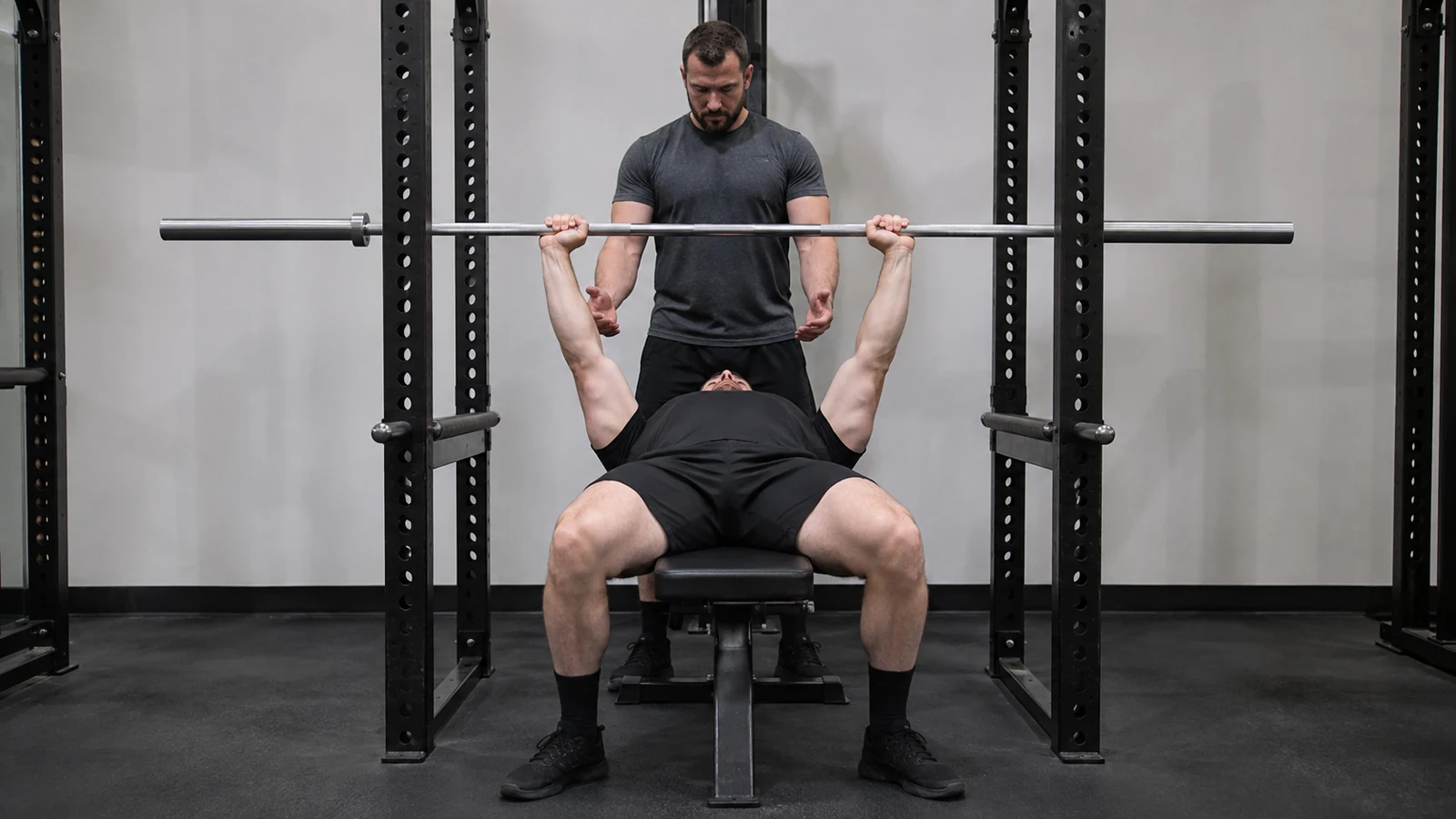
Add paused reps regularly, holding the bar briefly on the chest, since that pause mirrors what a judged meet attempt actually requires.
Film the bar path from the side occasionally, and check whether it travels in a straight vertical line or a slight, controlled curve toward the strongest leverage point.
Push the feet into the floor on every rep, not only the heaviest ones, so leg drive becomes automatic under real load.
Structure matters as much as raw effort.
A 2020 study on elite powerlifters compared linear and undulating periodization models, tracking stress hormone response and competition results across a full training cycle, and found that planned variation in training load produced better competition-day results than unplanned heavy training (Landram, Koch, & Mayhew, 2020).
That kind of structure is part of why careers like Mendelson’s took decades, not months, even with real talent behind them.
Readers curious how removing leg drive changes a heavy press can see that tradeoff explained in our floor press versus bench press comparison.
Who Should Be Cautious Before Loading Up
A raw bench specialist’s training is built on years of structured work, expert coaching, and gradual load increases, not one ambitious training block.
It is not a realistic near-term goal for someone newer to lifting, and it was never meant to be read as one.
Anyone with a history of shoulder impingement, rotator cuff issues, wrist pain, or a recent upper-body surgery should talk to a doctor or physical therapist before loading a heavy bench press.
People managing high blood pressure should also be careful with true maximal-effort lifts, since a max attempt briefly spikes blood pressure more than lighter, higher-repetition work does.
A qualified coach can catch setup and bar path problems far earlier than trial and error alone, which is part of what our guide on deciding whether you need a personal trainer covers in more detail.
A spotter is not optional at heavy training weights, regardless of experience level.
The same disciplined, years-long pattern behind Mendelson’s own progression shows up in very different record holders too, including the pacing behind DonnaJean Wilde’s push-up world record, and in Edith Connor’s Guinness record for oldest competitive female bodybuilder, an athlete who did not touch a barbell until her sixties.
Watch the Original Video
Enjoy stories like this one? Subscribe to WorkoutHealthy Insider for practical explanations behind popular fitness claims.
References
Evangelista, P., Rum, L., Picerno, P., & Biscarini, A. (2025). Decoding the contribution of shoulder and elbow mechanics to barbell kinematics and the sticking region in bench and overhead press exercises: A link-chain model with single- and two-joint muscles. Journal of Functional Morphology and Kinesiology, 10(3), 322. https://doi.org/10.3390/jfmk10030322
Gomo, O., & Van Den Tillaar, R. (2016). The effects of grip width on sticking region in bench press. Journal of Sports Sciences, 34(3), 232 to 238. https://doi.org/10.1080/02640414.2015.1046395
Landram, M. J., Koch, A. J., & Mayhew, J. L. (2020). Salivary stress hormone response and performance in full competition after linear or undulating periodization training in elite powerlifters. The Journal of Sports Medicine and Physical Fitness, 60(1). https://doi.org/10.23736/S0022-4707.19.09977-8
This article is for general information only and is not medical advice. If you have an injury, ongoing pain, or a medical condition, talk to a doctor or physical therapist before you change how you train or eat.