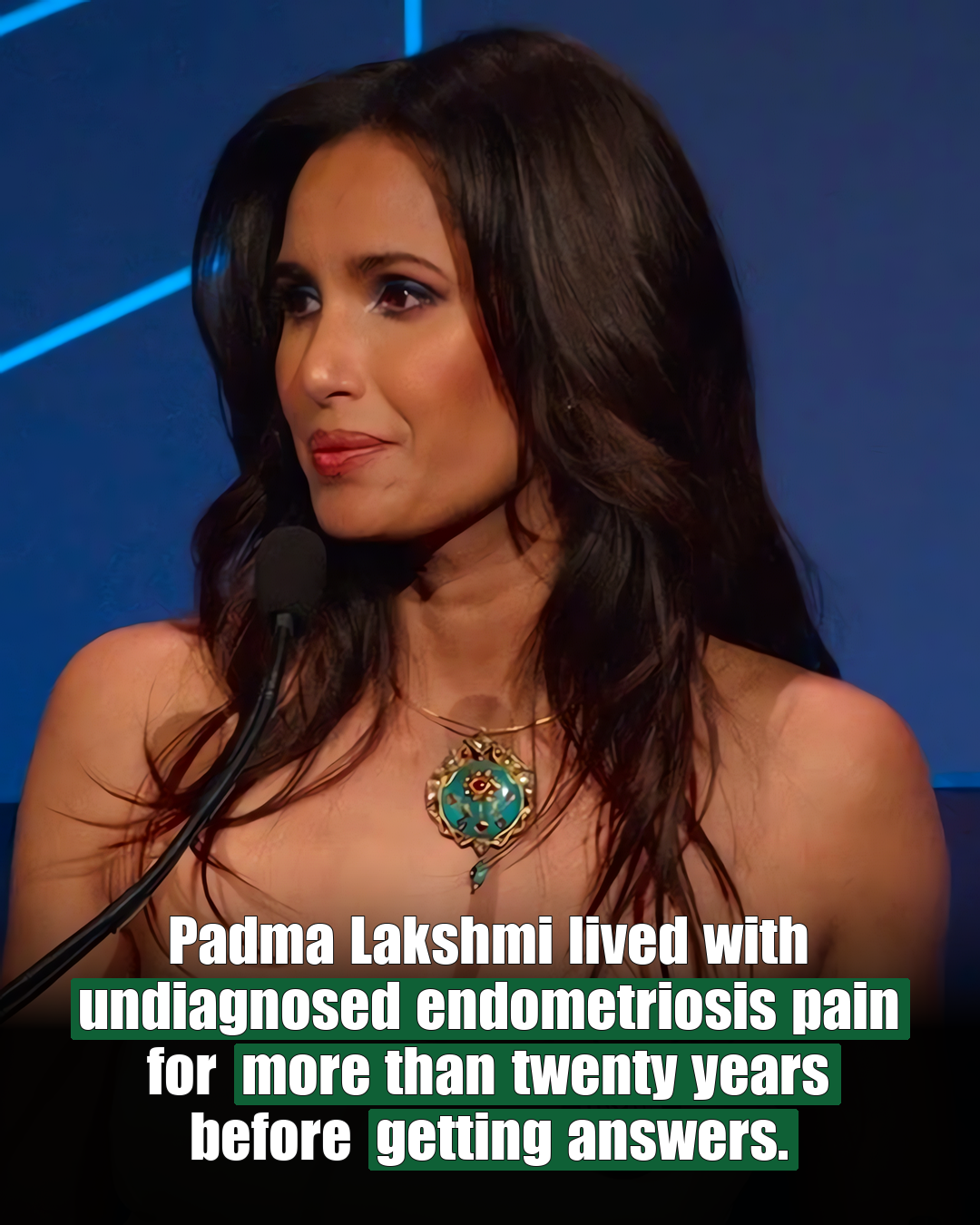

Padma Lakshmi spent more than two decades living with pain that doctors kept telling her was normal.
She is best known as the longtime host of Bravo’s Top Chef. That role earned her sixteen Primetime Emmy nominations.
Behind the cameras, she was managing a chronic condition. It took years to even get a name.
Lakshmi was not diagnosed with endometriosis until she was 36 years old. She had been dealing with symptoms since early adolescence.
That gap between symptom and diagnosis is not unusual. It is one of the most documented problems in how the condition gets treated.
Who Is Padma Lakshmi
Lakshmi was born in Chennai, India. She moved to the United States as a child.
She built a career across food television, writing, and modeling. That work eventually made her one of the most recognized faces in American cooking shows.
Her work on Top Chef ran from 2006 to 2023. She also created and hosted Taste the Nation, a Hulu docuseries exploring immigrant food culture across the country.
Outside of television, Lakshmi has built a second, quieter body of work. That work centers on endometriosis research and advocacy.
What Actually Happened
Endometriosis is a condition where tissue similar to the lining of the uterus grows outside of it, according to the Mayo Clinic.
This tissue can attach to the ovaries, fallopian tubes, and pelvic lining.
It still responds to hormonal changes during the menstrual cycle.
That response can cause significant pain, especially around a person’s period. Common symptoms include severe pelvic pain, pain during intercourse, discomfort with bowel movements, heavy bleeding, and fatigue.
Some people with endometriosis have no symptoms at all. That adds another layer of difficulty to catching it early.
For Lakshmi, the opposite was true. Her symptoms were present for years before anyone identified the cause.
In 2009, Lakshmi co-founded the Endometriosis Foundation of America. Her partner in that work was Dr. Tamer Seckin, a gynecological surgeon.
The organization’s stated mission is to increase disease recognition, support advocacy, provide expert surgical training, and fund research into the condition.
The foundation helped establish the first interdisciplinary research center focused on gynepathology. It was a joint project between Harvard Medical School and MIT that opened in December 2009.
Lakshmi delivered the keynote address at its launch. Since then, the foundation’s ENPOWR program has reached tens of thousands of high school students with education about endometriosis.
In Her Own Words
Lakshmi has spoken publicly, in general terms, about living for years with pain that was dismissed by medical providers.
Detailed, word for word quotes from those interviews are not reliably documented in public sources.
This article describes her experience the way it has been broadly reported, rather than quoting her directly.
What is well documented is the shape of her advocacy since her diagnosis. She has used her public platform to push endometriosis into a more visible, better understood conversation.
That advocacy has been formally recognized. The New York State Senate has honored her work on the issue.
The foundation she co-founded has grown into one of the more prominent endometriosis organizations in the country.
That growth has happened largely because Lakshmi kept talking about it publicly, year after year.
The Science Behind the Diagnostic Delay
Lakshmi’s twenty year gap between symptoms and diagnosis is not an outlier story. Research backs up just how common that delay is.
A widely cited 2006 study in Fertility and Sterility, led by researcher Karen Ballard, examined women’s experiences trying to get an endometriosis diagnosis.
The qualitative research described a pattern of delayed recognition. Many patients reported that their pain was minimized or called normal menstrual discomfort for years before anyone investigated further.
The impact of that delay is not just about the wait itself. A 2011 study in Fertility and Sterility, led by Kelechi Nnoaham, surveyed women across ten countries.
The researchers measured the effect of endometriosis on quality of life and work productivity. They found substantial reductions in both, driven largely by chronic pain and its downstream effects.
In other words, the condition does not just hurt. It quietly reshapes how people are able to work and live while waiting for an answer.
Diagnosis itself is part of the problem. According to the Mayo Clinic, a definitive endometriosis diagnosis typically requires laparoscopic surgery.
A surgeon inserts a small camera to directly visualize and sample suspected tissue. That is a more involved step than most conditions require, which may partly explain the long delays so many patients experience.
Why the Condition Is So Often Missed
Part of the problem is that endometriosis symptoms overlap heavily with other conditions. Painful, heavy periods get written off as ordinary menstrual variation more often than they should.
Digestive symptoms tied to endometriosis can also be mistaken for irritable bowel syndrome. That mix up sends some patients toward the wrong specialist entirely, adding more time before an accurate diagnosis.
The Mayo Clinic lists several known risk factors. These include never having given birth, starting menstruation at an early age, short menstrual cycles under 27 days, heavy periods lasting more than seven days, and having a close family member with the condition.
None of these risk factors guarantee a diagnosis. Their absence does not rule one out either.
They are simply patterns doctors look for when pelvic pain has no obvious explanation.
Awareness of these patterns matters. So much of the diagnostic delay comes down to nobody connecting the dots early.
A patient who knows her own risk factors can bring that information into the conversation herself.
Where Exercise Fits, and Where It Does Not
Exercise often gets framed as a cure for almost anything. It is worth being precise here instead.
Research on physical activity and endometriosis symptoms is still limited and mixed. A 2021 systematic review in BMC Women’s Health, led by researcher M.K. Tennfjord, examined the existing studies on this question.
The review concluded that current evidence was too weak to say exercise reliably improves symptoms.
Study quality and sample sizes across the existing research were inconsistent.
That does not mean movement has no place in managing life with the condition. It means the science is not settled enough to promise pain relief through exercise alone.
General movement, at a comfortable intensity, is broadly considered safe for most people with endometriosis.
That is standard medical guidance, not a treatment claim.
Exercise is a supporting habit here, not a treatment plan. It should never replace medical evaluation for ongoing pelvic pain.
Who Should Talk to a Doctor First
Anyone with pelvic pain that disrupts daily life should bring it up with a doctor.
This matters especially if the pain feels worse than typical period cramps.
It also matters even if a previous provider called the pain normal. Lakshmi’s own story is a reminder that dismissal once does not mean the pain is not real.
A second opinion, or a more detailed workup, is worth pursuing if symptoms continue.
Persistent pain deserves a persistent search for answers.
Certain symptoms are worth mentioning together at an appointment. These include pain during intercourse, painful bowel movements or urination around your period, heavy or irregular bleeding, and unexplained fatigue tied to your cycle.
Doctors often piece together a diagnosis from a full symptom picture. One complaint alone rarely tells the whole story.
Anyone trying to conceive who has struggled with unexplained infertility should also raise endometriosis as a possibility with their doctor.
The Mayo Clinic notes that up to half of people with the condition experience some fertility challenges.
Anyone already diagnosed who is considering a new exercise routine should check with their doctor or physical therapist first.
This matters most for high intensity activity, since pain patterns from endometriosis vary a lot from person to person.
How to Advocate for Yourself With a Doctor
Keep a simple symptom log before your appointment. Note when pain happens, how severe it feels, and whether it lines up with your menstrual cycle.
Write down every symptom, not just the most severe one. Pain, bleeding changes, digestive symptoms, and fatigue can all matter together, even if they seem unrelated on their own.
Ask direct questions if your pain is being described as normal. A simple question about whether endometriosis has been ruled out can open the door to further testing.
Bring up family history if you know it. Endometriosis has a genetic component, and a family member’s diagnosis is relevant information for your doctor.
Do not hesitate to seek a second opinion. If your pain continues after being told it is normal, another provider may take a different approach.
Consider asking for a specialist referral. Gynecologists with specific training in endometriosis often have more experience recognizing subtler presentations of the condition.
If cost or access to specialty care is a concern, ask your primary care provider about local or telehealth options.
Organizations like the Endometriosis Foundation of America also maintain public resources and provider directories that can help point patients toward experienced specialists.
If movement becomes part of your plan after diagnosis, start gently. Simple daily walking is a low impact way to stay active without adding strain.
It is also a reasonable starting point before considering anything more intense. Progress from there only as your body and your doctor’s guidance allow.
Lean on support where you can find it. Whether that is a partner, friend, or online community, having people in your corner tends to make any ongoing health challenge easier to manage.
References
- Ballard, K., Lowton, K., & Wright, J. (2006). What’s the delay? A qualitative study of women’s experiences of reaching a diagnosis of endometriosis. Fertility and Sterility, 86(5), 1296-1301.
- Nnoaham, K. E., Hummelshoj, L., Webster, P., d’Hooghe, T., de Cicco Nardone, F., de Cicco Nardone, C., Jenkinson, C., Kennedy, S. H., & Zondervan, K. T. (2011). Impact of endometriosis on quality of life and work productivity: a multicenter study across ten countries. Fertility and Sterility, 96(2), 366-373.
- Tennfjord, M. K., Gabrielsen, R., & Tellum, T. (2021). Effect of physical activity and exercise on endometriosis-associated symptoms: a systematic review. BMC Women’s Health, 21(1), 355.
- Mayo Clinic. Endometriosis: Symptoms and Causes.
This article is for general educational purposes only. It does not replace individualized medical advice. Anyone experiencing persistent pelvic pain or symptoms that may suggest endometriosis should talk to a doctor or gynecologist for proper evaluation and diagnosis.