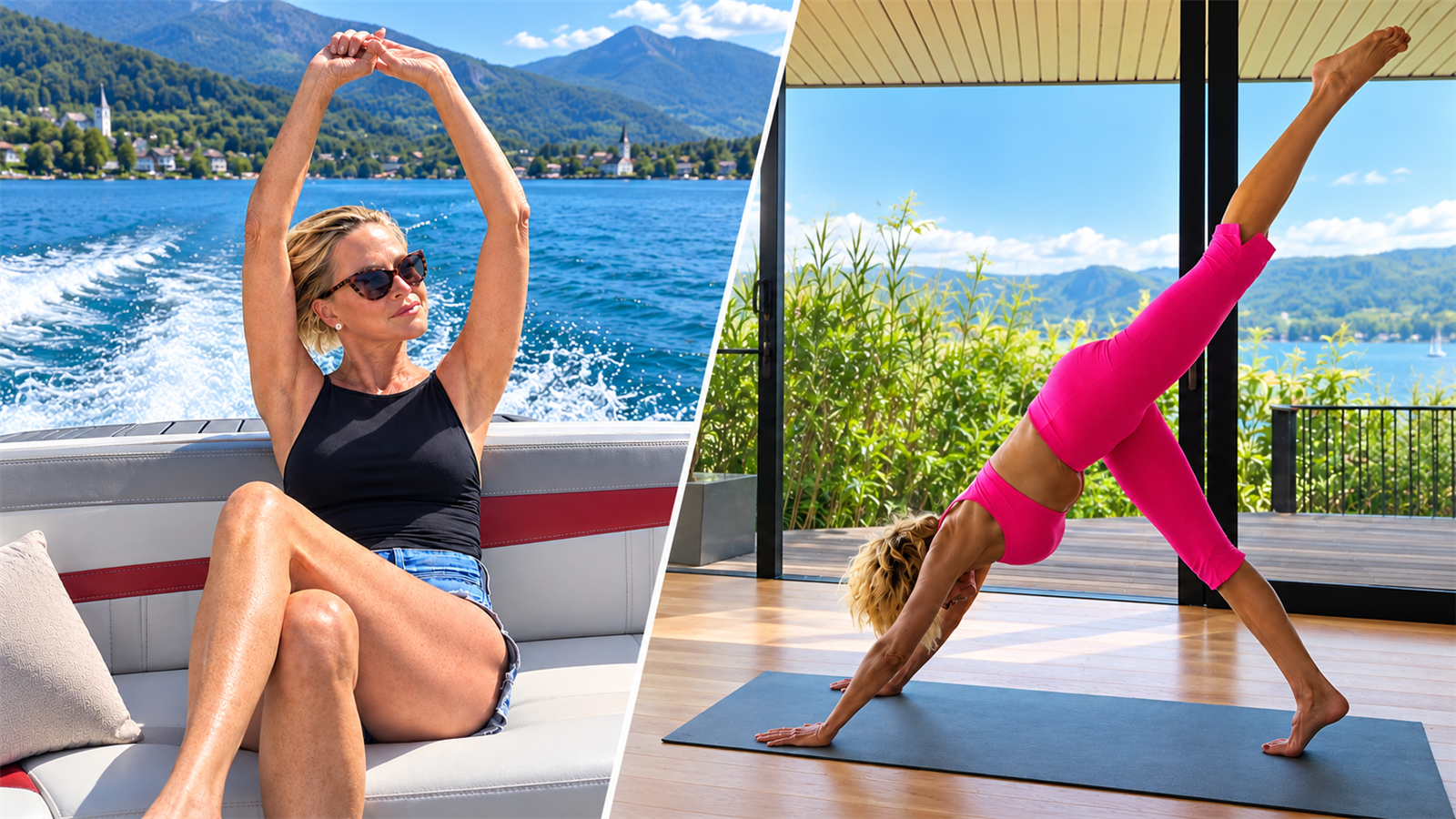

Melanie Griffith’s recent Instagram carousel offered two views of her time in Austria: a relaxed moment beside Lake Wörthersee and a striking yoga pose in a hot-pink outfit.
The 69-year-old actress said she spent a few weeks at VIVAMAYR Maria Wörth. She described the stay as a chance to rest and feel renewed.
One image shows her in a three-legged downward dog, with one leg lifted while her hands and other foot support her on a mat. It is an eye-catching moment. It is also only a moment.
Her post did not give a weekly training plan, before-and-after measurements, or a medical result. The more useful story is what she actually shared, why movement and balance can matter with age, and how to read a wellness photo without turning it into a prescription.
What Griffith shared from Austria
In an Instagram post, Griffith shared images from VIVAMAYR Maria Wörth, a medical wellness resort on Austria’s Lake Wörthersee. The set included lakeside scenes, time on a boat, food, and yoga.
In her caption, she said she had spent a few weeks there. She thanked the doctors, therapists, and other practitioners who were part of her experience.
Her description of how she felt was personal and concise.
“Recharge, replenish and relax.”
The resort describes its services as individually tailored and guided by clinicians and therapists. That tells us something about the setting. It does not tell us which treatments Griffith received, how often she practiced yoga, or whether any clinical measure changed.
Several reports about the post have concentrated on the swimsuit pictures or on how young Griffith looks. Her own caption put more emphasis on feeling restored and appreciating the people who cared for her.
The yoga image gives the story a fitness angle, but it should be read alongside that wider account of rest, movement, and time away.
The yoga pose in the photo
In the workout image, Griffith wears a bright-pink top and leggings and holds a three-legged downward dog. Her hands and one foot are on the mat while the other leg reaches upward.
The shape asks for some combination of shoulder support, hip movement, coordination, and control. It can also be modified in many ways, depending on a person’s experience and range of motion.
The photograph does not show how she entered the pose, how long she held it, or whether an instructor was nearby. It shows one visible position, not a full session.
It would be a mistake to convert that single frame into a claim that she practices daily, has a particular level of flexibility, or followed a specific yoga program at the resort.
In the shared images, the pink yoga scene appears alongside a relaxed lakeside moment. The contrast is useful: movement and rest can both be part of someone’s account of a trip.
Neither picture, by itself, is a medical assessment.
What a photo cannot tell us
A camera can document that Griffith held a pose long enough to be photographed. It cannot measure her balance on other days, her walking ability, her pain level, or her future risk of falling.
It also cannot establish what caused the pose to be possible. We do not know whether she learned it years ago, practiced during the retreat, or performed it only briefly for this photo.
Her Instagram caption did not provide a baseline, a follow-up assessment, or the details of an exercise routine. That means claims of a physical transformation would go beyond the public evidence.
The same caution applies to the word “reset.” A person can genuinely feel refreshed after time away, and Griffith said she did. That is different from proving that a particular resort program changed a measurable health condition.
This distinction protects the value of her account. Readers can appreciate her enjoyment of movement without asking the image to serve as a clinical test.
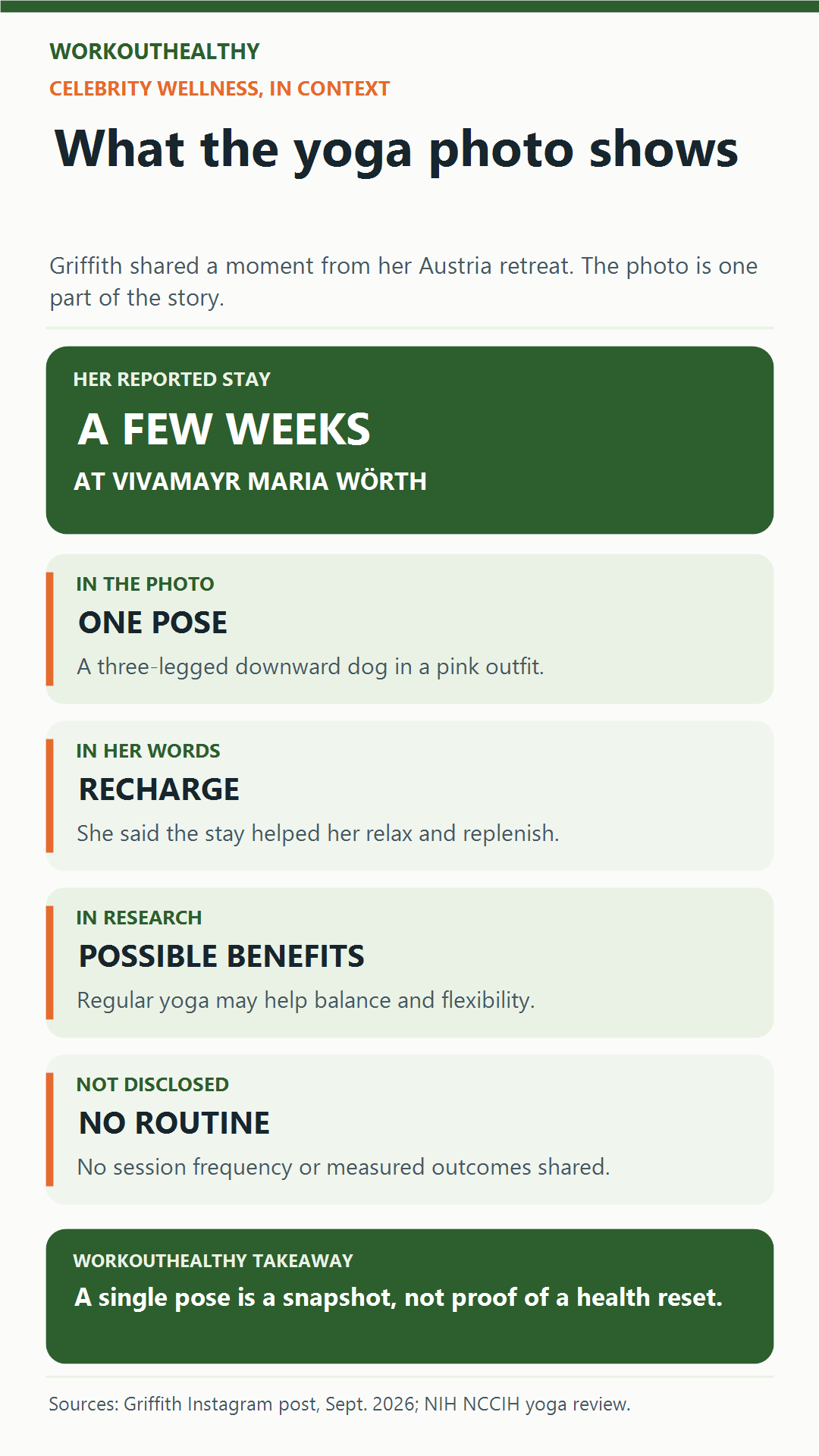
The graphic above separates the photograph, Griffith’s own description, broader research, and the information that has not been disclosed.
What yoga research supports
Yoga can be a reasonable way to practice movement and attention together. The National Institutes of Health’s National Center for Complementary and Integrative Health reports evidence that yoga may support balance and some aspects of general well-being.
A systematic review of randomized trials in community-dwelling older adults found improvements in balance, flexibility, and strength in the groups studied. The studies differed considerably, so their results do not establish what one pose or one retreat will do for an individual.
There is also a difference between improving a balance test and preventing a fall. Research on yoga has not made every outcome equally certain. The strongest article about Griffith’s image is therefore modest: it illustrates a type of movement that can be part of an active life, while the science concerns repeated practice across groups of people.
Yoga can have risks, especially for someone with a joint problem, a history of falls, or another health condition. The NIH advises older adults to consider a qualified instructor and to adapt demanding positions to their needs.
A three-legged downward dog is not a required starting point. A person may begin with a gentler class, a supported standing pose, or chair-based work and still be doing worthwhile movement.
For a separate look at how specific yoga claims should be tested, see our article on whether 20 minutes of yoga can lower blood pressure.
The broader movement picture after 65
Griffith is 69, and her photo naturally invites a question about staying capable as we age. The answer is broader than a single yoga pose.
The World Health Organization recommends regular aerobic activity for older adults, muscle-strengthening activity on at least two days a week, and a varied mix of balance and strength work on three or more days a week. The aim is functional ability, not a particular social-media pose.
That guidance does not describe Griffith’s personal schedule. She has not published one in this post. It provides a useful frame for readers deciding what to do in their own lives.
A walk, appropriate resistance exercise, and balance practice each contribute something different. Yoga may provide part of the balance or mobility work, but it need not replace all other forms of activity.
Small movements can be useful when they are repeated and matched to the person. Our guide to animal-inspired moves for total-body mobility offers another way to think about varied movement, while our look at low-impact walking as cardio covers an accessible aerobic option.
Those stories are examples, not a personalized program. Someone with balance concerns or pain may need a clinician or qualified exercise professional to help choose the safest starting point.
Reading “health reset” carefully
Griffith called her resort experience a “health reset” and spoke warmly about the people and setting. The phrase describes how she understood her stay.
VIVAMAYR presents itself as a medical wellness resort with individually tailored treatments. Its own descriptions are useful for identifying the place and its services, but promotional claims should not be treated as independent evidence that a treatment works for everyone.
Griffith did not publish medical records, test results, or a comparison between her health before and after the trip. We cannot infer a diagnosis or a cure from the photographs and caption.
Rest, a change of routine, enjoyable surroundings, and gentle activity can all be meaningful to someone. The public information does not let us isolate which part of the experience mattered most to her.
Her phrase also should not make a costly resort feel like a requirement for healthy aging. Balance practice, appropriate strength work, walking, and sufficient recovery can happen in ordinary settings.
“A little heaven on earth.”
That is an endorsement of her own experience, not a medical result that another visitor should expect.
A practical takeaway for readers
Start with a goal that matters in daily life. It might be getting up from a chair comfortably, walking farther, reaching overhead without discomfort, or feeling steadier on uneven ground.
Choose a form of movement that meets that goal and suits your current ability. A beginner yoga class may appeal to one person; walking and simple resistance exercises may suit another.
If balance is the priority, make practice safe. Use a stable surface or an instructor, leave room to step out of a position, and progress from easier tasks before trying an elevated-leg pose.
Build in rest. Griffith’s post is a reminder that she valued relaxation as part of her trip. Recovery is not a substitute for activity, but doing more is not always the answer either.
Finally, judge progress by what you can do over time, not by whether you can reproduce a celebrity photograph. One polished frame cannot show the whole process behind it.
The grounded lesson from Griffith’s Austria post is simple: she enjoyed a few weeks of care, scenery, and movement, and shared a yoga moment she was proud of. Readers can take inspiration from that without turning her personal retreat into a universal health plan.
Common questions
Where did Melanie Griffith go on her wellness retreat?
She said she spent a few weeks at VIVAMAYR Maria Wörth in Austria, on Lake Wörthersee.
What yoga pose did she show?
The image shows a three-legged downward dog, with one leg lifted while her hands and other foot remain on the mat.
Did she share her workout schedule?
No. The public post showed one yoga image and described the retreat, but it did not give session frequency, a weekly split, or training duration.
Does the photo prove a health transformation?
No. It documents a moment of movement. It does not provide before-and-after measurements or a clinical outcome.
Medical disclaimer: This article provides general fitness information, not medical advice. A celebrity’s retreat and yoga pose are not a personal exercise or treatment plan. Talk with a qualified health professional before beginning a demanding new activity, especially if you have a health condition, pain, or balance concerns.