
A viral video shows a 39 year old training mobility next to a 53 year old training partner.
Their tool is not a stretching routine.
The source video demonstrates five ground-based movements: bear walk, frog hop, duck walk, sumo frog, and crab walk.
The pitch is simple.
Move like an animal for a few minutes and your joints, hips, and shoulders will move better for it.
That is a big claim to hang on a few YouTube minutes.
So we went looking for what peer reviewed research actually says about this style of training, sometimes called animal flow or quadrupedal movement training.
Here is what holds up, what is still uncertain, and how to try it safely.
What Animal Movement Training Actually Is
Animal movement training is a style of bodyweight exercise built around crawling patterns instead of standing exercises.
You move on your hands and feet, or your hands and knees, in patterns that mimic how animals travel.
Examples include bear and crab walks, while this video’s sequence also includes frog hops, duck walks, and a sumo frog variation.
A branded version called Animal Flow packages these patterns into flowing sequences.
Unlike a static stretch, where you hold one position and try to relax into it, these movements keep your joints moving through a range while your core and shoulders support your body weight the entire time.
That combination, load plus movement, is the main thing that separates this trend from traditional mobility work like yoga holds or foam rolling.
Why Ground Based Movement Challenges the Body Differently
Most mobility routines fall into one of two camps.
Static stretching lengthens a muscle while you stay still.
Traditional strength training moves a joint through a controlled path, usually with a machine or a free weight doing most of the stabilizing work for you.
Quadrupedal movement asks for something else entirely.
When your hands and feet are both on the ground, your shoulders, wrists, hips, and spine all have to coordinate at once just to keep you from collapsing.
There is no bench or machine holding your torso steady.
Your core and shoulder stabilizers have to do that job in real time, while your hips and ankles move through flexion, extension, and rotation together instead of one direction at a time.
Crawling asks a joint to be strong and mobile at the same time, in every direction it can move, instead of just one.
That is the theoretical case for why these movements might build something a standard stretch or a standard lift does not.
The next question is whether real studies back that theory up.
What the Research Actually Found
The most direct study on this style of training comes from researchers at Grove City College, published in the Journal of Strength and Conditioning Research in 2022.
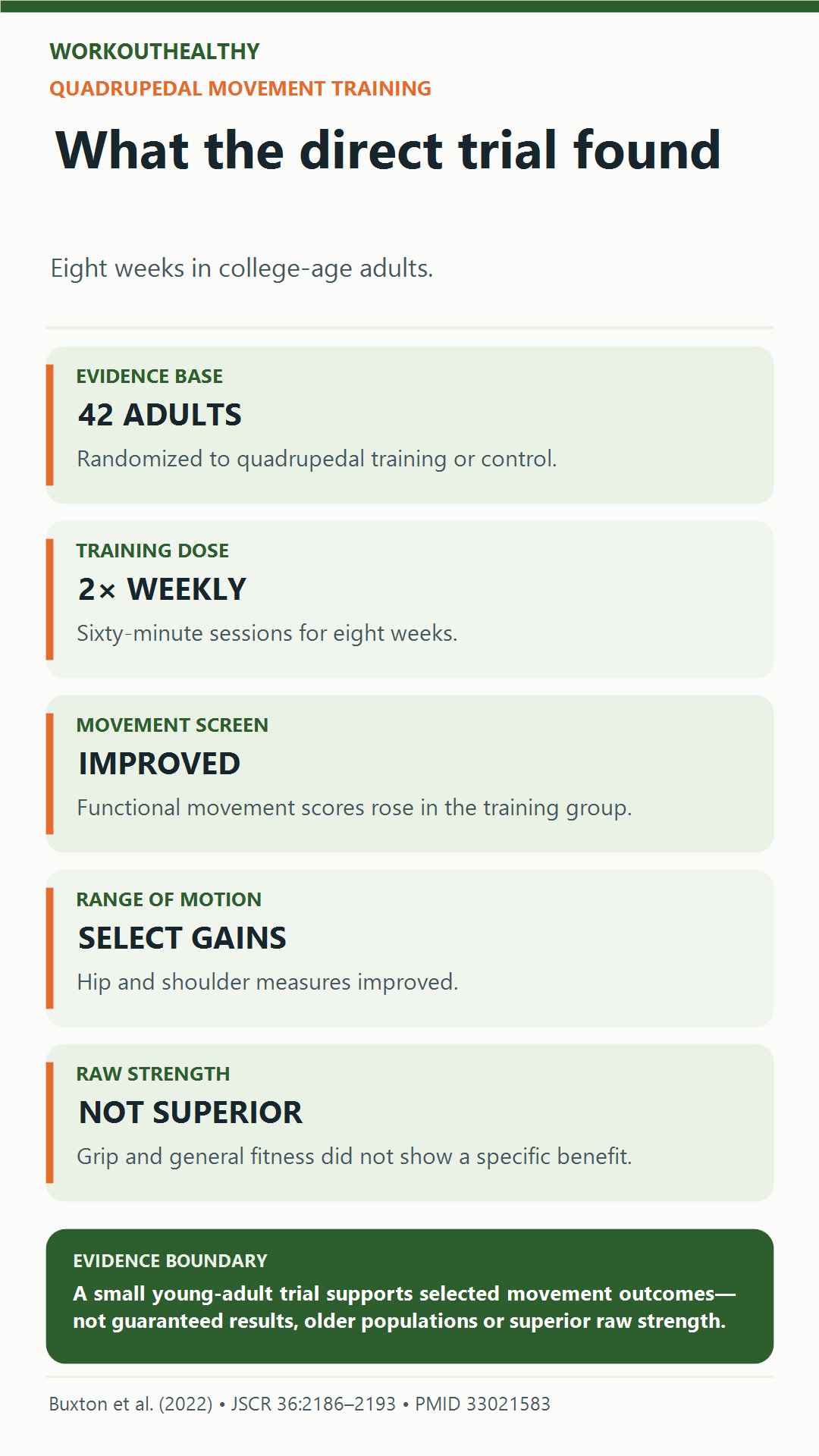
Buxton and colleagues put 42 college age adults through an 8 week quadrupedal movement training program, twice a week, 60 minutes per session, and compared them to a control group that did not train this way.
The training group showed significantly greater improvement on the Functional Movement Screen, a test used to rate how well someone moves through basic patterns like a squat, a lunge, and a shoulder reach.
They also gained meaningful range of motion at the hip, in both flexion and rotation, along with more shoulder extension range compared to the control group.
Grip strength and general fitness markers held steady across both groups.
Push up performance improved in both groups over the 8 weeks, not just the group doing animal movements.
So the honest read is that this training improved how well people moved through the screen and improved specific joint ranges, but it was not shown to be a superior way to build raw strength compared to normal training.
How Hard Is This Training, Really
A separate 2022 study, also involving Buxton and colleagues, measured the actual energy cost of a 60 minute Animal Flow style session.
Researchers compared it against self selected walking pace and against walking that was intensity matched to heart rate, using 30 healthy young adults.
The animal movement session burned about 6.7 calories per minute on average, which qualifies as moderate intensity exercise by standard classification.
That was higher than casual, self paced walking.
It was slightly lower than brisk, heart rate matched walking.
The most demanding segment, a choreographed flow section that strings movements together continuously, pushed intensity noticeably higher than the drills done in isolation.
In plain terms, this is a real moderate intensity workout, not just a gentle warm up.
It is roughly in the same intensity zone as a decent paced walk.
The Aging and Fall Prevention Angle
The video’s own hook, one person at 39 and one at 53 doing the same routine, points at a real and separate body of research: what keeps adults moving well as they get older.
A 2023 systematic review in Frontiers in Public Health looked at 29 randomized trials covering more than 4,300 community dwelling older adults.
It found that balance training, strength training, and especially multi component programs that combine several types of movement reduced fall rates and improved mobility scores.
Animal movement training was not one of the specific programs reviewed in that paper.
But it fits the same general category the review found helpful, a program that blends strength, balance, and multi directional joint movement rather than isolating one quality at a time.
That is a reasonable, well supported reason this style of training could matter for someone thinking ahead about aging, even though no study has tested animal flow itself against fall risk directly.
If daily movement quality is already a concern, it is worth reading how standing more instead of sitting all day factors into general joint and metabolic health, since the two habits reinforce each other.
What This Evidence Does Not Prove
It is worth being direct about the limits here.
The main quadrupedal training study used 42 college age adults, not older adults, and not people with existing joint pain or a history of injury.
An 8 week program is also short.
Nobody has published long term data on what happens after 6 months or a year of this training.
No published study has directly compared animal movement training to well designed general strength training or to a standard mobility program using the same test battery.
So the fair claim is that this specific style of training improved movement screen scores and some joint ranges in young, healthy adults over 8 weeks.
The claim that it is uniquely better than other well designed training for mobility, at any age, has not actually been tested head to head.
Treat the more dramatic promises you see in short videos as the creator’s own framing, not as an established scientific conclusion.
Common Mistakes People Make With Animal Movements
The most common mistake is loading the wrists too early.
Crawling patterns put a lot of body weight through an extended wrist, a position most people rarely load in daily life.
Jumping straight into long bear crawl sets without building wrist tolerance first is a fast way to end up with sore wrists instead of better mobility.
A second mistake is letting the hips sag or pike up during crawling, which turns a hip and core exercise into a lower back exercise.
A third mistake is treating these movements as a single all or nothing workout instead of a short, regular practice.
The research programs used short, frequent sessions, not one exhausting hour done occasionally.
Consistency mattered more than intensity in the actual study design.
Who Should Be Cautious or Check With a Doctor First
Anyone with an existing wrist injury, carpal tunnel symptoms, or significant wrist arthritis should be cautious, since almost every animal movement loads the wrist in extension.
People with shoulder impingement or a history of shoulder dislocation should also check with a physical therapist before adding load bearing crawling patterns.
The same goes for anyone with an acute knee injury, since movements such as duck walks and frog hops place substantial load through a bent knee.
Pregnant individuals, particularly in the second and third trimester, should talk to their doctor before doing prone, floor based movements that involve pressure on the abdomen.
People recovering from a hip replacement or another major joint surgery should get clearance first.
If you want a sense of how seriously that kind of recovery timeline is usually taken, a real hip replacement recovery case shows how gradual and supervised that return to movement actually is.
None of this means animal movements are dangerous for a typical healthy adult.
It means the same common sense rule applies here as with any new exercise.
Start light and stop if something feels sharp or wrong.
Watch the Five-Move Animal Mobility Routine
How to Do the Five Movements in the Video
Strength Side and GMB Fitness demonstrate a bear walk, frog hop, duck walk, sumo frog, and crab walk. These are the video’s five movements, not a generic animal-flow list.
Use the video to see the form before you try a short, comfortable practice. The descriptions below are an editorial guide, not a substitute for individualized coaching.
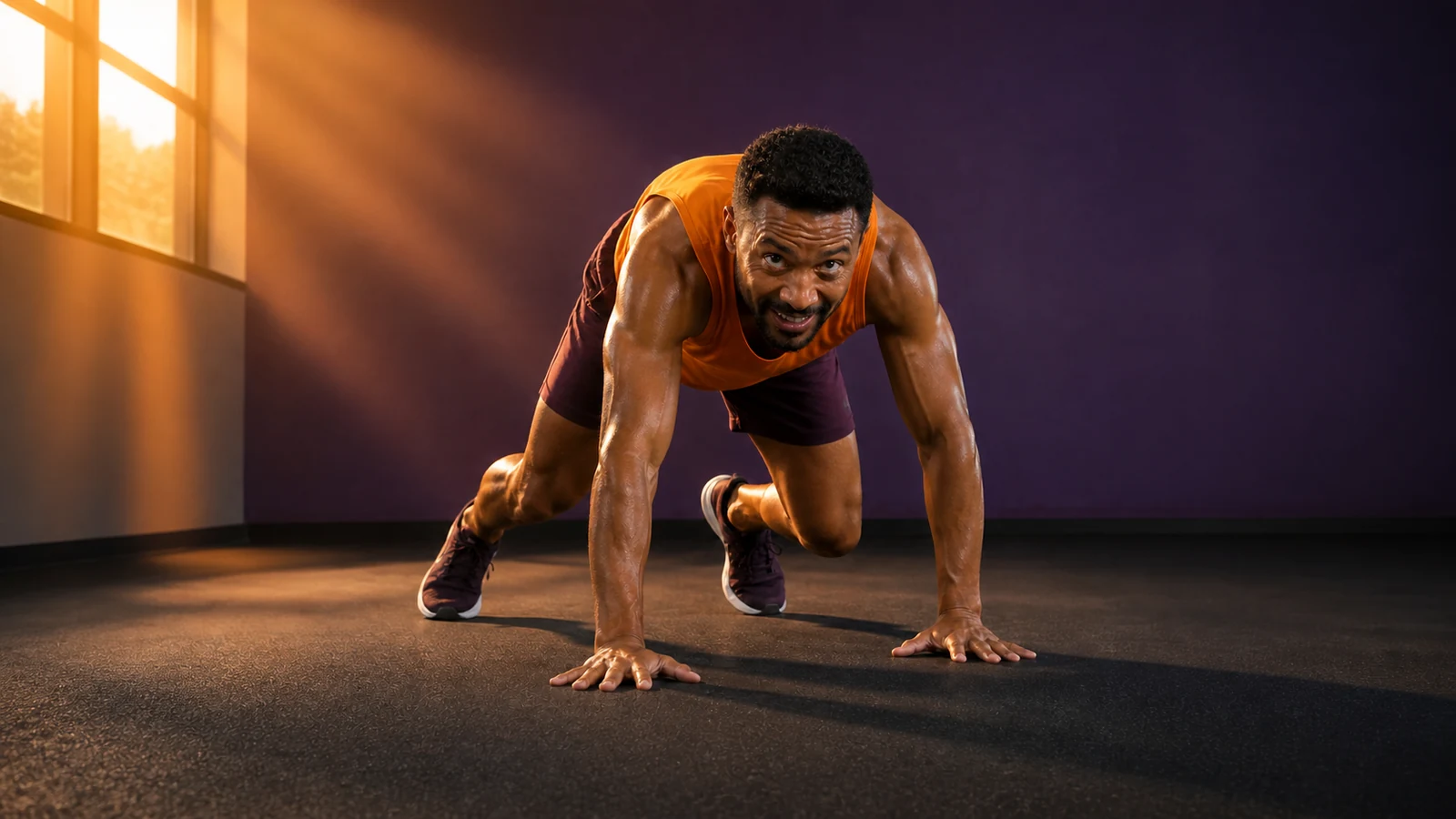
1. Bear Walk
Place your hands under your shoulders and feet on the floor, then lift your knees slightly. Move one hand and the opposite foot forward together.
Keep the steps small enough to hold a steady torso. If your wrists object, shorten the bout or skip the move.
2. Frog Hop
Lower into a comfortable squat and place your hands on the floor in front of you. Shift weight into your hands, then bring your feet forward in a small hop or step.
The video shows the pattern dynamically. A step instead of a hop is a lower-impact way to explore it when jumping is not appropriate.
3. Duck Walk
Start in a squat depth you can control and take small steps while staying low. Keep your knees tracking in the direction of your toes.
This move can demand substantial knee and ankle range of motion. Stand up between steps or omit it if the position causes pain.
4. Sumo Frog
Take a wider stance and lower only into a comfortable squat. Place your hands down, shift your weight, and move through the wide-legged frog pattern shown in the video.
Avoid forcing a deeper hip position simply to copy the demonstrator. Work within your own available range.
5. Crab Walk
Sit with your feet planted and hands behind you, then lift your hips as far as is comfortable. Move a hand and the opposite foot together in short steps.
Keep your shoulders comfortable and stop if the position aggravates your wrists. The goal is controlled coordination, not distance or speed.
WorkoutHealthy’s beginner adaptation is one short pass per movement with a full reset between them. That is a cautious starting suggestion, not a dose tested by the cited studies or prescribed in the video.
Building a Simple Weekly Routine
Two short practices a week can be a manageable beginner schedule, but the cited training trial tested 60-minute classes twice weekly, not this short home version.
A simple WorkoutHealthy practice might include one brief, controlled pass of each movement with rest between moves. Skip any pattern that causes pain.
This short practice is a conservative way to learn the movements, not a study-tested dose or a guarantee of the outcomes shown in the longer trial.
The research behind this trend supports a short, consistent practice far more than it supports one exhausting session done occasionally.
If you already lift weights or walk regularly, this fits well as a warm up or as a separate short session on off days.
Pairing it with something like a daily walking target or ongoing strength training gives you a more complete picture than any single method on its own.
Get the next evidence check. Subscribe to WorkoutHealthy Insider for practical explanations behind popular fitness claims.
References
Buxton, J. D., Prins, P. J., Miller, M. G., Moreno, A., Welton, G. L., Atwell, A. D., Talampas, T. R., & Elsey, G. E. (2022). The effects of a novel quadrupedal movement training program on functional movement, range of motion, muscular strength, and endurance. Journal of Strength and Conditioning Research, 36(8), 2186 to 2193. https://doi.org/10.1519/jsc.0000000000003818
Buxton, J. D., Sherman, S. A., Sterrett, M. T., Kannel, K. D., Blanchflower, M. E., Jancay, K. T., Jenkins, A. K., Donofrio, T. P., & Prins, P. J. (2022). A comparison of the energy demands of quadrupedal movement training to walking. Frontiers in Sports and Active Living, 4, Article 992687. https://doi.org/10.3389/fspor.2022.992687
Sadaqa, M., Németh, Z., Makai, A., Prémusz, V., & Hock, M. (2023). Effectiveness of exercise interventions on fall prevention in ambulatory community-dwelling older adults: A systematic review with narrative synthesis. Frontiers in Public Health, 11, Article 1209319. https://doi.org/10.3389/fpubh.2023.1209319
This article is for general information only and is not medical advice. If you have an injury, ongoing pain, or a medical condition, talk to a doctor or physical therapist before you change how you train or eat.