

Jordin Sparks has described losing about 50 pounds through changes that she could keep doing, including more attention to portions and making exercise a priority. Her comments became a celebrity weight-loss story, but the useful lesson is not a magic menu or a target number on the scale. It is that a person can make changes without declaring entire categories of food forbidden.
The WorkoutHealthy Facebook post presents her experience as an example of moderation and consistency. Her own interviews support much of that story, although they do not prove every detail of a single fixed diet or training plan. Here is what she has said, what a trainer described, and how to translate the broader evidence without turning one person’s body into a prescription for yours.
What Sparks said about her change
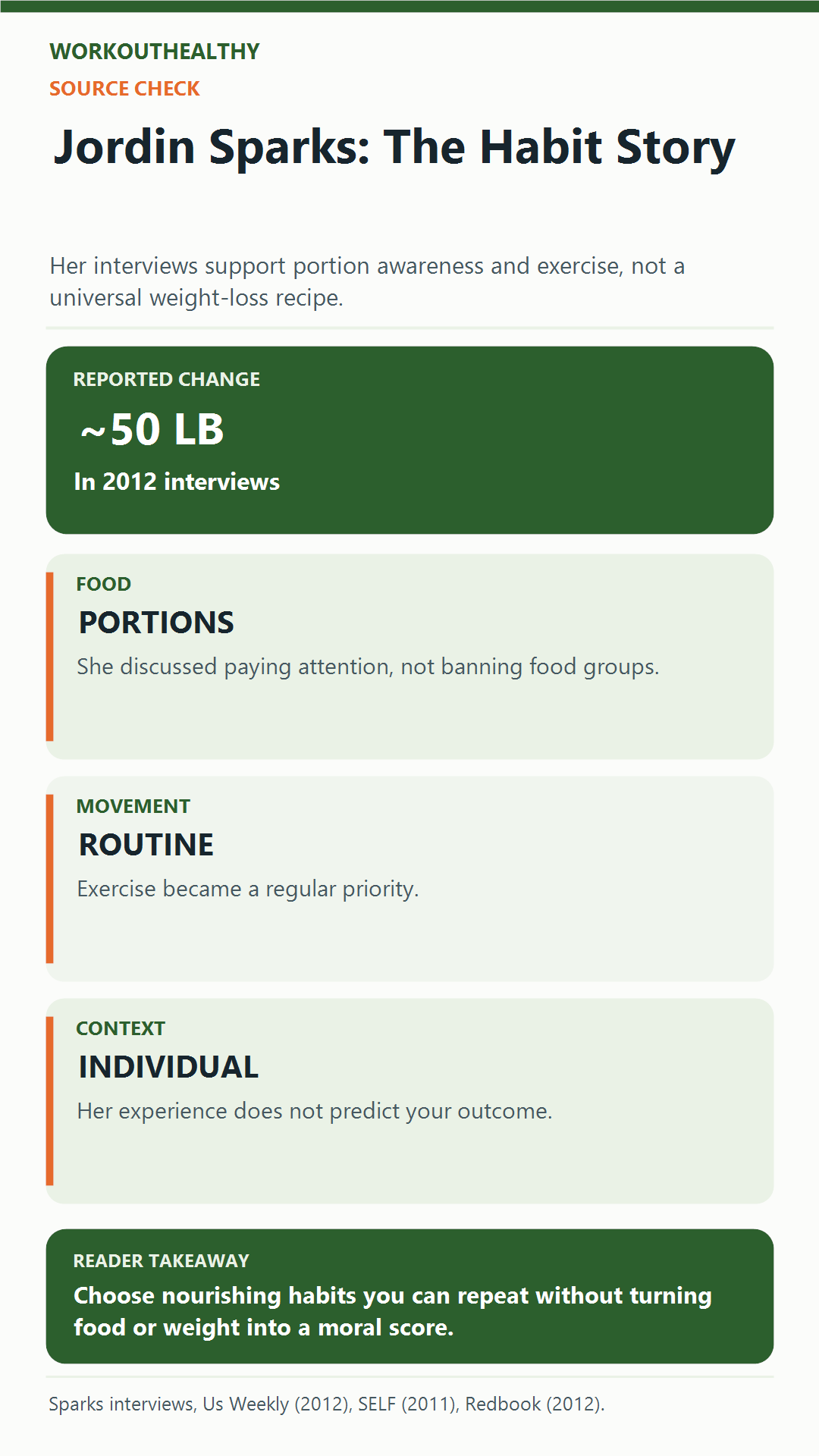
In a 2012 interview, Sparks described her roughly 50-pound weight change in uncomplicated terms: eating better and working out as a daily practice. Earlier coverage captured her saying she made exercise a priority and paid more attention to portion sizes. A Redbook interview portrayed a person enjoying a variety of foods, taking tastes rather than automatically finishing everything served. These are firsthand or interview-based reports, not a controlled measurement of every calorie and workout.
Her trainer David Ashley later described a high-intensity, mixed workout approach and a more restrictive diet when “dieting down.” That means the simplified social-media version—“no restrictions at all”—does not capture every period of her routine. It is safer to say that Sparks publicly emphasized healthier choices, portion awareness and regular activity rather than a permanent ban on whole food groups. We should not infer that every meal she ate looked like the image accompanying the Facebook post. Both that creative and our article hero are editorial illustrations.
Sparks has also spoken about exercise as a form of self-care. The mental benefits someone reports from activity are real to them, but we cannot isolate them from the rest of life or claim that weight loss itself caused better mental health. Weight and mental well-being are different outcomes and should not be morally tied together.
Her story is evidence of what she reported doing, not proof that the same plan will produce the same number for another person.
What portion awareness means
“Portion control” can sound like a strict rule, but it can simply mean noticing how much food satisfies you and how serving sizes compare with your needs. The National Institute of Diabetes and Digestive and Kidney Diseases advises awareness of portion size, foods and beverages, and eating frequency as one way to make healthier choices. It does not require banning bread, desserts or another entire category.
A reasonable portion depends on energy needs, activity, medical conditions, appetite and the rest of the day. The amount that fits one person’s meal may be too much or too little for another. A restaurant serving is not automatically the amount you must eat, and a package’s “serving size” is labeling information, not an instruction to stop while hungry. Paying attention can be flexible rather than punitive.
For some people, detailed tracking improves awareness; for others, it increases anxiety or compulsive behavior. If numbers or food rules are becoming distressing, seek guidance from a registered dietitian or mental-health professional rather than forcing the method. Our article on what calorie-tracking apps get right and wrong explores their limits. The healthiest tool is one that helps you eat adequately and make decisions calmly.
Why routine beats a perfect workout
Activity was another recurring theme in Sparks’ interviews. Coverage from the time mentioned several forms of exercise, including running, yoga and workouts she could fit into her life. Her trainer later described more structured sessions. That variety suggests the plan changed rather than existing as one immutable “celebrity routine.”
Regular movement can support cardiovascular health, mood, function and weight maintenance, but the most effective program for a reader is not necessarily the most intense one a trainer can devise. A manageable walk, a beginner strength session or a dance class can be a better starting point than a demanding circuit you abandon after a week. Different activities deliver different benefits. Our guide to cardio and strength work for long-term health explains why combining types of movement can be useful without copying a celebrity schedule.
It is also important not to claim that a 30-minute workout automatically “keeps metabolism elevated for 24 hours” in a way that determines fat loss. The magnitude of post-exercise energy expenditure varies and is usually much smaller than marketing language suggests. The stronger reason to exercise is the direct physical and psychological value of being active, along with the opportunity to maintain muscle and capacity during changes in body weight.
What sustainable-change research says
The NIDDK emphasizes a healthy eating plan that can be maintained over time and physical activity that supports health and weight maintenance. This is a broader principle than any particular food list. It acknowledges that people need a pattern they can live with, not a few dramatic days of restriction.
A systematic review of successful weight-loss and maintenance interventions found that physical activity appeared in many of the effective programs and behavioral strategies such as self-monitoring were common. The review does not prove that a single ingredient—portion size, exercise or self-monitoring—caused success on its own. The interventions were multifaceted, and participants, settings and definitions of success differed. That is one reason to avoid promising a specific number of pounds from a handful of tips.
For adults who choose to pursue weight change, the relevant pattern usually combines appropriate energy intake, food quality, activity, sleep, medical context and behavioral support. Not everyone needs weight loss. People with a history of disordered eating, growing adolescents, pregnant people and those with medical conditions may need a different approach. A celebrity outcome should never overrule individual medical advice.
The goal is not “be perfect today.” It is to find enough supportive habits that tomorrow remains doable.
There is another reason to avoid copying the number on a celebrity headline. Weight is only one possible measure, and it can change with age, medication, pregnancy, illness, activity and many factors outside willpower. A person can improve blood pressure, fitness, sleep or relationship with food without reaching a public figure’s result. Conversely, a large visible change does not reveal everything about someone’s health. If you decide to pursue a weight-related goal, work from your own medical context and the behaviors you can sustain—not someone else’s photo. The most helpful headline would be about habits and quality of life, not a single “before” and “after.”
A flexible three-part framework
Here is a reader-facing approach inspired by the general lessons—not copied from Sparks’ private routine. First, make meals satisfying. Include foods you enjoy alongside sources of protein, fiber and produce where they fit your preferences and needs. Notice portions without treating a food as a moral failure. A meal should nourish you and let you get on with the day.
Second, schedule movement you can repeat. Begin with a dose that works with your current capacity. That might be two short strength sessions, several walks, dance breaks or another activity. Add challenge gradually rather than jumping to a trainer-led intensity level meant for someone else. If exercise improves your mood, notice that as a worthwhile benefit separate from the scale.
Third, review gently. After a couple of weeks, ask whether your energy, hunger, sleep, strength and sense of control are moving in a helpful direction. Adjust one thing at a time. When a week goes poorly, return to the routine at the next ordinary opportunity instead of declaring it ruined. If you have a medical weight-management goal, a registered dietitian and your clinician can help turn these broad ideas into an appropriate plan.
That framework should not be used to audit someone else’s body. Sparks’ appearance and weight change are her own story. The transferable value is permission to make realistic, compassionate choices and to let a routine evolve as life changes.
Bottom line
Jordin Sparks has publicly connected her roughly 50-pound weight change with better food choices, attention to portions and regular exercise. Some trainer descriptions add more structure and restrictions than a simple “eat anything” headline implies. Research supports the broader importance of maintainable eating, activity and behavioral support, but no celebrity story predicts an individual result. Build a routine around health, energy and repeatability, and seek individualized help when needed. This article is educational, not personal medical or nutrition advice.
References
- Sparks J. Interview on eating better and working out after a reported 50-pound weight change. Us Weekly. 2012. Read interview.
- Sparks J. Comments on exercise priority and portion sizes. SELF. 2011. Read coverage.
- Interview and profile of Sparks’ food approach. Redbook. 2012. Read interview.
- NIDDK. Eating and physical activity to lose or maintain weight. Read guidance.
- Healthy strategies for successful weight loss and weight maintenance: systematic review. PubMed.