
How accurate is MyFitnessPal? It depends on which number you mean.
Its suggested calorie goal, the calories logged from a food entry, exercise adjustments and a photo-based meal suggestion each have different sources of error.
| Number in the app | What it represents | Best way to interpret it |
|---|---|---|
| Daily calorie goal | An estimate built from profile details, selected activity and a chosen weight goal. | A starting estimate, not a measurement of your body’s energy needs. |
| Food diary total | Nutrition values for the entries and serving amounts selected. | Check the food identity and portion; a correct calculation on a wrong entry is still wrong. |
| Exercise calorie adjustment | An estimated change in the daily net-calorie budget when activity is logged or synced. | A second estimate, not extra food that the body has precisely “earned.” |
| Meal Scan suggestion | Foods the photo tool proposes, followed by a serving selection or edit. | A logging shortcut that still needs human review, especially for mixed dishes. |
A separate, widely discussed 345-calorie figure concerns a preliminary photo-app experiment, not a universal daily MyFitnessPal error. That distinction matters before using any number to judge the app.
The society’s release traces the claim to 102 weighed meals in an NIH metabolic kitchen. The four photo estimates averaged about 250 to 345 calories below the meal reference, depending on the app; this does not mean MyFitnessPal misses 345 calories each day or that manually entered food logs have the same error.
This is a research and documentation review, not a hands-on test of the current app. App menus and subscription features can change; the studies below tested particular databases, people and time periods.
Why your MyFitnessPal goal may differ from another calculator
MyFitnessPal’s help documentation says the initial goal uses age, height, weight, sex, usual activity and a selected pace of weight change. It then changes the day’s net-calorie allowance when exercise is recorded or synced.
Another calculator can produce a different number because it uses a different equation, activity assumption or goal setting. Neither answer has directly measured your individual energy expenditure from those profile fields alone.
This explains a source of disagreement between calculators; it does not identify which target is appropriate for an individual. No calorie target or pace of weight change is prescribed here.
What researchers found when they checked MyFitnessPal food entries
| Study | What was compared | Useful result | What it cannot prove |
|---|---|---|---|
| 2020 MyFitnessPal validation | Two records each from 50 participants, mostly covering four days, using MyFitnessPal values and a Belgian reference database. | In the second record set, mean energy was 1,984 versus 1,958 kcal per day, with strong correlation between methods. Sodium and cholesterol agreement was poorer. | These are group results, not the error range for one person’s diary. Participants received detailed instructions, and the app database has changed. |
| 2025 Canadian athlete study | Two raters entered 43 three-day endurance-athlete food records in MyFitnessPal and Cronometer, then compared them with a reference analysis. | The authors reported poor MyFitnessPal validity for total energy and several nutrients in this setting, despite some differences between raters being too small to be clinically meaningful. | Results from these athlete records do not supply a universal error number for every user or current app entry. |
| 2019 seven-app review | A prepared three-day food diary entered into seven apps and compared with USDA reference values. | The average calorie-coding difference across apps was 1.4% for that diary; MyFitnessPal had the closest calorie and macronutrient coding in this comparison. | This was a small, controlled coding exercise, not a measure of today’s app, calorie goals, or missed meals in everyday life. |
| 2026 NIH photo-app presentation | Standardized photos of 102 weighed metabolic-kitchen meals were entered into four apps, including MyFitnessPal. | The American Society for Nutrition reported that the apps’ average estimates were about 250 to 345 calories low per meal, and fat was about 30 grams low. | This is preliminary conference research rather than a peer-reviewed full paper; it is a photo-only test, not a current app audit or a universal correction for any one meal or app. |
The studies can disagree without either being useless: food choice, data source, user training and comparison method differ. The 2020 study explicitly supplied a manual and preferred standardized generic entries, while the 2025 study tested how two raters handled athlete records with many possible entries.
Neither study establishes that every entry is accurate or that everyday logging captures everything eaten. A review of self-reported dietary intake found that underreporting is common across diary and recall methods, including errors no app can repair when a food is never entered.
How to check a food entry without chasing perfect numbers
MyFitnessPal’s current help says a check mark means its team has reviewed or added an entry, but even checked entries can contain mistakes. An unchecked entry is not automatically wrong either.
For a packaged item, compare the selected food name, serving unit and nutrition panel with the package when a decision depends on accuracy. For a homemade meal, review the ingredients and chosen portions rather than assuming that a similar-sounding database entry matches your recipe.
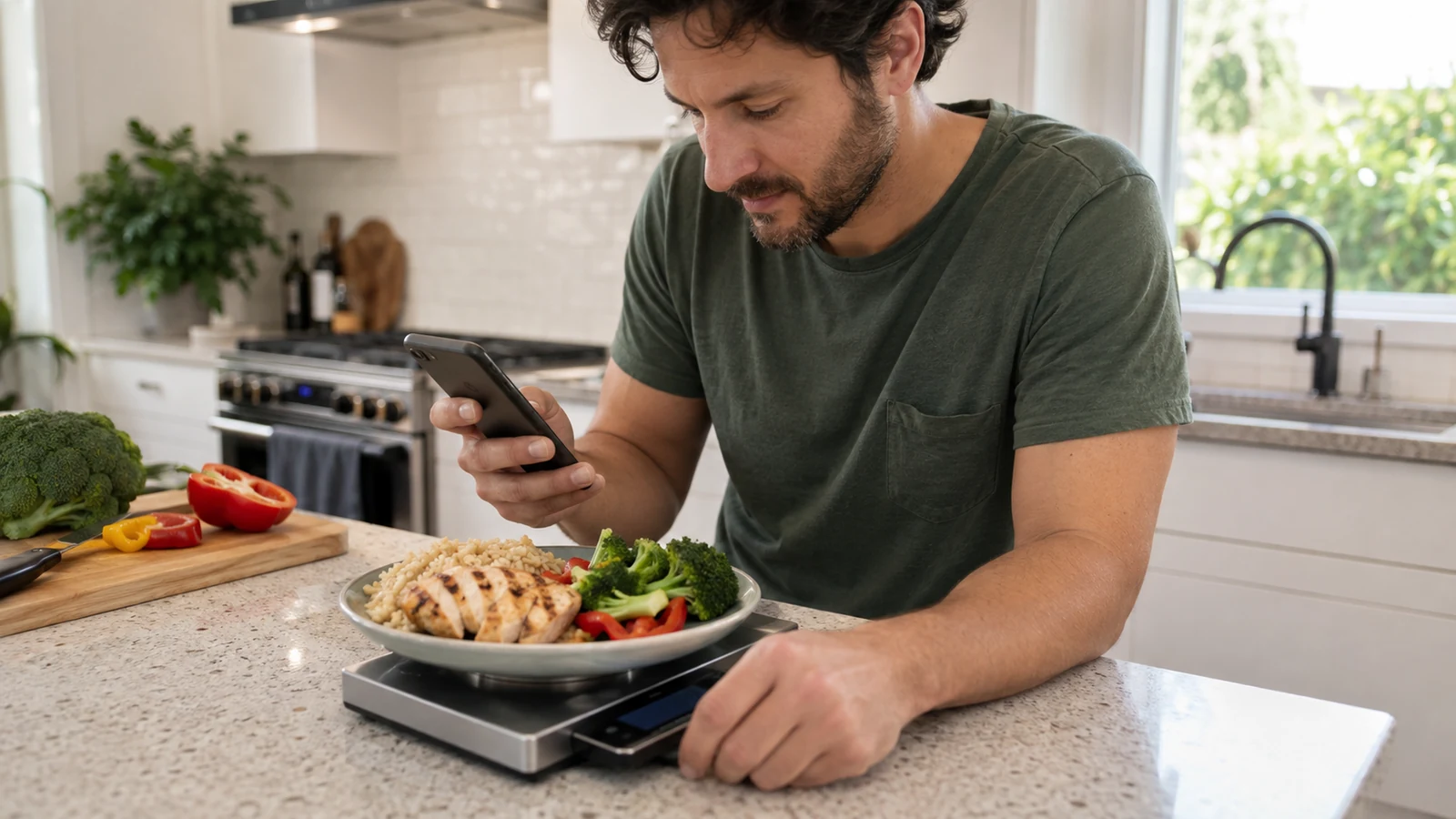
The official Meal Scan guide describes a Premium mobile feature that suggests food matches. It asks users to choose foods, adjust servings and search for items it missed.
Those are documentation findings, not a comparison of the current app against weighed meals. A feature description explains how a number is produced without proving its accuracy.
One unit mismatch, explained without an app test
Imagine a fictional package value stated per 100 grams, while an entry is selected for 50 grams. The corresponding value should be half of the per-100-gram figure if the food and preparation are identical.
Entering the 100-gram amount for a 50-gram portion would double that entry’s calculated contribution. This is an arithmetic example, not a tested MyFitnessPal screen, a claim about how often errors occur, or a suggested amount to eat.
Exercise adjustments and photo scans add another layer
MyFitnessPal describes its daily goal as a net-calorie budget: food calories minus exercise calories. That accounting explains why logging exercise may raise the number displayed as available to eat, but the activity estimate has its own uncertainty.
Subtracting an exercise estimate from a food estimate does not independently validate either input. The displayed result can be arithmetically correct while the quantities entering that calculation remain uncertain.
Meal Scan uses an image to suggest food matches, then asks the user to choose and adjust servings. Research on image-based dietary assessment has long identified hidden ingredients and portion size as difficult problems, so a convenient suggestion should not be described as a direct measurement.
Accuracy is a tool question, not an obligation to track
Understanding an estimate does not require keeping a food diary. These studies do not make calorie tracking necessary or establish that a more detailed log is better for every person.
If tracking feels distressing or you need food data for a medical decision, a qualified clinician or registered dietitian can help choose an appropriate approach. A database comparison cannot make that personal decision for you.
Frequently asked questions
Is a verified MyFitnessPal food always accurate?
No. MyFitnessPal says a checked entry has been reviewed or added by its team, while acknowledging that checked entries can still have errors.
Does the 1.4% study mean my own daily intake is within 1.4%?
No. That figure was the average calorie-coding difference across seven apps for a known three-day diary, and it does not account for omitted foods, portion guesses or a changing database.
Is Meal Scan more accurate than typing?
The current feature suggests entries and lets users edit portions, but we have not independently benchmarked the current version against weighed meals. The published documentation alone cannot establish which method is more accurate for a particular meal.
Get the next evidence check.
Five practical fitness stories worth your time, every Friday.
One email a week. No product pitches. Unsubscribe in one click.
References
- Evenepoel, C., et al. (2020). Accuracy of nutrient calculations using the consumer-focused online app MyFitnessPal: Validation study. Journal of Medical Internet Research, 22, e18237. Full study.
- Morello, O., et al. (2025). Reliability and validity of nutrient assessment applications for Canadian endurance athletes. Journal of Human Nutrition and Dietetics. PubMed record.
- Ferrara, G., et al. (2019). A focused review of smartphone diet-tracking apps. JMIR mHealth and uHealth, 7, e9232. Original review.
- American Society for Nutrition. (2026). Photo-based calorie-tracking apps may underestimate energy in meals. Preliminary NUTRITION 2026 research release, reporting an NIH team study; no peer-reviewed full paper identified. Society release.
- Livingstone, M. B. E., and Black, A. E. (2003). Markers of the validity of reported energy intake. The Journal of Nutrition, 133, 895S to 920S. PubMed record.
- Lo, F. P. W., et al. (2020). Image-based food classification and volume estimation for dietary assessment: A review. IEEE Journal of Biomedical and Health Informatics, 24, 1926 to 1939. PubMed record.
Medical disclaimer: This article is general nutrition information, not medical advice or an individual calorie prescription. A qualified clinician or registered dietitian can help with medical decisions, personal nutrition needs or distress related to food tracking.