
Most people who lift weights never pull twice their own bodyweight off the floor, even after years of training.
Jessica Buettner pulled almost three and a half times hers.
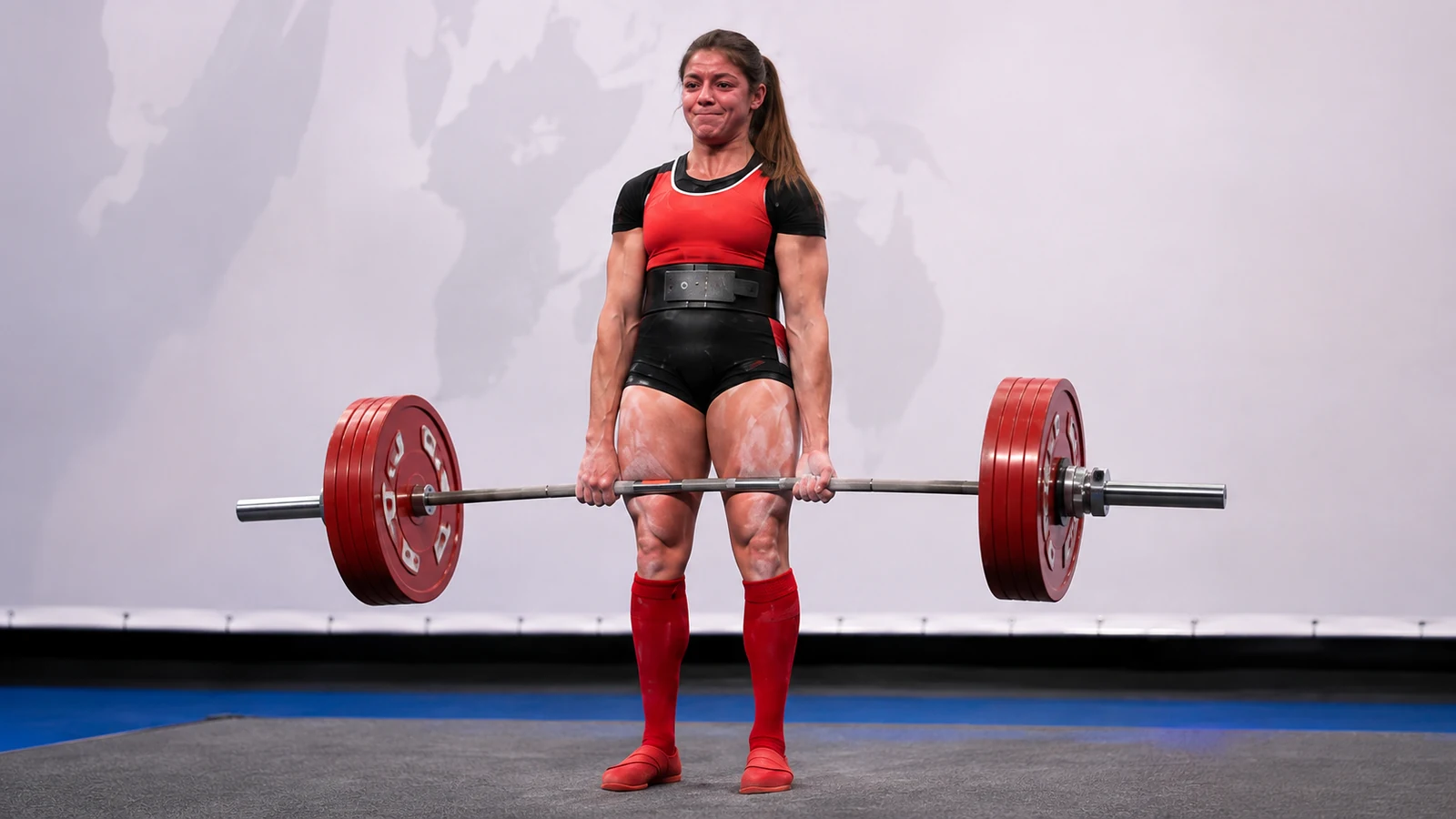
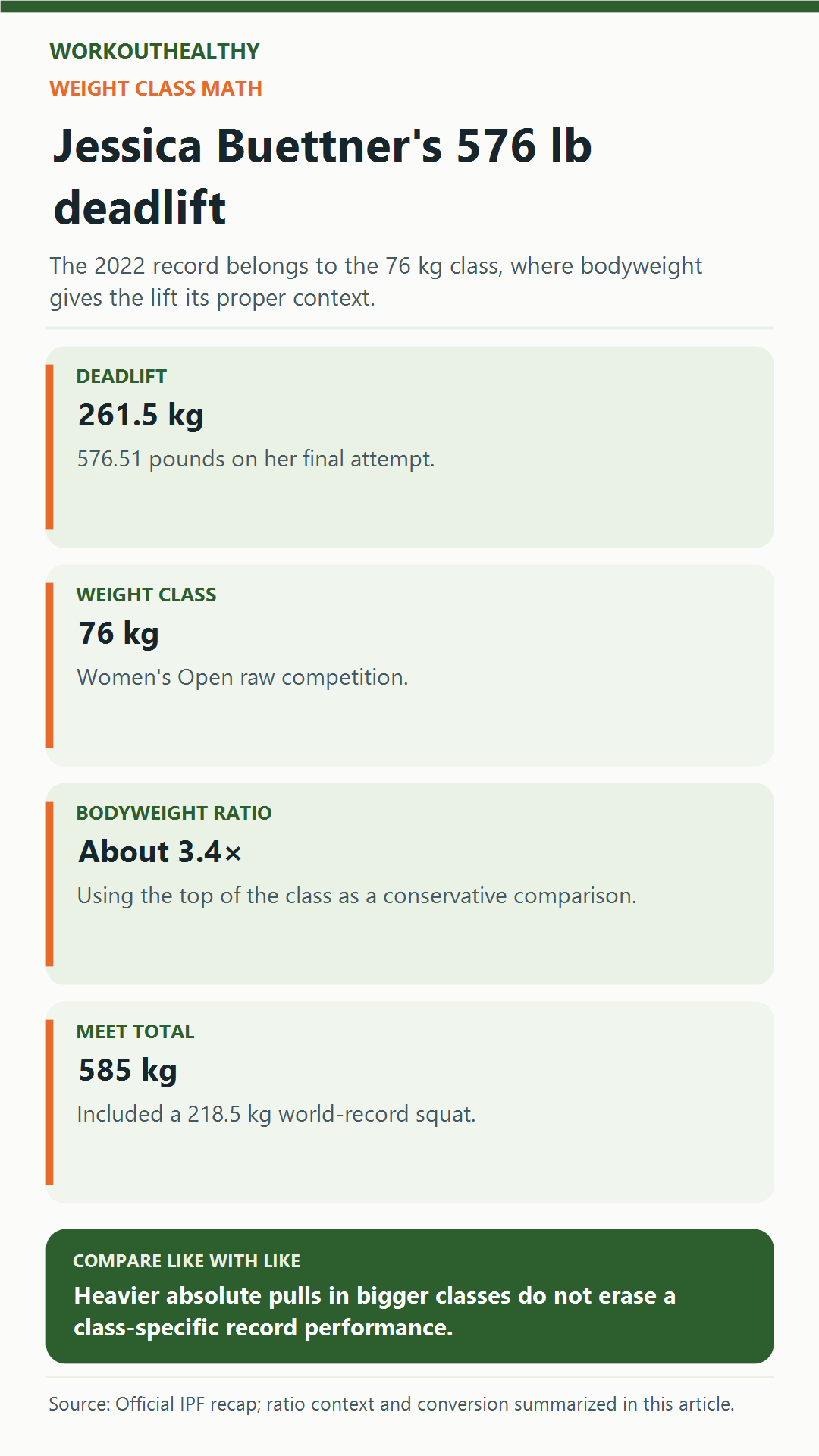
In June 2022, at the IPF World Classic Powerlifting Championships in South Africa, the Canadian lifter locked out 261.5 kilograms in the 76 kilogram women’s class.
Converted to pounds, that comes out to 576.51 pounds, close to the 576 pound figure you may have seen shared online.
It was a raw deadlift world record, pulled with a lifting belt and nothing else, no suit and no wraps.
Since then, other IPF world records have been set by other women in heavier weight classes, including marks well above 600 pounds.
It is worth being upfront about that before going any further.
None of it changes what Buettner did in her own class.
Weight class records are not one single ladder where only the top rung counts.
They are a system built so a lighter lifter’s best effort and a heavier lifter’s best effort can both be a world record at the same time.
Neither one cancels out the other.
That system, and why it makes sense, is what this article is about.
What Happened at the 2022 IPF World Classic
The IPF World Classic Powerlifting Championships is the sport’s top annual event for raw, or “classic,” lifters, meaning no supportive squat suits, bench shirts, or deadlift suits are allowed.
Buettner competed in the 76 kilogram women’s Open class, the top level of competition open to any adult lifter regardless of age.
She opened strong in the squat and eventually pushed to 218.5 kilograms, a world record in its own right.
In the deadlift, she called for 261.5 kilograms on her final attempt and locked it out clean.
The IPF’s own recap of the event described it as the biggest female raw deadlift in the federation’s history at that point.
Her total for the day reached 585 kilograms across squat, bench press, and deadlift, good enough to win gold.
That win made her the Open world champion for the second year in a row, after also winning the 2021 title.
Counting two earlier Junior world titles from 2016 and 2018, it was her third IPF world championship overall.
Her silver medalist that day, Poland’s Agata Sitko, finished with an equally massive total and reportedly called Buettner one of her own idols in the sport.
That detail matters here for a simple reason.
The athletes who compete directly against a record holder are usually the first to recognize how real the effort was, long before an online caption ever explains the number.
How Big Is 576 Pounds, Really
Raw numbers on a bar do not mean much without context, and this is a case where the unit conversion matters more than usual.
The workbook caption behind this article carries a garbled hashtag fragment mixing the weight class number into the lift number, so the figures here were checked independently rather than copied as given.
261.5 kilograms converts to 576.51 pounds, which matches the figure in the original caption.
The 76 kilogram weight class limit converts to 167.55 pounds, also matching.
Both of those numbers hold up under a direct kilogram-to-pound conversion, so they can be trusted.
What they mean in practice is the more interesting part.
A lifter weighing in at the top of the 76 kilogram class, close to 168 pounds, who then deadlifts 576.51 pounds is moving roughly 3.4 times her own bodyweight off the floor.
Most competitive male powerlifters, working with more favorable leverages on average, do not reach that ratio on a deadlift.
It is the kind of number that is easy to lose track of when it is presented purely as an absolute weight, which is exactly why record keepers built other posts on this site around similarly precise math, like the pacing behind DonnaJean Wilde’s push-up world record.
Why Powerlifting Splits Lifters Into Weight Classes
Bodyweight has an enormous effect on how much a person can lift.
Bigger frames generally support more muscle mass, longer levers for the pull, and more total force production, all else being equal.
A 130 kilogram super heavyweight and a 76 kilogram lifter are not competing on a level field if the only measure is kilograms on the bar.
That is precisely why every strength sport, from Olympic weightlifting to strongman to powerlifting, divides competitors into weight classes in the first place.
It is the same underlying logic boxing and wrestling use, just expressed through a barbell instead of an opponent.
Each class effectively runs its own separate competition, with its own separate record book.
A 76 kilogram record and an 84 kilogram record are not measuring the same thing, in the same way a Guinness record for oldest competitive bodybuilder is not measuring the same thing as a record for most reps in an hour.
Both can be entirely legitimate on their own terms, the way Edith Connor’s record for oldest female bodybuilder stands on criteria that have nothing to do with how much weight she moved.
A weight class record answers one specific question. Not “who lifted the most weight on earth,” but “who lifted the most weight at this bodyweight.” Those are different questions, and both are worth answering.
Without weight classes, every division of the sport would collapse into one contest that only super heavyweights could ever win, no matter how strong a lighter athlete became relative to their own size.
The Case for Pound for Pound Strength
Sports scientists have spent decades trying to build fair formulas that compare strength across different bodyweights, precisely because raw kilograms lifted is not a fair comparison on its own.
One widely studied example is the Wilks formula, a bodyweight-adjustment coefficient validated in a peer-reviewed analysis published in Medicine and Science in Sports and Exercise (Vanderburgh & Batterham, 1999).
The IPF has since moved to its own updated version of that idea, called DOTS, which produced a score of 568.78 for Buettner’s 2022 total, an extremely high mark by any standard.
Separate peer-reviewed work has looked specifically at how powerlifting performance should be adjusted for differences in body mass across weight classes (Cleather, 2006), reinforcing the same basic conclusion from a different angle.
Pound for pound, a smaller lifter moving a very high multiple of their own bodyweight is doing something that a formula like Wilks or DOTS is specifically designed to recognize as elite, even when the absolute number on the bar is smaller than a heavier lifter’s best.
That is not a consolation prize.
It is arguably the harder feat, since a lighter frame has less raw mass and shorter leverages to work with in the first place.
Heavier Deadlifts Exist in Bigger Classes, and That Is the Point
Since 2022, other IPF competitors have pulled heavier absolute numbers than Buettner’s 576.51 pounds, and it would be strange to write this article without saying so directly.
Records in the 84 kilogram and 84 kilogram-plus super heavyweight classes have climbed into the 600s and beyond, including a widely discussed pull above 629 pounds in the heaviest class.
Those achievements belong to different lifters, competing in different classes, against a different pool of bodyweights.
They do not sit above Buettner’s record in any competitive sense, because they were never competing against her class in the first place.
A useful way to think about it is that IPF world records are not one leaderboard with a single winner at the top.
They are dozens of separate leaderboards, one for every combination of sex, weight class, and lift, each with its own champion.
Buettner’s is the 76 kilogram women’s classic raw deadlift leaderboard, and on that leaderboard, June 2022 marked the top of it.
Like most single-class records in a sport this competitive, it is also worth being honest that a class record can eventually be broken by another lifter in that same weight class, the same way any record in any sport gets challenged over time.
That possibility does not change what happened on the platform in 2022, and it does not make the lift any less real.
What a Heavy Deadlift Actually Does to the Body
A maximal deadlift is not just a test of the lower back, despite how it often gets talked about.
Biomechanical research on competitive-style deadlifts has shown the lift relies heavily on hip extension, meaning the glutes and hamstrings are doing much of the heaviest work, alongside the quadriceps, spinal erectors, lats, and grip (Escamilla et al., 2000).
That same research compared conventional and sumo stances and found real differences in joint loading between the two, which is part of why competitive lifters spend years finding the stance and bar position that fits their own proportions.
A full powerlifting meet also includes the squat and bench press, and even a lifter built for pulling still has to train pressing strength to compete, which is part of why a movement like the floor press shows up in so many strength programs as a joint-friendly way to build pressing power, discussed in more detail in this comparison of the floor press and bench press.
None of that happens instantly, and none of it happens by accident.
How a Deadlift Like This Gets Built
Buettner did not arrive at 576.51 pounds in one training block.
Her competition history stretches back to 2014, with steadily climbing totals across roughly a decade of meets.
That kind of long, gradual progression is consistent with what strength research generally shows about building maximal strength over time.
A meta-analysis of resistance training studies found that higher total weekly training volume, meaning more hard sets performed per week within a person’s recovery capacity, was associated with greater strength gains over time (Ralston et al., 2017).
In practice, that usually means years of structured programming, not a handful of maxed-out attempts.
A typical build toward a heavy deadlift includes dedicated pulling sessions, accessory work for the hamstrings, glutes, and upper back, and a planned taper before any competition or true max attempt.
Grip strength and bracing technique also get trained specifically, since both tend to become limiting factors long before the legs and back run out of capacity.
For most people working toward their own best deadlift, the more realistic path involves qualified coaching rather than guesswork, particularly around bar setup and hip position, and that is exactly the kind of decision covered in this guide on whether you need a personal trainer and how to hire one.
Mistakes That Keep Lifters From Ever Testing Their Real Max
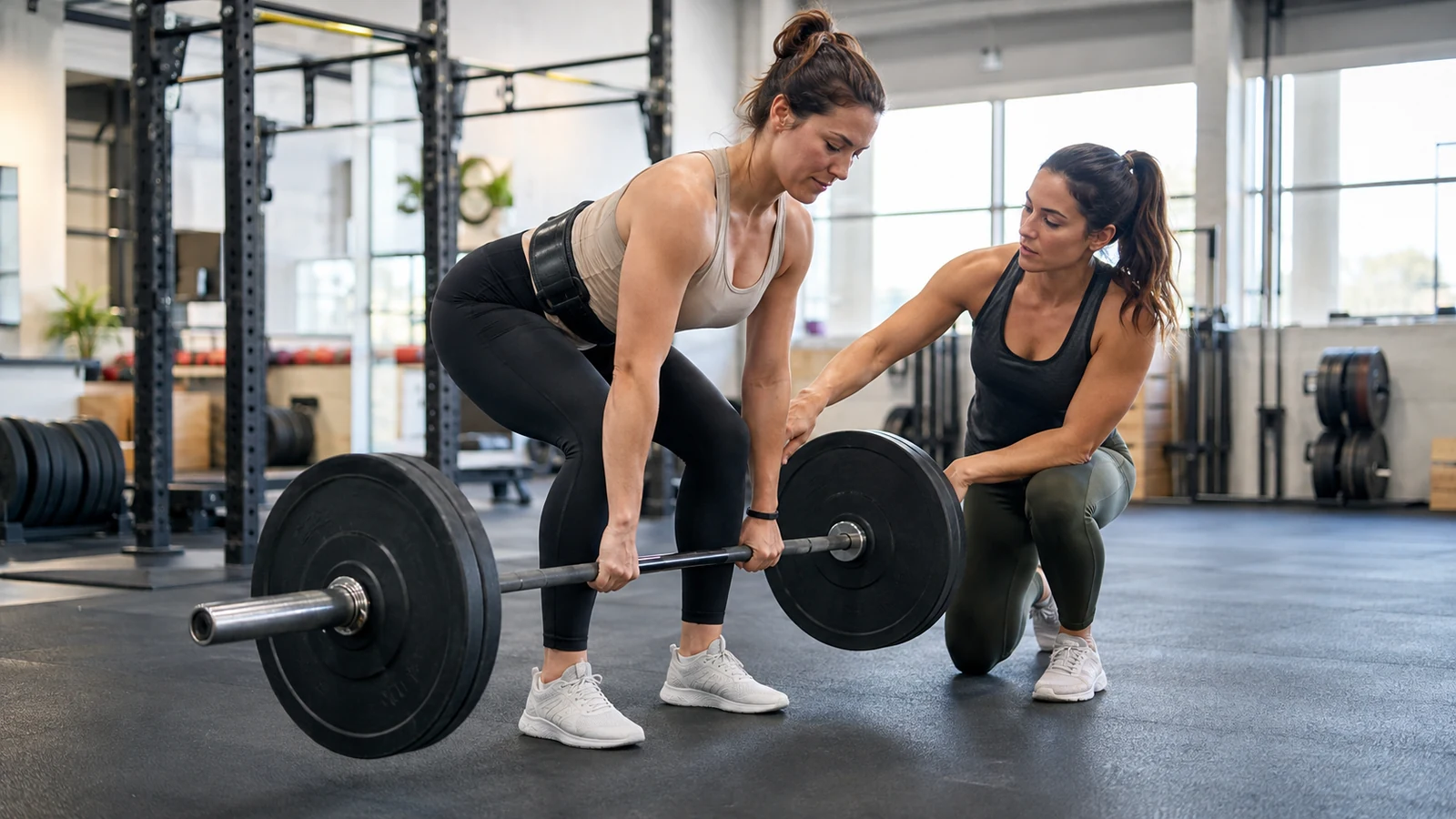
The most common mistake is rounding the lower back at the bottom of the pull to compensate for weak hips or a poor starting position.
That flexed-spine position increases injury risk and usually caps how much weight a lifter can safely move.
A second common mistake is starting the pull with the hips too high, which turns the lift into a stiff-legged deadlift and removes the legs from the movement almost entirely.
A third is skipping a structured warm-up and jumping straight to heavy singles, which increases both injury risk and the odds of a missed lift.
A world record deadlift looks simple on video. What it actually represents is years of unglamorous accessory work, careful loading, and a lot of missed lifts nobody posted online.
Finally, many lifters chase a bigger number before their technique is consistent, which builds strength on top of a flawed pattern instead of fixing the pattern first.
Who Should Be Careful With Maximal Deadlifts
Elite competition lifting like Buettner’s is the product of years of progressive, coached training, not a starting point for a beginner to copy directly.
Anyone with a history of lower back injury, disc issues, or uncontrolled high blood pressure should talk to a doctor or physical therapist before attempting a true one-rep max deadlift.
People who are new to lifting generally benefit from months of building technique at lighter loads before testing anything close to a maximum effort.
Pregnant lifters, and anyone recovering from recent surgery, should get individualized medical clearance before heavy pulling as well.
None of this takes anything away from what Buettner accomplished.
It simply reflects that a world record is, by definition, an outlier result built on a foundation most lifters spend years establishing first.
Watch the Original Video
Want more record breakdowns like this one? Subscribe to WorkoutHealthy Insider for practical explanations behind popular fitness claims.
References
Cleather, D. J. (2006). Adjusting powerlifting performances for differences in body mass. Journal of Strength and Conditioning Research, 20(2), 412–421. https://doi.org/10.1519/00124278-200605000-00030
Escamilla, R. F., Francisco, A. C., Fleisig, G. S., Barrentine, S. W., Welch, C. M., Kayes, A. V., Speer, K. P., & Andrews, J. R. (2000). A three-dimensional biomechanical analysis of sumo and conventional style deadlifts. Medicine & Science in Sports & Exercise, 32(7), 1265–1275. https://doi.org/10.1097/00005768-200007000-00013
Ralston, G. W., Kilgore, L., Wyatt, F. B., & Baker, J. S. (2017). The effect of weekly set volume on strength gain: A meta-analysis. Sports Medicine, 47(12), 2585–2601. https://doi.org/10.1007/s40279-017-0762-7
Vanderburgh, P. M., & Batterham, A. M. (1999). Validation of the Wilks powerlifting formula. Medicine & Science in Sports & Exercise, 31(12), 1869–1875. https://doi.org/10.1097/00005768-199912000-00027
This article is for general information only and is not medical advice. If you have an injury, ongoing pain, or a medical condition, talk to a doctor or physical therapist before you change how you train or eat.