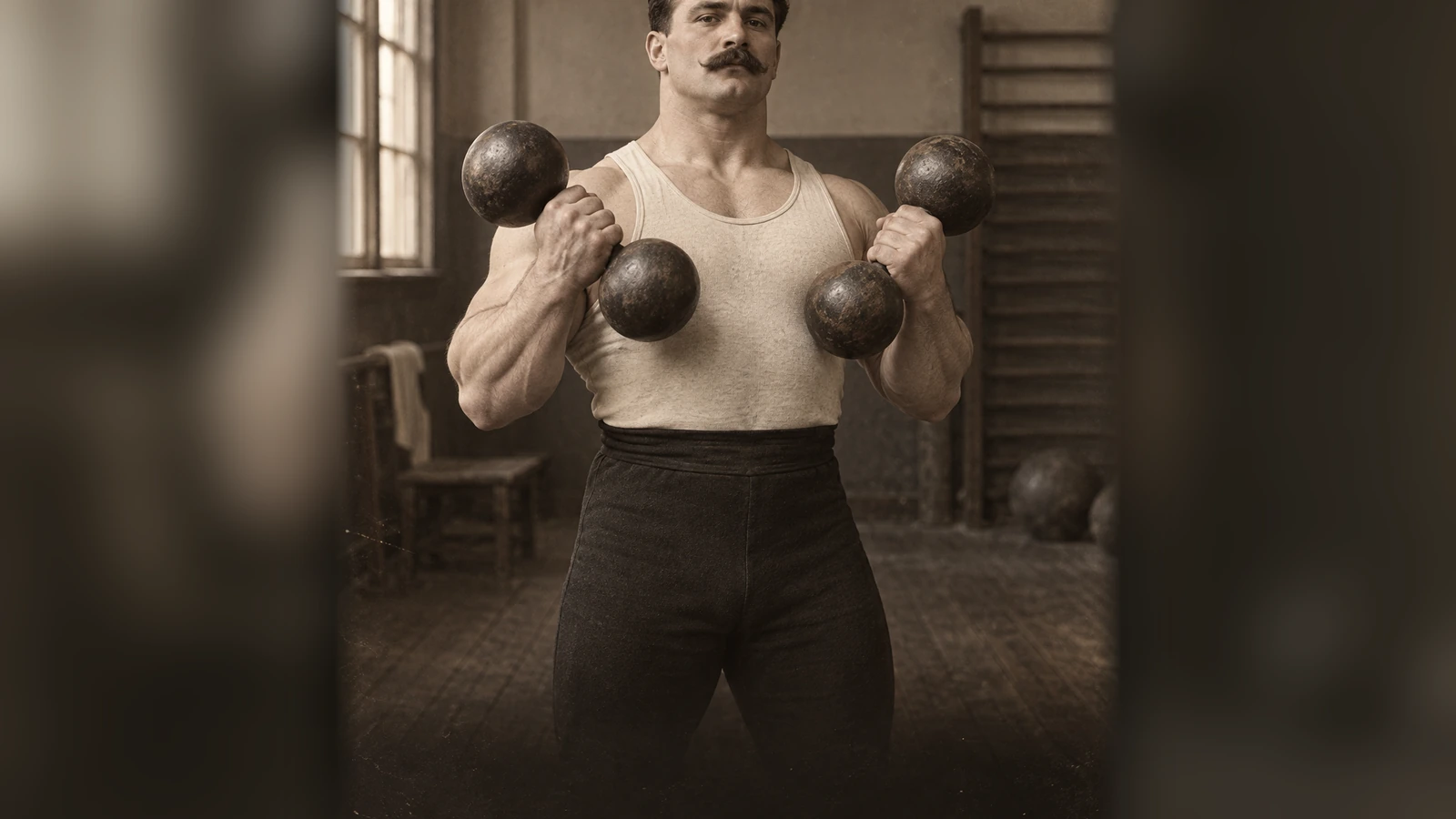

George Hackenschmidt was one of the most famous strongmen and wrestlers of the early 1900s.
He was nicknamed “The Russian Lion,” and the hack squat is named after him.
A popular post says he built his strength on a small set of heavy, basic lifts and kept his training simple.
His own book backs much of that up, with a few details worth getting right.
Who George Hackenschmidt Was
Hackenschmidt was born in 1877 in Dorpat, now Tartu, in present day Estonia.
He won the European Greco Roman heavyweight title in 1898.
In 1905 he became the first recognized world heavyweight wrestling champion.
He also placed third at the 1898 world weightlifting championships and set many lifting records.
He spent his later years in London, wrote books on fitness and philosophy, and died there in 1968 at age 90.
What His Book Actually Says
His best known training book is The Way to Live, commonly dated to 1908 and reprinted many times.
It lays out a small number of weight exercises for the whole body, done with bar bells and dumb bells.
One of them is the “Hacke,” a deep knee bend done while rising onto the toes.
He argued that all parts of the body should be developed equally, and that the legs should never be neglected.
He wrote that the sinews “can only be exercised and strengthened by correspondingly heavy muscle work.”
He also said about thirty minutes of training is fully enough to build and keep strength and endurance.
Health can never be divorced from Strength.
Where the Popular Version Goes Too Far
“Heavy” in his book does not mean maximal lifts every session.
He told readers to pick a weight they could lift about ten times with full effort, then start with five reps using it.
He also warned, “Never on any account continue the exercises until exhaustion sets in.”
So his idea of heavy basics was challenging but controlled, not all out.
And his plan was not limited to a tiny handful of lifts. It covered every major muscle group.
What Research Says About Basic Multi Joint Lifts
A 2017 study by Paoli and colleagues compared two training plans with equal total work over eight weeks.
One group used multi joint exercises, and the other used single joint exercises.
Both groups improved body composition by a similar amount.
The multi joint group made bigger gains in strength and in maximal oxygen uptake.
A 2015 study by Paulo Gentil and colleagues looked at the arm muscles of untrained young men.
One group did only lat pulldowns, and the other did only biceps curls, for ten weeks.
Both groups gained similar muscle thickness and strength in the elbow flexors.
The authors concluded that exercise choice can be based on practical factors like equipment, time, and preference.
What the Research Does Not Prove
These studies do not show that isolation work is useless.
The Gentil study found curls worked as well as pulldowns for the biceps in beginners.
They also did not test Hackenschmidt’s exact routine.
The fair takeaway is that a few well chosen compound lifts give a lot of results for the time spent.
Extra exercises can still help, especially for lagging areas.
How to Build a Simple Strength Routine
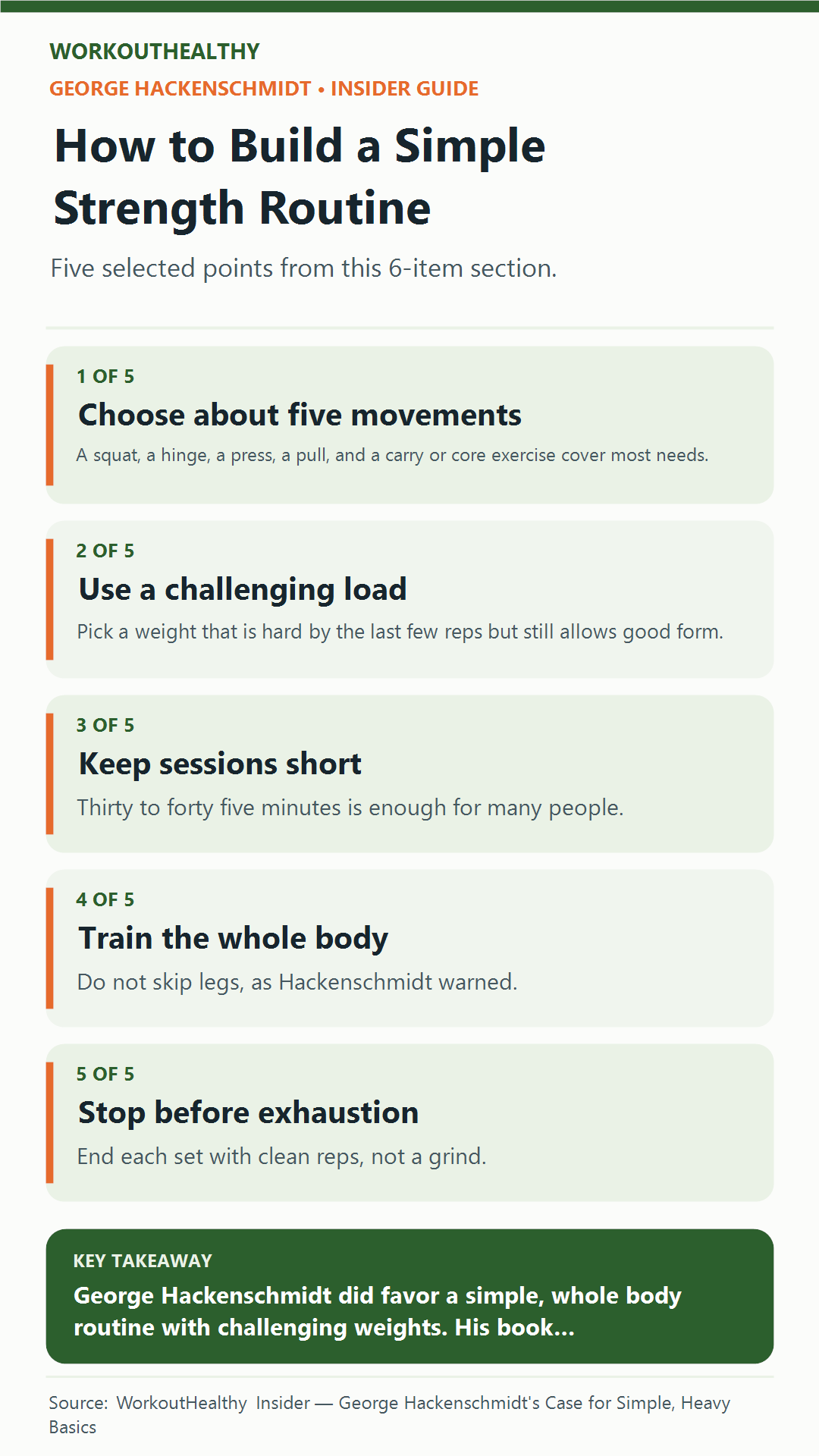
- Choose about five movements. A squat, a hinge, a press, a pull, and a carry or core exercise cover most needs.
- Use a challenging load. Pick a weight that is hard by the last few reps but still allows good form.
- Keep sessions short. Thirty to forty five minutes is enough for many people.
- Train the whole body. Do not skip legs, as Hackenschmidt warned.
- Stop before exhaustion. End each set with clean reps, not a grind.
- Repeat the same lifts for weeks. Practice is what makes simple routines work.
If a lift does not suit your body, our guides to squat alternatives and deadlift alternatives offer simple swaps.
For a plan built around a busy middle age schedule, see our strength plan for your 40s.
A Sample Simple Week
Here is one way to put these ideas into a plain three day week.
On Monday, do goblet or barbell squats, push ups or bench presses, and rows.
On Wednesday, do a hip hinge such as a Romanian deadlift, an overhead press, and pull ups or pulldowns.
On Friday, repeat Monday’s lifts, and add a loaded carry at the end.
Use two to four sets of each lift, in a rep range where the last reps feel hard but clean.
Warm up with a few lighter sets of your first exercise.
Keep the whole session to roughly half an hour to forty five minutes.
Stay with the same lifts for at least six to eight weeks before changing anything.
That sameness is the point. It lets you see whether you are actually getting stronger.
When the weights stop moving up, adjust sets or reps before you swap exercises.
This kind of plan would look familiar to a lifter from Hackenschmidt’s era, even with modern equipment.
Common Mistakes
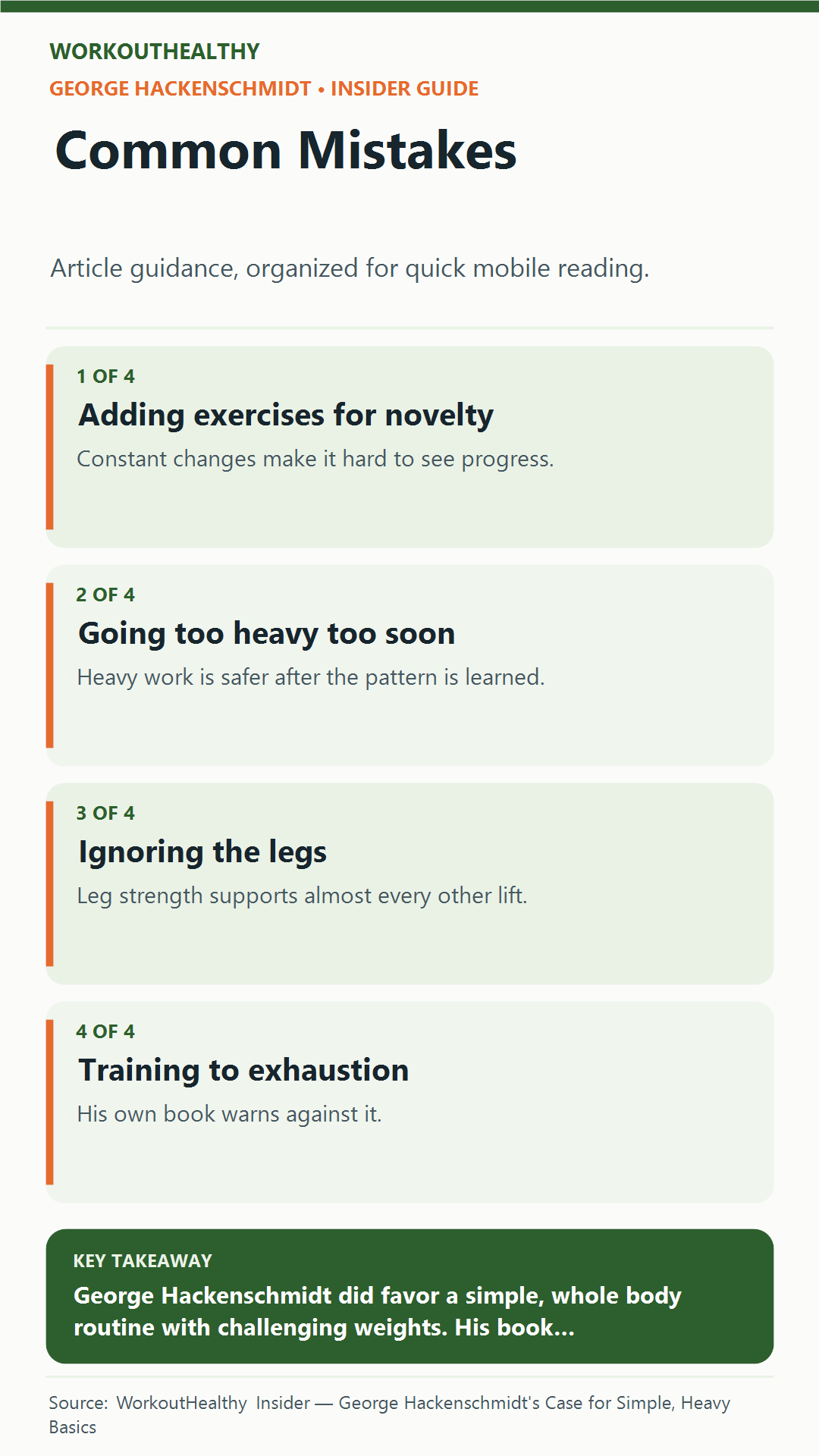
- Adding exercises for novelty. Constant changes make it hard to see progress.
- Going too heavy too soon. Heavy work is safer after the pattern is learned.
- Ignoring the legs. Leg strength supports almost every other lift.
- Training to exhaustion. His own book warns against it.
Who Should Be Careful
The Hacke, a deep knee bend done up on the toes, may not suit people with knee pain.
People with back, hip, or shoulder problems should get guidance before loading basic lifts.
Beginners should start light and build up over several weeks.
The Bottom Line
George Hackenschmidt did favor a simple, whole body routine with challenging weights.
His book also stressed moderation, short sessions, and stopping before exhaustion.
Research supports compound lifts as an efficient base, while showing smaller exercises still have value.
Keep your plan simple, train the whole body, and let steady practice do the work.
Want more stories like this? Subscribe to WorkoutHealthy Insider for practical explanations behind popular fitness claims.
References
- Gentil, P., Soares, S., & Bottaro, M. (2015). Single vs. multi-joint resistance exercises: Effects on muscle strength and hypertrophy. Asian Journal of Sports Medicine, 6, e24057. https://doi.org/10.5812/asjsm.24057
- Hackenschmidt, G. (c. 1908). The way to live in health and physical fitness. https://archive.org/details/the-way-to-live
- Paoli, A., Gentil, P., Moro, T., Marcolin, G., & Bianco, A. (2017). Resistance training with single vs. multi-joint exercises at equal total load volume: Effects on body composition, cardiorespiratory fitness, and muscle strength. Frontiers in Physiology, 8, 1105. https://doi.org/10.3389/fphys.2017.01105
This article is for general information only and is not medical advice. If you have an injury, ongoing pain, or a medical condition, talk to a doctor or physical therapist before you change how you train or eat.