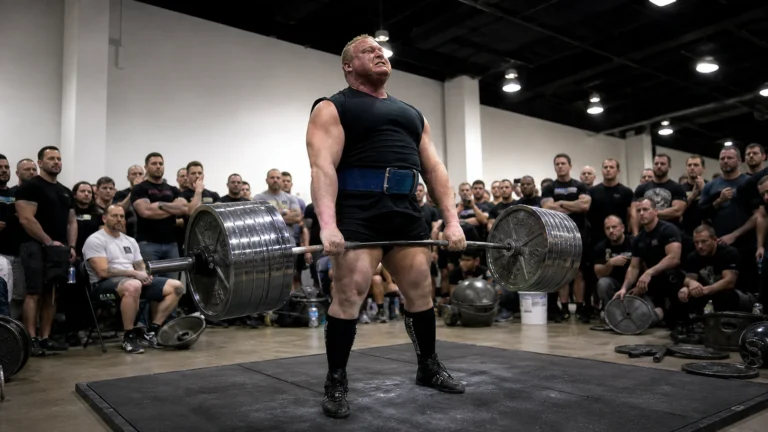

Eddie Hall pulled 500 kilograms off a competition platform on July 9, 2016.
No man had ever done that before.
Then he let go of the bar, took a step back, and went down.
Blood vessels in his face had burst under the strain, and he needed help getting off the platform.
That single lift made Eddie Hall the first person in history to deadlift half a metric ton in competition, and it very nearly broke him doing it.
A decade later, one workbook description of this event calls the record “superseded.” That framing is not quite right, and untangling why takes a closer look at what Guinness actually still lists today.
What Happened at the World Deadlift Championships
The event was held at Leeds’ First Direct Arena on July 9, 2016, staged alongside that year’s Europe’s Strongest Man contest.
Hall built to his record attempt in stages rather than jumping straight to it.
Footage of the session shows him working up through 420 kilograms, then 465, before loading the bar to 500.
Five hundred kilograms converts to 1,102.31 pounds, more commonly rounded to 1,102 pounds in coverage of the lift.
Hall pulled it to full lockout, held it at the top for a beat, and set it back down under control before the strain caught up with him.
He wore a lifting suit and wrist straps for the attempt.
That is standard equipment under strongman deadlift rules, not a shortcut unique to Hall.
The Moment After the Lift
What happened immediately afterward is part of why this lift is still remembered nearly a decade later.
Hall lost consciousness within seconds of setting the bar down.
Small blood vessels in his face and eyes had ruptured from the pressure he generated during the pull, a visible mark that stayed for days afterward.
He needed assistance to leave the platform and was checked over by event medical staff before he was cleared.
Hall has since spoken publicly about how close to the edge that single attempt pushed him physically.
He has also said he does not plan to chase a heavier deadlift again, calling the toll on his body too high a price for one more kilogram.
A lift heavy enough to burst blood vessels in a trained strongman’s face is not a lift the body performs without real cost.
Why the Body Reacts This Way: Blood Pressure at the Edge
A 500 kilogram deadlift is not simply a bigger version of an ordinary deadlift.
It is heavy enough to push blood pressure into territory researchers have specifically measured in trained lifters.
A classic study by MacDougall and colleagues placed a catheter directly into the arm arteries of experienced bodybuilders and recorded blood pressure while they performed heavy leg presses to failure (MacDougall et al., 1985).
During the hardest repetitions, systolic pressure climbed past 320 millimeters of mercury in some lifters.
Diastolic pressure climbed past 250.
Both numbers are far beyond what a resting cardiovascular system ever experiences, even during a hypertensive emergency.
The researchers traced this spike to straining against a closed airway while bracing the torso, a natural reflex the body uses to stabilize the spine under a maximal load.
That same reflex is exactly what a 500 kilogram deadlift demands from anyone attempting it.
The Valsalva Maneuver and Why Lifters Black Out
The bracing reflex behind that blood pressure spike has a name: the Valsalva maneuver.
It means holding a full breath and pushing against a closed throat to build pressure inside the chest and abdomen.
That pressure stiffens the trunk and helps protect the spine under extreme load.
It also comes with a real cost once the lift ends.
A follow-up study by MacDougall and colleagues tracked what happens in the few seconds right after a lifter releases that held breath (MacDougall et al., 1992).
Blood pressure does not simply return to normal.
It briefly drops, sometimes sharply, as pressure inside the chest suddenly falls and blood pools in the lower body.
That drop can reduce blood flow to the brain just long enough to cause dizziness, tunnel vision, or a full loss of consciousness.
This exact phenomenon has a documented medical history that predates Hall’s own competitive career by more than 40 years.
A 1973 case series in The Lancet described a cluster of competitive weightlifters who blacked out within seconds of completing a maximal lift, coining the phrase “weight-lifters’ blackout” for the pattern (Compton et al., 1973).
The authors traced it to the same mechanism MacDougall’s team later measured directly: a sharp post-lift drop in blood pressure and brain perfusion following intense straining.
Hall’s collapse in Leeds fits that same well-documented pattern, at a weight far beyond what any of those earlier case reports involved.
Not a Powerlifting Record: What “Strongman Deadlift” Rules Allow
It matters exactly what kind of deadlift this was, because “deadlift record” covers more than one rulebook.
A raw powerlifting deadlift, contested in federations like the IPF or USAPL, allows a belt and little else.
No straps. No suit built for extra tension. Just a bar, a floor, and a lifter’s own grip and back.
Strongman deadlift rules are far more permissive.
Competitors can wear a supportive lifting suit and double-loop wrist straps that shift most of the grip demand from the fingers to the forearm and wrist.
They can also use a technique called hitching, walking the bar up the thighs in short stages rather than pulling it in one continuous motion off the floor.
Hall’s 500 kilogram pull used all three of these allowances, which is exactly why it is tracked as its own distinct Guinness category rather than folded into the raw powerlifting record books.
Two Different Records: Untangling the “Superseded” Claim
This is the detail that gets flattened most often when this lift is retold, including in the source material behind this article.
Guinness does not track one single “heaviest deadlift” title. It tracks two, and they cover different rulebooks.
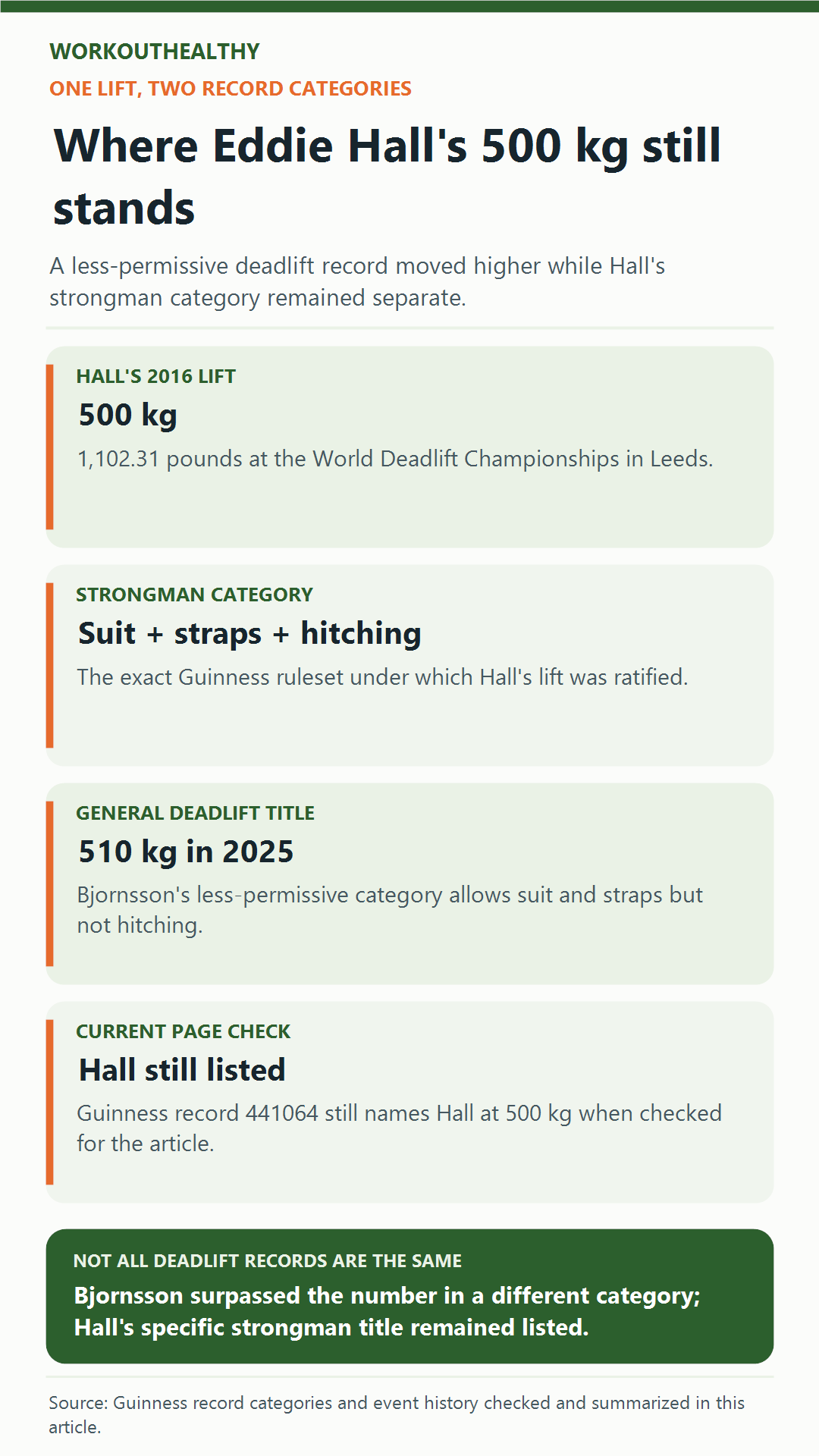
The general “heaviest deadlift” title allows a suit and straps but not hitching.
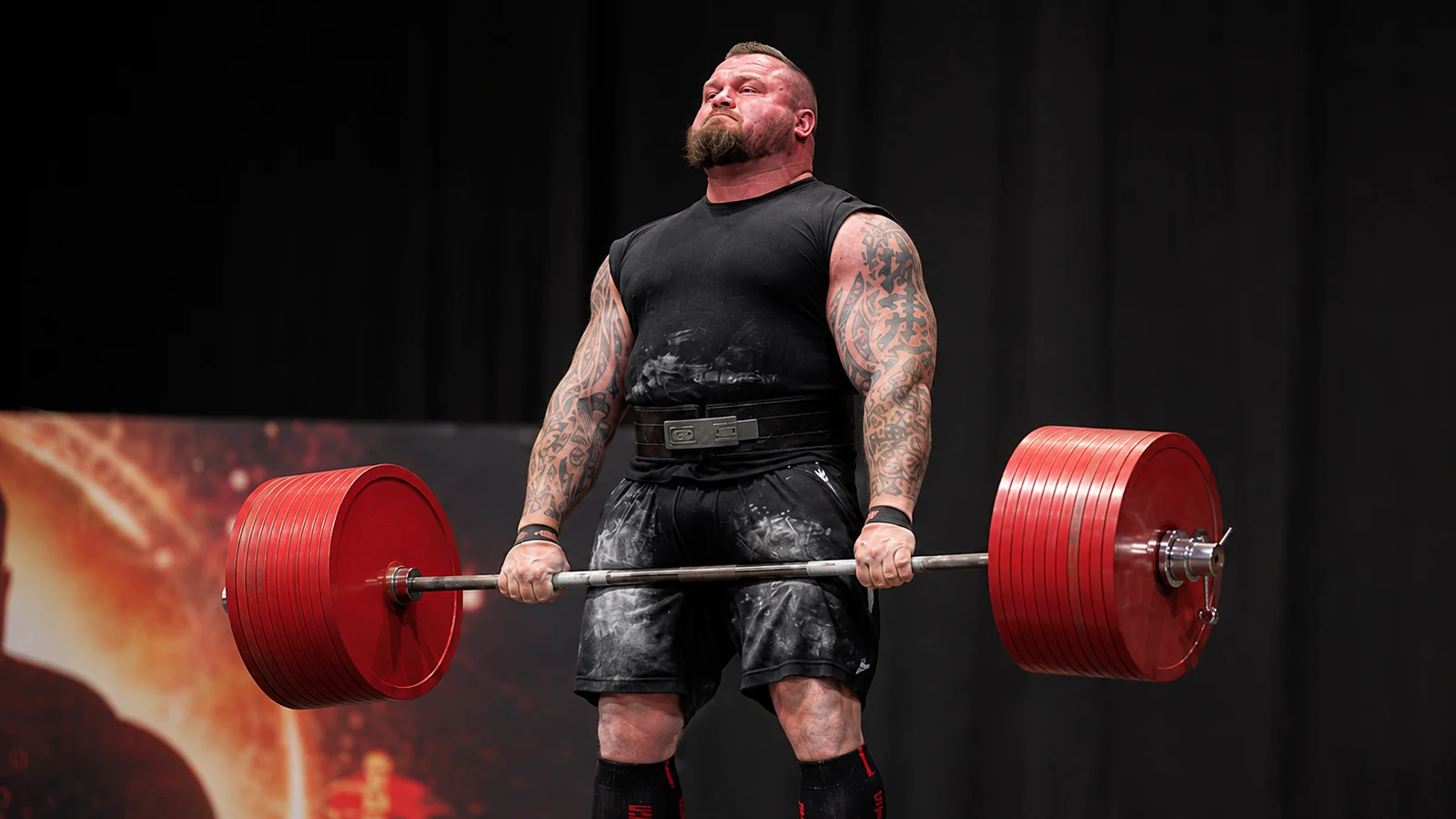
Hafthor Bjornsson claimed that specific title in May 2020 with a 501 kilogram pull, and later pushed his own mark to 510 kilograms in September 2025.
The separate “heaviest Strongman deadlift” title allows everything the general title allows, plus hitching. That is the exact category Hall’s 2016 lift was performed and ratified under.
Checked directly against Guinness’s own current page for that specific title, record ID 441064, Eddie Hall is still listed as the record holder today: 500 kilograms, 9 July 2016, First Direct Arena, Leeds.
No newer entry has replaced him in that category.
Guinness’s own site notes that records can change before an update is reflected online, so this reflects the page as it stands at the time of this verification, not a permanent guarantee against a future challenge.
But as of that check, the framing that Hall’s specific title was “superseded” does not hold up.
What actually happened is narrower and, honestly, more interesting: a different, less permissive record moved past his number, in a category his own lift was never entered into.
Hall’s own title, the one built specifically around the ruleset he lifted under, has not been broken by anyone in the decade since.
The Physical Toll of Strongman Competition
Hall’s collapse was dramatic, but it was not a freak event unique to one man on one night.
A retrospective study of competitive strongman athletes tracked injury patterns across a full season of training and competition (Winwood et al., 2014).
The researchers found an injury rate of roughly 2.1 injuries per 1,000 hours of strongman-specific training, concentrated heavily in the lower back, shoulders, and biceps.
Deadlift-style events were among the highest-risk movements in the entire sport, alongside atlas stone lifts and heavy carries.
That study measured musculoskeletal injury specifically, not the kind of acute cardiovascular event Hall experienced.
Together, the two pictures line up: strongman competition asks the body to tolerate forces near the outer edge of what a trained system can handle, in more than one system at once.
What This Means If You’re Training Toward a Heavy Pull
Almost nobody training in a regular gym needs to think about hitching straps or a competition deadlift suit, and that is a good thing.
Those tools exist to solve problems that only appear at weights most lifters will never load onto a bar.
Learning to brace with the Valsalva maneuver on a heavy set is still useful, and most lifters do a mild version of it without ever naming it.
The difference is intensity and duration.
A working set taken to a hard but manageable effort is not the same event as a single competition-record maximal pull.
Anyone with uncontrolled high blood pressure, a history of aneurysm, glaucoma, retinal issues, or a hernia should talk to a doctor before working toward a heavy single of any kind.
The same pressure spike that stabilizes a heavy pull can aggravate every one of those conditions.
Warning signs during a set, including sudden dizziness, tunnel vision, ringing in the ears, or chest tightness, are a signal to rack the weight immediately rather than push through.
Our coverage of what heat does to the heart in a sauna looks at a gentler example of the same cardiovascular strain principle: a stressor most people tolerate well, that still carries real risk for some.
A qualified coach can also check your bracing and setup before you approach anything close to a personal record.
Our guide on deciding whether you need a personal trainer covers how to find one worth trusting with that kind of coaching.
WorkoutHealthy has covered other verified strength feats built the same slow way, including DonnaJean Wilde’s push-up world record and Edith Connor’s Guinness bodybuilding record.
Both are very different feats from a strongman deadlift, but each one rests on the same pattern: years of progressive training behind a single headline number, not one lucky day.
Watch the Original Video
Want more verified world records explained clearly? Subscribe to WorkoutHealthy Insider for practical explanations behind popular fitness claims.
References
Compton, D., Hill, P. M., & Sinclair, J. D. (1973). Weight-lifters’ blackout. The Lancet, 302(7840), 1234-1237. https://doi.org/10.1016/S0140-6736(73)90974-4
MacDougall, J. D., Tuxen, D., Sale, D. G., Moroz, J. R., & Sutton, J. R. (1985). Arterial blood pressure response to heavy resistance exercise. Journal of Applied Physiology, 58(3), 785-790. https://doi.org/10.1152/jappl.1985.58.3.785
MacDougall, J. D., McKelvie, R. S., Moroz, D. E., Sale, D. G., McCartney, N., & Buick, F. (1992). Factors affecting blood pressure during heavy weight lifting and static contractions. Journal of Applied Physiology, 73(4), 1590-1597. https://doi.org/10.1152/jappl.1992.73.4.1590
Winwood, P. W., Hume, P. A., Cronin, J. B., & Keogh, J. W. L. (2014). Retrospective injury epidemiology of strongman athletes. Journal of Strength and Conditioning Research, 28(1), 28-42. https://doi.org/10.1519/JSC.0b013e3182986c0c
This article is for general information only and is not medical advice. If you have an injury, ongoing pain, or a medical condition, talk to a doctor or physical therapist before you change how you train or eat.