
Today, most people expect a gym teacher or personal trainer to have formal training.
In 1861, Dio Lewis was already building a school around that idea.
A popular post says Lewis believed physical education needed trained specialists, so he founded a school to train them.
The main facts check out. The numbers vary a little depending on the source.
The Problem Lewis Saw
Dio Lewis had developed a light, music driven system of gymnastics meant for men, women, and children.
A system like that only spreads if someone can teach it well.
His answer suggests he saw teaching exercise as a skill that needed real preparation.
So instead of only writing books, he set out to train teachers.
The Normal Institute for Physical Education
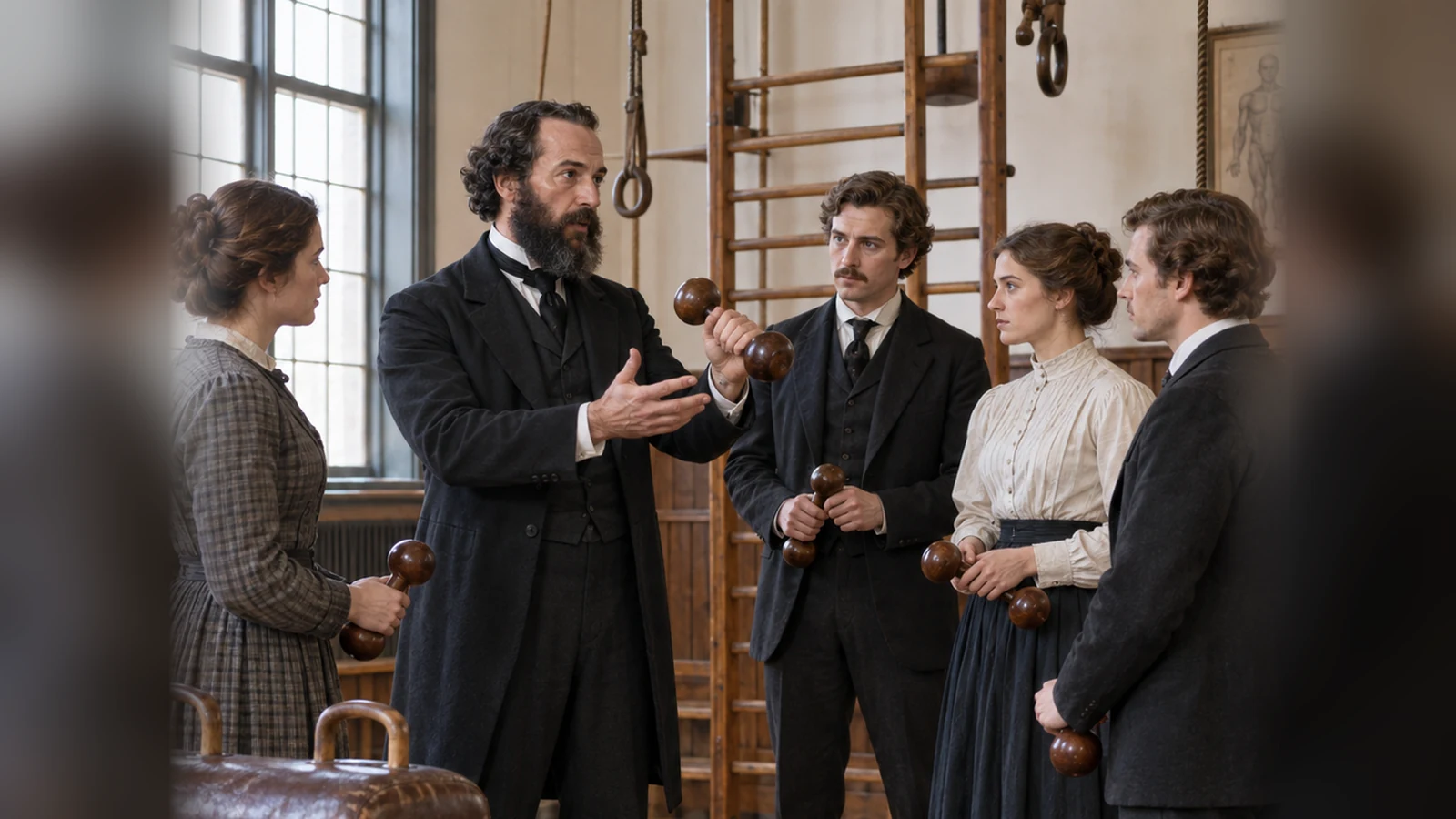
According to Wikipedia, Lewis founded the Normal Institute for Physical Education in Boston in the spring of 1861.
In the 1800s, a “normal” school was a school that trained teachers.
Lewis described it in the 1863 edition of his book The New Gymnastics.
He wrote that “a college has been incorporated,” and that its graduates of “either sex” received “a legal diploma” after “a full training.”
That detail matters. Women could train and graduate, not just men.
What Students Studied
The school did not teach only exercises.
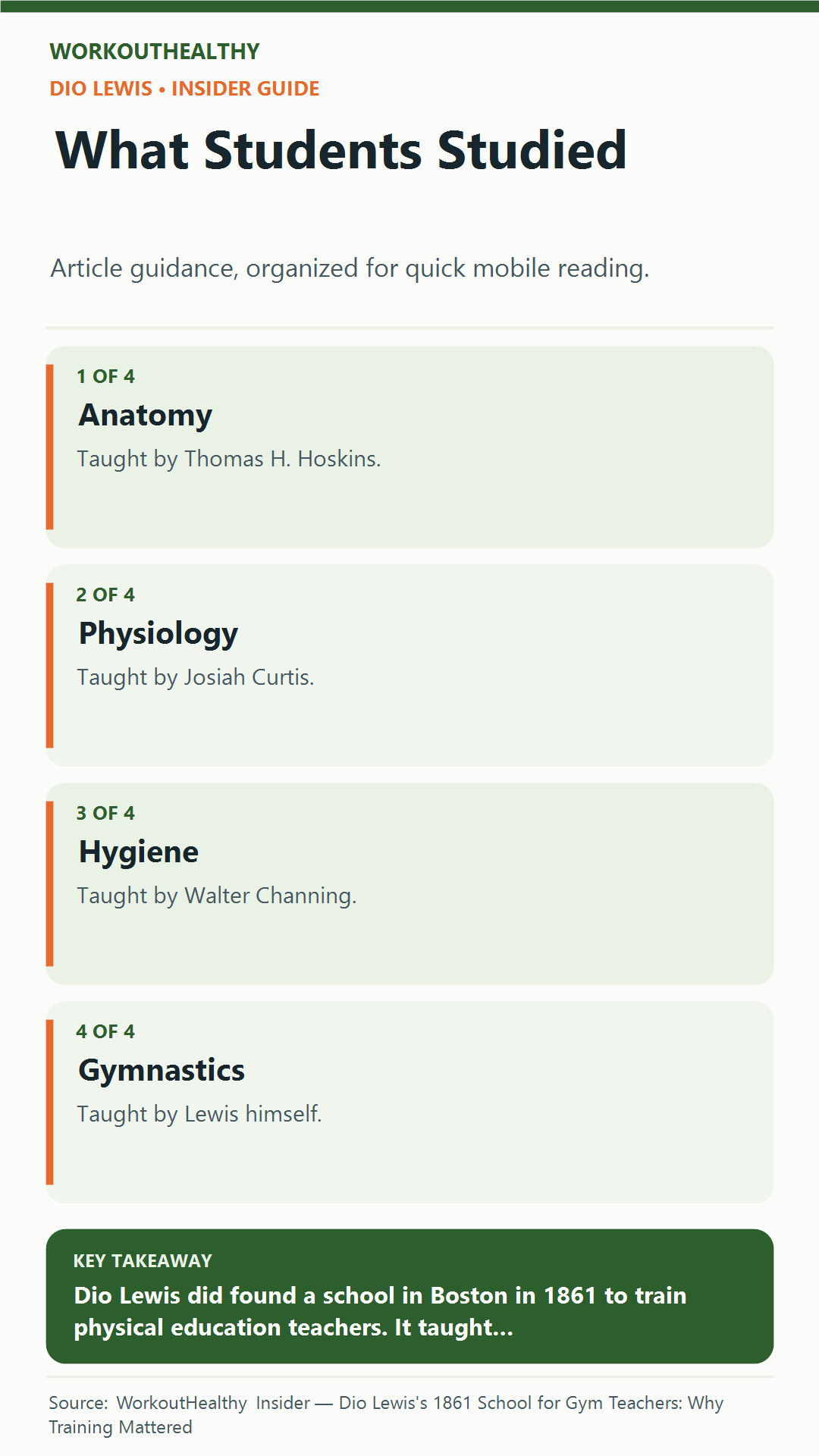
Wikipedia lists a faculty that covered several sciences.
- Anatomy. Taught by Thomas H. Hoskins.
- Physiology. Taught by Josiah Curtis.
- Hygiene. Taught by Walter Channing.
- Gymnastics. Taught by Lewis himself.
That mix of body science and practical teaching is close to what exercise professionals still study.
Good exercise advice is only as useful as the person who can teach it safely to the people in front of them.
How Many Teachers It Trained
Here the sources disagree.
Wikipedia’s biography of Lewis says that “in seven years, five hundred pupils were graduated.”
Wikipedia’s article on his girls’ school says 270 students graduated from the institute.
We could not settle which number is right, so a range of a few hundred graduates is the safest summary.
Lewis also ran a girls’ school in Lexington, Massachusetts, from 1864 to 1867, until the building burned.
The claim that this was one of the first formal programs for exercise teachers in the United States fits the timeline, but we did not find a source that ranks it exactly.
What Research Says About Trained Instructors
Modern studies support Lewis’s core belief.
Two lines of research are especially useful here. One looks at children in school, and the other looks at older adults.
The SPARK study, published in 1997 by James Sallis and colleagues, followed 955 students in seven elementary schools.
Classes were taught by physical education specialists, by trained classroom teachers, or as usual in control schools.
Students were active for 40 minutes a week in specialist led classes.
That compared with 33 minutes in teacher led classes and 18 minutes in control classes.
After two years, girls in the specialist group had better abdominal and aerobic fitness.
However, the program did not raise activity outside of school.
So better teaching improved what happened in class, but it did not change the whole day.
Supervision matters for adults too.
This is especially true when balance and fall risk are part of the picture.
A 2017 meta-analysis by André Lacroix and colleagues looked at 11 trials in adults 65 and older.
Supervised balance and resistance training beat unsupervised training for several balance and strength measures.
The authors suggested making about two of every three weekly sessions supervised.
What Good Instruction Looks Like
Lewis’s faculty list hints at what a good teacher needs to know.
Anatomy explains how the body is built. Physiology explains how it responds to effort.
Hygiene covers the everyday habits that keep people healthy.
Practical gymnastics then turned that knowledge into a lesson people could follow.
A good modern coach does something similar.
They watch how you move before they add load.
They explain why an exercise is in your plan, not just how to do it.
They adjust the session when you are tired, sore, or short on time.
And they give clear, simple cues instead of long lectures.
If a coach skips those basics, the credential on the wall matters less.
What This Does Not Prove
These studies do not test Lewis’s own methods or his school.
They also do not prove that every certificate guarantees a good coach.
Credentials vary widely, and experience and communication skills matter too.
What the research does show is that trained, supervised instruction tends to get better results.
How to Use This Today
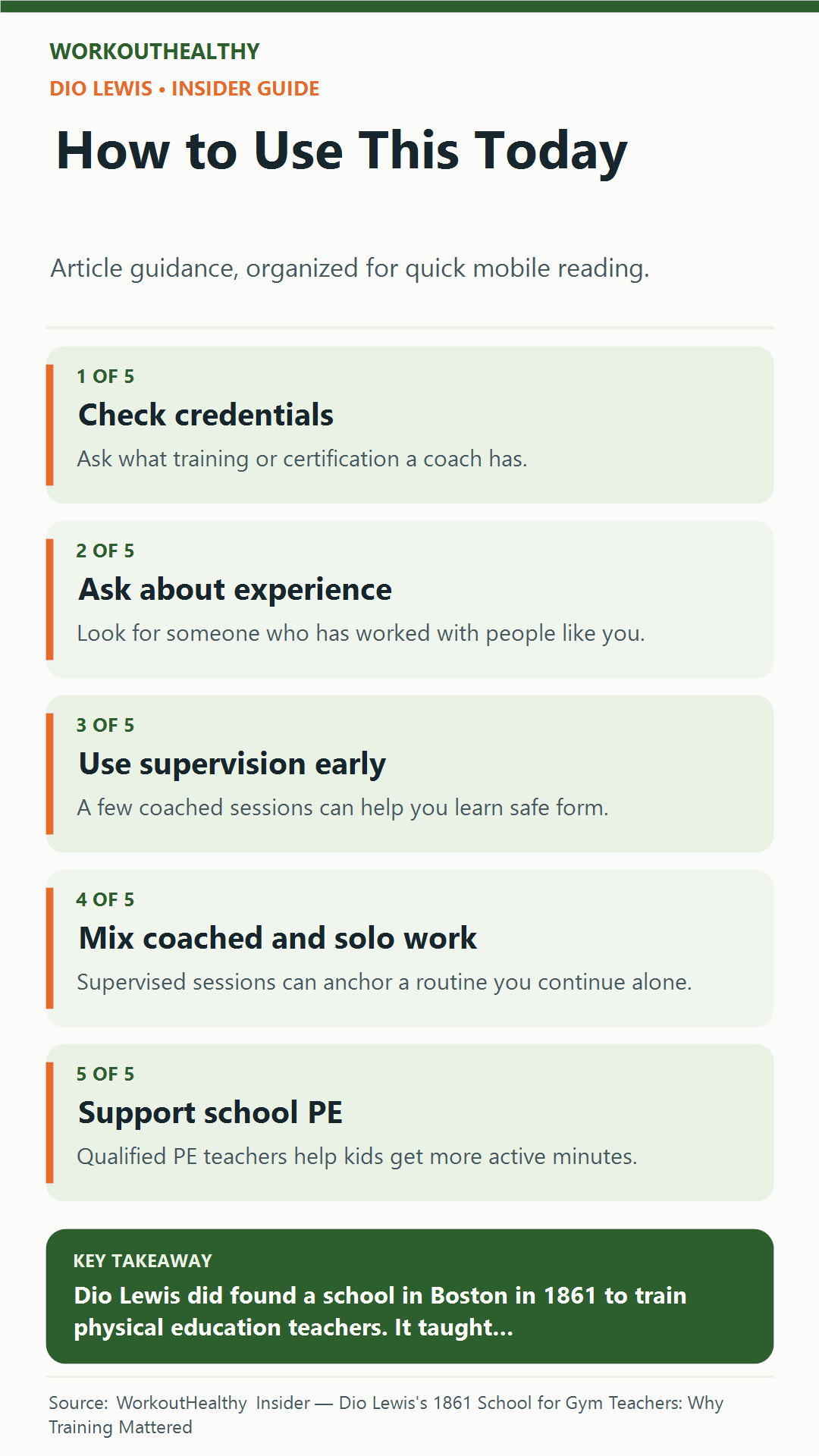
- Check credentials. Ask what training or certification a coach has.
- Ask about experience. Look for someone who has worked with people like you.
- Use supervision early. A few coached sessions can help you learn safe form.
- Mix coached and solo work. Supervised sessions can anchor a routine you continue alone.
- Support school PE. Qualified PE teachers help kids get more active minutes.
Group classes are one way to get coaching. See our take on whether a boot camp class is worth it.
For an example of guided exercise in a clinical trial, read about home Pilates in a multiple sclerosis trial.
Who Should Be Careful
People with a medical condition may need more than a fitness coach.
After surgery, an injury, or a heart event, a physical therapist or clinical exercise program is often the right first step.
Be cautious with anyone who promises fast results or gives medical advice outside their training.
Parents can also ask how their child’s school handles PE.
Useful questions include who teaches the class, how much of it is spent moving, and how skills are taught.
The Bottom Line
Dio Lewis did found a school in Boston in 1861 to train physical education teachers.
It taught anatomy, physiology, and hygiene alongside gymnastics, and it graduated women as well as men.
Modern research backs his belief that trained instructors lead to better results.
If you can, get some qualified coaching, especially when you are starting out.
Want more stories like this? Subscribe to WorkoutHealthy Insider for practical explanations behind popular fitness claims.
References
- Lacroix, A., Hortobágyi, T., Beurskens, R., & Granacher, U. (2017). Effects of supervised vs. unsupervised training programs on balance and muscle strength in older adults: A systematic review and meta-analysis. Sports Medicine, 47(11), 2341 to 2361. https://doi.org/10.1007/s40279-017-0747-6
- Lewis, D. (1863). The new gymnastics for men, women, and children (4th ed.). Ticknor and Fields. https://archive.org/details/newgymnasticsfor00lewi
- Sallis, J. F., McKenzie, T. L., Alcaraz, J. E., Kolody, B., Faucette, N., & Hovell, M. F. (1997). The effects of a 2-year physical education program (SPARK) on physical activity and fitness in elementary school students. American Journal of Public Health, 87(8), 1328 to 1334. https://doi.org/10.2105/ajph.87.8.1328
- Wikipedia contributors. (n.d.). Dio Lewis. In Wikipedia. Retrieved September 16, 2026, from https://en.wikipedia.org/wiki/Dio_Lewis
- Wikipedia contributors. (n.d.). Dr. Dio Lewis’s School for Young Ladies. In Wikipedia. Retrieved September 16, 2026, from https://en.wikipedia.org/wiki/Dr._Dio_Lewis%27s_School_for_Young_Ladies
This article is for general information only and is not medical advice. If you have an injury, ongoing pain, or a medical condition, talk to a doctor or physical therapist before you change how you train or eat.