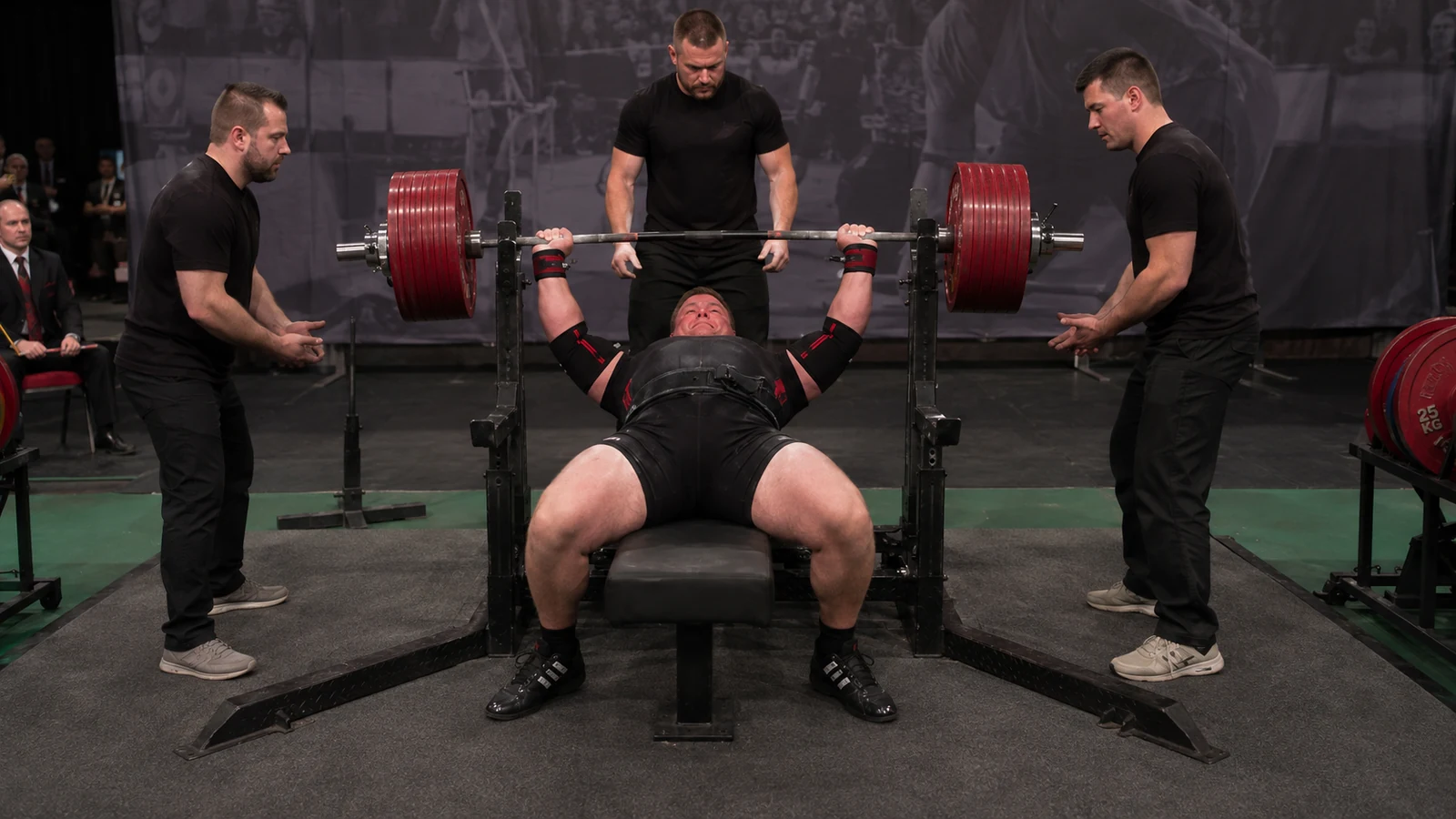

On March 5, 2016, at the Arnold Sports Festival in Columbus, Ohio, a super heavyweight powerlifter named Blaine Sumner lay back on a bench, gripped a loaded barbell, and pressed 401.5 kilograms off his chest.
That is 885.16 pounds.
He was wearing a bench shirt, a piece of stiff, supportive fabric built for exactly this kind of attempt, and the lift stood as the heaviest bench press ever recorded in his weight class under International Powerlifting Federation rules.
Guinness World Records still lists it today as the heaviest bench press by a man.
This article checks that claim against the actual record books, explains what a bench shirt does to the barbell and the body wearing it, and walks through what happened to this number in the years since, including Sumner’s own later attempts and a very different kind of bench press record that has since climbed far past his.
The Lift That Set the Record
Sumner competed that day in the IPF’s Open division at 120-plus kilograms, the sport’s heaviest weight class.
His 401.5-kilogram bench press was ratified as an IPF world record and a USA Powerlifting American record in the same slot.
It broke his own prior mark and extended a run of squat, bench, and total records he had been setting at this same weight class since 2012.
Guinness World Records separately recognizes the lift as the heaviest bench press by a man, citing the same date, meet, and weight.
The IPF is the sport’s oldest international federation and is widely described, including by Sumner’s own sponsors at the time, as one of the strictest, most consistently drug-tested organizations in powerlifting.
That detail matters later in this article, because not every organization that sanctions a bench press record tests for the same things or allows the same equipment.
The Arnold Sports Festival itself has produced plenty of famous training lore over the decades, including one of bodybuilding’s most repeated quotes about pushing through a set’s final reps, a very different kind of intensity than the single all-out attempt a max-effort bench record requires.
A world record bench press is never just a number. It is a number attached to a federation, a piece of equipment, and a set of rules, and all three change what the number actually means.
What “Equipped” Actually Means in Powerlifting
Competitive powerlifting splits into two broad equipment categories, and the difference is not cosmetic.
Raw lifting, sometimes called classic, allows a belt, wrist wraps, and knee sleeves, but nothing that assists the bar’s path.
Equipped lifting allows supportive garments, a squat suit, knee wraps, and a bench shirt, that are built from stiff, low-stretch fabric sewn to resist the exact motion of the lift.
The IPF, Sumner’s federation, only sanctions one type of supportive shirt in its equipped division: single-ply, meaning the shirt is made from one layer of that stiff fabric.
Other federations, including several that are not IPF-affiliated, allow multi-ply shirts, stacking two or more layers for even more resistance and rebound.
A handful go further still, permitting looser-fitting shirts sometimes labeled unlimited, which behave closer to a spring than a garment.
This is the detail that gets lost when equipped bench press numbers get compared casually online.
Single-ply and multi-ply are not two versions of the same record.
They are different equipment classes with separate record books, and a heavier number in one does not erase a record set in the other.
How a Bench Shirt Changes the Lift
A bench shirt does not press the weight for the lifter.
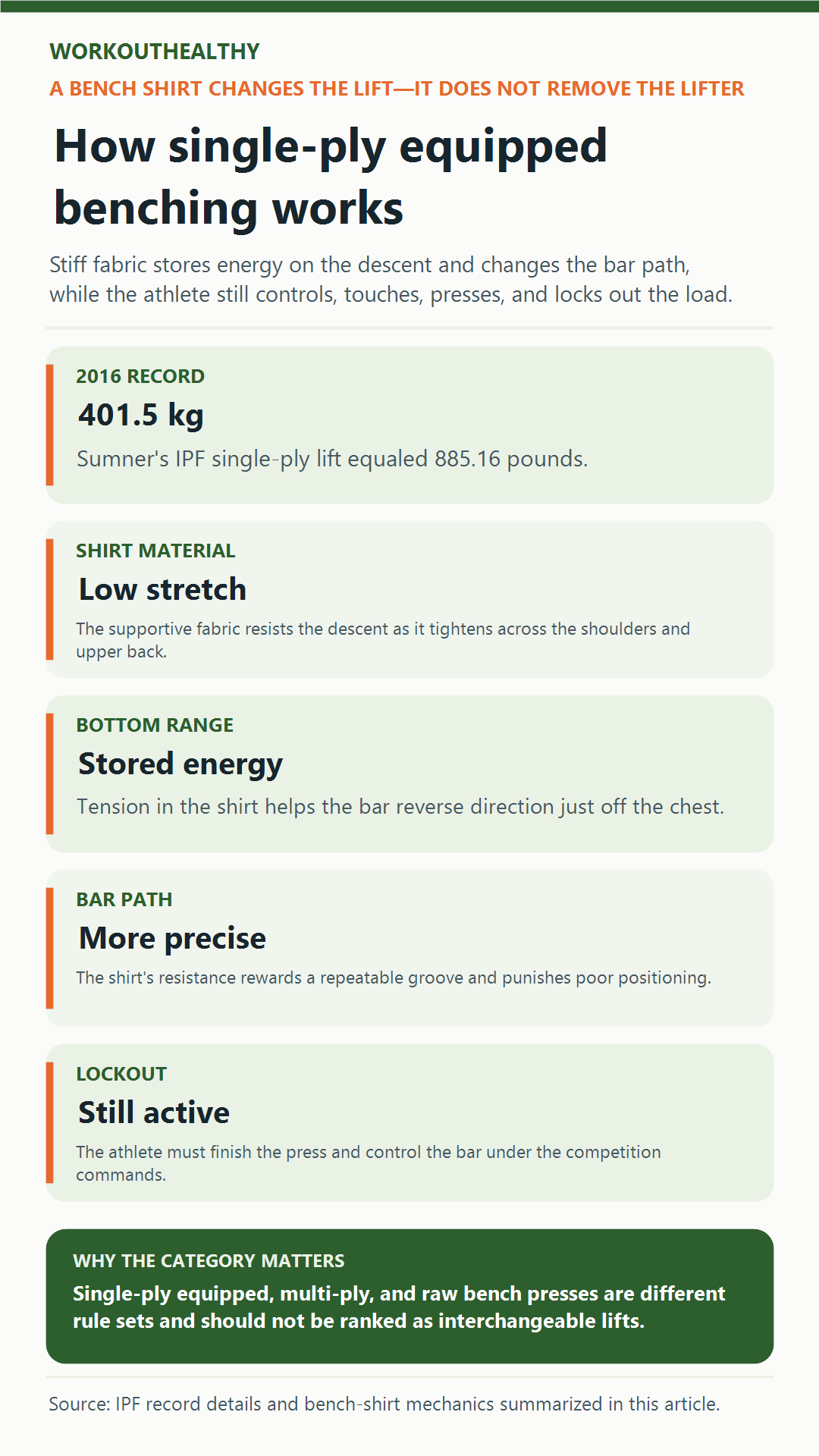
What it does is store and return mechanical energy.
As the bar descends toward the chest, the shirt’s fabric stretches across the shoulders and upper back, resisting the descent and storing elastic energy the way a drawn bow stores it in its limbs.
At the bottom of the lift, that stored energy helps drive the bar back up through the hardest part of the press, the range just off the chest where a raw lifter has the least mechanical advantage.
Researchers who study bench press mechanics have shown that even smaller, cheaper training tools built on the same idea change the lift measurably.
A study of competitive powerlifters using the Slingshot, an elastic training aid worn around the upper arms that mimics part of what a bench shirt does, found it significantly increased the load lifters could press while also changing the bar’s velocity profile through the lift (Dugdale et al., 2019).
A separate study of the same device found it let lifters complete more total volume at loads they could not otherwise handle unassisted, evidence that the assistance is real and measurable, not just a feeling (Niblock & Steele, 2017).
A full bench shirt is a far stiffer, far more restrictive piece of equipment than a Slingshot, which is part of why the weights involved are so much higher.
It also changes technique.
Equipped lifters typically use a wider grip, a more pronounced back arch, and a shorter, more controlled bar path than raw lifters, partly to work with the shirt’s resistance instead of fighting it.
Detailed biomechanical analysis of the raw bench press has found that technique, not just raw strength, meaningfully changes the forces and joint moments involved in a heavy attempt, and that those demands shift further with training background (Mausehund & Krosshaug, 2023).
Layer a bench shirt on top of that, and the technical skill required to use the equipment well becomes its own specialty within the sport.
Sumner Kept Raising His Own Bar
The 885-pound lift from 2016 was not Sumner’s final word on the record.
He extended it to 415 kilograms, 915 pounds, at the IPF World Open Equipped Championships in November 2018.
In March 2019, at a USA Powerlifting meet, he pressed a sanctioned 425 kilograms, 937 pounds, and also completed a 455-kilogram, 1,003-pound single-lift attempt widely reported as the first confirmed single-ply bench press over 1,000 pounds by any lifter in any federation.
That 1,003-pound lift is remarkable, but it is worth being precise about what it was. It was reported as a bonus attempt at a national meet, not the IPF world record figure itself.
Sumner’s own IPF world record continued climbing separately, reaching 425.5 kilograms, 938 pounds, in November 2019, then 426 kilograms, 939 pounds, in March 2020.
That final mark is the most recent IPF single-ply, 120-plus-kilogram world record this research could independently confirm.
No later IPF-ratified lift in that exact class turned up in the sources checked for this article.
IPF’s own record listings update on their own schedule, so that page is worth checking directly for the current status.
A Different Kind of Equipped: Multi-Ply and the Far Heavier Numbers
If a reader has seen headlines about a bench press well north of 1,300 pounds, that number is real, and it is not the same record.
Jimmy Kolb, an American powerlifter, has built a career in multi-ply and unlimited-gear federations that permit far more supportive shirts than the IPF allows.
Competing in those categories, Kolb pressed 598.7 kilograms, 1,320 pounds, in February 2022, then 612.5 kilograms, 1,350 pounds, in February 2023, then 635.5 kilograms, 1,401 pounds, in July 2023.
By June 2025, he had pushed the mark to 659 kilograms, 1,453 pounds, at a meet sanctioned outside the IPF.
Those are almost certainly the heaviest bench presses ever recorded under any equipment rules, in any federation.
They are not, however, IPF records, and they were not lifted in the same equipment class as Sumner’s shirt.
The federations Kolb competes in are also generally not part of the IPF’s testing structure, so the two sets of numbers describe different sports wearing the same name.
Worth noting directly: Kolb’s own single-ply best, a 508-kilogram, 1,120-pound lift from 2021, is itself heavier than Sumner’s final IPF single-ply mark.
That comparison sits closer to apples-to-apples on equipment.
It still crosses federation lines, though, since Sumner’s record was set specifically within IPF competition.
None of this makes Sumner’s 2016 lift, or his later ones, any less real.
It means two separate, honestly reported record books exist side by side, and collapsing them into one number misrepresents both.
Why Guinness Still Lists an Eight-Year-Old Lift
Guinness World Records’ own page for the men’s heaviest bench press, checked for this article, still names Sumner’s 401.5-kilogram lift from 2016 as the record.
That is worth sitting with given everything above. Guinness did not list Kolb’s far heavier multi-ply numbers on that same page.
Guinness titles are certified through their own formal application and verification process, which a lifter or their team has to actively pursue.
A federation setting a heavier internal record does not automatically update a Guinness title.
It is possible no multi-ply lifter has formally submitted a claim for that specific Guinness title, or that Guinness’s criteria for the category differ from how powerlifting federations classify equipment internally.
Either way, the honest summary is this: Sumner holds a specific, well-documented Guinness title tied to a specific date and lift, and separately, far heavier bench presses have since occurred under different equipment rules that Guinness’s own page does not currently reflect.
What the Research Says About Building Real Pressing Strength
Almost nobody reading this article is deciding between single-ply and multi-ply gear.
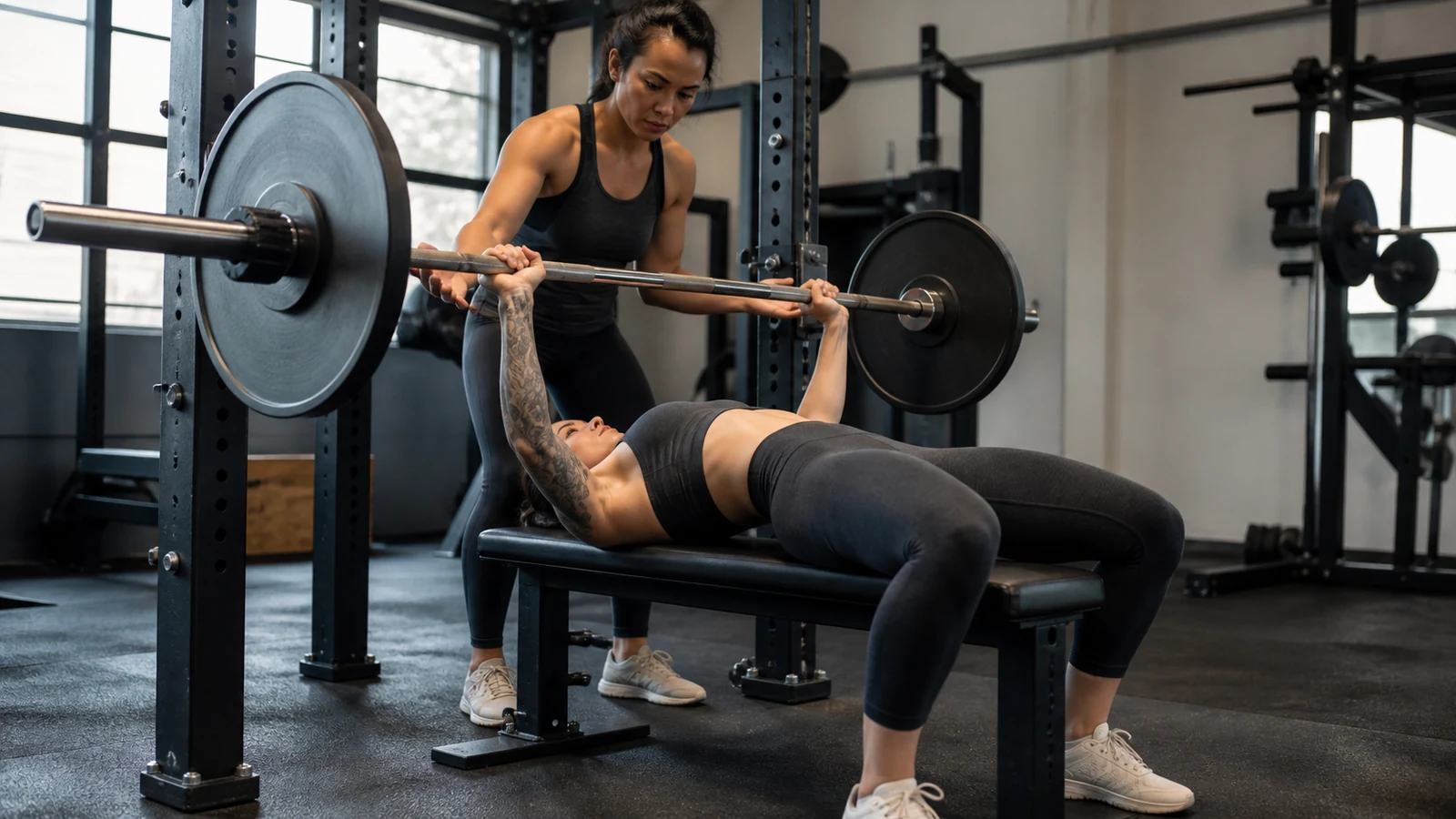
The more useful question is what actually drives a bigger raw bench press, since that is the number nearly every lifter in a normal gym cares about.
A study of elite, drug-tested raw powerlifters looked specifically at what separated stronger competitive lifters from weaker ones at a given bodyweight, and found that measures of upper-body muscle thickness and technical consistency across attempts were both meaningfully associated with bench press performance (Reya et al., 2021).
In plain terms, that supports two things a lifter can actually control: building the muscle that does the pressing, and grooving a bar path that repeats reliably under heavy load.
Consistent, progressive loading over months and years does more for a raw bench number than any single training trick, a point covered in more depth in our look at what actually holds up in Mike Mentzer’s high-intensity training approach.
Range of motion also matters more than most lifters assume.
Changing how far the bar travels changes the load a lifter can handle, and it changes where in the lift they are working hardest.
That is worth understanding before assuming one pressing variation is simply harder or better than another, as our comparison of the floor press against the standard bench press lays out in more detail.
Common Mistakes Lifters Make Chasing a Bigger Bench
The most common mistake is loading the bar before the technique underneath it is solid.
A bar path that wanders forward toward the face, rather than tracking back toward the shoulders on the way up, wastes strength on every single rep.
Flared elbows at 90 degrees to the torso put more strain on the shoulder joint than a moderately tucked position, and the difference gets more costly as the weight climbs.
Skipping stable foot placement and leg drive is another common gap.
The legs and upper back create a stable base the arms press from, and a bench press without that base leaks force before the bar even moves.
Chasing a heavier number every single session, rather than accepting planned lighter weeks, is a fast way to stall progress or get hurt, since the body needs recovery time to actually adapt to hard training.
The lifters who set records like this one did not get there by adding weight every week and hoping. They spent years building the base the record sat on top of.
Who Should Be Cautious With Max-Effort Pressing
Anyone with a history of shoulder instability, a labral tear, or a prior pectoral strain should treat true one-rep max attempts as a decision to make with a physical therapist or sports medicine physician, not alone.
Lifters newer to the bench press, roughly under a year of consistent training, generally have more to gain from mastering technique at moderate loads than from testing a true max, since technical breakdown under unfamiliar heavy weight is a common source of injury.
A spotter is not optional at loads close to a lifter’s limit.
A missed rep with no spotter present can trap the bar across the chest or neck with no safe way out.
Working with a qualified coach or personal trainer can catch technical issues, like an uneven bar path or poor shoulder positioning, that are difficult for a lifter to see in themselves.
Anyone returning from a recent illness, a long training layoff, or a joint injury should rebuild loading gradually rather than testing old numbers immediately.
Watch the Original Video
Footage of Sumner’s 401.5-kilogram, 885-pound world record bench press at the 2016 Arnold Sports Festival shows the full lift, the shirt, and the moment the bar locks out.
Curious what other verified world records actually reveal about training and the body. Subscribe to WorkoutHealthy Insider for practical explanations behind popular fitness claims.
References
Dugdale, J. H., Hunter, A. M., Di Virgilio, T. G., Macgregor, L. J., & Hamilton, D. L. (2019). Influence of the “Slingshot” bench press training aid on bench press kinematics and neuromuscular activity in competitive powerlifters. Journal of Strength and Conditioning Research, 33(2), 327-336. https://doi.org/10.1519/JSC.0000000000001853
Mausehund, L., & Krosshaug, T. (2023). Understanding bench press biomechanics: Training expertise and sex affect lifting technique and net joint moments. Journal of Strength and Conditioning Research, 37(1), 9-17. https://doi.org/10.1519/JSC.0000000000004191
Niblock, J., & Steele, J. (2017). The “Slingshot” can enhance volume-loads during performance of bench press using unaided maximal loads. Journal of Trainology, 6(2), 47-51. https://doi.org/10.17338/trainology.6.2_47
Reya, M., Škarabot, J., Cvetičanin, B., & Šarabon, N. (2021). Factors underlying bench press performance in elite competitive powerlifters. Journal of Strength and Conditioning Research, 35(8), 2179-2186. https://doi.org/10.1519/JSC.0000000000003097
This article is for general information only and is not medical advice. If you have an injury, ongoing pain, or a medical condition, talk to a doctor or physical therapist before you change how you train or eat.