
Anthony Ippolito did not have to copy the body Sylvester Stallone carried through every Rocky sequel.
For I Play Rocky, his reference was the young Stallone who made the 1976 original, a boxer with a fuller, thicker silhouette.
In a September 2026 interview with GQ, Ippolito said the change took somewhere between a year and a half and two years, and that he gained around 40 pounds at his heaviest.
He was equally clear that the added weight was not all muscle.
The distinction matters because a movie transformation is built for a specific character, costume, camera, and production schedule.
Here is what he described, what the available images show, and what remains unknown.
What Ippolito actually said
Ippolito plays Stallone in Peter Farrelly’s film about the struggle to make the original Rocky.
After the film premiered at the Toronto International Film Festival, he discussed the physical preparation in an interview with GQ.
He estimated that it lasted between 18 and 24 months.
For much of the early period, he said he was working on his own, eating enough to gain size, and trying to match the shape audiences associate with young Stallone.
He described the main bulking phase as mostly five training days per week, though he could not reconstruct a precise push and pull split.
Near the shoot, the schedule changed to include some two-a-day sessions, boxing, and cardio.
When asked about his heaviest point, he estimated roughly 40 pounds of added body weight.
“And it wasn’t all muscle.”
That qualification prevents a common mistake: treating a scale change as a measured gain in muscle.
No public body composition test, starting weight, final weight, or week-by-week log accompanied the interview.
The reported figure is his own rough estimate, and the evidence does not support a more exact claim.
The 1976 Rocky target
The role was about a particular period of Stallone’s life, not a composite of every later Rocky appearance.
Ippolito said the first film presented a thick physique that differed from the more sharply defined look viewers may remember from the sequels.
That choice shaped the training goal.
He and Farrelly discussed matching Stallone’s body as closely as they could while keeping the character recognizable as the struggling actor and boxer of the first film.
Physical resemblance was only part of the acting work.
In the same interview, Ippolito described studying Stallone’s voice and speaking with him about the experience of getting the original film made.
Associated Press coverage of the Toronto premiere reported that Ippolito had pursued the role before formal casting was underway, sending audition tapes from his grandmother’s basement.
That context matters because the physique was in service of a performance, not an independent fitness contest.
The camera needed to suggest the 1976 character, while the actor still had to move, speak, and carry the film.
The long bulk before boxing
Ippolito described the first stretch as an effort to add size.
He said he was eating enough, paying attention to macronutrients, and training mostly five days a week during the main bulk.
He did not release a meal plan, calorie target, exercise list, set count, or progression chart.
Any article that presents a named “Ippolito workout” with those details is filling gaps the actor left open.
A resistance-training schedule can support muscle growth, but the number of gym days alone says little about the actual dose.
Sets, exercise selection, effort, recovery, and how work is spread across muscle groups all matter.
A 2026 American College of Sports Medicine review emphasizes consistency and a suitable training dose over elaborate program labels.
That is a useful lens for reading his account, though it cannot tell us which lifts he used or how much of the weight gain was muscle.
His wording points to a sustained change in routine, not a brief final sprint before the cameras rolled.
The most striking part may be the length of time he kept pursuing a very specific visual target.
Readers interested in the broader difference between an actor’s role preparation and ordinary training can also see our look at Ryan Gosling’s stunt-focused preparation for The Fall Guy.
The final five months of coaching
Ippolito said trainers Grant Roberts and Kirk Myers joined during the last five months of the process.
He credited them while describing a change from mostly self-directed preparation to work closer to the demands of the shoot.
The interview does not assign a separate program to either coach.
It also does not establish exactly when each exercise, food adjustment, or boxing session was introduced.
That prevents a tidy before-and-after story in which one training method suddenly produced the whole result.
Five months can be a meaningful stretch of practice, but it was only the end of a much longer effort by his own estimate.
For a film role, coaching may also involve rehearsing movement and appearance under production constraints.
That is a reasonable way to understand the schedule, not a claim about what these two trainers specifically prescribed.
The available account supports the names, the approximate timing, and Ippolito’s gratitude.
It does not support a copied weekly split or a claim that the coaches caused a measured number of pounds of muscle gain.
Why boxing and cardio came later
As filming approached, Ippolito said he added boxing and cardio and began some two-a-day sessions.
He linked that change to losing a little of the fat gained during the bulk while retaining the fuller shape the role required.
The goal was not to become as lean as possible.
It was to refine the outline of the character without losing the body size built earlier.
Boxing also served a performance purpose: an actor portraying the making of a boxing film must look credible moving in that world.
We cannot infer his boxing skill, fight conditioning, or exact session structure from a short interview.
Research on combining resistance and aerobic training shows that both can coexist, but the balance depends on the person, training dose, and goal.
It does not justify copying a film actor’s two-a-day schedule as a default for general fitness.
Our coverage of Robert Pattinson’s boxing-based preparation for Batman offers another example of how a role can shape the training mix.
The useful common thread is that the work followed the on-screen requirement, rather than a universal physique formula.
The timeline math behind the change
WorkoutHealthy’s calculation starts with two estimates Ippolito supplied: 18 to 24 months of preparation and coaches joining for the final five months.
Subtracting five months leaves roughly 13 to 19 months before that final coached stretch.
Five months represents about 21% to 28% of the total period, depending on which end of his estimated range is used.
This does not prove that every earlier month was a bulk or that coaching was absent in every form before Roberts and Myers joined.
It does show why the transformation should not be compressed into a “five-month makeover” headline.
Most of the elapsed preparation came before the last stretch he described.
Dividing the estimated 40 pounds by 18 or 24 months would produce a mathematical average of about 1.7 to 2.2 pounds per month.
That quotient is not his actual rate of gain, because neither the timing of the gain nor his weight after adding cardio is public.
It should not be used as a target for anyone else.
The more honest summary is a long, role-specific size phase followed by a shorter period with added boxing, cardio, and specialist help.
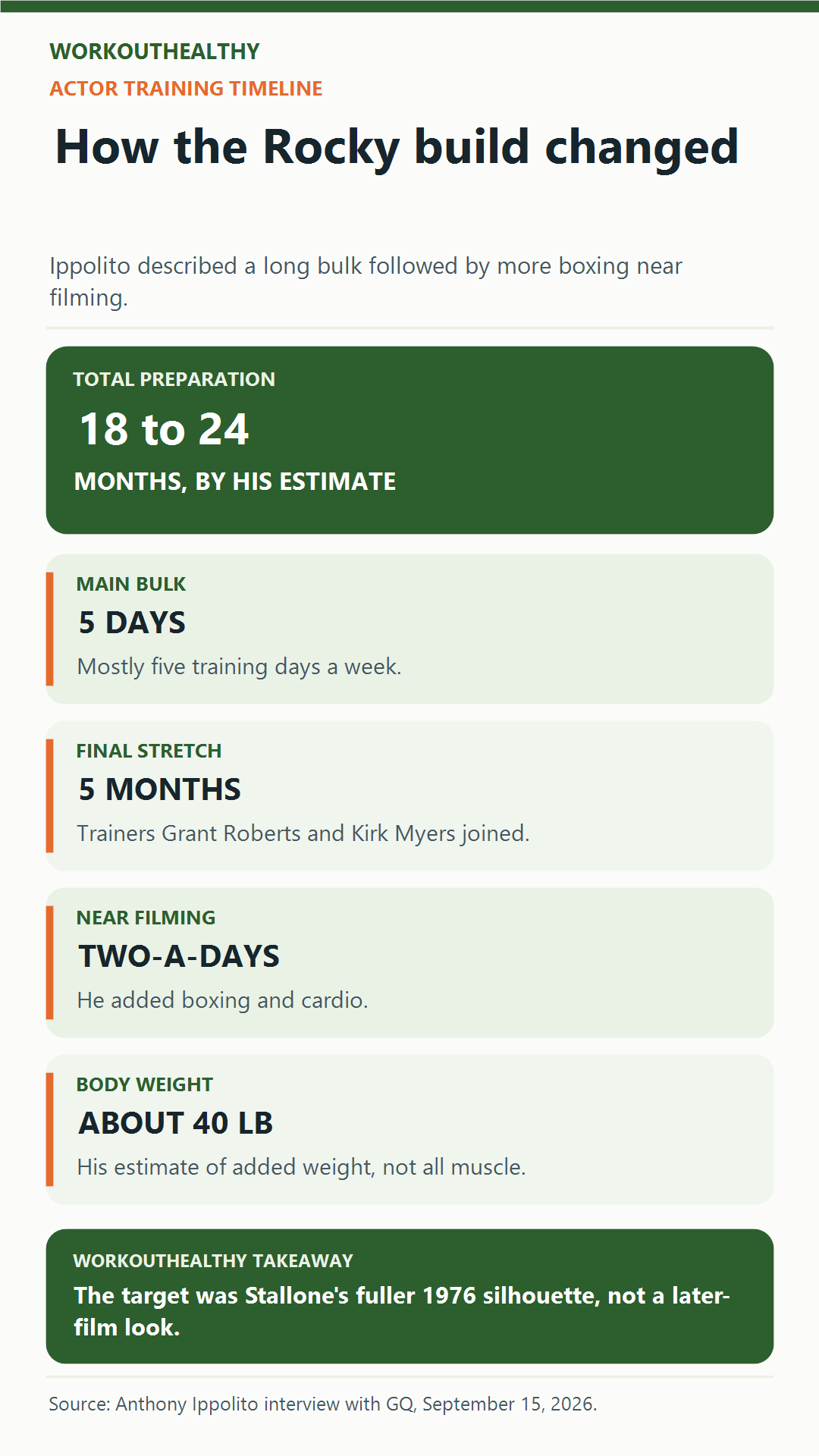
The graphic summarizes the facts he disclosed, including his reminder that the 40 pounds were not all muscle.
What the comparison image can show
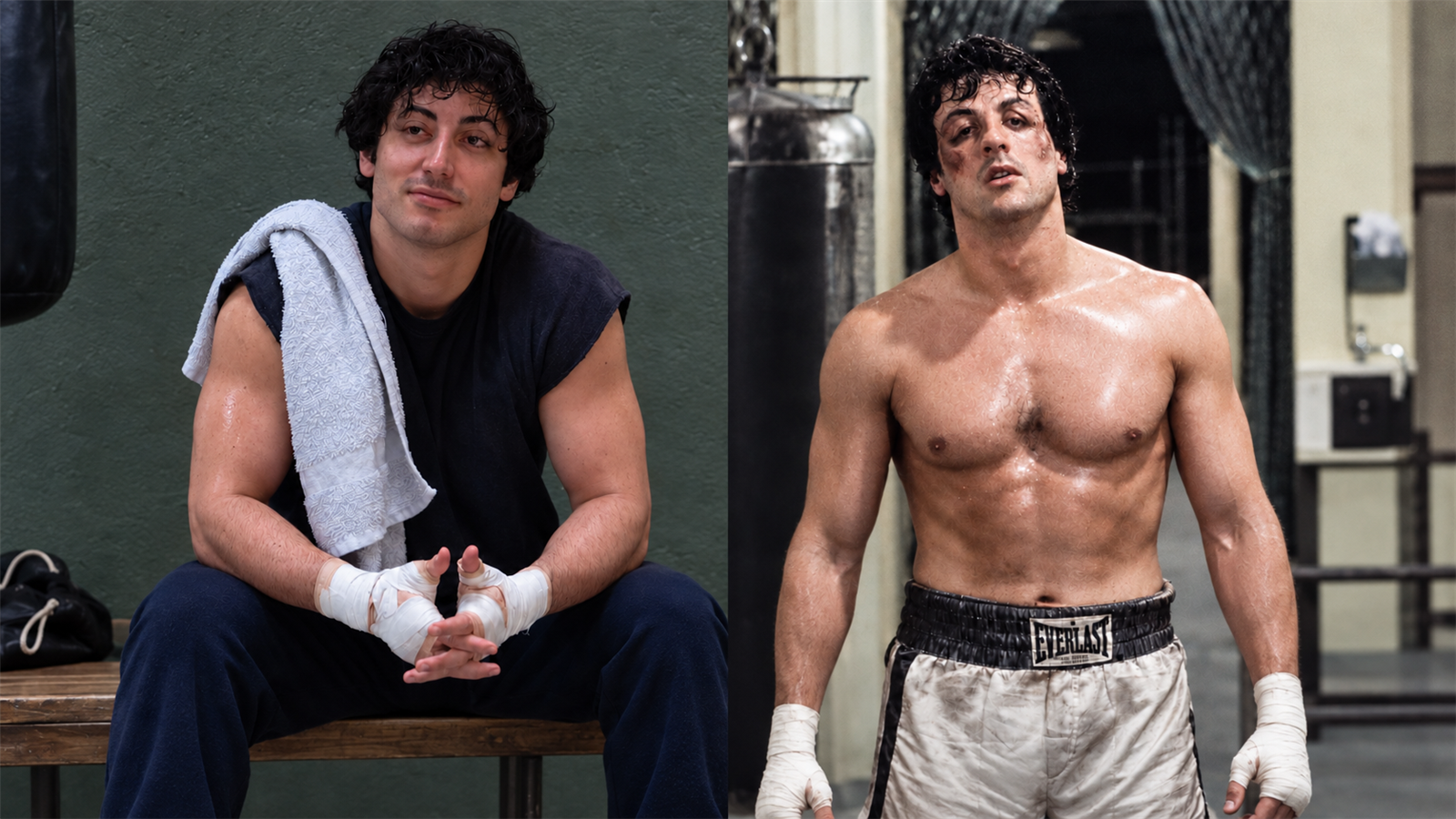
The Facebook post pairs a still of Ippolito in a dark sleeveless training shirt with a still of Stallone in the original Rocky.
The two faces, curls, shoulder outlines, and boxing context make the casting resemblance easy to understand.
The images do not create a controlled body-composition comparison.
They show two different people, at different moments, in different lighting and clothing.
Ippolito’s shirt conceals part of his torso, so a viewer cannot use the side-by-side to measure his muscle gain or body-fat change.
The stills support a visual point about silhouette and character resemblance.
They cannot validate an exact training result.
That distinction is especially useful when a social graphic includes a large number.
The 40-pound figure comes from Ippolito’s interview, not from the two photographs.
For another role-focused comparison, read how Paul Mescal used boxing in preparation for Gladiator II.
What readers can take from the story
The first lesson is to define the goal before judging the program.
Ippolito sought the fuller outline of the first Rocky, so judging the result against Stallone’s later, leaner look misses the target.
The second is to separate what a performer disclosed from what an observer assumes.
We know the broad duration, approximate scale change, general training frequency during the bulk, late addition of boxing and cardio, and names of two trainers.
We do not know his exact starting weight, daily intake, workout split, recovery schedule, or measured muscle gain.
The third is to respect the cost of the process.
Ippolito described it as demanding enough to change his daily life, and he later said he did not want to keep eating that way after the film.
His experience was tied to a paid acting role with a deadline and professional support.
Someone training for health or enjoyment can choose a smaller, more sustainable goal without falling short of any meaningful standard.
The 2026 ACSM position stand supports regular resistance training for healthy adults, but it does not say they must train five days a week or pursue a 40-pound change.
Take the principle of consistent work from this story, not the actor’s role-specific body-weight target.
“It was a lifestyle shift.”
That brief description is a more useful summary than an invented secret exercise.
Common questions
Did Anthony Ippolito gain 40 pounds of muscle?
No such measurement has been published.
He estimated about 40 pounds of added body weight and explicitly said it was not all muscle.
How long did he train for I Play Rocky?
He described a period between a year and a half and two years.
The exact start date, end date, and length of each training phase are not public in the interview.
What was his workout split?
He could not recall a precise push and pull schedule.
He described training mostly five days a week during the main bulk, then adding boxing, cardio, and some two-a-day sessions closer to filming.
Who helped him prepare?
Ippolito named Grant Roberts and Kirk Myers as trainers brought in for the final five months.
His account does not divide their responsibilities or provide a public program to copy.
For more reporting on how performers prepare for physical roles, continue with the related WorkoutHealthy Insider stories linked above.
Medical disclaimer: This article provides general fitness information, not medical advice. An actor’s role-specific training and body-weight change are not individual exercise or nutrition prescriptions. Speak with a qualified health professional before making major changes to training, diet, or body weight.