
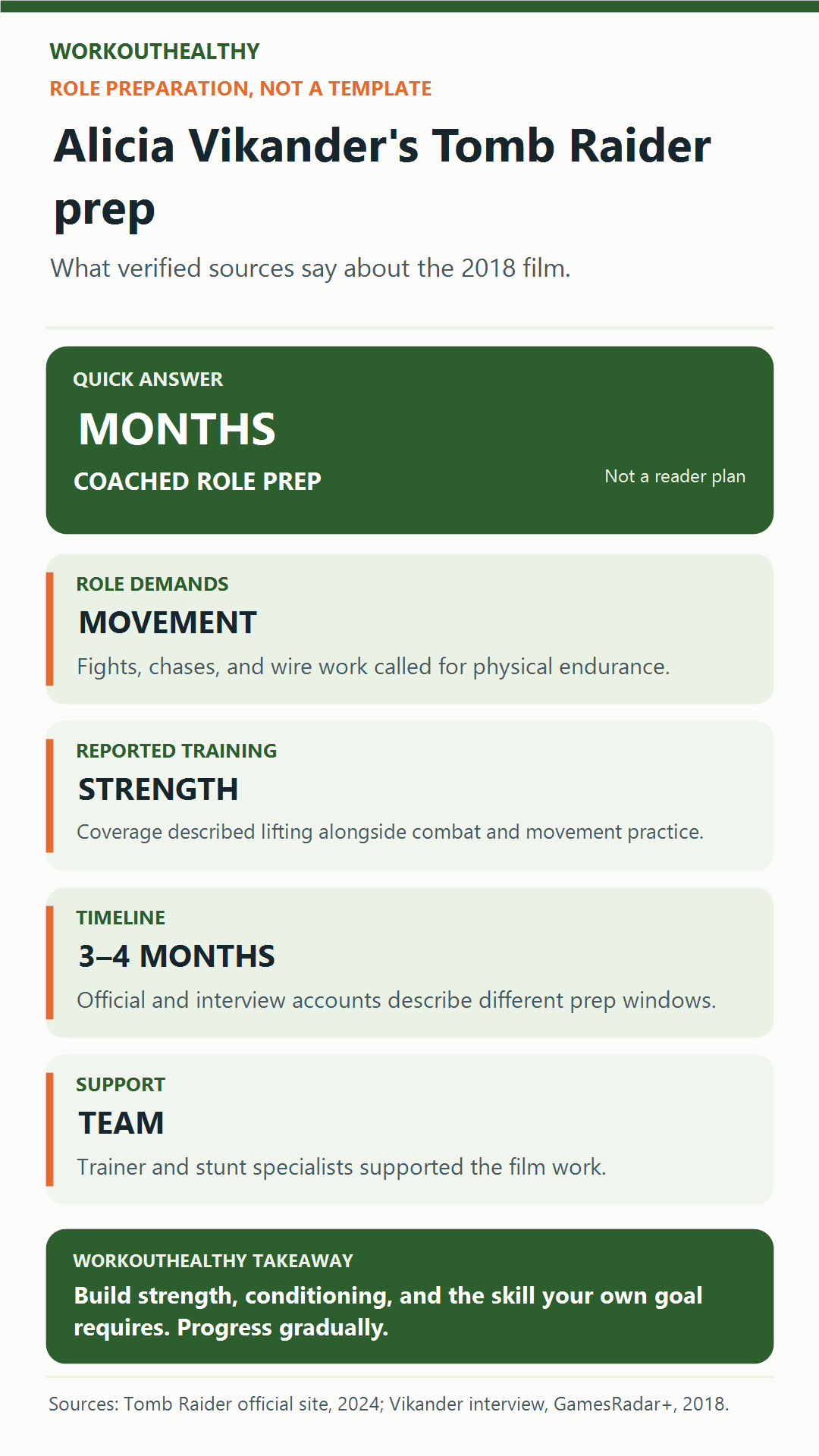
Alicia Vikander’s preparation to play Lara Croft in the 2018 Tomb Raider film was about making an action character believable on screen. The role involved fights, chases, wire work, and other physically demanding scenes. The official Tomb Raider site says Vikander worked closely with trainer Magnus Lygdback and began training three months before principal photography. In an interview with GamesRadar+, Vikander described being given four months to prepare. Those timelines need not describe exactly the same starting point, and neither is a complete training log.
The Facebook post about her emphasizes functional athletic strength over appearance. That is one part of the story: the character had to move convincingly. Vikander also discussed building muscle for the role, and the preparation included professional coaching, time, and stunt support. Here is what the sources actually say, how the different elements fit together, and what an ordinary reader can take from the approach without attempting a film-set transformation.
Why Lara Croft Required More Than a Camera-Ready Physique
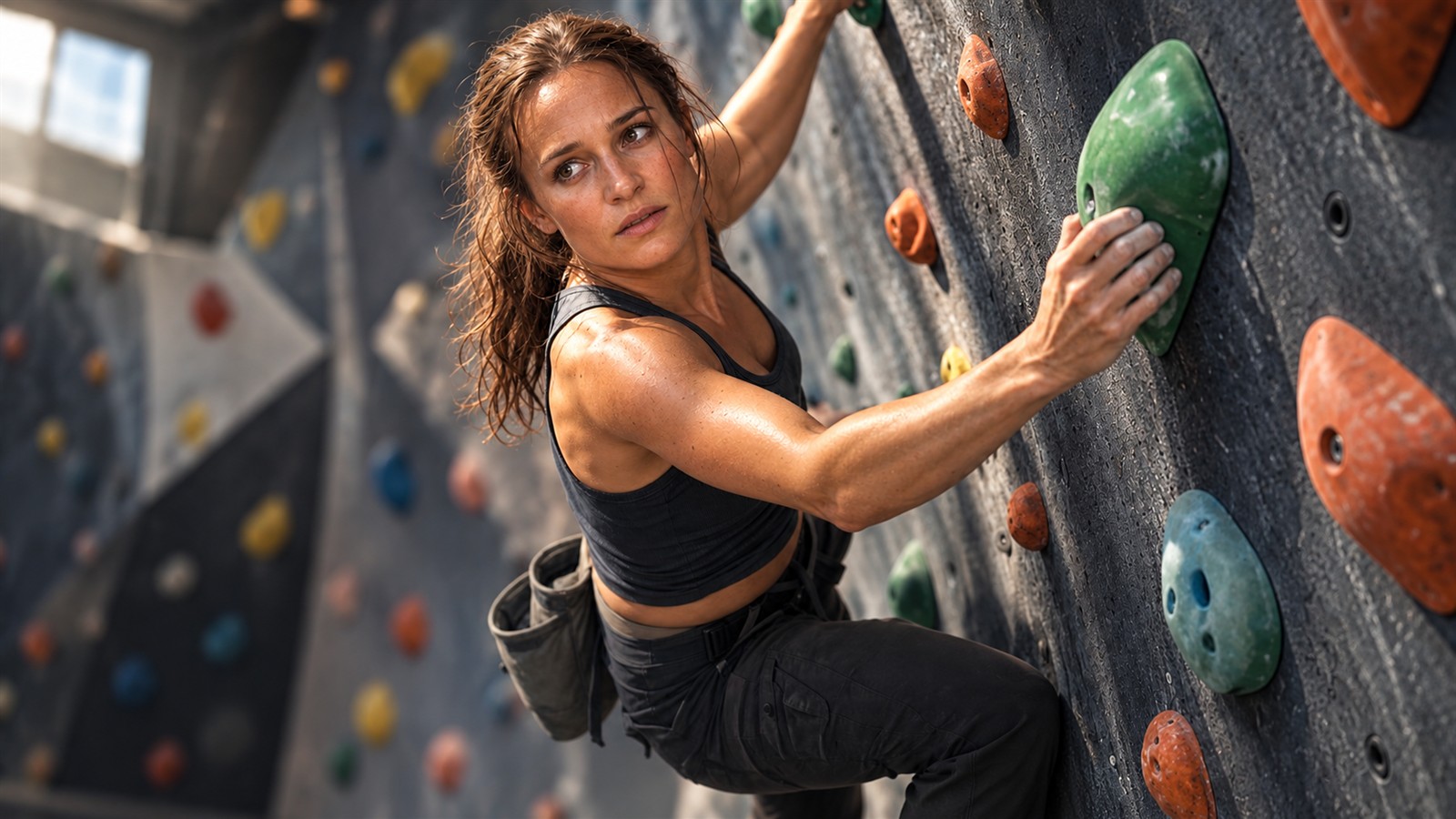
The 2018 film presents Lara as a young adventurer who runs, fights, climbs, and survives hazards. The official franchise account notes that the production demanded physical endurance for fights, chases, and wire work. In her GamesRadar+ interview, Vikander said she wanted audiences to believe that a person from a recognizable modern world could do the things in the script. She pointed to the character’s mixed martial arts practice and bicycle-courier background as parts of that plausibility.
That is a performance goal, not a clinical definition of fitness. A movie also relies on choreography, stunt performers, editing, props, and safety crews. Vikander said she performed many of her stunts while stunt professionals prepared the work and took the dangerous ones. The athletic preparation supported the role; it did not remove the production’s need for specialists.
The distinction matters when people watch an action film and assume every scene is evidence of a particular exercise method. A convincing climb or fight may reflect practice and coordination as much as raw strength. A visual transformation does not prove which drill caused it.
What Vikander and Her Trainer Reported
Vikander named Magnus Lygdback as her coach. The official Tomb Raider site says he led a promotional fitness-video series explaining techniques used in her preparation. In her interview, she linked the role to a period of deliberate exercise and eating that differed from her usual work. She had a dance background, but this project asked her to add muscle and prepare for physically intense scenes.
Reporting at the time described strength training alongside movement and combat practice. Vogue reported that her plan included weight training and mixed martial arts. Entertainment Tonight interviewed Lygdback about the preparation. Those reports are useful context, but the public record does not provide every set, rep, load, rest day, or rehearsal in a single verified calendar. A viral “exact Tomb Raider workout” should therefore be treated cautiously unless it is tied to a specific source and time.
The timeline itself shows why precision matters. The franchise site says training began three months before principal photography; Vikander recalled four months of role preparation. Rather than force those accounts into an invented day-by-day schedule, the defensible conclusion is that she spent months preparing with professional support. Her routine was a project, not a quick fix.
Strength, Conditioning, and Skill Serve Different Jobs
Strength training can increase the ability to produce force and support demanding movement. Conditioning develops the capacity to keep moving through repeated efforts. Skill practice helps a performer learn choreography, timing, and movement patterns needed for a scene. For a role like Lara Croft, these are complementary rather than competing categories.
There is no reason to frame “functional” training as the opposite of lifting weights. A squat or pull can be valuable when it builds capacity for a goal; a climbing drill can be useful when the goal includes climbing. What makes training relevant is the link between the task, the person’s current ability, and an appropriate progression. It is not an exercise’s ability to look cinematic.
Similarly, a film role does not require the public to copy the actor’s workload. A healthy adult training for recreation may need two or three strength sessions and some aerobic activity, not months of supervised role preparation. The U.S. Physical Activity Guidelines recommend at least two weekly muscle-strengthening days plus aerobic activity. That is a broad starting point; goals, experience, and medical constraints determine the details.
What a Functional-Strength Plan Could Mean for a Reader
For someone inspired by Vikander’s story, define the function before selecting exercises. Is the goal to carry groceries comfortably, hike uphill, climb at a gym, return to a sport, or simply feel stronger in everyday life? Each goal suggests different practice. The plan should be sustainable enough to repeat and challenging enough to improve.
- Build a strength base. Train major muscle groups with movements you can control, such as a squat variation, hinge, push, pull, and loaded carry.
- Add aerobic work. Walking, cycling, or another enjoyable activity can develop endurance without imitating stunt conditioning.
- Practice the actual skill. If the goal is climbing, supervised climbing practice matters; weight-room strength alone is not identical to technique.
- Progress gradually. Increase workload or difficulty as your technique and recovery allow, rather than jumping to an actor’s reported peak schedule.
- Respect rest and safety. Pain, dizziness, illness, and persistent fatigue are reasons to reassess, not to prove commitment.
This is a planning example, not Vikander’s personal program. Our Alexander Ludwig training story explores how consistency can make a plan more durable. Our Nabela Noor story shows another way to value function over a single appearance metric.
Why the Film-Set Timeline Should Not Become a Deadline
A production schedule can create intense pressure to change physical capacity and appearance by a fixed date. Actors may have a coach, rehearsals, food support, and paid work time devoted to the role. Readers generally do not have the same incentives or resources. Even if a reported body change is accurate, it is not a sensible benchmark for someone else’s calendar.
Vikander’s own interview described the food and training as demanding. The specific eating pattern she mentioned reflected her circumstances during production, not a nutrition plan validated for readers. No article about this role can determine another person’s energy needs, medical history, or relationship with food. We therefore focus on her preparation’s structure rather than republishing a celebrity menu as advice.
Long-term fitness usually benefits from goals that can survive a work deadline, vacation, or difficult week. Developing strength and movement skill can take months or years. A few weeks of consistency can start the process, but the camera-ready finish line of a movie should not define success for a non-actor.
What “Functional” Can—and Cannot—Claim
Functional training is often used as a marketing phrase. It becomes meaningful when the function is specific. For an actor performing action choreography, the desired capacity might include repeated movement, balance, coordination, and controlled force. For an older adult, it might mean rising from a chair and carrying a bag. For a climber, it might mean efficient technique and grip endurance.
No single exercise is inherently functional for every person. A lift can be useful for one goal and less relevant for another. A movement that looks like a stunt is not automatically superior to basic resistance training. The 2026 American College of Sports Medicine guidance emphasizes training major muscle groups at least twice a week and building gradually; it does not require a branded Hollywood protocol.
The Facebook caption’s contrast between capability and aesthetics is best read as a reminder to choose meaningful outcomes. Vikander did prepare for movement demands, but the sourced reporting also discusses physique. Pretending the aesthetic component did not exist would be as misleading as claiming that appearance was the only aim.
What Remains Unknown About Her Exact Program
We can verify the named coach, months-long preparation, film’s physical demands, and reported combination of strength and movement work. We cannot verify a single complete daily program from the public sources used here. Reports differ on the exact preparation window. Individual exercises demonstrated in promotional videos should not be assumed to represent every day of her training.
There are also limits to what an actor’s performance can teach us about outcomes. We have no controlled comparison showing that this training blend is better than another for a general population. A film image cannot show recovery, injuries avoided, or how long gains lasted. The story is an example of task-specific preparation, not proof of one best method.
Our celebrity-fitness reporting policy explains why we keep a public figure’s account separate from exercise advice for readers.
The Bottom Line
Alicia Vikander prepared for Tomb Raider over months with Magnus Lygdback, combining strength work with practice relevant to a physically demanding action role. The best takeaway is not an exact set-and-rep list or a movie-transformation deadline. Choose a real-world capability you care about, build a strength and endurance base, practice the relevant skill, and let the workload fit your own life and recovery.
References
- Crystal Dynamics/Tomb Raider. Alicia Vikander’s Training for Tomb Raider (2018). July 10, 2024.
- Sullivan L. Alicia Vikander on Becoming Lara Croft. GamesRadar+. 2018.
- Alicia Vikander’s Tomb Raider Workout. Vogue. March 16, 2018.
- Interview with Magnus Lygdback on Vikander’s preparation. Entertainment Tonight. February 8, 2018.
- U.S. Office of Disease Prevention and Health Promotion. Physical Activity Guidelines Questions and Answers.
- American College of Sports Medicine. Resistance Training Position Stand infographic. 2026.
This article is general fitness information, not individualized training, nutrition, or medical advice. Consult a qualified professional when managing an injury, health condition, or new exercise restriction.