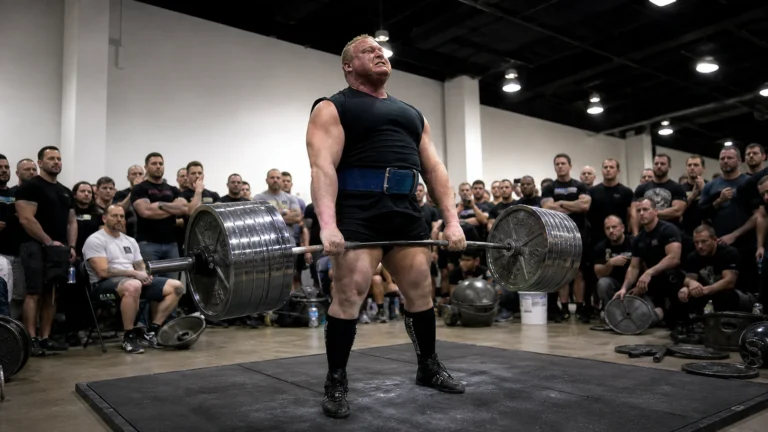

Alex Pereira has become one of the most feared strikers in the UFC.
He holds the UFC light heavyweight title.
He built that reputation on a background in professional kickboxing, not wrestling or jiu jitsu.
But a knockout punch only matters if a fighter can still throw it with power in the final round.
That is why so much of Pereira’s training happens away from the cameras, in the unglamorous work of conditioning.
Who Is Alex Pereira
Pereira, often called “Poatan,” grew up in Brazil.
He spent years competing in kickboxing before he ever stepped into an MMA cage.
He won titles in the Glory kickboxing organization in two different weight classes at once, a rare feat.
He then moved to the UFC and became the first fighter in the promotion’s history to win championships in both the middleweight and light heavyweight divisions.
His left hook has become one of the most recognized weapons in the sport.
Reaching that level took more than raw punching power.
It took a training camp built around specific, demanding conditioning work that most fans never see.
He also holds the record for the fastest three consecutive UFC title defenses in company history.
That kind of pace is only possible with a body that recovers quickly between camps.
What His Training Actually Looks Like
Fight camp reporting on Pereira describes a routine built around a few repeating pieces.
Heavy bag work sharpens his striking power and his timing.
Pad rounds with his coaches simulate the pace and pressure of an actual five round fight.
Explosive strength circuits round out the conditioning side.
Think medicine ball throws, sled pushes, and short sprints.
These build the kind of power that has to survive fatigue, not just look good on a highlight reel.
Mobility and recovery sessions fill out the rest of the week.
None of this is designed to look impressive on camera.
It is designed to hold up in the fourth and fifth round of a title fight, when most fighters have already slowed down.
What Pereira Has Said About His Approach
Pereira has described his fighting style as patience mixed with explosive power.
He has talked about trusting his coaches, Plinio Cruz and former champion Glover Teixeira, to build a camp around his specific strengths.
He came into MMA with relatively little grappling experience.
Reporting on his camps describes years of deliberate work closing that gap, not just relying on his striking.
Coverage of his training routine consistently points to a mix of sport specific conditioning and recovery work, not a generic gym plan pulled off a shelf.
That combination, more than any single drill, is what fight camps mean when they talk about being “fight ready.”
Combat sport conditioning is not built around looking fit. It is built around still having something left when the fight gets hard.
Why Size and Durability Are Part of the Conditioning Story
Part of what makes Pereira dangerous is his frame.
He has fought at a large size for his weight classes, reportedly weighing well above his opponents on fight night after a cut and rehydration.
Carrying that much size through five rounds takes more than raw strength.
It takes a cardiovascular system that can support a bigger body under repeated hard effort.
That is part of why his camp puts so much weight on conditioning specifically, not just striking practice.
A fighter who gasses out in the third round loses the advantage that size and power gave him in the first.
Durability, in that sense, is not a separate skill from power.
It is what allows power to still matter late in a fight.

Why Short, Intense Intervals Matter for Fighters
A UFC round lasts five minutes.
Inside that window, a fighter moves between short bursts of maximum effort and brief windows of lower intensity, over and over.
A 2016 systematic review in Sports Medicine looked at the physical traits that separate successful mixed martial arts athletes from less successful ones (James et al., 2016).
It found that the ability to repeat high intensity efforts tracked closely with fight performance.
That mattered more than raw strength or a high maximum heart rate alone.
That repeat effort quality is exactly what interval style conditioning is designed to build.
A separate paper in Strength and Conditioning Journal laid out specific programming guidance for combat athletes (La Bounty et al., 2011).
It recommended interval work that mimics the actual work to rest pattern of a round.
Steady, moderate paced cardio does not do that job as well.
The idea is simple.
Training the body to recover fast between short, hard efforts prepares it for what actually happens inside a fight.
The Physiology Behind High Intensity Intervals
Short, hard intervals do something steady cardio does not do as efficiently.
A widely cited review in The Journal of Physiology found that low volume, high intensity interval training can produce many of the same aerobic and metabolic adaptations as much longer sessions of moderate exercise (Gibala et al., 2012).
It can do this in a fraction of the training time.
Those adaptations include how efficiently muscles use oxygen during hard effort.
They also include how well the body clears waste products like lactate.
For a fighter who needs to be sharp in round five, not just round one, that kind of conditioning is close to the entire game.
Recovery Is Not an Afterthought
Pereira’s training reporting also emphasizes mobility and recovery work.
The research backs up why that matters.
A 2018 systematic review and meta-analysis in Frontiers in Physiology examined which recovery techniques actually reduce muscle soreness, fatigue, and inflammation after hard training (Dupuy et al., 2018).
It found that some popular recovery methods have real supporting evidence.
Others are mostly marketing with thin research behind them.
The bigger point is that recovery is not separate from performance.
It is part of how a fighter is able to train at high intensity again the next day, camp after camp.
What This Evidence Does Not Prove
None of this research was done on Pereira specifically.
It describes patterns across groups of combat athletes, not a guarantee for any one fighter.
A training style built for an elite professional with a full coaching staff is not automatically the right plan for someone training for general health.
Fight camp intensity also comes with real injury risk.
That is one reason it is closely supervised by coaches and medical staff at every step.
How This Compares to General Fitness Guidance
Most public health guidance for adults recommends a mix of moderate aerobic activity and strength training spread across the week.
It does not call for daily maximum effort intervals.
Pereira’s routine is built for one specific outcome, winning a professional fight, not for general health or longevity.
That distinction matters.
A demanding, sport specific plan like his is not a template most gym goers should copy directly.
It is, however, a useful example of a real training principle.
Training should match the actual demands of the goal.
Common Mistakes People Make Copying Combat Sport Conditioning
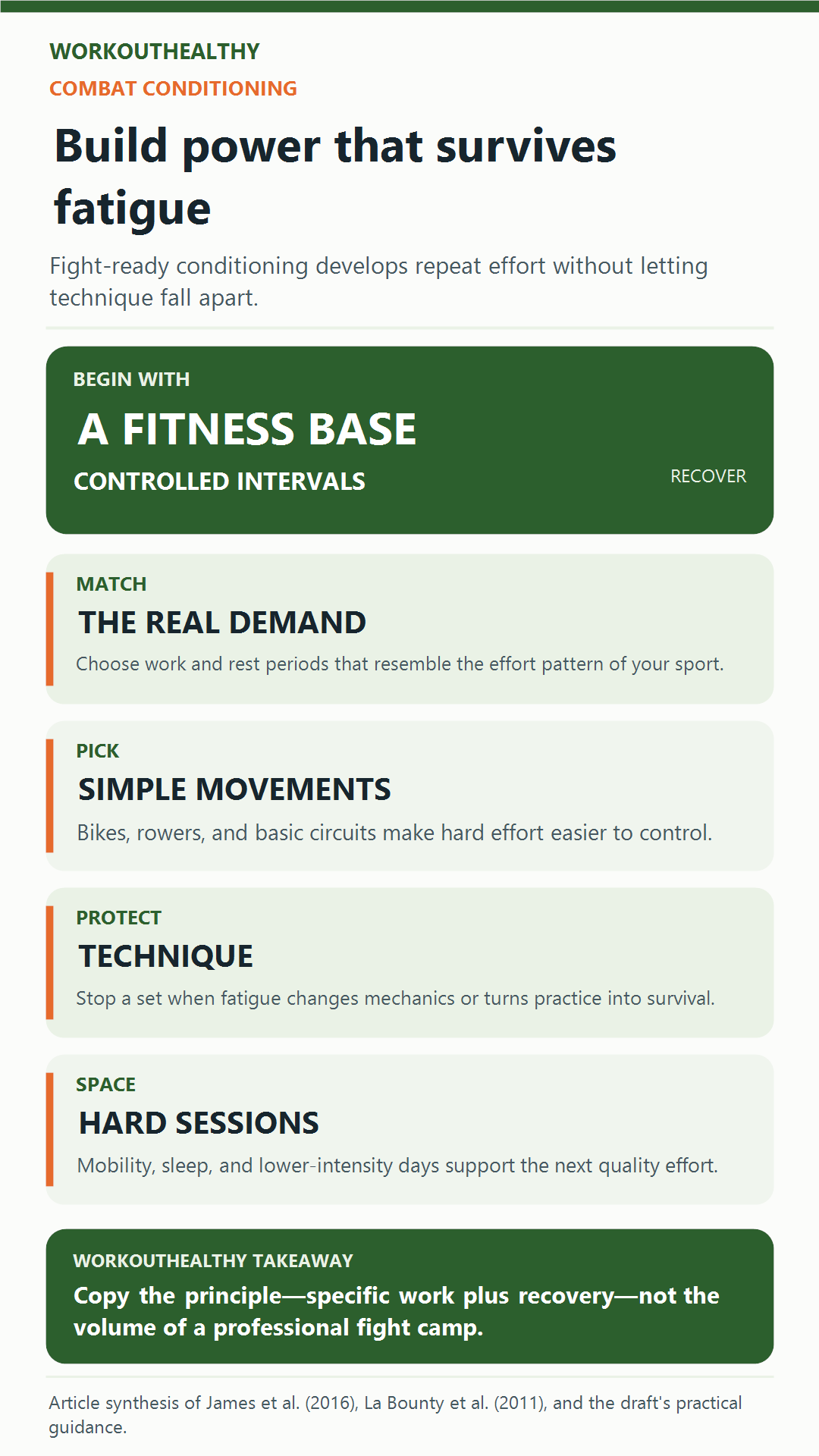
The biggest mistake is jumping straight into daily maximum intensity intervals without a base of general fitness first.
Interval training is demanding on joints, connective tissue, and the nervous system.
Skipping the mobility and recovery side of the routine, while keeping only the hard conditioning, is another common error.
Many people also copy the volume of a professional fighter’s schedule without a professional’s recovery resources.
Daily coaching, monitored nutrition, and built in rest time are part of the real picture.
Combat sport conditioning is demanding by design.
It is meant to be layered onto an already trained body, not used as a starting point.
How to Borrow From This Approach Safely
Start with a base of general conditioning before adding short, hard intervals.
Two or three interval sessions a week is plenty for most people who are not training for a fight.
Keep the work to rest ratio close to even at first.
Thirty seconds of hard effort followed by thirty to sixty seconds of rest is a reasonable starting point.
Pick simple, controllable movements for the hard intervals.
A stationary bike, a rower, or a bodyweight circuit works well.
Complex striking drills need real coaching before they belong in a home workout.
Build in at least one full rest or mobility focused day between hard interval sessions.
Pay attention to sleep and general recovery, since interval training adds real stress to the body.
Watch for warning signs like joint pain, unusual fatigue, or a resting heart rate that will not come down.
Any of those is a signal to back off and let the body catch up.
A qualified coach can help build a plan around your own goals.
Here is how to decide if you need one and how to hire one.
A simple stair test is one low cost way to check your current conditioning.
See what a four flight stair climb can tell you.
Combat sports are not the only place an athlete has made a demanding comeback work.
George Foreman’s boxing comeback is another example worth reading.
References
- James, L. P., Haff, G. G., Kelly, V. G., & Beckman, E. M. (2016). Towards a determination of the physiological characteristics distinguishing successful mixed martial arts athletes: A systematic review of combat sport literature. Sports Medicine, 46(10), 1525-1551. https://doi.org/10.1007/s40279-016-0493-1
- La Bounty, P., Campbell, B. I., Galvan, E., Cooke, M., & Antonio, J. (2011). Strength and conditioning considerations for mixed martial arts. Strength & Conditioning Journal, 33(1), 56-67. https://doi.org/10.1519/SSC.0b013e3182044304
- Gibala, M. J., Little, J. P., MacDonald, M. J., & Hawley, J. A. (2012). Physiological adaptations to low-volume, high-intensity interval training in health and disease. The Journal of Physiology, 590(5), 1077-1084. https://doi.org/10.1113/jphysiol.2011.224725
- Dupuy, O., Douzi, W., Theurot, D., Bosquet, L., & Dugué, B. (2018). An evidence-based approach for choosing post-exercise recovery techniques to reduce markers of muscle damage, soreness, fatigue, and inflammation. Frontiers in Physiology, 9, 403. https://doi.org/10.3389/fphys.2018.00403
This article is for general educational purposes only.
It is not a substitute for individualized coaching or medical advice.
Combat sport conditioning is demanding and carries real injury risk.
Talk to a qualified coach or a medical professional before starting a new high intensity training program.