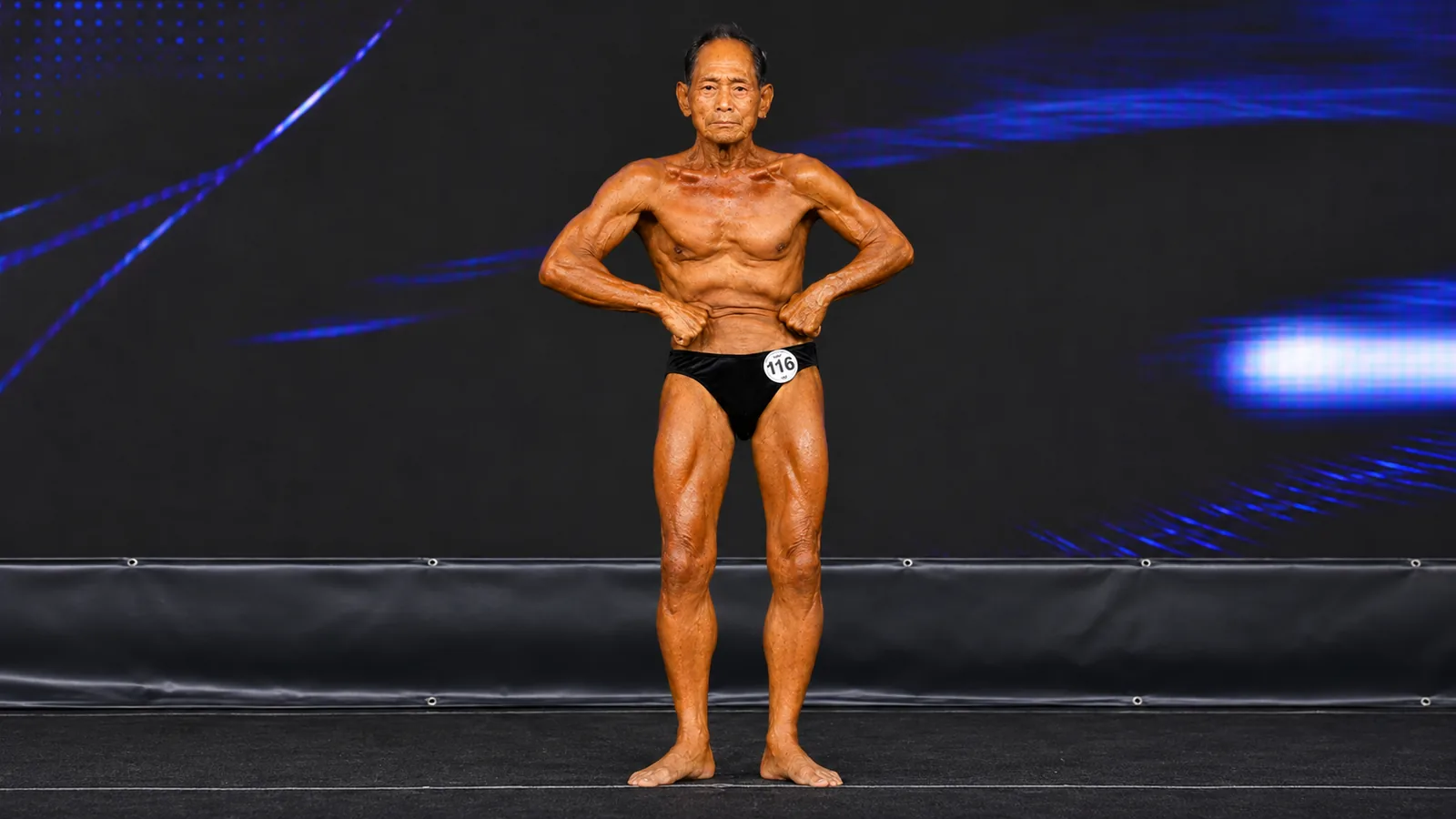

At 90, Japanese bodybuilder Toshisuke Kanazawa stepped onto the stage at the 2026 IFBB World Fitness and Bodybuilding Championships in Santa Susanna, Spain, and competed in a Masters category open to athletes aged 50 and older.
VITUP’s event report placed him sixth, while current wire coverage documented the larger point: Kanazawa prepared, traveled, posed, and completed an international contest against men decades younger, then said he was considering another competition at 93.
In this article
Taking the world stage at 90
The IFBB scheduled its 2026 world championships from October 29 through November 2 in Santa Susanna. Kanazawa competed on October 30, warming up backstage and applying posing color alongside younger athletes before presenting his physique under the same stage lights.
He was not shown in a ceremonial exhibition. He entered the Masters category for athletes 50 and older, and the event photographs show competitor number 116 attached to his posing trunks.
Kanazawa’s achievement was not that age disappeared. It was that preparation still led him to the stage at 90.
What the sixth-place report does and does not say
VITUP reported that Kanazawa finished sixth in his Masters category. That result should not be confused with sixth place in the entire championship, and it did not put him on the main podium.
The category itself was broad because the minimum age was 50, leaving room for a four-decade spread between Kanazawa and the youngest eligible competitors. Placing behind younger athletes does not erase the competitive result, but neither should his age be used to manufacture a title he did not win.
Why he is looking toward 93
In current event reporting, Kanazawa said he likes attempting things few people have done and wants bodybuilding to remain part of his life. He also described 93 as a possible age for one more competition before retirement.
That is a goal, not a guaranteed schedule. Three years can bring changes in health, recovery, travel, and federation plans, so the accurate story is that he is considering the return and has given himself a direction.
The age gap in context
This is the article’s original calculation: a category beginning at 50 creates a minimum 40-year age gap between Kanazawa and its youngest eligible entrant. If he competes at 93 under the same threshold, the gap could be at least 43 years.
The math helps explain why sixth place drew attention without turning the result into an age-adjusted victory. Bodybuilding judges the physique presented on the day; the audience can recognize the unusual longevity while keeping the formal placing intact.
The stage number records one contest, while the age records the much longer project required to reach it.
Training later in life changes the target
Older athletes often need more recovery and more deliberate exercise selection, but there is no single program for everyone past a certain birthday. The useful plan is the one a person can repeat while managing joints, medical conditions, sleep, and changes in capacity.
Consistency can also mean changing the work instead of abandoning it. Machines, supported movements, reduced ranges, longer rest periods, and fewer hard sessions may all have a place when they help an individual train with better control, though the right choice depends on health history and professional guidance.
Our report on Robby Robinson’s training at 77 shows another veteran bodybuilder emphasizing the long game. Dorian Yates after 60 offers a different example in which mobility and sustainability replaced the old goal of maximum mass.
Kanazawa is evidence of possibility, not a template
A 90-year-old international bodybuilder is an outlier with a long training history, not proof that every older adult should pursue contest conditioning. Stage leanness, posing practice, travel, and high-volume resistance training can carry demands that are unnecessary for health or independence.
His example is most responsible when it expands imagination without becoming pressure. Aging is not a moral test, and illness, disability, access, genetics, and caregiving duties can shape what movement is possible; showing up may look very different from one person to the next.
Someone beginning later in life can still benefit from appropriately scaled strength work, but the comparison should be with that person’s starting point and medical context. Liam Neeson’s walking and strength routine at 74 illustrates how an active-aging goal can be meaningful without resembling a bodybuilding prep.
The practical lesson is to keep a reason to train
Kanazawa’s most transferable quality is not his posing routine or contest diet. It is the presence of a concrete reason to practice: prepare for the next event, show up, and see what remains possible.
That reason can remain ambitious without becoming rigid or punitive.
For one person that reason may be competition; for another it may be carrying groceries, climbing stairs, playing with grandchildren, or keeping confidence after a setback. A sustainable goal should support life rather than force life to orbit the goal.
References
- International Fitness and Bodybuilding Federation. 2026 IFBB World Fitness and Bodybuilding Championships main information.
- Associated Press. At 90, Japanese bodybuilder is still competing, in photos.
- Reuters reporting syndicated by DZRH. Japanese bodybuilder, 90, flexes ageless ambition on Spanish stage.
This article is for general educational purposes and is not a substitute for individualized medical or training advice.