

Liam Neeson says he no longer spends hours in a gym. At 74, the actor told Fox News Digital that he stays reasonably fit, walks every day, and increases his activity when a script includes physical action. He also drew a line around what he can do, saying he still performs fight scenes only up to a point.
That is a more useful story than “gym or no gym.” A daily walk can anchor an active life. It does not automatically supply every kind of training that supports strength, balance, and physical function later in life.
A routine can get simpler with age without becoming passive.
The best plan is not the hardest plan. It is the one that keeps the important capacities in view.
What Neeson actually said
In the October 31, 2026 interview, Neeson said he does not go to a gym now, although he used to spend much more time there. His priority is maintaining a general level of fitness so he can meet the physical demands of a leading role. When a project calls for action, he said he increases his workout activity.
The distinction matters. “I do not go to a gym” is not the same as “I do not train.” Walking, role-specific preparation, rehearsal, and carefully managed fight choreography can all contribute to activity. The interview did not provide a complete weekly program, so it should not be treated as one.
When walking counts as cardio
Walking can count toward aerobic activity when the effort reaches a moderate intensity for the person doing it. A practical check is the talk test: you can speak, but singing would be difficult. A slow stroll may still be valuable for movement, mood, and routine, but it may not create the same aerobic demand as a brisk walk.
The useful question is not whether walking “counts” in the abstract. It is what the walk asks of your body. Terrain, pace, duration, hills, heat, and current fitness all change that answer. Our guide to walking as cardio explains how to adjust effort without turning every walk into a test.
The three-part active-aging week
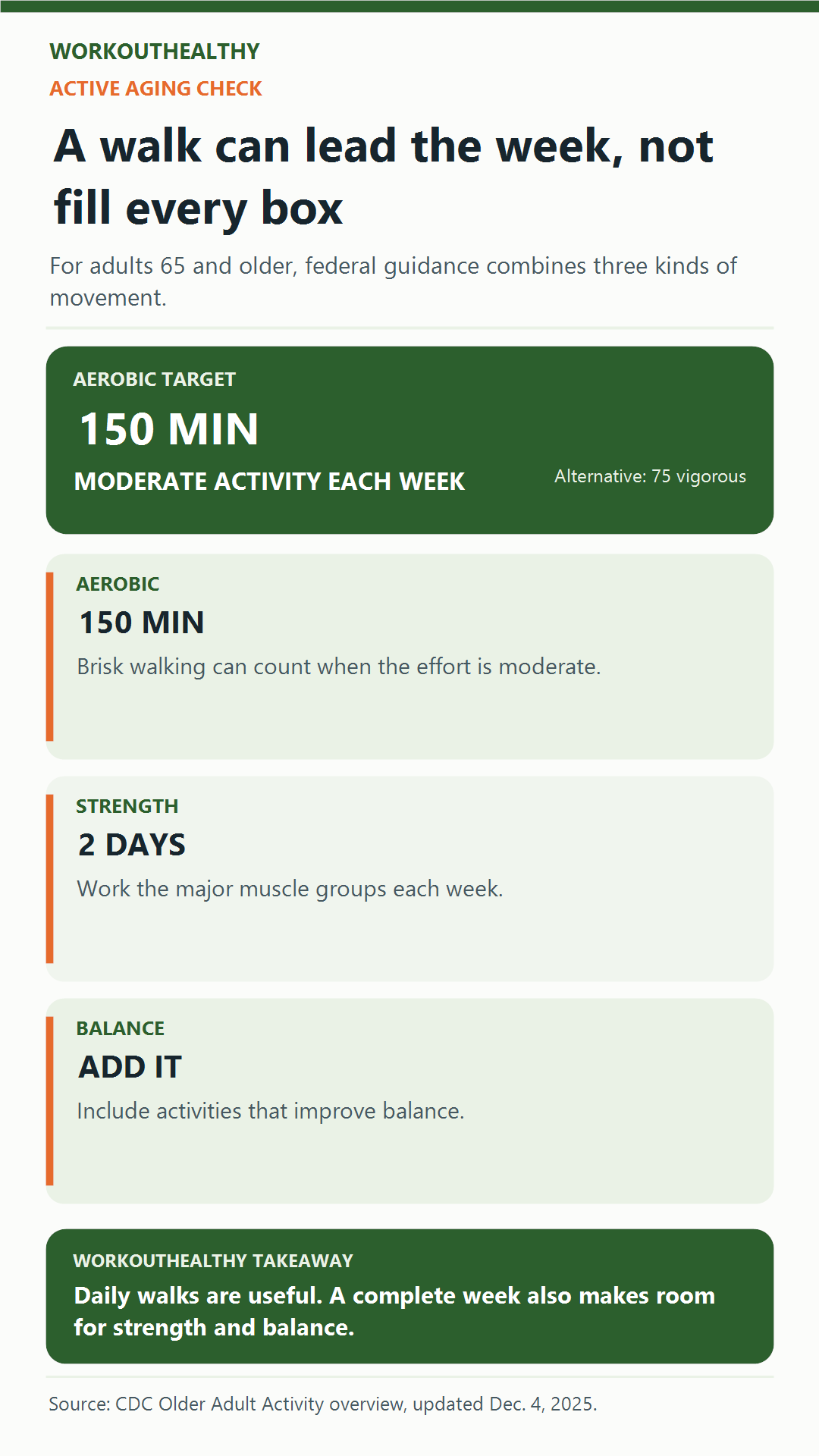
The CDC currently describes three components for adults 65 and older: aerobic activity, muscle-strengthening work, and balance activity. The aerobic target is at least 150 minutes of moderate activity each week, or 75 minutes of vigorous activity, or an equivalent combination. Strength work belongs on at least two days, and balance activities should also be included.
This is not a prescription for Neeson. It is a public-health framework readers can use to check what a routine includes and what it leaves out.
Strength without a gym
A gym makes progressive loading convenient, but it is not the only place to train strength. Sit-to-stands from a stable chair, wall or counter push-ups, step-ups, loaded carries, and resistance-band rows can all be scaled. The goal is to make the muscles work harder than they do in ordinary daily activity while keeping the movement controlled.
Progress can come from adding a repetition, slowing the lowering phase, increasing range of motion, using a slightly harder variation, or adding load. If you want a broader starting menu, see these functional movement patterns for older adults.
Balance deserves its own place
Walking challenges balance, especially on uneven ground, but it may not cover the situations a person most needs to practice. Supported heel-to-toe walking, standing from a chair with less hand support, controlled step-overs, and brief single-leg stands near a stable surface can make balance work more deliberate.
Support is not cheating. A wall, rail, or countertop lets the exercise match the person. Anyone with recent falls, dizziness, new weakness, or a condition that affects balance should discuss the safest starting point with a qualified clinician.
Why an action role is different
Movie preparation includes choreography, stunt coordination, camera angles, repeated takes, and professionals who decide what the performer should not do. Neeson also has decades of experience with action scenes. None of that turns a screen fight into a benchmark for a viewer of the same age.
The more transferable idea is readiness. Neeson maintains a base and adds work when a role demands it. Recreational exercisers can use the same structure: keep a manageable base, then add specific preparation before a hike, trip, race, or demanding season.
Build a realistic week
Start by writing down what already happens. If you walk on five days, keep that anchor. Add two short strength sessions on nonconsecutive days. Attach five minutes of balance practice to activities you already do, such as after a walk or before brushing your teeth.
A simple week could include three brisk 30-minute walks, two easier 30-minute walks, two 20-minute strength sessions, and short supported balance drills. That example is a planning tool, not a universal target. Adjust the duration and difficulty to your health, schedule, and recovery.
The bottom line
Neeson’s routine is a reminder that fitness does not require living in a gym. Daily walking can be an excellent anchor, and training can change as goals and recovery change. The fuller lesson is to keep checking the whole week. Aerobic activity, strength, and balance each protect a different part of capability.
If pain, breathlessness, dizziness, or a recent health change limits activity, get individualized guidance before increasing the workload. Consistency matters most when the plan is safe enough to continue.