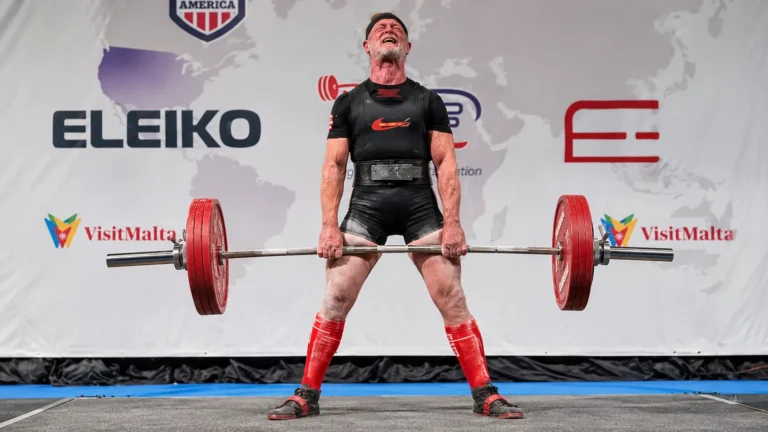

Anthony Harris arrived at the 2026 IPF World Masters Equipped Powerlifting Championships with decades of experience and still produced a result that moved the record book: at 61, the American lifter squatted 292.5 kilograms, or about 645 pounds, for a Masters 3 world record in the 120 kg class.
The official results also show why one dramatic photograph does not tell the whole story. Harris completed seven good lifts, won his class, set another world record in the deadlift, and built a 707.5 kg total across the squat, bench press, and deadlift.
In this article
The 292.5 kg squat that entered the record list
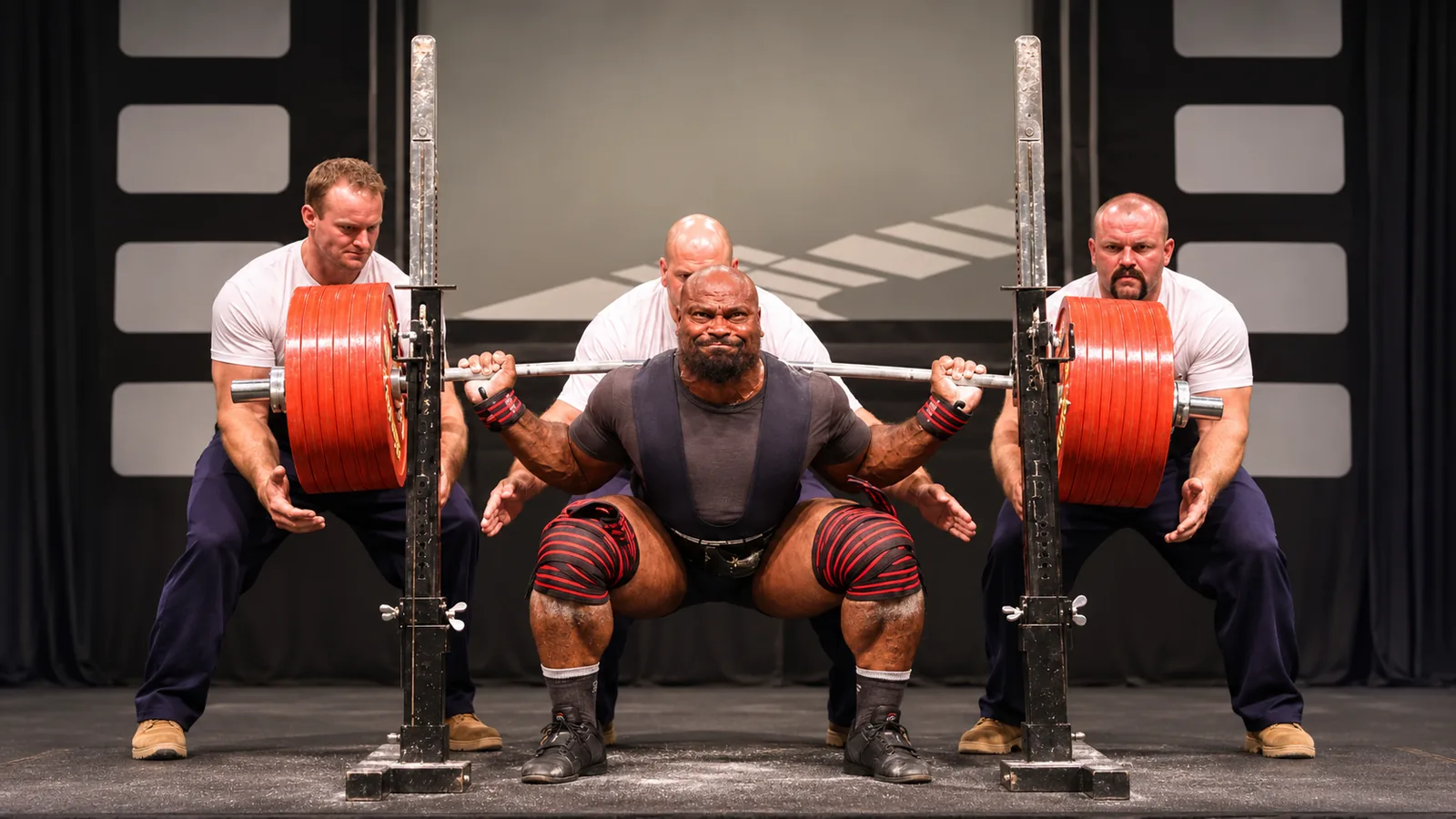
Harris weighed 113.00 kg and competed in the Masters 3, 120 kg equipped division in Reno, Nevada. His successful squat sequence was 260 kg, 285 kg, and 292.5 kg, with the final lift marked as a Masters 3 world record in the International Powerlifting Federation’s official sheet.
The conversion is 644.9 pounds, which explains the 645-pound shorthand used in social posts. The record belongs to a specific age division, weight class, federation, and equipment category, details that matter whenever a strength result is described accurately.
At 61, Harris did not merely complete the meet. He finished all three squat attempts and made the heaviest one the record.
What equipped powerlifting means
Equipped powerlifting permits supportive gear such as a squat suit, bench shirt, and knee wraps under federation rules. That gear can help a lifter handle more weight, but it does not make the lift automatic because timing, technique, depth, commands, and control still decide whether the referees award a good lift.
It is therefore misleading to compare an equipped result directly with a raw result as if the conditions were identical. Our explanation of Carl Yngvar Christensen’s equipped IPF deadlift offers more context on why the category needs to stay attached to the number.
His complete meet was bigger than one squat
Harris followed the squat with a 105 kg bench press, then improved to 115 kg and 127.5 kg. In the deadlift he made 265 kg and 287.5 kg before missing 305 kg, so his best successful deadlift was 287.5 kg, another Masters 3 world record listed by the IPF.
Those best lifts produced a 707.5 kg total, or roughly 1,560 pounds. He placed first in his class and earned 12 team points for the United States, a fuller competitive picture than the viral squat image alone can provide.
The numbers in context
This is the article’s original calculation: Harris’s record squat was about 2.59 times his measured body weight, while his best deadlift was about 2.54 times body weight. His three-lift total was roughly 6.26 times the number on the weigh-in scale.
Those ratios do not make different age groups, body sizes, or equipment categories interchangeable, but they show the scale of the performance without pretending that 292.5 kg was simply a large gym lift. It was one part of a judged international meet in which every attempt had to satisfy the same platform rules.
The official sheet records two Masters 3 world records for Harris on October 22, 2026: a 292.5 kg squat and a 287.5 kg deadlift.
What Masters 3 tells us, and what it does not
Masters 3 is the IPF division for lifters aged 60 through 69. The label establishes the competitive age group; it does not mean every person in that range should attempt similar loads, nor does one exceptional athlete define what aging should look like for everyone.
Harris’s result belongs beside other carefully documented Masters performances, such as Dale McLaren’s 882.5 kg Masters total. Together, these records show that serious competition continues well beyond the open division, while still representing highly trained outliers.
The useful training lesson is progression, not imitation
The cleanest lesson from the attempt chart is that Harris built toward the record. His successful jumps were 25 kg from the opener to the second squat and 7.5 kg from the second to the third, a meet-day sequence that protected the total before testing the record.
For ordinary lifters, the transferable idea is to earn heavier attempts through repeated training, consistent technique, and conservative starting numbers. The target should match the person’s preparation and coaching, not the number attached to somebody else’s highlight.
Heavy lifting deserves a real safety margin
The source image shows multiple spotters and competition equipment around Harris, which is the appropriate context for a maximal squat. A personal best attempted without safeties, competent spotters, and a plan for failure is a different and less defensible decision.
Our guide to ego-lifting habits that increase injury risk explains why load selection and setup matter before intensity rises. Anyone with a medical condition, recent injury, or long break from training should get individualized guidance before returning to maximal lifting.
References
- International Powerlifting Federation. 2026 IPF World Masters Equipped Powerlifting Championships, Men’s Final Results.
- International Powerlifting Federation. World Masters Classic and Equipped Powerlifting Championships 2026 results hub.
This article is for general educational purposes and is not a substitute for individualized coaching or medical advice.