
Thumb pain after scrolling is common enough to have earned nicknames such as “texting thumb,” but a sore thumb is not a diagnosis. One possible cause is de Quervain’s tendinopathy, a painful problem where two thumb-moving tendons pass through a tight tunnel on the thumb side of the wrist.
The scheduled WorkoutHealthy post suggests changing grip, using the other hand, and taking breaks. Those are reasonable ways to reduce a movement that provokes pain. The evidence does not prove that any exact phone posture, 30-second timer, or stretch prevents de Quervain’s in everyone.
Here is what the research and hand-therapy guidance support, how to make phone use less irritating, and when to ask a clinician to examine the wrist.
What De Quervain’s Actually Is
Two tendons, the abductor pollicis longus and extensor pollicis brevis, help move the thumb away from the hand and extend it. They run through the first dorsal compartment near the thumb-side wrist. When the surrounding sheath becomes irritated or thickened, movement through that narrow space can hurt.
The typical pain sits at the base of the thumb or along the thumb side of the wrist. Gripping a jar, lifting a child, twisting a handle, or moving the thumb repeatedly can make it worse. Some people notice tenderness, swelling, or a catching sensation. Pain can also spread a little up the forearm.
The name includes “tenosynovitis,” but the condition is not simply a visible pocket of inflammation. NHS hand-therapy guidance describes irritation and thickening around the tendons. A colorful anatomical overlay in a social image is an illustration, not a scan of the pictured person’s hand or proof of a particular diagnosis.
Does Smartphone Use Cause It?
A 2020 review of studies on smartphones and de Quervain’s reported an association between more texting and symptoms or positive clinical tests. Browsing and gaming also appeared in the research. That makes a repeated thumb task worth considering when it aggravates a sore wrist.
Association is not the same as proof of cause. Many studies used cross-sectional samples: phone behavior and symptoms were measured around the same time. They cannot show whether the device created the condition, whether someone with pain changed how they used the device, or whether another activity was responsible.
A broader review of repetitive manual work found an association but concluded that the available evidence did not establish a causal relationship under formal criteria. Likewise, NHS patient guidance says the exact cause is often unclear. Gardening, sports, tools, baby care, and a sudden change in hand workload can also matter.
The practical conclusion is modest: if one-handed scrolling or texting predictably increases your pain, change that task. Do not assume every thumb ache is a phone injury or that a person who uses a phone frequently will develop de Quervain’s.
Why Grip and Reach May Matter
A large phone held in one hand asks the thumb to reach across a wide screen while the fingers support the device. That can combine repeated thumb motion with pinching and a bent wrist. If those movements already provoke pain, a different setup can reduce the amount of irritating work.
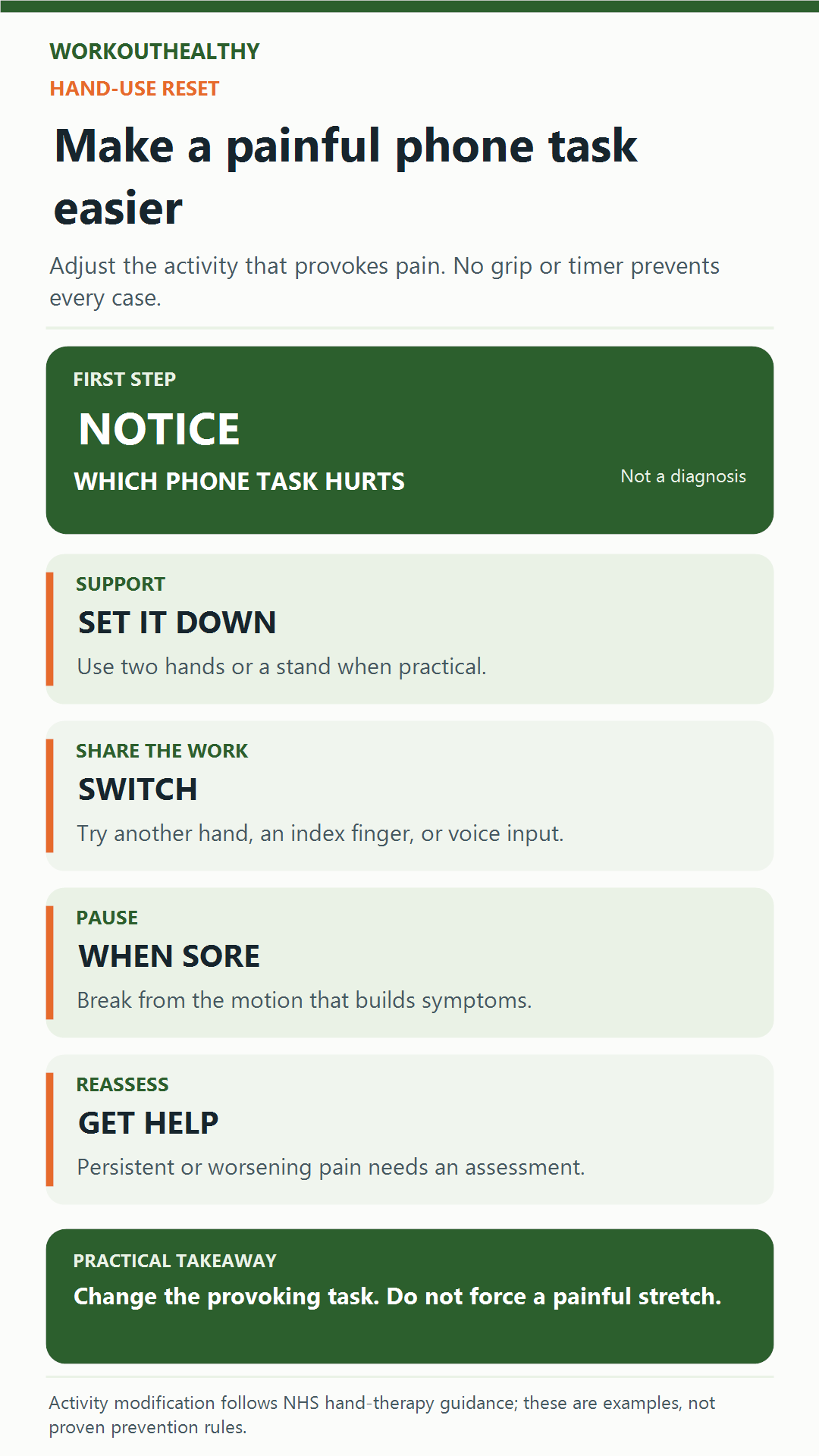
Try holding the phone with two hands, switching hands, or scrolling with an index finger while the other hand supports the device. A stand can take the gripping job away from the hand for reading or video calls. Voice input may reduce long stretches of thumb typing.
These are activity modifications, not treatments with a proven universal dose. The best change is the one that makes your own painful movement easier without creating a new strain elsewhere. A phone case may improve grip for one person and widen the reach for another.
A Practical Phone-Use Reset
Start by noticing the task that bothers you: fast scrolling, typing, carrying the phone while walking, or gripping it during a long call. Then change one variable. Support the phone, use the other hand, or move the scrolling finger. Keep the wrist in a comfortable position instead of forcing it into a rigid “perfect” angle.
When a long session increases symptoms, stop for a while or switch tasks. Regular breaks during painful gripping are part of NHS advice, but no clinical trial establishes “30 seconds every few minutes” as the prevention threshold. Set reminders if they help you notice time and pain; adjust the interval to the task and your symptoms.
Reduce unnecessary repetition where you can. Read an article on a larger screen with the device supported, dictate a long message, or use a keyboard for extended writing. You do not need to give up your phone; the goal is to stop forcing the same sore motion for a long uninterrupted period.
Notice whether the change actually helps over the next several days. A symptom diary can be simple: write down the activity, how long you did it, the pain during it, and whether the wrist was worse afterward. If changing the grip makes no difference, do not keep adding gadgets or increasingly rigid posture rules. The problem may be another hand task, a different diagnosis, or a level of irritation that needs professional care.
If you are also training with kettlebells or weights, look at all thumb-intensive tasks rather than blaming the device alone. Our hand-routine evidence check is a reminder that movement claims need to be matched to the outcome being promised.
Should You Stretch the Thumb?
Forceful thumb-and-wrist stretches can aggravate an already painful tendon. A hand therapist may prescribe gentle movement or progressive exercise at the right stage, but the direction and amount depend on how irritable the wrist is. A social caption cannot safely prescribe a single stretch for everyone.
If movement is comfortable, keep using the hand within a tolerable range. If a stretch sharply increases pain or leaves symptoms worse afterward, stop and get individualized advice. NHS guidance emphasizes reducing or modifying painful activity first, then gradually restoring motion and strength.
Do not confuse this with a plan to make your grip as strong as possible immediately. Grip strength can be useful as a health marker, but training through acute thumb-side wrist pain is a different question.
Signs That Need a Proper Assessment
De Quervain’s commonly causes pain and tenderness at the thumb-side wrist, especially with grasping, lifting, or twisting. A clinician may ask about work, childcare, sport, phone use, and any injury. They can examine the exact painful area and use movement tests while considering other causes.
Thumb arthritis, a sprain, a fracture after a fall, nerve problems, and other tendon conditions can produce overlapping symptoms. A positive self-test or a viral checklist does not settle the diagnosis. Imaging is not always needed, but a clinician may use it when the story or examination suggests another problem.
Get prompt medical advice after an injury, with marked swelling or deformity, numbness, loss of function, or pain that keeps worsening. Persistent pain that interferes with daily tasks also deserves a GP, hand therapist, or other qualified assessment rather than months of pushing through.
If It Is De Quervain’s, What Helps?
Early care usually begins with reducing the activities that provoke pain. That may mean changing how you hold a phone, lift a child, use tools, or train. Relative rest means lowering the irritating load, not immobilizing the whole arm indefinitely.
A clinician may recommend a thumb-and-wrist splint, pain relief or an anti-inflammatory medicine when appropriate, and a gradual exercise plan. Different NHS services describe different splint schedules, which is another reason to follow the advice given for your case rather than copying a social post.
If symptoms do not improve, a corticosteroid injection into the tendon sheath may be discussed. Surgery is reserved for selected cases that do not respond to appropriate care. The treatment decision depends on the diagnosis, duration, severity, health history, and what the person needs their hand to do.
Recovery can be uneven. A quiet day does not mean the tissue is ready for hours of uninterrupted gripping, and a brief symptom flare does not automatically mean permanent damage. Clinicians usually help people reintroduce normal tasks gradually, changing one demand at a time so they can tell what the hand tolerates. A plan that makes phone use easier should also consider lifting, cooking, childcare, and work, because the thumb does not reset between activities.
Evidence on injection, immobilization, and exercise concerns people who already have the condition. It should not be presented as proof that a certain case, app, timer, or grip prevents it in healthy phone users.
What the Social Claim Gets Right—and Where It Goes Too Far
The post is right to draw attention to repetitive thumb loading and to suggest changing a painful grip instead of ignoring symptoms. Switching hands, using an index finger, supporting the device, and taking breaks are low-cost examples of activity modification.
It is too definite when it says scrolling “triggers tendon inflammation” as though every sore thumb has one cause. It also gives a precise break schedule and implies that an opposite-direction stretch or particular phone case prevents the condition. The evidence supports symptom-guided changes; it does not establish those exact prevention rules.
Think of the phone as one possible contributor among many. The better question is which movements make your wrist hurt and how you can reduce that load while the problem is assessed and allowed to settle.
The Takeaway
If thumb-side wrist pain appears during phone use, change the task: share the work between hands, support the device, use a different finger or voice input, and pause when symptoms build. These steps may make the activity more comfortable, but they are not a guaranteed prevention program.
Persistent, worsening, or function-limiting pain needs an assessment. A qualified clinician can tell whether it is de Quervain’s or something else and guide a return to normal hand use.
Get the next evidence check.
Five practical fitness stories worth your time, every Friday.
One email a week. No product pitches. Unsubscribe in one click.
References
- Morgan SDJ, et al. A review of de Quervain’s stenosing tenovaginitis in the context of smartphone use. J Hand Surg Asian Pac Vol. 2020. PubMed record.
- Stahl S, et al. Systematic review and meta-analysis on the work-related cause of de Quervain tenosynovitis. Plast Reconstr Surg. 2013. PubMed record.
- Gloucestershire Hospitals NHS Foundation Trust. De Quervain’s syndrome of the wrist. Patient guidance.
- Berkshire Healthcare NHS Foundation Trust. Advice and resources: De Quervain’s tendinopathy.
- Management of de Quervain tenosynovitis: a systematic review and network meta-analysis. PubMed record.
Medical disclaimer: This article is general information, not a diagnosis or personal treatment plan. Seek a qualified clinician for persistent pain, injury, numbness, weakness, or limits in normal hand use.