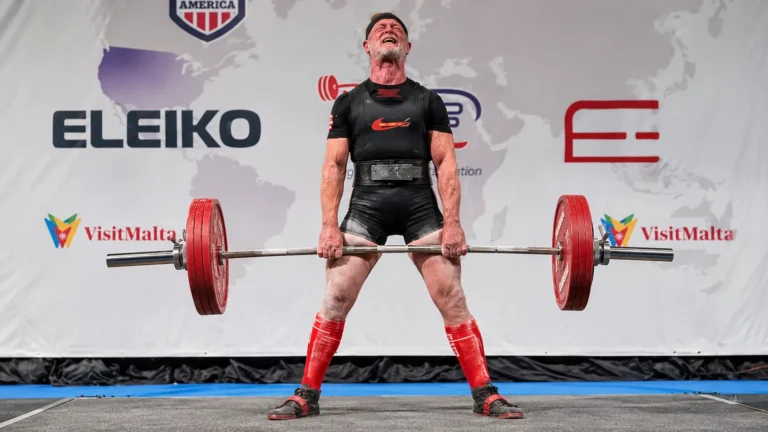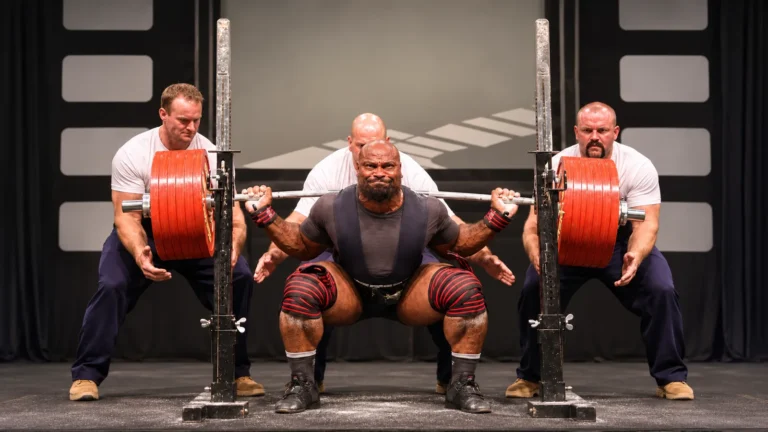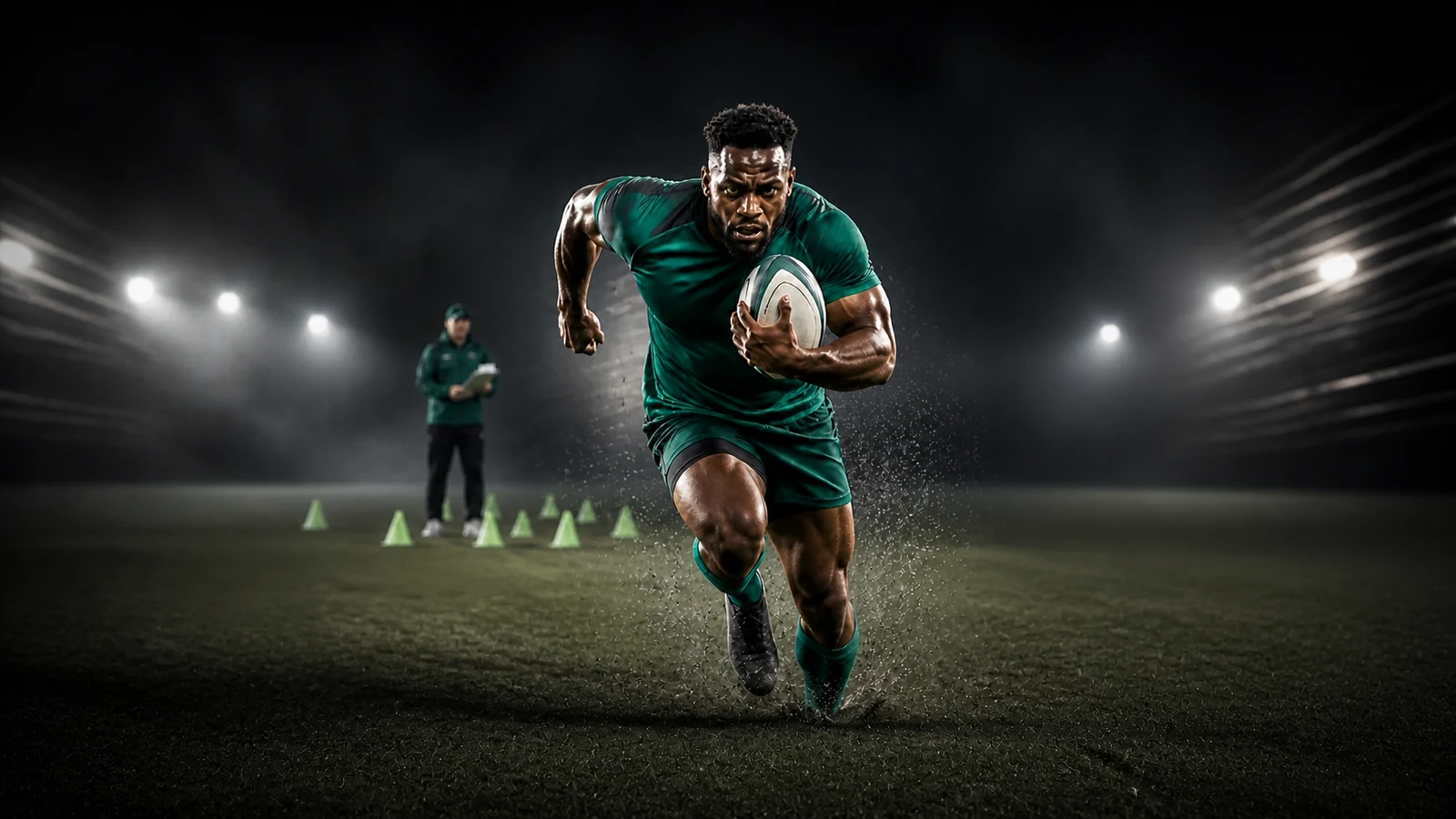

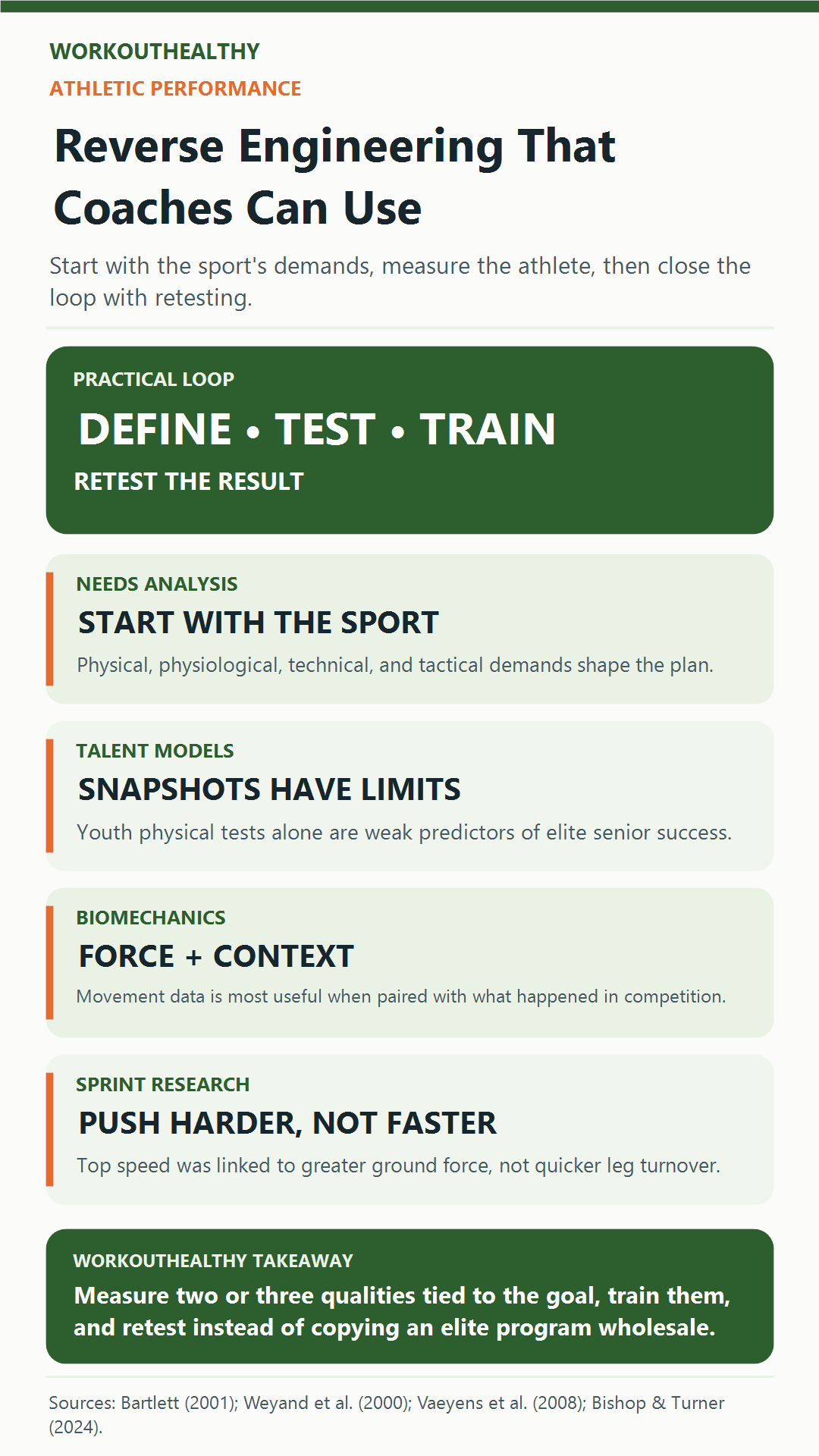
To improve athletic performance, choose one sport-specific result, measure it consistently, identify a plausible limiting skill or capacity, train that quality, and retest. This is a coaching loop, not a promise that copying a top athlete’s routine will reproduce their result.
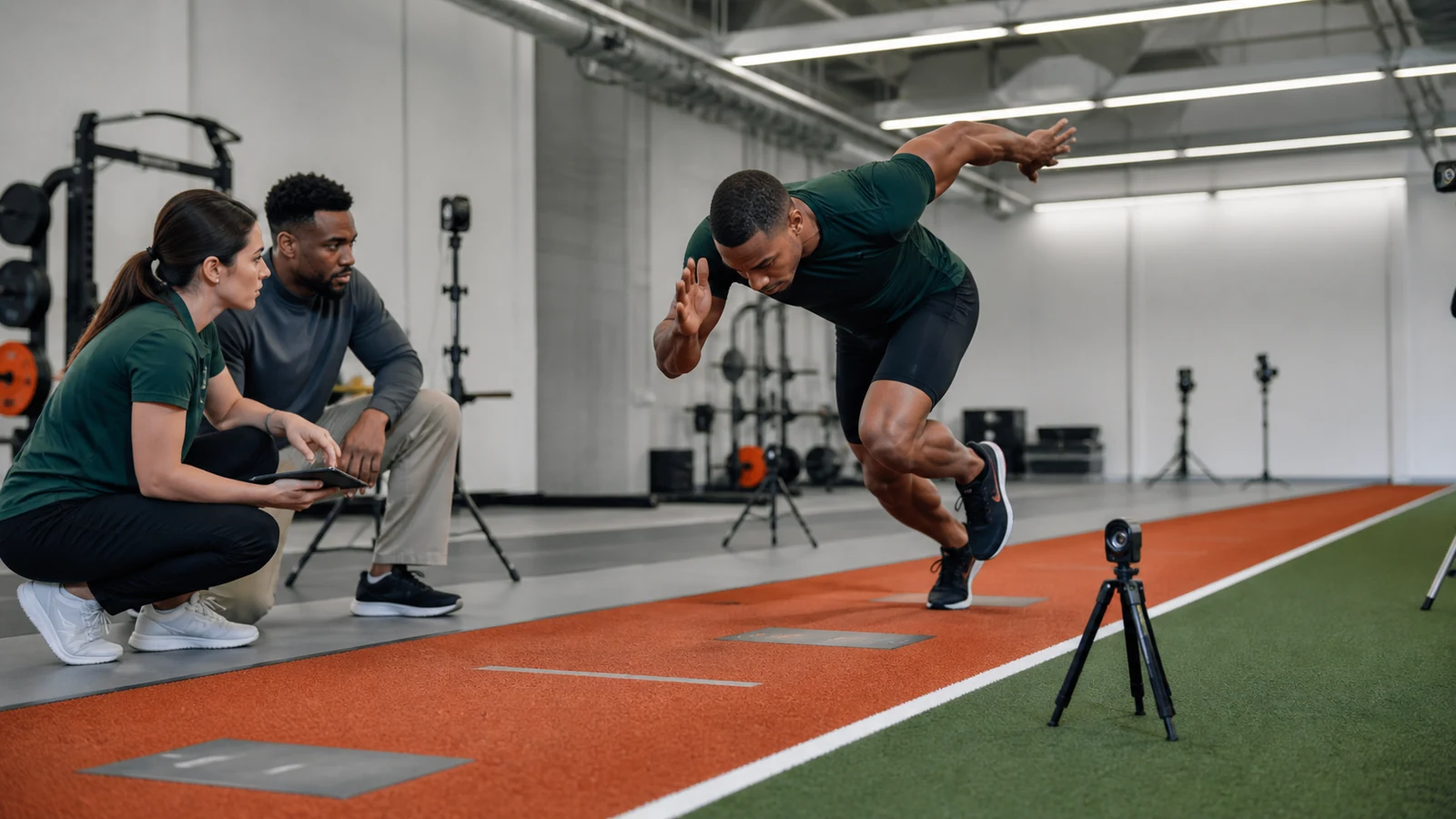
The field and laboratory scenes are illustrations, not records of the cited experiments, identified participants or prescribed exercise demonstrations.
North-West University describes performance-based reverse engineering. A needs analysis starts with sport demands and the individual athlete.
A five-step performance loop
- Define the result: Pick a competition outcome or skill that matters in your sport.
- Record a baseline: Repeat the same timing or scoring method and write down the conditions.
- Choose one testable bottleneck: Separate what you observed from your theory about why it happened.
- Train and recover: Select practice that fits your ability, schedule and injury history.
- Retest and decide: Keep, change or discard the hypothesis based on repeatable results.
A single number rarely captures a sport. Technical skill, pacing, tactics, strength, sleep and conditions can all influence the outcome, so the loop is more useful than a one-test diagnosis.
Worked example: a recreational 5K runner
The example below is fictional and shows a decision process, not a validated training prescription. It is for a person who already runs regularly and can do so comfortably; a new runner or someone returning from injury needs a different starting point.
| Step | Illustrative runner’s note | What it does and does not tell us |
|---|---|---|
| Goal and baseline | Run the same measured 5K route. Baseline time is 30:00 with kilometer splits of 5:30, 5:45, 6:00, 6:15 and 6:30. | The five splits total 30:00 and show a slower finish, but not the cause. |
| Hypothesis | The runner may be starting too fast or may need more endurance at this effort. | These are alternatives to test, not diagnoses from one run. |
| Training choice | For the next few weeks, keep familiar comfortable runs and practice an even starting pace on one repeatable route. | No elite mileage, target heart rate or required interval dose is copied. |
| Retest | On the same route, the fictional retest is 29:40, split 5:50, 5:55, 5:55, 5:55 and 6:05. | The splits total 29:40 and are more even; one improved attempt does not prove which change caused it. |
| Next decision | Repeat under similar conditions, then decide whether pacing practice helped or whether another limiting factor needs attention. | Weather, fatigue, measurement error and ordinary day-to-day variation remain possible. |
A coach could use the log to ask better questions, not to announce an exact physiological weakness. If the retest did not improve, the next step would be to check consistency, recovery, and whether pacing was actually the limiting issue before adding more work.
What research supports working backward?
Bishop and Turner’s 2024 chapter links needs analysis to sport demands, fitness tests and program design. The five-step worksheet here is our own planning aid.
Vaeyens and colleagues describe talent as dynamic and multidimensional, questioning traditional cross-sectional selection of adolescents. Their review favors development that considers maturation rather than excluding children early.
A famous sprinting study by Weyand and colleagues associated faster top speeds with greater ground forces rather than more rapid leg movements. That result concerns top running speed; it does not tell our fictional 5K runner what caused a slowing final kilometer or prove a specific strength routine will fix it.
Biomechanical and notational analysis can add useful observations when measured well, as Bartlett discussed. Video angles, timing quality and competition context still limit what a coach can infer from one highlight clip.
Why copying an elite plan can fail
An elite athlete may differ from you in event, training history, resources and recovery. A successful athlete’s habit could cause performance, follow success or be incidental.
Even an accurate biomechanical finding does not tell you the whole training path that created it. Use elite examples to generate ideas, then test whether an appropriate version helps your own measured goal.
For youth athletes, people returning from injury and people with persistent symptoms, a qualified coach or clinician should help set the test and training load. The example running log is not a return-to-sport plan.
How the source video fits
North-West University’s explainer presents reverse engineering as a way to learn from high-level performance. Its value is the question it raises: which qualities matter for a specific sport and athlete?
Watching an elite movement does not establish a proven recipe for everyone. The fictional 5K example illustrates a hypothesis check, not a champion’s secret.
Watch the North-West University video
Quick questions
What should I measure first?
Choose the result that represents your own sport goal, then use a repeatable method. If you cannot measure it reliably, start with a simpler record such as a consistent route, split or skill score.
How often should I retest?
Retest after enough consistent practice that a meaningful change is possible, using similar conditions. There is no universal retest interval that fits every event or training stage.
What if the number improves once?
Celebrate the progress, then repeat the measurement before crediting one training choice. A single better day can reflect pacing, conditions or normal variation.
Sources
- Bishop and Turner (2024), needs analysis, testing and program design chapter.
- Vaeyens et al. (2008), talent identification review.
- Weyand et al. (2000), top running speed and ground forces.
- Bartlett (2001), biomechanical and notational performance analysis.
This article gives general training information, not a personal performance or rehabilitation plan. Speak with a qualified coach or health professional when an injury, pain or medical condition affects training.