

Every experienced lifter in your gym was obvious once.
They loaded the bar wrong, rested for eleven minutes, and followed a program written for a professional bodybuilder.
The habits below are not embarrassing, and nobody is judging you as harshly as you think.
They are worth knowing because each one quietly slows your progress, and every single one has a fix that takes about five minutes to learn.
Here are eight of them, what the research says about the cost, and an honest answer about which fix matters most.
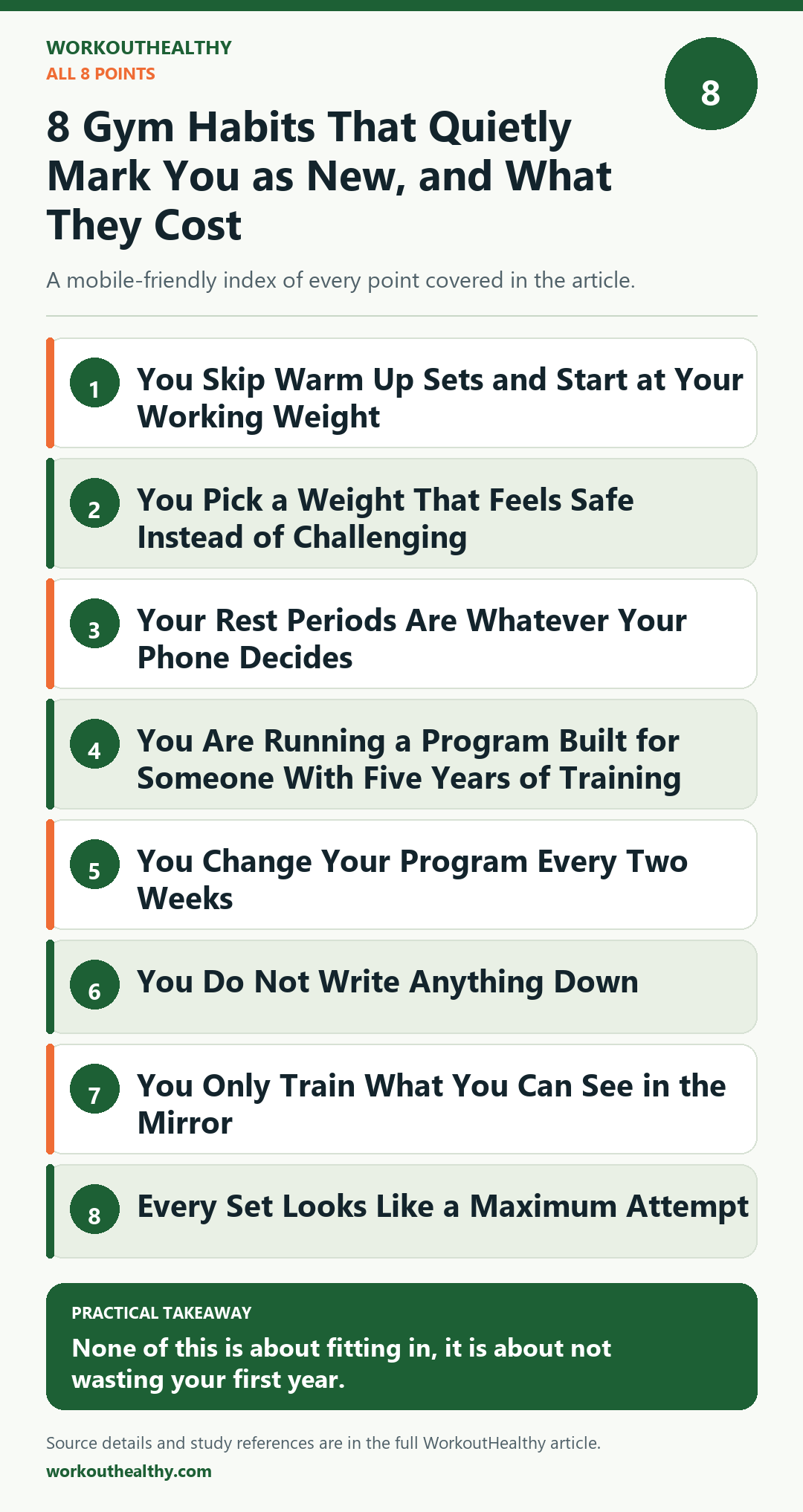
None of this is about fitting in, it is about not wasting your first year.
1. You Skip Warm Up Sets and Start at Your Working Weight
This is the clearest tell in the room.
A newer lifter walks up, loads the weight they plan to use, and starts.
Fradkin and colleagues reviewed 32 high quality studies and found that warming up improved performance in 79 percent of the measures examined.
That is a large share of measured outcomes pointing the same direction.
They also found little evidence that warming up harms performance, so the downside is close to zero.
Two or three lighter sets cost you four minutes and usually let you lift more in the sets that count.
Warm up sets also let you rehearse the movement pattern before the weight gets serious.
2. You Pick a Weight That Feels Safe Instead of Challenging
This is the opposite of the ego lifting stereotype, and it is far more common.
Glass and Stanton asked novice lifters to choose their own training weights and then measured those loads against each person’s one repetition maximum.
The self selected loads landed between roughly 42 and 57 percent of maximum.
That is well under what most strength guidelines call for.
Left to instinct, beginners underload almost every time, then wonder why eight weeks produced nothing.
A simple check is whether the last two reps of a set slow down noticeably.
If every rep moves at the same speed, the weight is probably too light to drive change.
3. Your Rest Periods Are Whatever Your Phone Decides
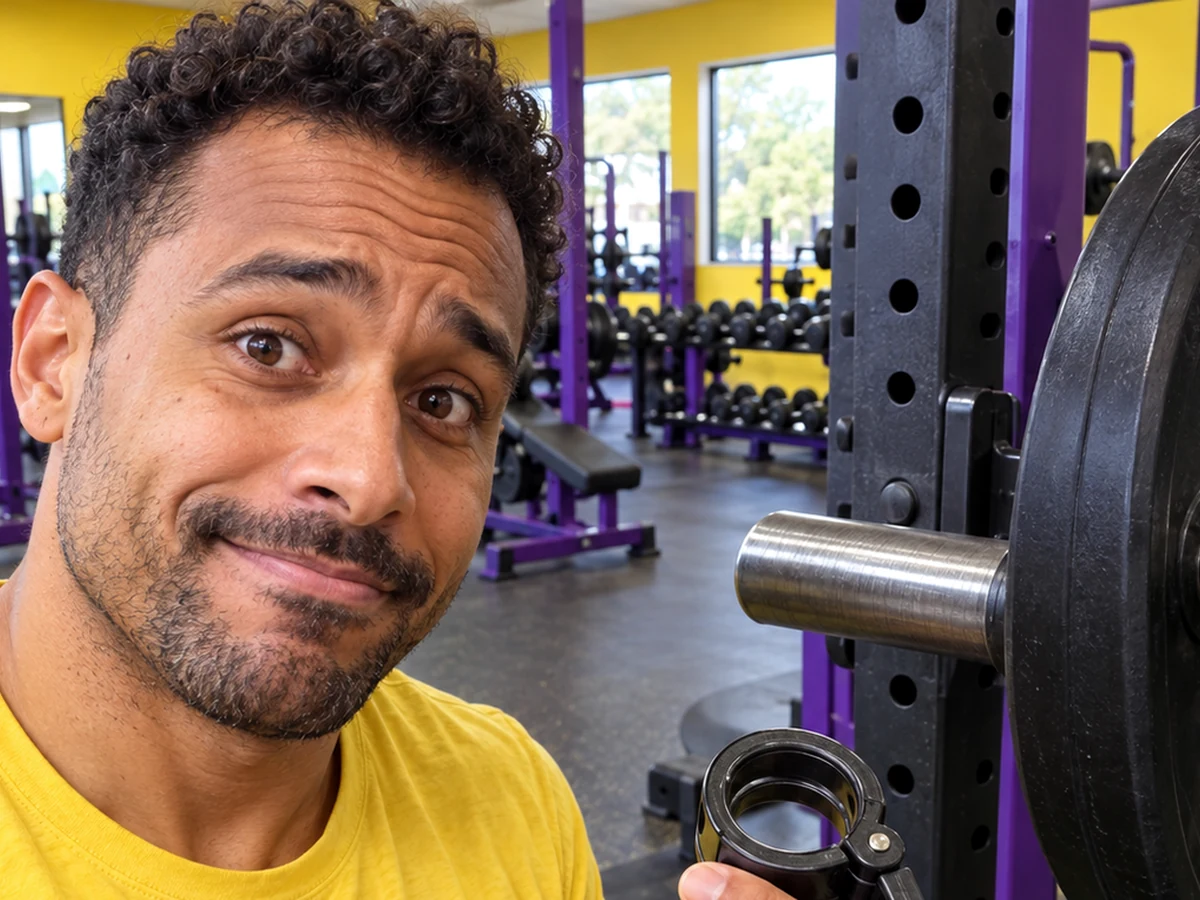
Newer lifters tend to rest until they feel like moving again, which usually means until a video ends.
Schoenfeld and colleagues compared one minute rest against three minute rest in trained men over eight weeks.
The three minute group gained more strength and more muscle thickness.
Longer rest let them keep more quality reps in later sets, which is where the growth signal lives.
Set a timer instead of guessing, and give yourself two to three minutes between hard sets of big lifts.
Small isolation work can use shorter rest, since fatigue matters less on a curl than on a squat.
Almost none of these habits are about looking foolish. They are about small leaks in a system, and a beginner who plugs three of them will out progress a beginner who plugs none.
4. You Are Running a Program Built for Someone With Five Years of Training
Advanced programs are written for people whose bodies no longer respond to simple things.
They pile on volume, specialty exercises, and intensity techniques designed to squeeze out the last few percent.
A beginner does not need any of that, because almost everything works in the first year.
Worse, that volume usually leaves you too sore to train the next session, so your weekly total drops.
Three sessions a week covering the whole body will beat a six day split for almost everyone in their first year.
Our guide to building a complete training program covers what a sensible starting structure looks like.
5. You Change Your Program Every Two Weeks
Program hopping feels productive because starting something new is exciting.
The problem is that progress in the gym is measured by whether last month’s weight is easier this month.
If the exercises keep changing, there is nothing to compare.
Give any reasonable plan eight to twelve weeks before you judge it.
Boredom is not evidence that a program failed.
If you genuinely need variety, change the accessory exercises and keep the main lifts fixed.
6. You Do Not Write Anything Down
Ask a beginner what they benched three weeks ago and you usually get a shrug.
Ask an experienced lifter and you get a number.
That difference is not memory, it is a record.
Human recall is unreliable about weights in a way that feels convincing at the time.
Without written sets, reps, and weights, you cannot tell whether you are progressing, stalling, or slowly going backward.
A notes app is enough, and our guide on what to record in a training log keeps it to about 30 seconds per session.
7. You Only Train What You Can See in the Mirror
Chest, arms, and abs get the attention, while the back, hamstrings, and glutes get whatever is left.
The muscles you cannot see are usually larger and matter more for everyday strength.
They also balance the joints that the mirror muscles pull on, especially the shoulders.
A simple rule fixes most of it: for every pushing set you do, do a pulling set.
Add one hip hinge movement each week and you have covered the biggest gap.
Rows, pull downs, and hip hinges are boring to photograph and hard to replace.
8. Every Set Looks Like a Maximum Attempt
Grinding, shaking, and bouncing on a set that was supposed to be moderate is a beginner signature.
It usually comes from treating every session as a test rather than as practice.
Most of your training should feel like you had two or three reps left in reserve.
Saving those reps is what lets you train again in 48 hours instead of limping for a week.
Testing your maximum once every few months is plenty.
Many of the strongest people in a commercial gym rarely take a big lift all the way to failure.
What This Evidence Does Not Prove
The Facebook post promised the single habit that speeds up a beginner’s progress fastest.
We need to be honest here: no study has ever ranked these habits against each other.
Nobody has run a trial where one group fixes their rest periods and another fixes their program choice, then measured who won.
So there is no research backed number one.
If you want the best supported answer rather than an invented one, it is this: track your lifts and make the weight or reps go up over time.
Progressive overload is the mechanism every one of these habits either supports or blocks.
Warm up sets protect it, sensible loads drive it, rest periods let you express it, and a log is how you see it.
The studies here also have limits worth stating plainly.
Schoenfeld tested trained men, not beginners, so the rest period numbers may not transfer exactly.
Glass and Stanton measured what novices chose on one occasion rather than following them for months.
And the warm up research covers athletic performance broadly, not injury prevention in a commercial gym.
Anyone telling you that warming up prevents a specific percentage of gym injuries is going beyond what these studies measured.
How to Fix All Eight in About a Month
Pick one habit per week rather than trying to overhaul everything on Monday.
Week one, add two warm up sets to your first exercise of every session.
Week two, start a training log and write down every working set.
Week three, set a timer for rest and hold yourself to two to three minutes on the big lifts.
Week four, audit your weekly plan for pushing and pulling balance and add a hip hinge if it is missing.
After that, commit to the same program for at least eight weeks and only change the weights.
Aim to add a small amount of weight or one extra rep whenever a set felt comfortable last time.
If you want faster feedback on technique, a handful of sessions with a coach is usually enough, and our piece on whether you need a personal trainer explains how to hire one without overcommitting.
Mistakes People Make While Fixing These Habits
- Jumping from underloading straight to maximum attempts in a single week.
- Adding so much warm up work that there is no energy left for the working sets.
- Turning the training log into a spreadsheet so detailed you stop filling it in.
- Resting three minutes between every set, including curls, and finishing a workout in two hours.
- Dropping all chest and arm work to punish yourself for mirror training.
- Assuming that because a beginner program is simple, more of it must be better.
Every one of these is an overcorrection rather than a fix.
Small, boring adjustments held for months beat dramatic ones held for a fortnight.
The people who look experienced are mostly people who kept doing unremarkable things for a long time.
Who Should Check With a Doctor Before Starting
Most healthy adults can start resistance training without medical clearance.
Some people should have a conversation first.
Talk to a doctor if you have heart disease, uncontrolled high blood pressure, or chest discomfort with exertion.
The same goes for a recent surgery, a hernia, or a joint injury that has not been assessed.
Dizziness, fainting, or unusual shortness of breath during light activity all deserve checking before you add load.
If you are pregnant, managing diabetes, or taking medication that affects heart rate or blood pressure, ask what adjustments make sense for you.
Clearance almost never means no training, it usually means a sensible starting point.
Want the reasoning, not just the rules? Subscribe to WorkoutHealthy Insider for practical explanations behind popular fitness claims.
References
Fradkin, A. J., Zazryn, T. R., & Smoliga, J. M. (2010). Effects of warming-up on physical performance: A systematic review with meta-analysis. Journal of Strength and Conditioning Research, 24(1), 140 to 148. https://doi.org/10.1519/JSC.0b013e3181c643a0
Glass, S. C., & Stanton, D. R. (2004). Self-selected resistance training intensity in novice weightlifters. Journal of Strength and Conditioning Research, 18(2), 324 to 327. https://doi.org/10.1519/R-12482.1
Schoenfeld, B. J., Pope, Z. K., Benik, F. M., Hester, G. M., Sellers, J., Nooner, J. L., Schnaiter, J. A., Bond-Williams, K. E., Carter, A. S., Ross, C. L., Just, B. L., Henselmans, M., & Krieger, J. W. (2016). Longer interset rest periods enhance muscle strength and hypertrophy in resistance-trained men. Journal of Strength and Conditioning Research, 30(7), 1805 to 1812. https://doi.org/10.1519/JSC.0000000000001272
This article is for general information only and is not medical advice. If you have an injury, ongoing pain, or a medical condition, talk to a doctor or physical therapist before you change how you train or eat.