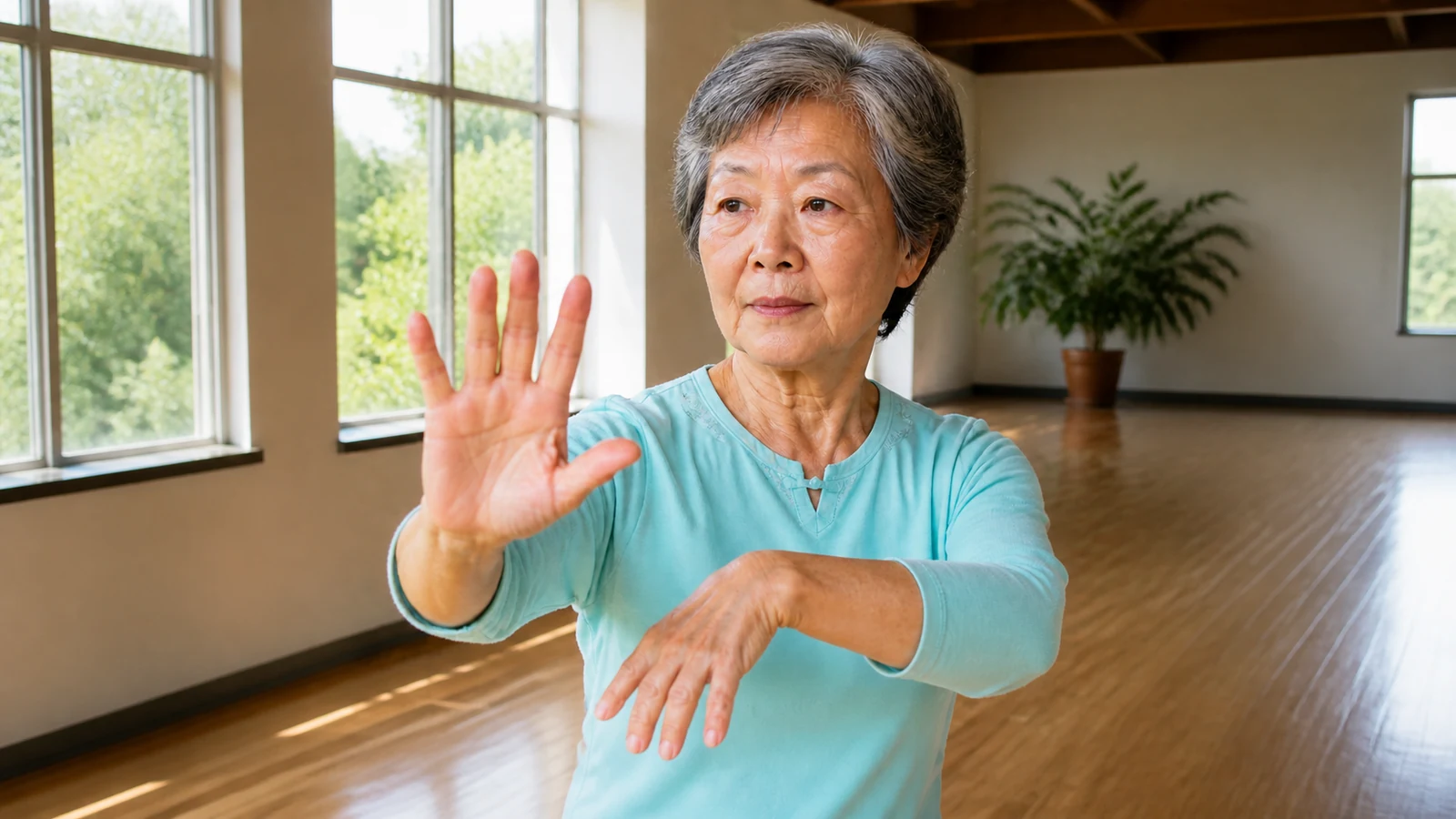

A short YouTube video is making a big promise.
It claims eight minutes of tai chi style finger and hand exercises can boost your brain, your memory, and even your heart.
That is an exciting idea, especially for anyone worried about memory as they get older.
But is it something real research actually supports, or is it a workout video borrowing the language of a lab report?
We looked into real, peer-reviewed research on tai chi and the brain, and on hand and finger exercises specifically, to find out.
The short answer is that those two claims are not equally supported by the science.
What the Video Claims
The video comes from a YouTube channel called Taichi Workout.
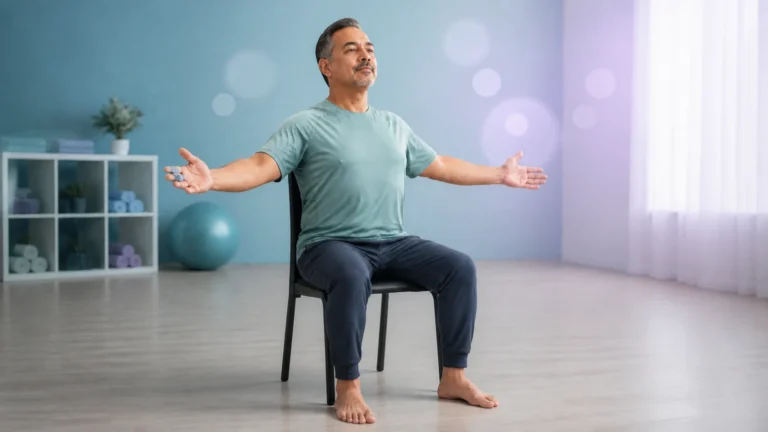
In it, an instructor leads viewers through an eight minute routine of hand stretches, finger movements, and wrist circles done in a tai chi style.
The title promises the routine will “boost your brain, memory and heart” in that short window of time.
That is a lot to pack into eight minutes and a title.
Videos like this often borrow a real, credible idea, and tai chi does have genuine research behind it, then stretch it further than the evidence actually goes.
Our job here is to separate what is solidly supported from what is closer to hopeful marketing.
What Real Research Shows About Tai Chi and the Brain
Tai chi itself, the slow, whole body movement practice, has been studied for decades.
A 2014 systematic review and meta-analysis in the Journal of the American Geriatrics Society pooled results from multiple studies on tai chi and thinking skills in older adults (Wayne et al., 2014).
The researchers found that people who practiced tai chi tended to perform better on tests of executive function than people who did not exercise at all.
Executive function covers skills like planning, focus, and switching smoothly between tasks, and it is one of the abilities that tends to slip with age.
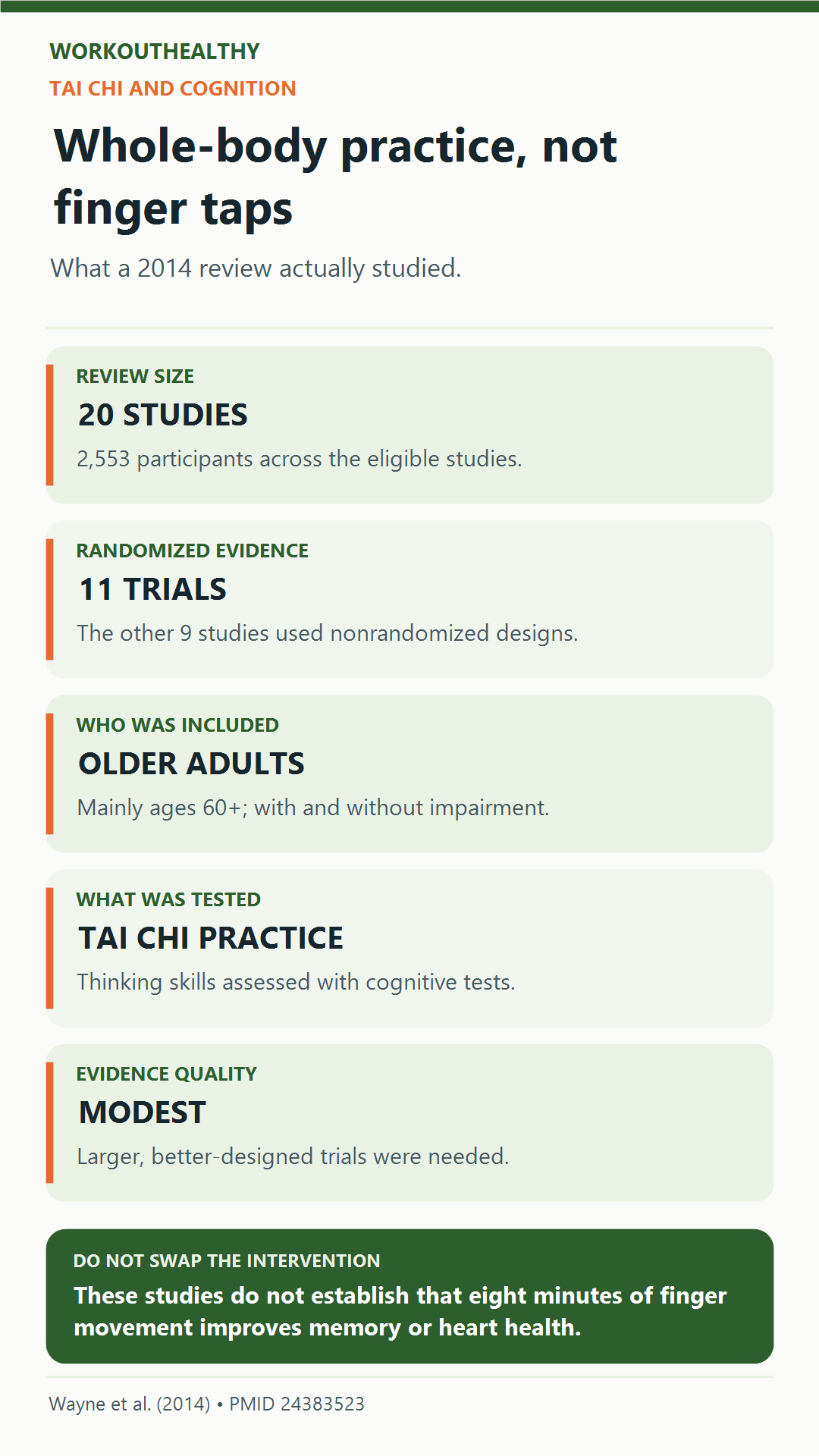
The review also found tai chi performed about as well as other active interventions, like walking programs, rather than being uniquely powerful on its own.
That is an important detail, because it points to whole body movement and staying active in general, not to any one specific technique.
Similar patterns show up in research comparing different forms of exercise and brain health, including work we covered in our piece on whether lifting weights keeps your brain young.
Tai chi’s real strength in the research is consistent, not dramatic. It shows up again in studies on balance, blood pressure, and older adult thinking skills.
The Mechanism: Why a Practice Like Tai Chi May Help the Brain
Researchers have started looking directly at the brain itself, not just at test scores.
A 2017 study in Scientific Reports used brain scans to compare longtime tai chi and baduanjin practitioners with people who did not practice either (Tao et al., 2017).
Baduanjin is a related slow, mind body movement practice, sometimes called the eight brocades.
The practitioners showed different patterns of connectivity in brain networks tied to attention and cognitive control, compared to the non-practicing group.
That does not prove tai chi caused those differences, since the study compared groups rather than tracking change over time in a controlled trial.
Still, it is a real, specific finding, not a vague claim about “boosting brain power.”
The likely mechanism behind tai chi’s effects is not any single arm or hand motion.
It is the combination of physical movement, balance challenge, breath control, and sustained mental focus required to follow a slow, coordinated sequence.
That combination is very different from eight minutes of simple, repetitive finger taps copied from a video.
Tai Chi and Heart Health: A Closer Look
The heart part of the video’s claim has its own separate research trail.
A systematic review in Preventive Cardiology looked specifically at tai chi and blood pressure (Yeh et al., 2008).
The authors found that many, though not all, of the available studies reported real drops in blood pressure among people who practiced tai chi regularly.
The effect looked strongest in people who started out with high blood pressure to begin with.
The authors were also careful to note that study quality varied a lot across the research they reviewed, and they called for larger, better designed trials.
That is a familiar pattern in exercise science, a real signal worth taking seriously, paired with a clear call for more rigorous testing.
It also mirrors what we found when we looked into sauna use and heart health, where a real association exists but does not prove a specific mechanism on its own.
None of this heart research measured finger or hand exercises on their own, only tai chi as a full practice.
Tai Chi and Balance: The Best Proven Benefit of All
If there is one area where tai chi research is genuinely strong, it is balance and fall prevention.
A meta-analysis in the International Journal of Gerontology pooled data from multiple randomized controlled trials on tai chi and falls in older adults (Hu et al., 2016).
The pooled results showed tai chi meaningfully reduced fall rates and improved balance test scores compared to control groups.
This is one of the most consistent findings in the entire body of tai chi research, and it matters a great deal for older adults.
A fall in later life is not a small event, as our coverage of Misty Copeland’s hip replacement recovery shows in detail.
Better balance, built through slow, controlled, whole body movement, is arguably tai chi’s single most trustworthy, well documented benefit.
What About Finger and Hand Exercises Specifically?
Here is where the video’s framing starts to outrun the evidence.
Everything above is about tai chi as a full practice, using the whole body, the legs, the core, the arms, balance, and breath together.
The video in question is narrower than that, focused mainly on finger and hand movement done while seated or standing still.
The research base for fine motor hand exercise, on its own, meaningfully changing memory or heart health is much thinner and far more speculative.
There is real research connecting the hands to brain aging, but it looks different than the video suggests.
A 2020 study in the Journal of the American Medical Directors Association followed aging Americans over time and found that weaker hand grip strength was associated with more cognitive decline over the following years (McGrath et al., 2020).
That is a genuinely interesting finding, and it is worth taking seriously.
But it is an association from observational data, not a test of finger exercises improving memory.
Weaker grip strength may simply reflect broader declines in muscle mass, nerve function, and overall health, all of which independently relate to brain aging on their own.
A separate, often cited study in Nature looked at what happens when people learn a genuinely complex new motor skill (Draganski et al., 2004).
Participants who practiced juggling for about three months showed measurable increases in gray matter in brain regions that process visual motion.
When they stopped practicing, some of that increase faded over the following months.
That is real evidence that sustained, challenging motor practice can change brain structure over time.
But learning to juggle for three months is a very different task than eight minutes of simple finger taps, and the study never measured memory or heart health at all.
No study has shown that eight minutes of finger movement alone boosts memory or heart health. That specific claim is a marketing promise, not a research finding.
What This Evidence Does Not Prove
It is worth being direct about the gaps here.
No study we found tested an isolated, eight minute finger and hand routine against a real memory or heart health outcome.
The tai chi research covers full body practice done over weeks or months, not a short seated hand drill.
The grip strength research is correlational, meaning it shows a connection, not a proven cause and effect.
The juggling research shows brain change from a demanding new skill learned over months, not from a brief daily warm up.
None of this means finger movement is useless or that the video is lying outright.
It means the specific promise of the title, that eight minutes of finger work alone will boost your brain, memory, and heart, is not something the current science can back up.
Common Mistakes People Make
One common mistake is treating a short finger routine as a full workout.
Eight minutes of seated hand movement raises your heart rate very little, if at all.
Another mistake is expecting fast results from a slow practice.
The tai chi studies that found real benefits generally involved months of consistent practice, not a single video watched once.
People also tend to skip the parts of tai chi that seem to matter most, the balance challenge and the whole body coordination, while keeping only the parts that are easiest to film in a close up shot of the hands.
Finally, some people assume a claim is proven simply because a video cites “research” without naming a specific study.
Always ask what was actually measured, in whom, and for how long.
Who Should Check With a Doctor First
Tai chi and gentle hand exercises are generally low risk for most healthy adults.
Even so, a few groups should talk to a doctor or physical therapist before starting.
That includes anyone with arthritis or joint problems in the hands, wrists, or shoulders that flare up with repeated movement.
People with a recent stroke, uncontrolled high blood pressure, or a heart condition should also check in first, since even gentle exercise changes how the heart works.
Anyone with a recent fall, balance problems, or a condition like Parkinson’s disease should ask a professional before adding a new standing balance practice.
If a movement causes sharp pain, numbness, or tingling in the hands, stop and get it checked rather than pushing through it.
How to Actually Build This Into Your Week
If the finger and hand routine looks appealing, there is no real harm in doing it.
Just do it with realistic expectations, as a small addition rather than a brain boosting shortcut.
Pair it with something that has stronger evidence behind it for the same goals.
A daily walk is a good place to start, since simple step counts are linked to lower mortality risk in large studies, as we cover in our breakdown of daily steps and mortality.
If you want the actual tai chi research to apply to you, look for a real, full body tai chi or baduanjin class, in person or on video, rather than a hand-only routine.
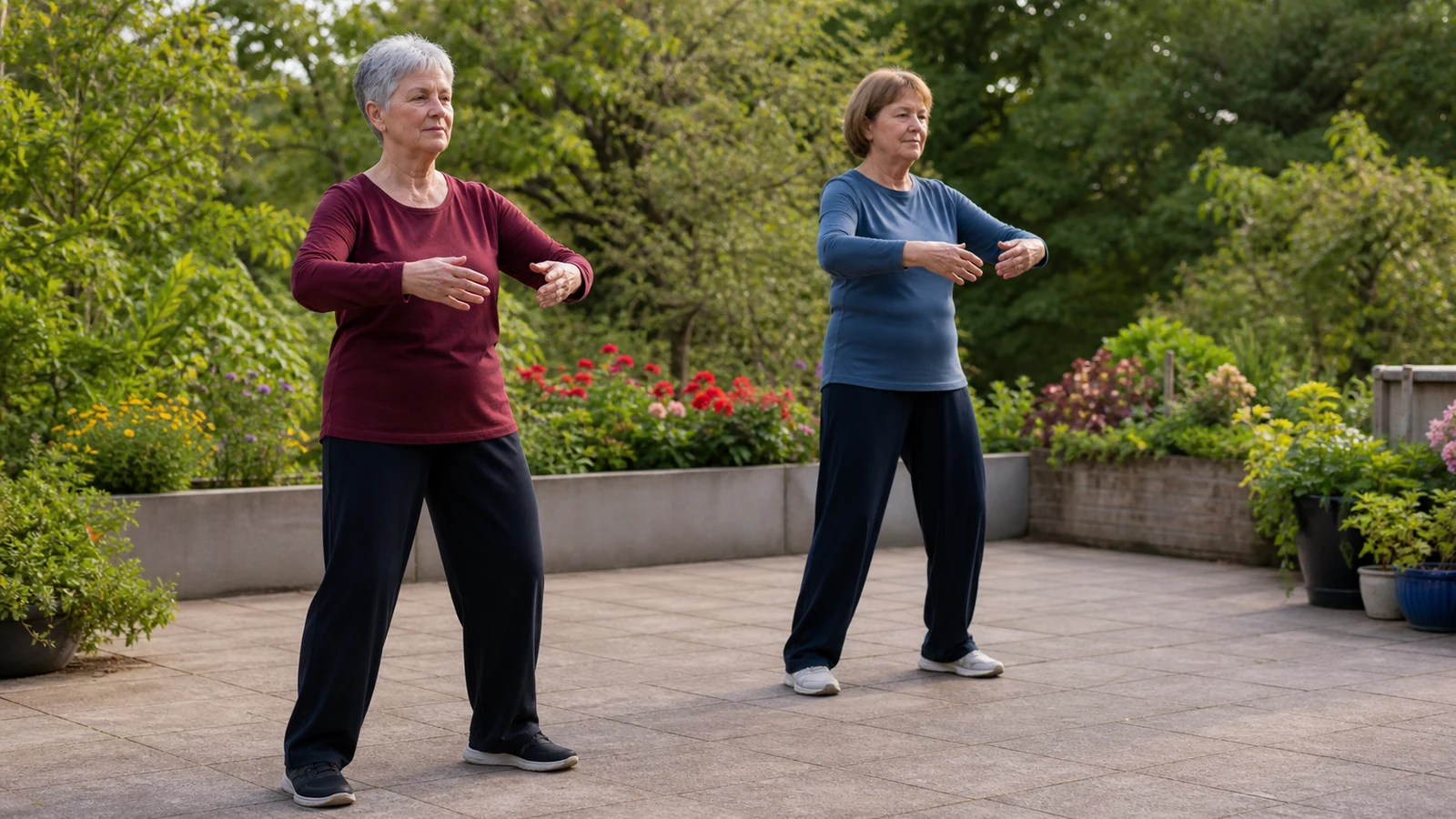
Aim for consistency over weeks and months, since that is the timeframe the research actually measured.
Two to three sessions a week of twenty to thirty minutes each is a reasonable starting target, based on the routines used in most of the studies above.
Keep movements slow and controlled, and focus on shifting your weight and balance, not just moving your arms.
If balance is a specific concern, mention that to your doctor and ask whether a tai chi based fall prevention class is available near you.
Treat the finger and hand portion, if you enjoy it, as a pleasant warm up or a relaxing habit, not a substitute for the whole practice.
Watch the Original Video
Want more like this? Subscribe to WorkoutHealthy Insider for practical explanations behind popular fitness claims.
References
Draganski, B., Gaser, C., Busch, V., Schuierer, G., Bogdahn, U., & May, A. (2004). Neuroplasticity: Changes in grey matter induced by training. Nature, 427(6972), 311 to 312. https://doi.org/10.1038/427311a
Hu, Y. N., Chung, Y. J., Yu, H. K., Chen, Y. C., Tsai, C. T., & Hu, G. C. (2016). Effect of tai chi exercise on fall prevention in older adults: Systematic review and meta-analysis of randomized controlled trials. International Journal of Gerontology, 10(3), 131 to 136. https://doi.org/10.1016/j.ijge.2016.06.002
McGrath, R., Vincent, B. M., Hackney, K. J., Robinson-Lane, S. G., Downer, B., & Clark, B. C. (2020). The longitudinal associations of handgrip strength and cognitive function in aging Americans. Journal of the American Medical Directors Association, 21(5), 634 to 639. https://doi.org/10.1016/j.jamda.2019.08.032
Tao, J., Chen, X., Egorova, N., Liu, J., Xue, X., Wang, Q., Zheng, G., Li, M., Hong, W., Sun, S., Chen, L., & Kong, J. (2017). Tai Chi Chuan and Baduanjin practice modulates functional connectivity of the cognitive control network in older adults. Scientific Reports, 7, 41581. https://doi.org/10.1038/srep41581
Wayne, P. M., Walsh, J. N., Taylor-Piliae, R. E., Wells, R. E., Papp, K. V., Donovan, N. J., & Yeh, G. Y. (2014). Effect of Tai Chi on cognitive performance in older adults: Systematic review and meta-analysis. Journal of the American Geriatrics Society, 62(1), 25 to 39. https://doi.org/10.1111/jgs.12611
Yeh, G. Y., Wang, C., Wayne, P. M., & Phillips, R. S. (2008). The effect of tai chi exercise on blood pressure: A systematic review. Preventive Cardiology, 11(2), 82 to 89. https://doi.org/10.1111/j.1751-7141.2008.07565.x
This article is for general information only and is not medical advice. If you have an injury, ongoing pain, or a medical condition, talk to a doctor or physical therapist before you change how you train or eat.