

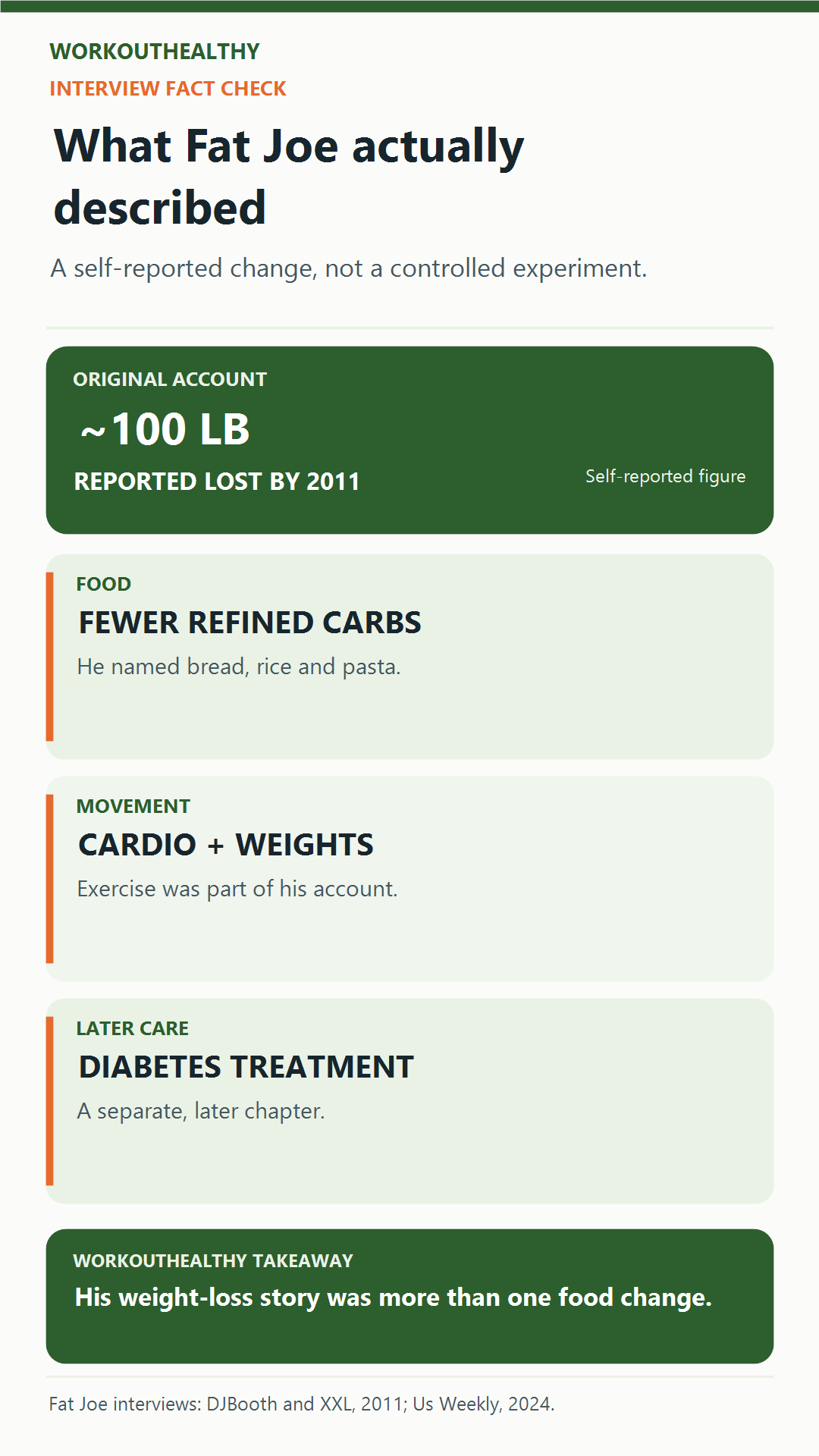
Fat Joe’s weight-loss story is often compressed into a simple rule: cut refined carbohydrates and keep going to the gym. Those choices appear in his own interviews, but the phrase “one change caused 100 pounds” leaves out the timeline, exercise, portions, and later medical care. In 2011, he described losing nearly 100 pounds while changing how he ate and doing regular cardio and weights. In a 2024 interview, he said he still paid attention to bread, pasta, and rice, and also disclosed using semaglutide for diabetes. Those are different points in a long health story, not a controlled experiment that identifies one cause (DJBooth, 2011; XXL, 2011; Somers, 2024).
There is a constructive lesson here: replacing one habitual, low-satiety food choice can be easier to sustain than a total overnight diet overhaul. There is also a limit: neither Joe’s experience nor nutrition research says all carbohydrate foods are harmful, or that anyone should copy his portions, workouts, or medication decisions.
What he said about the first major loss
In a 2011 DJBooth interview, Joe was congratulated for losing almost 100 pounds that year. He described reducing bread, rice, and pasta while working out. His advice to a beginner was to start with roughly 20 to 30 minutes of activity, even a walk, rather than trying to train brutally from the first day (DJBooth, 2011). This was his personal account, not a verified clinical record of exact weight, duration, or calorie intake.
Another 2011 interview with XXL gives more context. Joe described having lost friends to heart attacks, which changed how urgently he viewed his health. He said he still ate some carbohydrate at breakfast, while limiting it at later meals, and described both cardio and weight training. He also talked about the effort of changing a longstanding eating pattern (XXL, 2011). That is a more complex story than simply crossing one ingredient off a shopping list.
The social graphic’s roughly 100-pound number is therefore directionally consistent with the early interview record. What is not established is a neat causal formula of “remove refined carbs, add gym, lose exactly 100 pounds.” We do not have a complete food diary, measured activity volume, or comparison group. The honest version treats his account as motivation and context, not as a test of a diet.
Why it was more than one change
When someone removes a frequent high-calorie snack or large refined-grain portion, several things can change at once. They may eat fewer calories, shift meal timing, add more filling foods, or become more deliberate about serving size. Joe also reported sustained exercise. None of those effects can be isolated from one another in an interview.
That distinction protects the useful lesson. A person who routinely eats a large portion of pasta with a sugary drink may feel better and eat less by changing the portion, swapping a whole-grain or legume option, and adding vegetables or protein. Another person who already eats moderate portions and plenty of fiber may gain little from removing the same food. Starting point matters more than a celebrity’s forbidden-food list.
Joe’s 2011 comments were also about a particular period. Later interviews covered continued weight management. A single “before and after” number cannot tell readers what he maintained, regained, or changed over more than a decade. Treating a long, evolving process as one irreversible breakthrough risks making normal fluctuations look like failure.
Refined carbs versus carbohydrate quality
Carbohydrate is a broad category. White bread, beans, fruit, oats, and sweetened drinks all contain carbohydrate, but they differ in fiber, protein, water, micronutrients, and how they fit into a meal. Advising everyone to “cut carbs” discards those distinctions. For people living with diabetes, the American Diabetes Association’s 2026 standards emphasize high-quality, minimally processed, nutrient-dense, high-fiber carbohydrate sources regardless of the overall carbohydrate amount selected with a clinician (ADA, 2026).
Refined flour products and added-sugar snacks can be easy to eat in large amounts while contributing less fiber than whole-food alternatives. Reducing them may be a useful strategy, especially if the replacement is satisfying and nutritionally richer. It does not follow that a serving of whole fruit, beans, or intact whole grains should be feared. Even Joe noted in a 2024 interview that he still consumed some carbohydrates; portion control was part of his current thinking (Somers, 2024).
Research also warns against declaring one macronutrient pattern universally superior. In the 12-month DIETFITS randomized trial, healthy low-fat and healthy low-carbohydrate groups did not have a statistically significant difference in average weight loss (Gardner et al., 2018). Participants received behavioral guidance and were encouraged to improve food quality. The trial does not prove any two diets are identical for every person; it shows that a low-carb label alone is not a guaranteed advantage.
The more useful principle is to look at the whole eating pattern, not just one nutrient number. Choosing more fiber-rich foods can improve dietary quality without requiring someone to avoid every carbohydrate. The research and first-person sources below support that narrower message; they do not prove that a single swap caused his weight loss.
What blood-sugar language misses
The Facebook caption says refined carbohydrates digest quickly and spike blood sugar. Some refined, low-fiber foods can produce a faster glucose response than higher-fiber alternatives, but the response depends on the food, portion, other foods eaten with it, and the person’s physiology. “All refined carbs always spike everyone” would be an overstatement. The word spike can make ordinary post-meal glucose changes sound automatically dangerous.
For someone with diabetes, carbohydrate quantity and timing can matter for glucose management, especially when insulin or other glucose-lowering drugs are involved. That makes clinician-guided planning more important, not less. The ADA notes that very-low-carbohydrate plans can require medication adjustment and monitoring to avoid low blood sugar. No one should change medication on the strength of a celebrity anecdote or social post (ADA, 2026).
Weight loss, blood glucose, and long-term health are related but not interchangeable outcomes. A lower scale reading does not prove a particular food is uniquely harmful; a post-meal glucose rise does not prove that eliminating an entire food group will improve someone’s overall diet. Sleep, activity, stress, total intake, and medical conditions all affect the picture.
The later diabetes-treatment disclosure
In a 2024 Us Weekly interview, Joe said he used Ozempic for diabetes and that it had helped him keep weight off. This disclosure belongs in any honest retelling of his broader weight-management story, but the timing matters. It should not be retroactively described as the cause of his already documented 2011 weight loss (Somers, 2024).
Nor should readers turn the disclosure into a debate about whether his earlier food and exercise choices were “real.” Chronic conditions often require more than one kind of support over time. Medication, eating patterns, activity, and clinical follow-up can all have distinct roles. The public interviews do not contain enough information to assign a percentage of his long-term change to any one component.
Semaglutide is a prescription medication with eligibility, monitoring, and potential adverse effects that must be discussed with a clinician. It is not a substitute for evaluating a person’s health needs, and it is not appropriate to infer Joe’s private medical history beyond what he chose to disclose publicly. The important editorial point is simply that “one food swap did it all” is incomplete.
A practical, non-extreme food swap
If Joe’s story prompts you to change one thing, make it specific and observable. Pick a food or drink you consume most days, note its typical portion and what it tends to displace, then choose a replacement you actually enjoy. For example, a large sweetened drink could become a smaller serving or water; a low-fiber side could become beans or a whole-grain option. The goal is a food pattern that remains satisfying, not a purity test.
Try the change for a few weeks and pay attention to hunger, energy, digestion, and how repeatable it feels. You can add gentle movement separately, beginning near your current capacity. Joe’s own early advice to start with a walk is more accessible than assuming everyone must copy a celebrity’s gym schedule. If you have diabetes or another condition affected by food intake, review changes with your care team, especially if you use medicine that can lower glucose.
A useful experiment also asks what the swap replaces. Removing bread from a meal but adding an equally large dessert may not improve the outcome you care about. Replacing a refined item with a fiber-rich food can help food quality even if weight does not change quickly. Individual results vary, and sustainability is more meaningful than a dramatic first week.
Bottom line
Fat Joe did publicly credit reducing bread, rice, and pasta while exercising during an early, roughly 100-pound weight-loss period. He also described cardio, weights, portions, motivation, and later diabetes treatment. It is fair to say that a focused change helped him organize his habits; it is not fair to present that one change as the proven, sole cause of his weight loss.
For readers, the better takeaway is to choose one sustainable improvement in food quality or portion size and pair it with activity you can repeat. Keep nutritious carbohydrate foods in the conversation, and make medical decisions with a qualified professional. This article is general information, not individualized diabetes or weight-loss treatment.
References
- DJBooth. (2011). Fat Joe jumps “In the Mix” [exclusive interview].
- XXL. (2011, July 19). Fat Joe chats about losing weight and new music.
- Somers, C. (2024, October 15). Fat Joe opens up about diet changes and Ozempic for diabetes. Us Weekly.
- Gardner, C. D., et al. (2018). Effect of low-fat vs low-carbohydrate diet on 12-month weight loss in overweight adults: The DIETFITS randomized clinical trial. JAMA, 319(7), 667–679.
- American Diabetes Association Professional Practice Committee. (2026). Facilitating positive health behaviors and well-being to improve health outcomes: Standards of Care in Diabetes—2026. Diabetes Care, 49(Supplement 1).