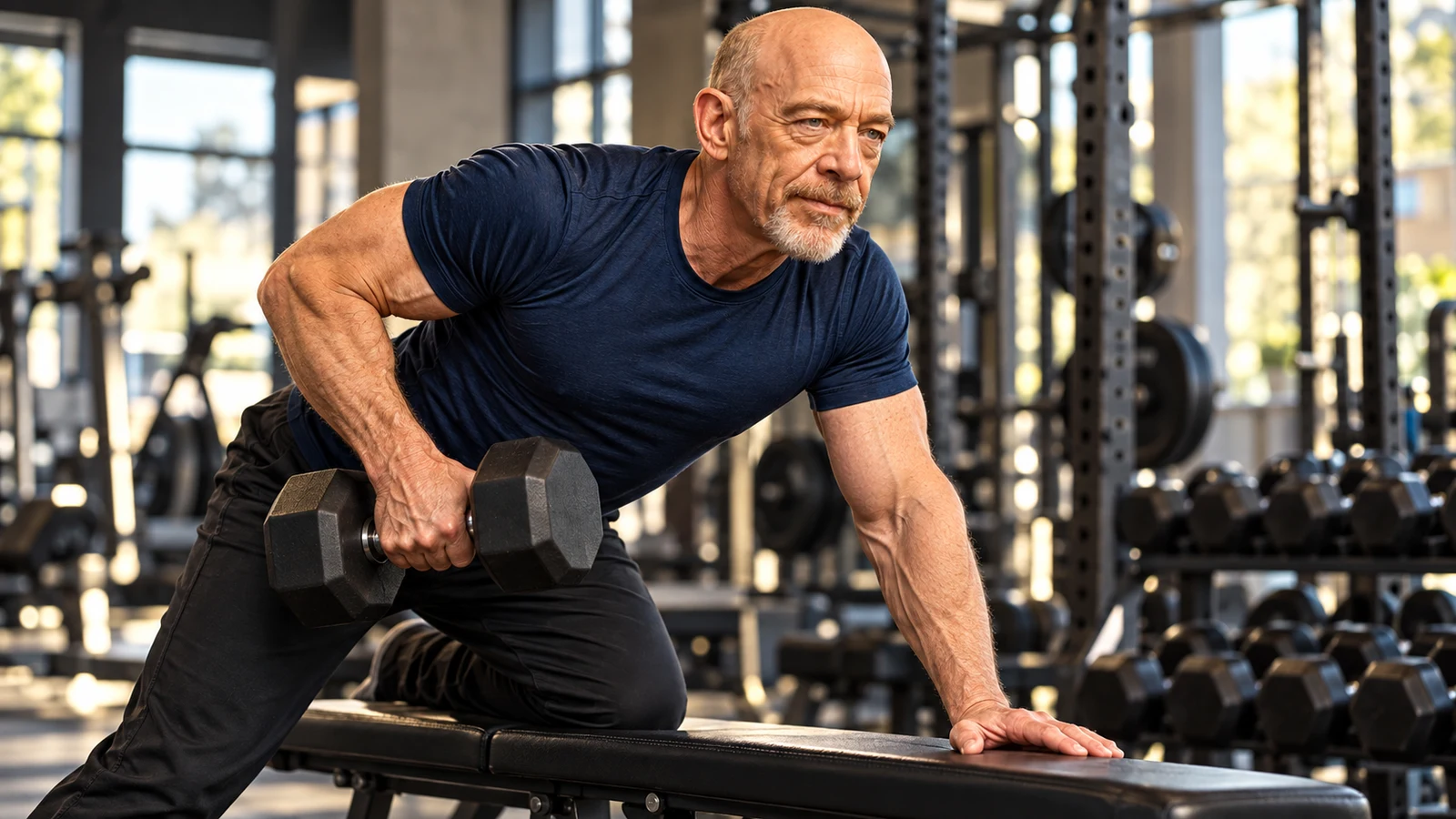

J.K. Simmons’s muscular gym photos at 61 were real, but the common explanation for them was wrong. When the images circulated in 2016, headlines linked them to his role as Commissioner Gordon in Justice League. Simmons later said the timing was coincidental: he was working out with trainer Aaron Williamson and wanted to take better care of himself, not transform for that specific film. This distinction is the starting point for any accurate fitness story about the actor.
The photos can still challenge an unhelpful belief that strength work stops mattering after 60. But they cannot reveal his complete program, dietary intake, genetics, recovery, or how his body changed over time. A social image is not a training log. The useful story is what Simmons actually said, what the aging-and-exercise evidence supports, and how a regular person can build a practical strength routine without trying to duplicate a celebrity physique.
How the viral story started
In 2016, Williamson shared gym images of the 61-year-old actor. Simmons had been cast as Commissioner Gordon, so many reports connected his visible musculature with the upcoming superhero film. It made a neat entertainment headline. But a neat timeline is not proof of motive. In a 2017 firsthand Rotten Tomatoes interview, Simmons said he was working out with a friend and trainer, and that the pictures had nothing to do with Commissioner Gordon.
His earlier comments, reported by TheWrap from a firsthand interview, said the same thing: he liked to work out and was not going to the gym because of Justice League. He connected the habit to wanting to care for himself after a period when he had felt out of shape. That is not the same as claiming he followed a movie-studio body transformation plan.
The correction matters because it changes the lesson. The story is not “actor gets ripped for a superhero role in a few weeks.” It is an older adult who had made exercise part of his life and happened to be photographed during a period of public attention. The public sources do not provide the start date or precise sequence needed to credit a specific physique to a particular short-term program.
What we know—and what we do not
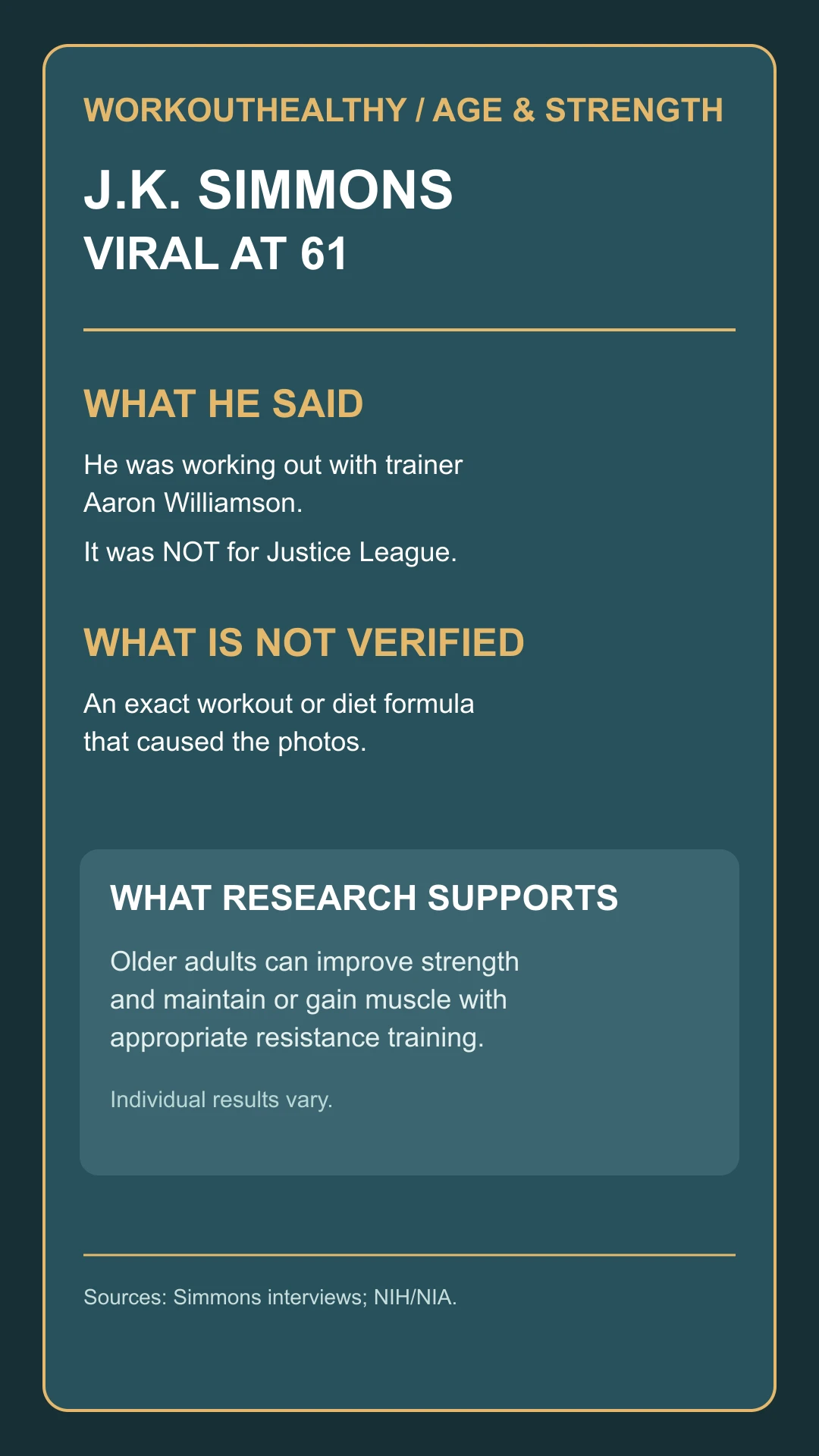
We know Simmons trained with Aaron Williamson, because both the trainer’s original photos and Simmons’s later description establish that connection. We know the actor rejected the claim that he was going to the gym for the Commissioner Gordon role. We know the 2016 photos showed a notably muscular 61-year-old. We do not know every exercise, set, load, frequency, calorie target, or recovery strategy that produced the look in those images.
A scheduled social caption said a carefully managed diet was part of the formula and attributed a “consistency, not intensity” message directly to Simmons. That language may sound reasonable as general fitness advice, but the interviews checked for this article do not establish the details or that specific quotation. The corrected version should not put unsupported words in his mouth.
Photos also reflect lighting, angle, timing, muscle pump, and individual body composition. None of that makes the training fake; it simply means a still frame cannot quantify muscle gained, strength improved, or health outcomes. Exercise advice built around a viral image has to be more cautious than the image itself.
Can people build strength after 60?
Yes. The National Institute on Aging explains that resistance training can help older adults maintain muscle mass, improve mobility, and preserve function. A systematic review of randomized trials examined lower-body muscle growth after supervised resistance training in older adults. The amount and rate of change vary, but the idea that muscle cannot respond to training after a milestone birthday is not supported.
Age-related losses in muscle and strength are real population-level concerns, not an unavoidable identical fate for every person. Physical activity can help counter those changes. It is also important to avoid the opposite oversimplification: one actor’s appearance does not prove that everyone in their 60s can or should attain the same physique. Genetics, training history, medical conditions, medication, nutrition, time, and support differ.
Functional goals often matter more than visible arm size: rising from a chair, carrying a bag, climbing stairs, maintaining balance, or remaining able to enjoy a chosen sport. Resistance training can be scaled toward those tasks. A body that becomes more capable is a meaningful outcome whether or not it looks like a viral photo.
What an older beginner might do
Begin with a manageable selection of movements for the major muscle groups: a sit-to-stand or squat pattern, a hip hinge, a supported row or pull, a push, and a carry or balance task as appropriate. Start at a difficulty that allows controlled repetitions. A qualified trainer or physical therapist can help choose safe variations, especially if arthritis, prior injury, osteoporosis, or cardiovascular disease affects the plan.
Progression can mean adding a little resistance, improving range of motion, performing an extra set, or mastering a more challenging variation. It does not require maximal lifts in the first week. Recovery days matter. So do walking, other aerobic activity, and balance practice. The NIA notes that older adults benefit from several types of exercise, not resistance work alone.
Suppose someone can perform eight controlled sit-to-stands from a stable chair. Over time they might improve the quality, add a few repetitions, use a lower chair if safe, or hold a light weight. The right next step depends on how the movement feels and how well they recover. That concrete progression is more informative than copying whatever exercise Simmons happened to be doing in a photograph.
Consistency is useful—but do not invent a quote
Training only works when it is repeated often enough to create and maintain adaptation. That makes a sustainable schedule important. But “consistency, not intensity” is not a magic formula, and we should not attribute it to Simmons without a source. Training still needs an appropriate challenge; doing the exact same very easy work indefinitely may have limited effect. Conversely, an unsustainable burst of hard sessions is unlikely to be a durable routine.
The better principle is consistent, appropriate challenge. Choose a level that is demanding enough for your goal, then repeat it with recovery and gradual adjustment. An older person returning after a long break may need a lower starting point than someone who has lifted for decades. Both can progress. Neither needs to turn every session into a test of toughness.
For many people, a simple plan done regularly beats a complicated plan they cannot keep. Time availability, enjoyment, and access to equipment influence that plan. A few well-chosen exercises at home may be more realistic than a celebrity trainer’s studio schedule. The measure is whether the program improves the tasks you care about without producing avoidable harm.
Diet claims need their own evidence
Nutrition supports training and general health, but we do not have a documented Simmons meal plan tied to the viral photos. That limits what this article can say about his diet. It would be misleading to assign his look to a precise calorie target, supplement, or branded protocol from speculation. For an older adult trying to build or preserve muscle, adequate overall food intake and protein can be part of an individualized plan, but needs vary with health conditions and goals.
Someone with kidney disease, diabetes, appetite changes, or other clinical considerations should not use a social-media protein target as medical advice. A registered dietitian and clinician can tailor recommendations. The simple point for this story is that a photo is not evidence of a specific diet.
Why the correction makes the story stronger
The original viral interpretation made Simmons’s strength look like a role requirement: a temporary demand imposed by a movie. His own account presents a more ordinary and more relevant motive—he wanted to take care of himself. That does not make his appearance easy to reproduce, but it makes the story less dependent on Hollywood circumstances. It also acknowledges that training after 60 is not just about a dramatic before-and-after image.
The research-backed message is broader than one person: older adults can respond to appropriate resistance training, and improving strength can support everyday function. Simmons is an illustration of what captured public attention, not a controlled demonstration of how much muscle any particular person can gain. Keeping those levels of evidence separate is what makes the article useful.
Takeaway
J.K. Simmons was photographed training with Aaron Williamson at 61. He directly rejected the claim that those workouts were for Justice League. His exact program and diet are not established by the available sources. Strength training can help older adults preserve and improve muscle and function, but the best plan is individualized, gradual, and repeatable—not a speculative reconstruction of a celebrity photo.