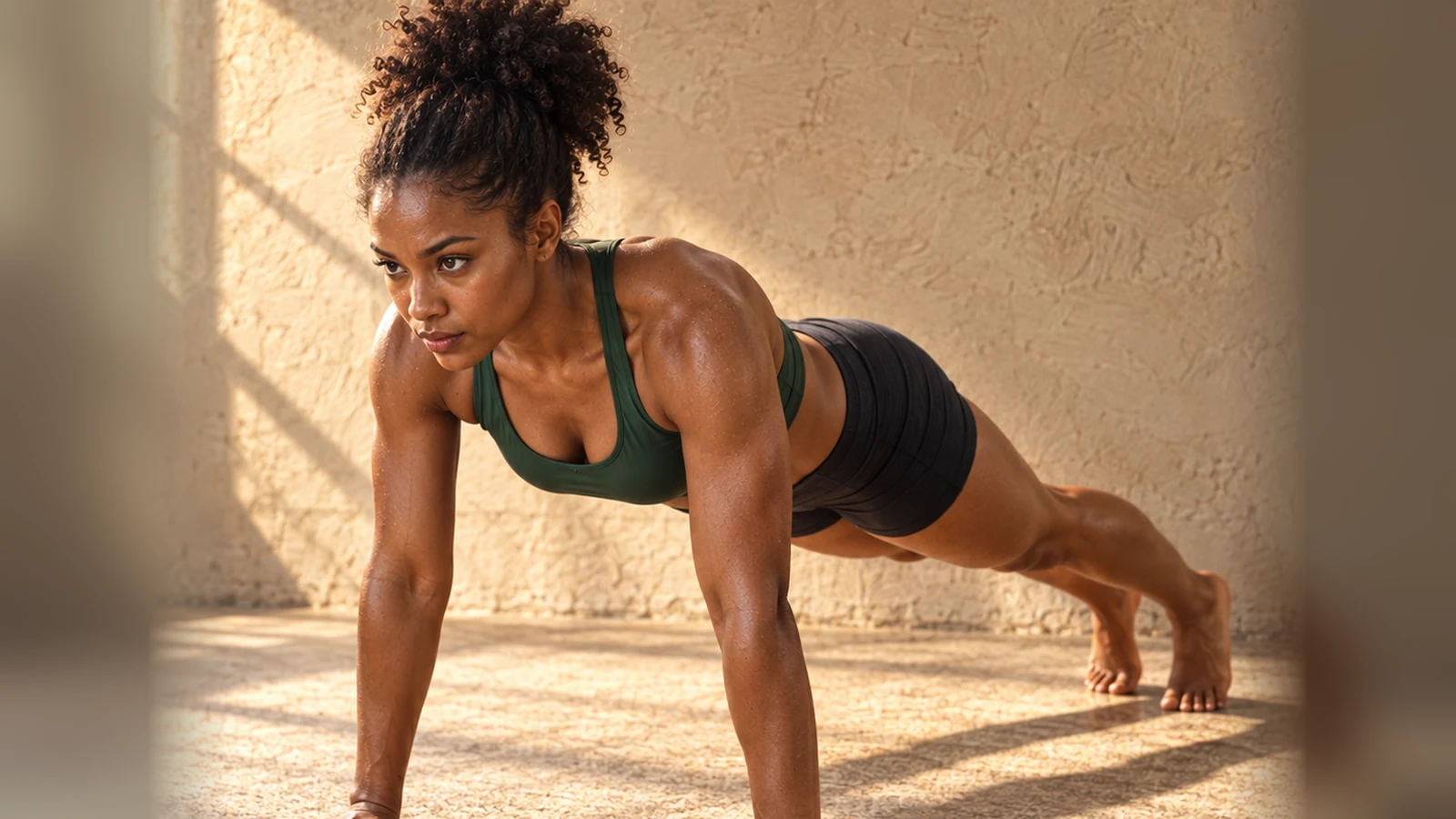

“I would train, but I do not have a gym” is the oldest excuse in fitness.
It is also getting harder to defend.
Push ups, pull ups, and slow controlled reps ask your muscles for the same thing a barbell does, which is tension and real effort.
The research is not as deep here as it is for weights, and we will be straight with you about that.
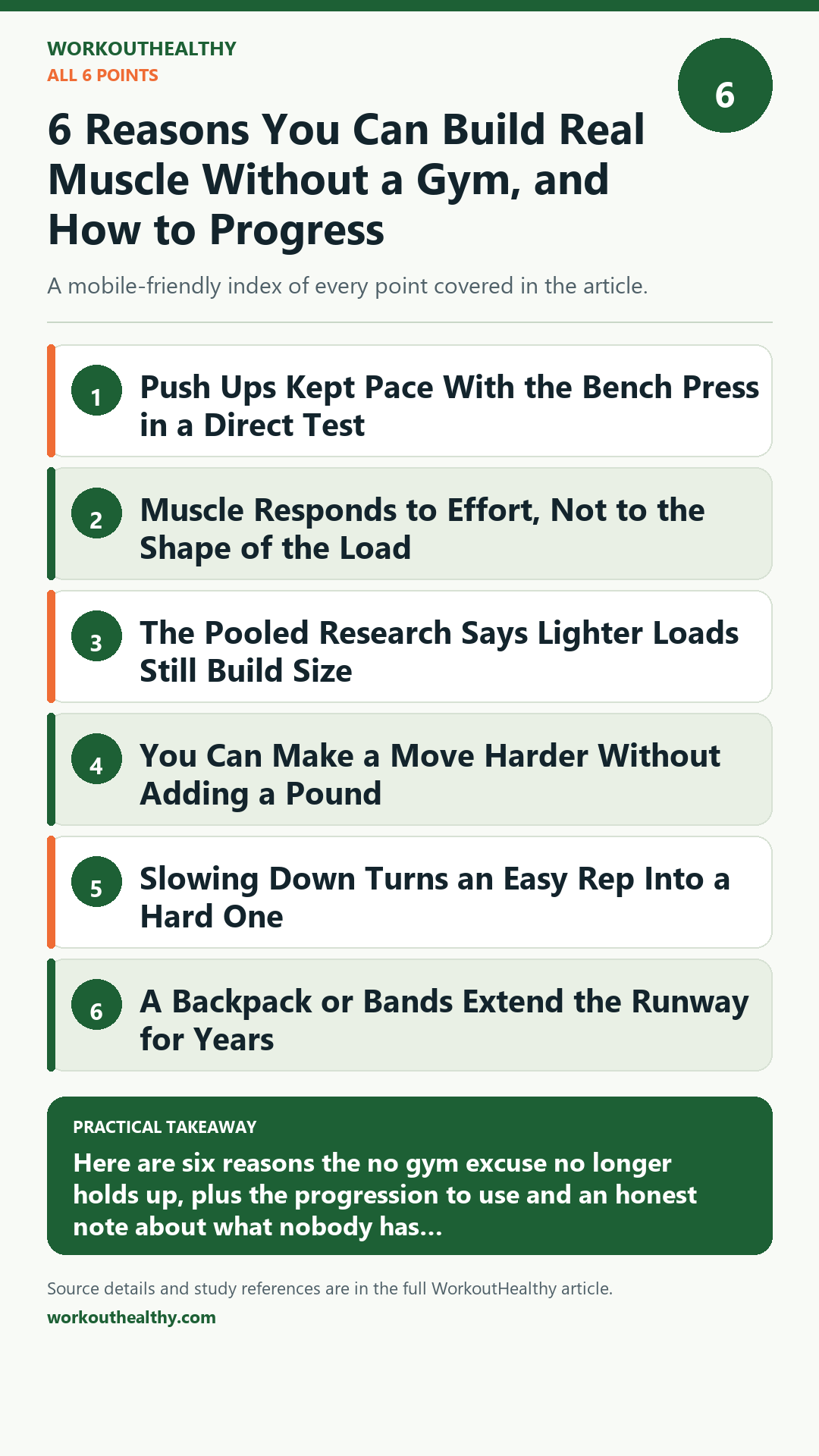
Here are six reasons the no gym excuse no longer holds up, plus the progression to use and an honest note about what nobody has tested yet.
1. Push Ups Kept Pace With the Bench Press in a Direct Test
Kotarsky and colleagues ran the comparison people always ask about.
They took 23 men with a few months of lifting experience and trained them three times a week for four weeks.
One group did the barbell bench press with a load allowing sets of six, adding weight as they progressed.
The other group worked through push up variations ordered by difficulty, moving to a harder version once they hit their target reps.
Both groups improved, and the barbell showed no clear advantage over the push up for muscle thickness.
Four weeks is short and the group was small, so treat this as encouraging rather than conclusive.
Still, it is the study people keep asking for, and the barbell did not run away with it.
That alone should retire the idea that push ups are only a warm up.
The push up group also had a structured way to get harder over time, which is the part most home routines are missing.
2. Muscle Responds to Effort, Not to the Shape of the Load
Morton and colleagues trained two groups for twelve weeks using very different loads.
One used heavy weights for sets of 8 to 12 reps, the other light weights for sets of 20 to 25 reps.
Both took their sets to the point where another rep was not possible, and both grew a similar amount of muscle.
That finding is the entire foundation of bodyweight training being taken seriously.
If effort is the trigger, then the source of the resistance matters far less than people assume.
A set of hard push ups taken near your limit is closer to a hard barbell set than most people believe.
The catch is that it has to be near your limit, which is where most home training quietly falls apart.
3. The Pooled Research Says Lighter Loads Still Build Size
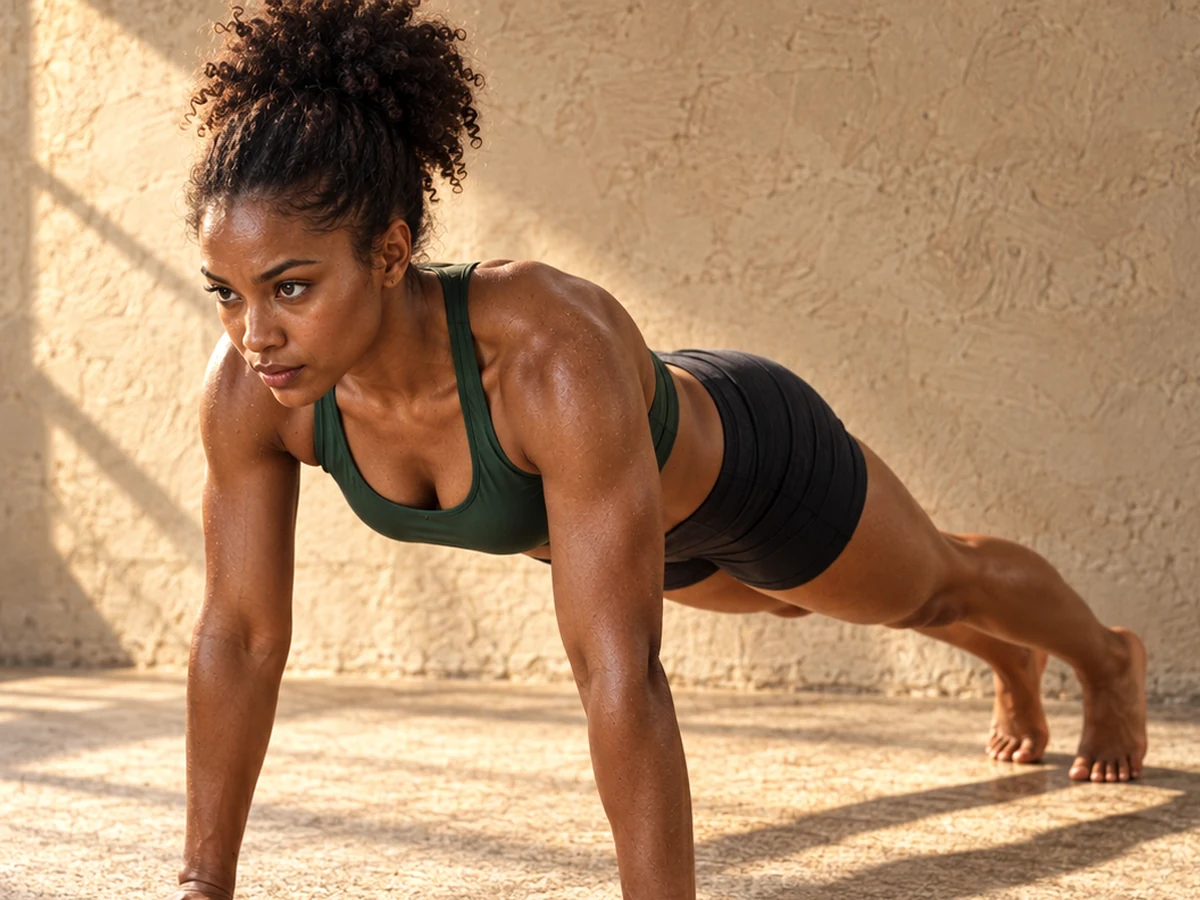
Schoenfeld and colleagues gathered the studies comparing lighter and heavier loading and analyzed them together.
Muscle size came out about equal between the two approaches.
Maximal strength, meaning the most weight you can lift once, still favored heavy training.
That is the honest split, and it sets a realistic expectation for bodyweight work.
You can build a genuinely muscular body at home, but a big one rep max on a barbell needs a barbell.
Your muscles cannot tell the difference between a dumbbell and your own body. They only register how hard the last few reps were.
Setting that expectation early saves a lot of frustration six months in.
If you want maximum strength numbers, plan to get to a barbell eventually.
4. You Can Make a Move Harder Without Adding a Pound
This is the piece most people miss, and it is why they conclude bodyweight training stalls.
Changing your leverage changes the difficulty dramatically.
Raising your feet on a chair turns an easy push up into a hard one.
Moving toward one arm, even with the other hand resting on a low surface, raises the difficulty again.
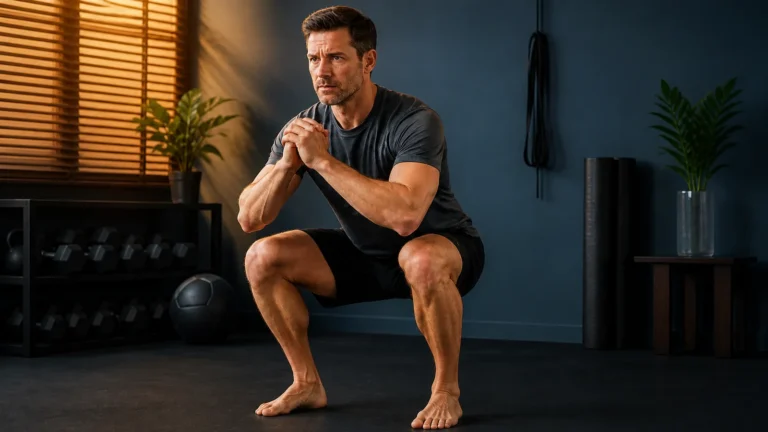
The same logic applies to squats through split stances, to rows through body angle, and to pull ups through added range.
Each of those changes is effectively adding weight without owning any.
Written out as a ladder, you can see that a single movement has ten or more difficulty levels in it.
Most people never climb past level two, then blame the method.
Write your ladder down before you start so you always know what the next step is.
5. Slowing Down Turns an Easy Rep Into a Hard One
Tempo is the cheapest difficulty dial you have.
Lowering yourself over four seconds instead of one roughly quadruples the time your muscle spends under tension in that phase.
Pausing at the bottom for two seconds removes the bounce that was doing some of the work for you.
Twenty easy push ups and eight slow ones with a pause are not remotely the same exercise.
This also makes hard sets safer at home, since you are not chasing speed with nobody around to spot you.
You can also add a short pause at the hardest point of the movement, which is usually near the bottom.
Count the seconds out loud if you have to, because tempo drifts the moment a set gets uncomfortable.
6. A Backpack or Bands Extend the Runway for Years
Eventually leverage and tempo run out, and that is when a little external load helps.
A backpack loaded with books adds resistance to squats, push ups, and step ups for almost nothing.
Resistance bands anchored under your feet add tension to presses and rows.
A single adjustable dumbbell opens up even more, which we covered in our piece on what one dumbbell can actually do.
None of this requires a membership, a commute, or waiting for a rack.
A doorway pull up bar costs less than a month of most memberships and solves the pulling problem outright.
Start with about ten pounds in the pack and add slowly, since bodyweight movements get hard quickly with extra load.
What This Evidence Does Not Prove
The push up study ran four weeks with 23 people, which is small and short by any standard.
Neither group in that study showed a statistically significant increase in muscle thickness, so the fair reading is that the two methods looked similar rather than that both clearly worked.
The load research that supports bodyweight training was done with weights, not with push ups, so applying it here is reasonable but not direct proof.
Nobody has run a multi year study comparing a serious bodyweight program against a serious barbell program.
Our social post promised the progression that builds strength fastest, and we cannot honestly deliver that, because no study has ever ranked bodyweight progressions by speed.
What we can give you is the progression with the best supporting evidence, which is the one used in the push up study above.
It is also worth saying that the volunteers had only a few months of training behind them, so these results may not hold for experienced lifters.
How to Run a Bodyweight Progression That Works
Pick one push, one pull, one squat pattern, and one hinge or core movement.
Start each at a variation where you can manage about six clean reps.
Do three sets, and stop each set two reps short of total failure at first.
When you can do three sets of eight with good form in two sessions in a row, move to the harder variation and drop back to six reps.
Train three times a week with a day off in between, exactly as the study did.
If you travel often, this same structure is what makes it possible to hold onto your strength on the road.
Once you are a few weeks in, take the last set of each exercise closer to genuine failure.
Keep a short written record of the variation, the sets, and the reps, because progressions are easy to lose track of.
Expect to spend three to six weeks on each variation before it feels easy enough to move up.
Common Mistakes With Bodyweight Training
The most common failure is staying at the same variation for months and calling it a plateau.
- Chasing high rep numbers instead of moving to a harder version.
- Rushing reps so momentum does the work.
- Skipping pulling movements because there is no bar at home.
- Training every day because it does not feel heavy, then never recovering.
- Ignoring legs because squats without weight feel too easy.
Adding cardio helps too, and there are plenty of quiet options that need no equipment at all.
Fix the progression problem and most of the others take care of themselves.
The second most common failure is treating bodyweight work as something you do whenever you feel like it.
A loose plan produces loose results, whether you are holding a barbell or not.
Who Should Check With a Doctor First
Anyone with shoulder pain should get assessed before doing large volumes of push ups or pull ups.
People with wrist problems should talk to a physical therapist, since push ups load the wrist in extension.
Anyone with high blood pressure or a heart condition should get guidance before training repeatedly to failure.
Older adults starting from a long break should get a general checkup and consider starting with wall or incline versions.
People recovering from a hernia repair or abdominal surgery need clearance before hard bracing work.
If you have had a shoulder dislocation, get specific advice before attempting pull ups or dips.
And if a movement gives you sharp pain rather than muscular effort, stop and get it looked at.
Watch the Original Video
Training at home and want it to actually work? Subscribe to WorkoutHealthy Insider for practical explanations behind popular fitness claims.
References
Kotarsky, C. J., Christensen, B. K., Miller, J. S., & Hackney, K. J. (2018). Effect of progressive calisthenic push-up training on muscle strength and thickness. Journal of Strength and Conditioning Research, 32(3), 651 to 659. https://doi.org/10.1519/JSC.0000000000002345
Morton, R. W., Oikawa, S. Y., Wavell, C. G., Mazara, N., McGlory, C., Quadrilatero, J., Baechler, B. L., Baker, S. K., & Phillips, S. M. (2016). Neither load nor systemic hormones determine resistance training-mediated hypertrophy or strength gains in resistance-trained young men. Journal of Applied Physiology, 121(1), 129 to 138. https://doi.org/10.1152/japplphysiol.00154.2016
Schoenfeld, B. J., Grgic, J., Ogborn, D., & Krieger, J. W. (2017). Strength and hypertrophy adaptations between low- vs. high-load resistance training: A systematic review and meta-analysis. Journal of Strength and Conditioning Research, 31(12), 3508 to 3523. https://doi.org/10.1519/JSC.0000000000002200
This article is for general information only and is not medical advice. If you have an injury, ongoing pain, or a medical condition, talk to a doctor or physical therapist before you change how you train or eat.