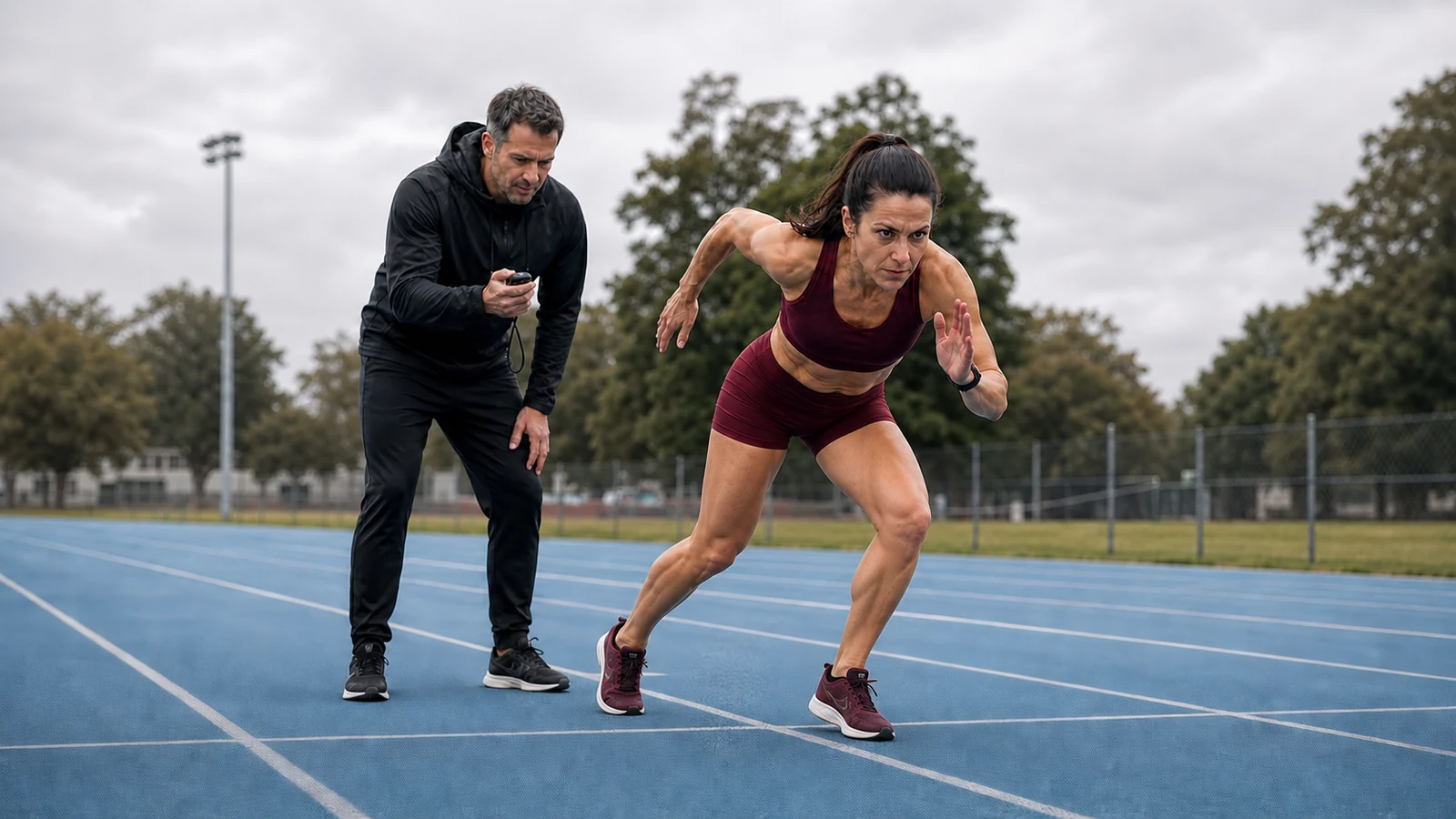

What is the peak athletic age? There is no single age for every sport, event, or person.
The comparison below separates competition results, population fitness tests and an individual’s next personal best.
Before using an age estimate, name the performance measure you mean. Keep the studied group and your own goal in separate columns.
Peak age depends on what is being measured
| Question | Evidence | What it does and does not mean |
|---|---|---|
| When do elite power-event results peak? | A 2024 analysis of 17,945 elite and masters results in the 100-meter dash, long jump, high jump, and triple jump modeled an average peak of 27.8 years for men and 28.3 for women. | These are averages across four power events, not the peak age of every sport or person. |
| Do other elite track events peak at the same age? | A 2018 study of world-ranked athletes found typical mean peaks around 25 to 27 years, with marathon and male throwing events closer to 28 to 29. | Even within track and field, event and athlete group change the estimate. |
| When do general fitness tests peak? | A 47-year population study estimated peaks around ages 26 to 36 for aerobic capacity and muscular endurance. | These laboratory or exercise-test outcomes are not elite competition results. |
| Can one person improve after 35? | A later start, better practice, or more consistent training may improve an individual’s own performance. | Personal improvement does not require surpassing the best elite result for an age group or reversing the population aging curve. |
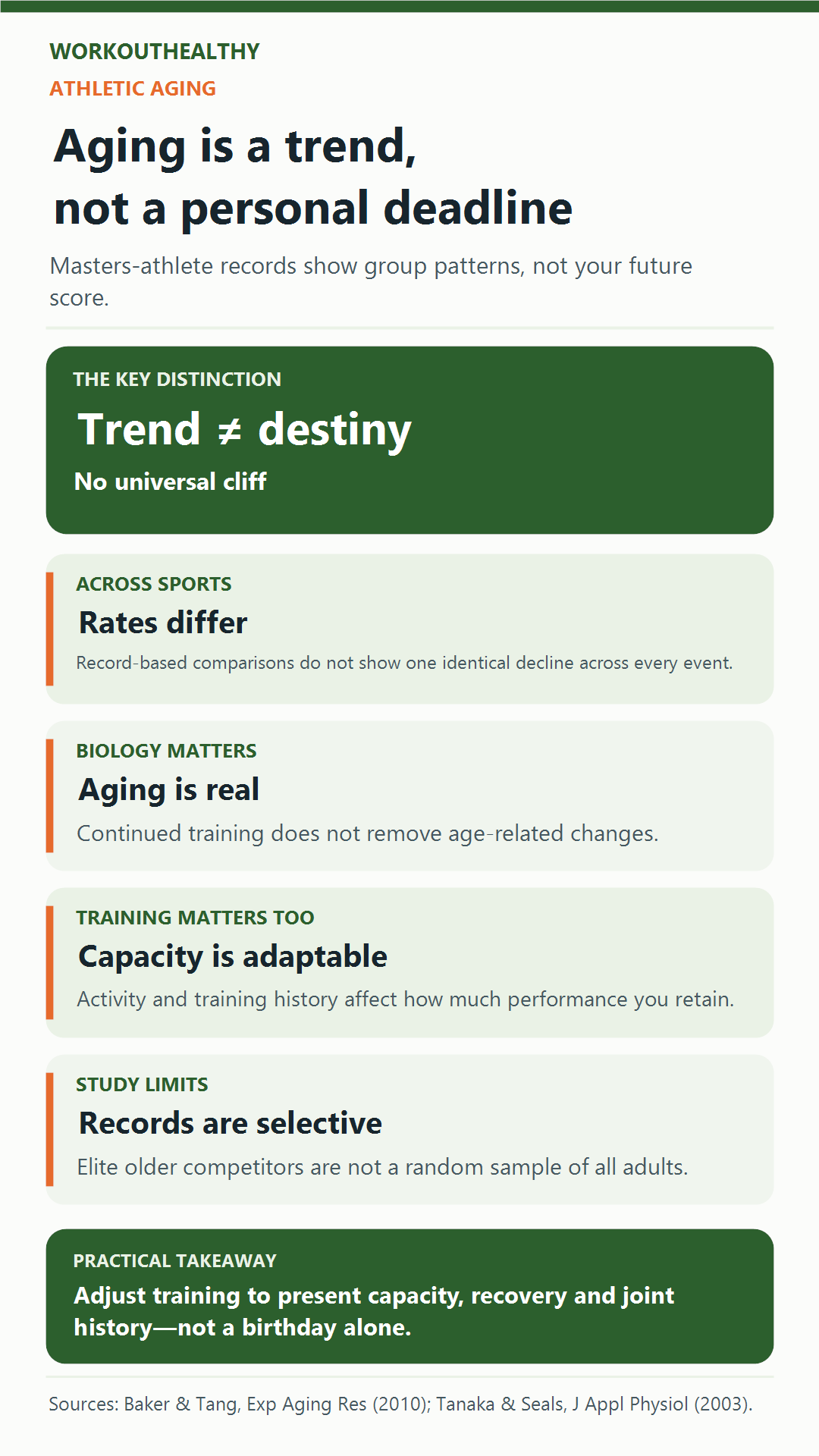
The key distinction is between an average absolute peak in a studied group and an athlete’s next personal best. Those are different questions, and one number cannot answer both.
The decline estimate
The 2024 paper modeled decline beginning in the early 30s. Masters results declined roughly linearly from 35 to 60, with event-and-sex group averages of 0.55% to 1.04% per year.
Use the curve to describe the studied results, not to choose a birthday when someone should stop competing.
These selected competitors were not a random sample of all adults; their results cannot forecast a previously inactive person’s response to training.
Your own comparison
For a later start, define success against your own earlier measurement. Specify the task, practice period and conditions before calling the result a personal best.
The 47-year general-population study found gradual declines after its measured fitness peaks, not a sudden stop in capability. People who became active in adulthood had better measured performance across its outcomes, an association that does not set a ceiling on the next training block for an individual.
Write down the demands of your event and your recent training exposure. Record injury history separately rather than using one age label to summarize everything.
How to use age information without mistaking it for a training plan
- Name the outcome. A sprint time, jump distance, aerobic test, strength lift, and ability to finish a race each have a different trajectory.
- Compare your own repeated measurements. Record comparable tests under similar conditions over months rather than judging capacity from a birthday.
- Account for training history. More consistent practice can change an individual’s short-term progress without changing the population peak estimate.
- Match the sport’s demands safely. A return to sprinting or jumping after a break deserves a gradual progression and coaching when technique or injury history calls for it.
Not everyone needs explosive training to benefit from activity. If pain, a recent injury, balance concerns, or a cardiovascular condition affects exercise, ask a clinician or qualified coach which movements fit your starting point.
What Jonathan Clark’s video shows
Jonathan Clark’s original video is included as additional context. The written studies above provide the group estimates; one athlete’s experience does not establish a population aging curve.
For your next review, bring comparable measurements and a description of your training block. Ask what changed in the task, conditions or practice before assigning the change to age.
Sources
- 2024 elite and masters power-event track and field analysis.
- Haugen et al. (2018), peak ages across world-class track and field events.
- Westerståhl et al. (2025), 47-year general-population physical-capacity study.
- Baker and Tang (2010), masters sporting-event analysis.
- Tanaka and Seals (2003), dynamic exercise performance review.
This article offers general fitness information, not a personal forecast or training prescription. If you have a medical condition, ongoing pain, or an injury, ask a qualified clinician before changing vigorous activity.