
Krysten Ritter used boxing while preparing to play Jessica Jones—but boxing was one part of a broader training mix, not a replacement for strength work. In firsthand interviews, the actor describes learning to punch, finding the sport unexpectedly enjoyable, and feeling more capable in a physically demanding role. She also lists running, hiking, yoga, weight circuits, and bodyweight exercises. That fuller picture is more useful than the familiar celebrity-fitness shortcut that one workout built the whole character.
Ritter’s preparation happened for a specific acting job. The goal was to look and move credibly as a powerful character, handle stunt work, and sustain an intense filming schedule. The role does not establish that boxing is superior to weightlifting for building strength, or that a viewer needs to train like an actor to get fit. Here is what the interviews actually support and what a regular person can take from them.
What Ritter said about learning to box
In a 2017 Women’s Health interview, Ritter said she discovered boxing while training for the first season of Jessica Jones. She described feeling awkward at first because she did not know how to throw a punch. With practice, boxing became something she did regularly and enjoyed. She also emphasized the focus required when another person can hit back. That last point describes her experience in training; it does not imply that sparring is necessary for everyone who wants a good workout.
In an earlier TRAIN for HER Q&A, Ritter said she wanted to feel strong and able to punch to inhabit the character. She reported improving her punching skills and enjoying both training and stunts more than she expected. Learning a new skill can make exercise feel different from chasing calories or a number on a scale. It gives the session a concrete task: stance, balance, timing, and coordination.
Those firsthand descriptions support the headline that boxing helped Ritter prepare. They do not tell us her exact punch volume, weekly boxing schedule, strength changes, or whether boxing alone produced a particular physique. The specific training program was more varied.
The rest of her training matters
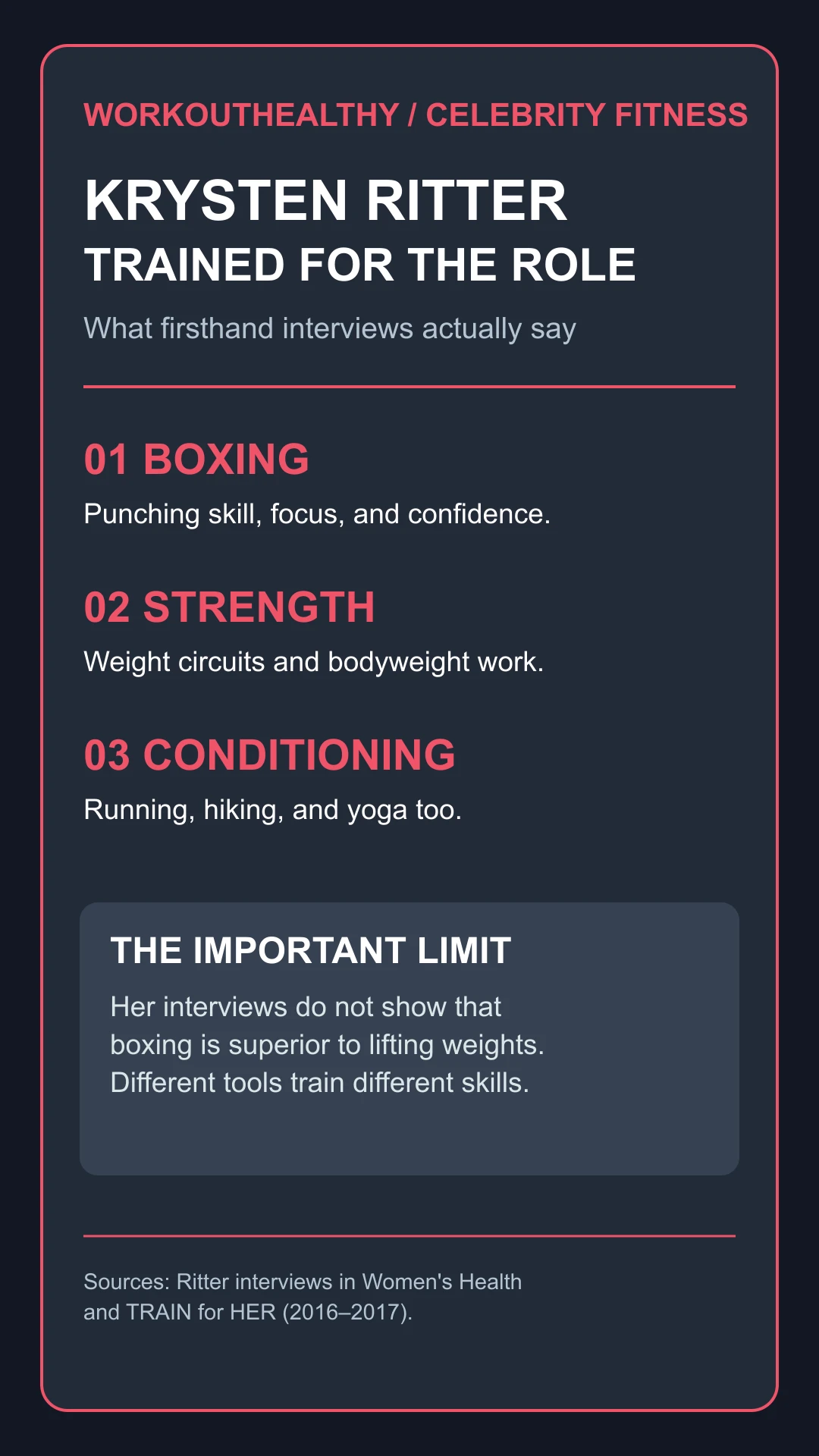
The TRAIN for HER interview lists running, hiking, yoga, boxing, weight circuits, and bodyweight exercises in Ritter’s preparation. She noted that her push-ups improved and that conditioning helped her endure stunt work and a long shooting schedule. That mix makes practical sense for a role demanding repeated physical effort. It also prevents a misleading conclusion: the available account does not isolate boxing from the rest of her training.
Weight circuits and bodyweight movements can provide progressive resistance. Running and hiking build aerobic capacity and tolerance for sustained activity. Yoga may contribute mobility or provide a different kind of practice, depending on how it is done. Boxing practice adds striking skill, coordination, and potentially a substantial cardiovascular demand. These are overlapping tools, not competitors in a single “best workout” contest.
Ritter also mentioned hard gym sessions during preparation. A celebrity’s reported 90-minute workout is not a beginner template; her schedule, support, baseline fitness, and recovery are not your own. The useful idea is choosing training that serves a defined task and can be sustained, not copying an actor’s longest day.
Does boxing build strength?
Boxing training can challenge the shoulders, trunk, legs, and cardiovascular system, especially when it includes footwork, bag drills, pad work, and conditioning. It requires control of the whole body to deliver and recover a punch. For a newcomer, practicing those movements may improve endurance, coordination, and the ability to perform the specific skill. The exact adaptation depends on the session, intensity, and prior training.
But “feels powerful” and “maximizes strength” are not the same claim. Maximum strength is typically trained most directly with progressive resistance—gradually increasing a manageable load or challenge over time. Punching a bag has a different primary purpose from a heavy squat or a carefully progressed push-up. For general fitness, both boxing and resistance training can have a place. For a defined goal, the plan should emphasize the quality you actually want to improve.
The original social caption suggested boxing offers more functional benefit than isolated weightlifting. Ritter’s interviews do not support that comparison, and “functional” is not a universal ranking. A weight exercise can be functional when it helps someone lift, carry, stabilize, or perform another real-life task. A boxing drill can be functional when the goal is punching skill or sport conditioning. Different tasks require different tools.
Why skill can make a workout stick
One reason Ritter’s account is relatable is that she was not instantly good at boxing. Her first attempts felt clumsy. Continued practice gave her a visible learning curve. That can be motivating for an ordinary exerciser: a session is not only about how exhausted you feel afterward; it can be about something you do a little more smoothly than last week.
Skill-based workouts also demand attention. Foot position, hand position, defensive movement, and breathing all compete for mental space. Ritter described the need to stay present during boxing. You may find that focus enjoyable, or you may prefer a calmer activity. Neither reaction is proof of a unique mental-health effect. It is a reason to try a safe beginner class and see what works for you.
The same principle applies outside boxing. A person learning a deadlift, a swim stroke, a dance step, or a hiking route may feel the satisfaction of competence. The exercise that you can practice consistently and recover from is often more valuable than the one that looks dramatic in a celebrity profile.
How to try boxing without copying a stunt-training schedule
Start with a beginner-oriented class or qualified coach who teaches stance, wraps, hand protection, and controlled technique. Shadowboxing and pad drills can build familiarity before hard bag rounds. A beginner does not need contact sparring to benefit from learning to box. In fact, sparring adds a different risk profile and should never be treated as an automatic fitness progression.
Keep the first sessions short enough that you can maintain form. If your wrists, shoulders, or hands hurt, stop and get the technique and equipment checked. Fatigue can make a punch sloppy. Pair boxing with appropriate strength work, rest days, and other movement you enjoy rather than assuming one class must cover every goal.
If you have a history of concussion, joint injury, heart disease, or another condition that changes exercise risk, speak with a qualified clinician before starting strenuous or contact training. The general advice in a celebrity article cannot substitute for individual evaluation.
The role was demanding, but the character is fiction
Ritter wanted the physical confidence to portray a super-strong character. Her training helped her feel prepared for the work of acting and stunts, according to her interviews. That is a real athletic task. It is also important to separate the actor’s physical preparation from the fictional character’s superhuman abilities. No workout makes a person able to perform the impossible feats shown on screen.
Likewise, a screen production may involve stunt professionals, choreography, camera angles, editing, and other support. Fitness stories can overlook that collaborative context and imply a single actor built everything alone in the gym. Ritter’s own account is stronger when read as one part of a production and an example of role-specific preparation.
What to borrow from Ritter’s approach
Pick an actual goal. “Get strong” can mean improving a push-up, carrying groceries, or learning a punch. Define the task and choose training accordingly. Practice skills gradually. Feeling awkward at first is normal. Good instruction can make the learning process safer and more rewarding. Use more than one tool. Ritter’s account includes resistance work and aerobic activity as well as boxing. Let enjoyment count. She kept boxing in her routine partly because she found it fun. An activity you return to has an advantage over one that only sounds optimal on paper.
For most people, a manageable mix of aerobic movement and progressive strength work is a stronger foundation than trying to reproduce an entertainment-industry training block. Boxing can be an engaging addition when it fits your interests and health situation.
Takeaway
Krysten Ritter’s firsthand interviews confirm that boxing helped her prepare to play Jessica Jones, especially by building punching skill, focus, and a feeling of strength. They also show a varied plan that included weight circuits, bodyweight work, running, hiking, and yoga. The lesson is to train for a meaningful task with methods you can sustain—not to claim boxing beats lifting or that a fictional superhero’s routine is a universal fitness program.