
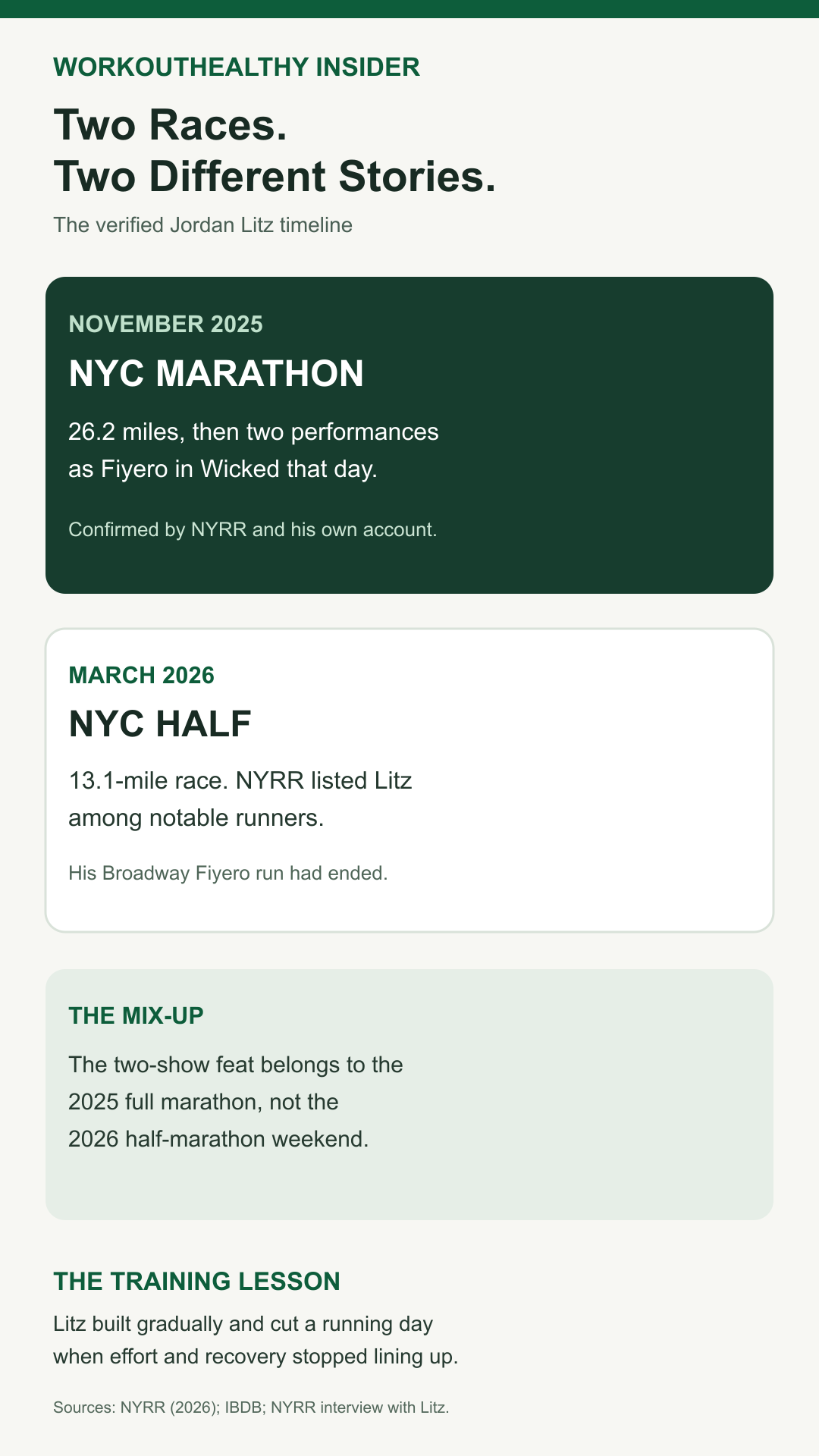
Jordan Litz appeared on New York Road Runners’ list of notable runners for the March 2026 United Airlines NYC Half. His best-known race-to-stage story, however, happened four months earlier: he ran the 2025 New York City Marathon and then performed twice as Fiyero in Wicked that same day. Those are two separate races, not one half-marathon weekend with back-to-back Broadway shows. The distinction matters because the 2026 race and the two-show feat are being joined into a more dramatic story than the records support.
There is still a compelling training lesson here. In a first-person New York Road Runners interview, Litz described a long marathon build, adjustments when the schedule became too much, and the way eight weekly performances fit around running. His experience is an example of managing two demanding pursuits, not a ready-made plan for a recreational runner.
Two Race Stories, One Easily Mixed-Up Timeline
The race organizer’s March 2026 NYC Half preview names Litz among notable entrants. It describes him as the Broadway actor who ran the 2025 New York City Marathon and performed two shows as Fiyero afterward. The wording looks backward to a previous accomplishment; it does not say the same sequence would occur after the 2026 half.
There is another date check. The Broadway League’s official Internet Broadway Database credits show Litz’s Fiyero engagement ending March 1, 2026. The NYC Half took place March 15. A claim that he ran that half and then did two Broadway performances in the same weekend conflicts with the documented end of that Broadway engagement.
That does not diminish either undertaking. The 13.1-mile event was real, and the prior marathon-plus-two-shows day was real. It simply gives each event its own date and context. A responsible account should not transfer the 2025 marathon aftermath to the 2026 half merely because Litz is associated with both races.
What Happened on the 2025 Marathon Day
Litz ran the November 2025 New York City Marathon, then went from the finish toward the theater for a matinee and evening performance of Wicked. A Juilliard profile based on his own account describes the race and two shows. The NYRR material published before the 2026 half repeats that sequence as part of his background.
Completing a marathon is not the same physical task as finishing a half marathon. The full distance is 26.2 miles. It generally requires a larger preparation load and creates a different recovery problem. Stage work has its own demands, but we should not pretend to know his exact fluid intake, calorie intake, sleep, or medical status that day. Neither the race organizer’s short biography nor the available interview documents a universal recovery protocol that allowed the performances.
His achievement is therefore best read as an individual accomplishment supported by months of preparation and a professional performer’s established workload. It is not evidence that an ordinary person can safely race hard and immediately do two demanding shifts. Even a talented runner-performer may have had discomfort or fatigue that an audience could not see.
How Litz Said He Built the Running Work
In the NYRR interview transcript, Litz described a 26-week marathon training block. He began with roughly 15 to 20 miles a week and built toward weeks in the high 40s. Those figures are his reported training history, not a minimum that anyone else must copy. The meaningful pattern is the gradual ramp, rather than suddenly trying to absorb peak mileage.
He initially ran five days a week and lifted twice. About 13 weeks into the block, he said the runs were becoming too costly: he could hit the target paces, but the effort required felt wrong. He reduced running to four days while keeping two lifting days. He also discussed changing foods or drinks that seemed to upset his stomach. Those are personal observations, not a clinical test proving any one adjustment caused improvement.
The most useful part is that he did not treat a plan as sacred. A performer has rehearsals and shows that are not “rest” just because they are not logged as miles. Litz described eight Broadway performances a week and treated that schedule as part of the total load on his body. Many runners have equally real non-running loads: standing work, caregiving, irregular sleep, or travel. Training capacity depends on all of it.
Did Broadway Function Like Another Cardio Session?
Litz told the NYRR interviewer that the aerobic background from swimming and running made his stage work feel more manageable. He described a demanding number from Wicked and said a watch had shown a peak heart rate of 119 beats per minute during rehearsal. That is an anecdote from one performer and one device; it is not a laboratory measure of the show’s energy cost or proof that a performance can replace an easy run.
Stage performance combines repeated movement, breath control, singing, choreography, and the need to deliver reliably in front of an audience. It also includes pauses, role-specific intensity, and technical work that do not map neatly onto running pace. A performer can be very fit while still having to budget leg fatigue and concentration differently from a road racer.
It is reasonable to infer that endurance training could help a physically demanding role feel easier, but the exact degree of crossover was not measured in Litz’s interview. The lesson is broader: fitness can support another craft, yet that craft should also be counted when assessing fatigue. Calling eight shows “free exercise” would miss the recovery side of the equation.
What the 2026 NYC Half Does—and Does Not—Add
The 2026 NYC Half placed Litz among a large field of runners crossing the city from Brooklyn toward Central Park. The organizer’s race-week announcement establishes his participation in the event’s notable-runner lineup and the 13.1-mile course. It does not establish a same-day Broadway double-header. The official Broadway credit dates make that combination especially implausible for this race.
Nor should the half be used to infer his exact recovery behavior or training metrics. Public promotional material is selective; it highlights a person’s story, not every detail of their week. We can say the half followed an earlier marathon-plus-stage feat. We cannot say he had a specific pacing strategy, fueling routine, or two-show schedule afterward unless a reliable account documents it.
This distinction is useful whenever a celebrity fitness claim travels through social posts. A name, a race, and a familiar older anecdote can be assembled into a new event that never occurred as described. Checking the date of the race and the date of the professional engagement is often enough to reveal the mix-up.
A Training Framework That Transfers to Everyday Life
The transferable idea is workload management, not reproducing Litz’s calendar. Start with a goal appropriate to your present conditioning. If a half marathon is the goal, build time on your feet over months, not through a last-minute surge. A performance, physically demanding job, or long travel day belongs in the same weekly planning conversation as the long run.
Keep strength work in the picture if it is sustainable, but do not assume more sessions always mean more adaptation. Litz’s own reported change—from five running days to four—illustrates a practical principle: when target paces become disproportionately hard, review the whole training load. Reduce or redistribute a session before forcing every number on the plan. A coach can help translate that principle into a specific schedule.
Practice race-day eating and drinking during training if you are preparing for an endurance event. That does not require copying another runner’s diet. It means learning what your own stomach tolerates and following event-specific guidance. After a hard race, allow for recovery; do not treat an exceptional performer’s schedule as the standard against which to judge your own resilience.
People with heart symptoms, an injury, or a major change in exercise volume should seek individualized medical advice. For most readers, the win is a repeatable plan that leaves room for work, family, sleep, and the things that make training worth doing in the first place.
When reviewing a remarkable race-and-work story, ask three simple questions: Which exact event took place? What did the person actually do on that date? What is a separate anecdote being reused for color? For Litz, the answers separate a 2025 26.2-mile race with two same-day performances from a 2026 13.1-mile race. The timeline is clearer, and the training lesson becomes more credible.
The Bottom Line
Jordan Litz’s story contains two separate milestones. He ran the 2025 NYC Marathon and performed two Wicked shows that day. He was also a notable runner in the March 2026 NYC Half, after his Broadway Fiyero engagement had ended. Merging those into “2026 half, then two Broadway shows” is inaccurate.
His own account of marathon preparation offers a better takeaway than the embellished timeline: build gradually, notice when the work costs too much, and adjust the plan to fit the rest of your life. The real achievement is impressive enough without moving performances from one race weekend to another.
This article is for general information and is not medical advice. Endurance training and recovery needs vary; discuss symptoms, injury, or major training changes with a qualified clinician.