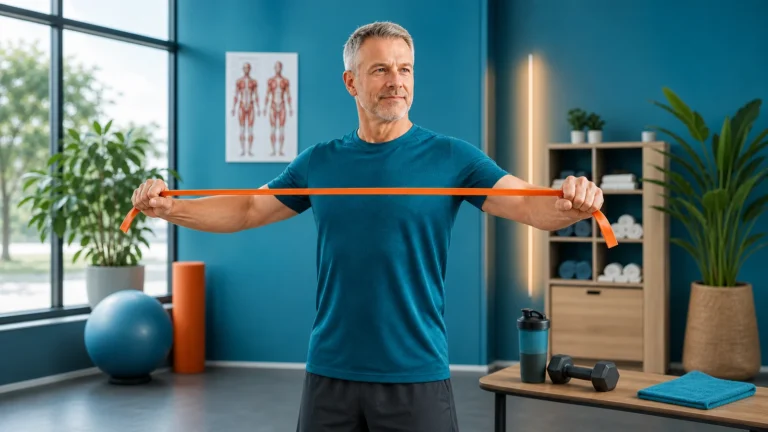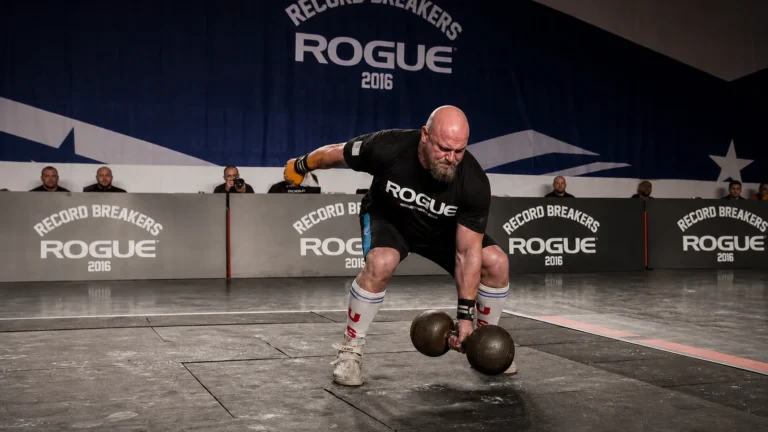

When fitness progress stalls, check nutrition, sleep, programming, effort and the comparisons you use to judge your results.
Those five basics are a useful starting point.
They are not a diagnosis, and they cannot establish that genetics or a medical issue has nothing to do with your situation.
The social post behind this guide presents a confident checklist.
The evidence supports a more careful version: examine the inputs you can observe, then decide what actually needs attention.
A repeatable workout and a short, honest log can make that review concrete without requiring a new supplement stack or a complete training overhaul.
Start With a Measurable Training Goal
Before calling something a plateau, write down the result you wanted and the measurement you have been using to judge it.
“Get stronger” might mean completing more controlled repetitions with the same load on a particular exercise.
“Look different” is a separate goal with a different way of measuring it.
A heavier bar is not automatically a better comparison if your range of motion, rest periods or exercise setup changed at the same time.
For this checklist, start by reviewing comparable sessions rather than your most disappointing workout.
Treat that as a practical filing rule, not a scientifically validated definition of a plateau.
Record the exercise, load, repetitions, rest and any meaningful change in technique.
A coach can help you decide whether the sessions are comparable.
Individual responses also differ.
In a study of 585 people completing 12 weeks of arm resistance training, muscle size and strength changes varied substantially (Hubal et al., 2005).
That study does not tell you what caused your own stall or separate every genetic influence from every behavioral one.
It does show why another person’s improvement cannot establish the result you should have achieved after the same number of weeks.
Choose a result you can measure under conditions you can repeat.
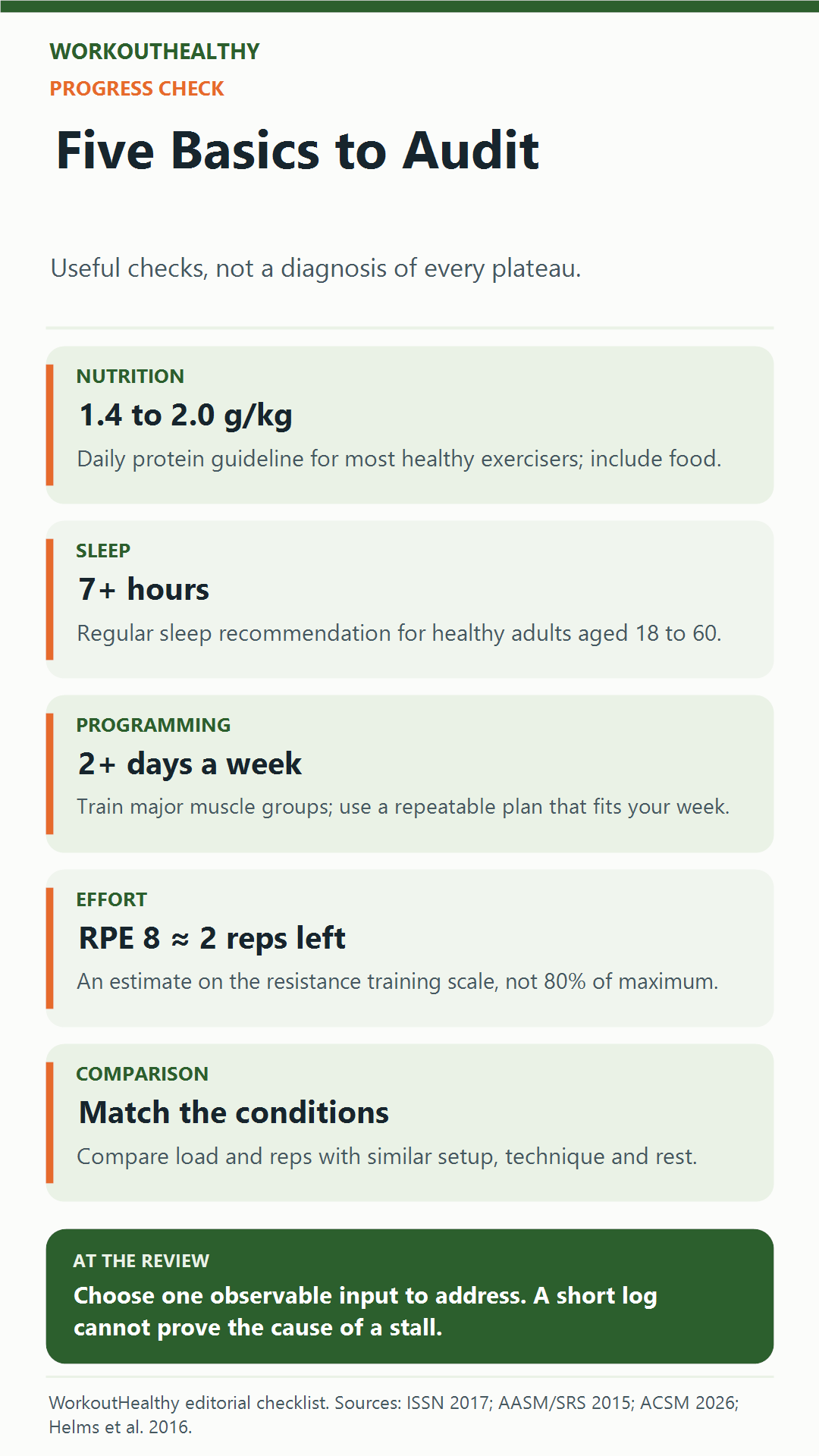
1. Check Protein and the Food Pattern
The International Society of Sports Nutrition identifies about 1.4 to 2.0 grams of protein per kilogram of body weight per day as sufficient for most healthy exercising people (Jäger et al., 2017).
This is a population guideline for total daily protein, including food.
It is not a requirement to buy protein powder or a personalized prescription.
The position stand also considers energy intake and training status when discussing outcomes.
A protein number by itself does not describe your whole diet (Jäger et al., 2017).
A useful first check is whether you know what your usual meals contain.
Include an ordinary weekday and a day when your schedule changes.
If numerical food tracking is comfortable for you, use food labels or a reliable food record to identify the pattern you already follow.
If tracking encourages anxiety, restriction or obsessive behavior, leave that method out.
You can discuss meal regularity and food choices with a qualified dietitian instead.
Write your current priority beside the food record: stronger lifts, a sports event, maintaining your routine or another clearly defined goal.
Avoid assigning yourself aggressive calorie changes just because a caption says to “bulk or cut.”
This article cannot determine your energy needs.
Our guide to the basics behind building muscle examines why a simple message still needs context.
For this audit, the question is narrower: can you describe your current eating pattern well enough to review it with your training goal?
2. Check Actual Sleep, Not Time in Bed
A joint American Academy of Sleep Medicine and Sleep Research Society consensus recommends seven or more hours of sleep regularly for healthy adults aged 18 to 60 (Watson et al., 2015).
The recommendation supports general health.
It does not promise that seven hours will produce a particular strength gain or meet every individual’s sleep need.
Sleep quality, timing and regularity matter alongside duration, according to the same consensus statement (Watson et al., 2015).
For the checklist, write down when you went to bed, when you woke up and whether you spent a noticeable part of the night awake.
Keep the distinction visible: eight hours between bedtime and the alarm is an opportunity to sleep, not proof of eight hours asleep.
Use the record to identify a schedule problem you can name.
“I stayed up later than planned on three work nights” is more actionable than “my recovery is bad.”
You do not need to turn every night into a score.
A brief note is enough to explain a disrupted week when you review your training.
Consider a practical bedtime routine and an environment that feels comfortable for sleeping.
Neither should become a claim that a particular room temperature fixes your plateau.
Our article on rest days and muscle recovery provides additional context for reviewing what happens between workouts.
3. Follow a Plan You Can Repeat
The American College of Sports Medicine’s 2026 guidance emphasizes training all major muscle groups at least twice a week for healthy adults (American College of Sports Medicine [ACSM], 2026).
Its evidence review also found that complex periodization and training to momentary muscle failure did not consistently change outcomes for the average healthy adult (ACSM, 2026).
That qualifies the social caption’s emphasis on planned heavy and light days.
Such days can belong in a program, but every recreational lifter does not require that exact arrangement.
For the audit, find the written plan you are actually following.
Check whether it specifies exercises, sets, repetition targets and a way to decide the next session’s load.
A saved workout that you replace every visit is not the same thing as a repeated plan.
Mark completed sessions beside the planned ones.
When a session is missed, record the reason before adding more work elsewhere.
The schedule may need adjusting to the time you actually have.
Keep an exercise setup consistent enough that your log remains useful.
If you replace an exercise, label the change rather than treating its numbers as directly interchangeable.
Ask a qualified trainer how the plan should progress when repetitions feel controlled, and how it should change when technique deteriorates.
The goal of this check is to locate the missing instruction.
A plan can be simple and still tell you what to do next.
4. Give RPE 8 a Clear Meaning
On a repetitions-in-reserve resistance training scale, RPE 8 means you estimate that about two additional repetitions remain before failure (Helms et al., 2016).
This is not the same as calling a workout “eight out of ten,” and it does not mean using 80 percent of your maximum.
The authors describe familiarization and experience as relevant to applying the scale.
They also explain that estimating repetitions left becomes less useful far from failure (Helms et al., 2016).
Use the number as an estimate to discuss and refine.
It is not a laboratory measurement of the effort you produced.
In your log, write the load and repetitions first, then the estimated repetitions in reserve.
Add a note if the last repetition changed your technique.
Do not deliberately trap yourself under a barbell to prove the estimate.
Choose appropriate supervision and a safe exercise setup when learning to judge effort.
Also distinguish a challenging muscle effort from pain, dizziness or a reason to stop.
A target effort does not override a concerning symptom.
The caption’s RPE 8 example is useful because it gives “train hard” a definition.
It does not establish one mandatory effort level for every exercise.
Your program may assign a different target on different sets.
Follow the plan’s purpose and ask for clarification when the target is unclear.
5. Choose Comparisons That Inform Your Training
Comparing yourself with others is not automatically harmful.
In an 11-week randomized study of 790 university participants, social comparison conditions increased exercise class attendance (Zhang et al., 2016).
That outcome concerned attendance in a structured program.
It did not establish that comparing physiques or lifting records on social media improves your own strength gains.
The useful question is what the comparison makes you do.
Does it help you attend a planned session, or make you abandon a suitable plan?
A training partner’s progress can suggest a question for your coach.
It cannot tell you that your own nutrition, sleep or genetics must be the problem.
Use your previous comparable session when deciding whether a particular lift improved.
Use another person’s training as context rather than as your expected result.
When watching a clip, check what you do not know: training history, exercise setup, omitted attempts and the actual goal of that session.
You can enjoy an impressive performance without using it as the standard for your next workout.
Keep the measurement tied to the goal you wrote down.
Let comparison give you a useful question, then return to your own training record.
A Two-Week Log That Tests One Change
WorkoutHealthy editorial template: this log organizes a discussion about your training.
It is not a tested treatment or a promise to reverse a plateau within two weeks.
The two-week interval is a convenient review window.
It is not a biological deadline for muscle growth, and a short log cannot identify every cause.
Use the first week to describe your routine without making a bundle of changes.
At the review, choose one observable input to address.
| Check | Record | Question at review |
|---|---|---|
| Nutrition | Usual meals and optional protein estimate | Is the pattern clear enough to review? |
| Sleep | Sleep opportunity, estimated sleep and disruptions | Which disruption can be addressed? |
| Programming | Planned and completed sessions | Does the schedule fit your week? |
| Effort | Load, repetitions and estimated reps left | Is the effort target understood? |
| Comparison | The previous comparable session | Are setup and technique similar? |
For example, imagine someone planned three sessions and completed two because the third always conflicted with work.
The first change could be a realistic schedule.
During the second week, keep the exercise selection and recording method stable while trying that scheduling change.
Note illness, travel or other major interruptions.
At the next review, ask whether the change happened, whether the records remain comparable and whether a longer observation period is needed.
Changing one input makes the record easier to interpret.
It does not prove causation, because ordinary life can change several unmeasured factors at once.
If the change was not feasible, revise the plan before judging its results.
A template is useful only when it fits the person completing it.
When the Five Checks Are Not Enough
You may complete this review and still have no clear explanation.
That is a reason to seek better assessment rather than conclude that you lack discipline.
Bring the log to a qualified coach if you need help interpreting technique, exercise selection or the demands of your program.
Discuss continuing pain, persistent unusual fatigue or a health concern with a healthcare professional.
This checklist cannot diagnose a condition or decide whether training is medically appropriate.
Keep the original claim in proportion.
Nutrition, sleep, a repeatable plan, understood effort and useful comparisons are areas to examine, not five guaranteed fixes.
The most useful next step is a specific question supported by your own record.
You can then choose a change for a reason and review it honestly.
Get the next evidence check.
Five practical fitness stories worth your time, every Friday.
One email a week. No product pitches. Unsubscribe in one click.
References
American College of Sports Medicine. (2026, March 17). ACSM unveils landmark 2026 resistance training guidelines: First update in 17 years. https://acsm.org/resistance-training-guidelines-update-2026/
Helms, E. R., Cronin, J., Storey, A., & Zourdos, M. C. (2016). Application of the repetitions in reserve-based rating of perceived exertion scale for resistance training. Strength and Conditioning Journal, 38(4), 42 to 49. https://doi.org/10.1519/SSC.0000000000000218
Hubal, M. J., Gordish-Dressman, H., Thompson, P. D., Price, T. B., Hoffman, E. P., Angelopoulos, T. J., Gordon, P. M., Moyna, N. M., Pescatello, L. S., Visich, P. S., Zoeller, R. F., Seip, R. L., & Clarkson, P. M. (2005). Variability in muscle size and strength gain after unilateral resistance training. Medicine & Science in Sports & Exercise, 37(6), 964 to 972. https://doi.org/10.1249/01.mss.0000170469.90461.5f
Jäger, R., Kerksick, C. M., Campbell, B. I., Cribb, P. J., Wells, S. D., Skwiat, T. M., Purpura, M., Ziegenfuss, T. N., Ferrando, A. A., Arent, S. M., Smith-Ryan, A. E., Stout, J. R., Arciero, P. J., Ormsbee, M. J., Taylor, L. W., Wilborn, C. D., Kalman, D. S., Kreider, R. B., Willoughby, D. S., … Antonio, J. (2017). International Society of Sports Nutrition position stand: Protein and exercise. Journal of the International Society of Sports Nutrition, 14, Article 20. https://doi.org/10.1186/s12970-017-0177-8
Watson, N. F., Badr, M. S., Belenky, G., Bliwise, D. L., Buxton, O. M., Buysse, D., Dinges, D. F., Gangwisch, J., Grandner, M. A., Kushida, C., Malhotra, R. K., Martin, J. L., Patel, S. R., Quan, S. F., & Tasali, E. (2015). Recommended amount of sleep for a healthy adult: A joint consensus statement of the American Academy of Sleep Medicine and Sleep Research Society. Journal of Clinical Sleep Medicine, 11(6), 591 to 592. https://doi.org/10.5664/jcsm.4758
Zhang, J., Brackbill, D., Yang, S., Becker, J., Herbert, N., & Centola, D. (2016). Support or competition? How online social networks increase physical activity: A randomized controlled trial. Preventive Medicine Reports, 4, 453 to 458. https://doi.org/10.1016/j.pmedr.2016.08.008
Medical disclaimer: This article is general product information, not medical advice. The equipment described here is not a treatment for any condition. If you have an injury, ongoing pain, or a medical condition, talk to a doctor or physical therapist before using any of it.