
Quick take: Tumor mutational burden (TMB) can help oncologists estimate whether some advanced cancers may respond to immune checkpoint treatment. A tissue sample and a blood sample can produce different TMB numbers, however, and they are not automatically interchangeable. A 2026 meeting abstract comparing paired results found that the tissue measurement better separated treatment outcomes in its small treated subgroup. That finding is a reason to ask how a result was measured, not a reason to make a treatment decision from one number alone.
What does tumor mutational burden measure?
A tumor accumulates changes in its DNA. Tumor mutational burden estimates how many qualifying changes appear per megabase of DNA examined by a sequencing test. The laboratory reports a number such as 10 mutations per megabase, often shortened to 10 mut/Mb. The idea behind the marker is that a tumor carrying more mutations may produce more abnormal proteins that immune cells could recognize. Checkpoint medicines can release some of the brakes on those immune cells. That biological logic makes TMB potentially useful, but it is not a promise that an individual tumor will respond.
There is no single blood draw that counts every mutation in every cancer cell. A laboratory sequences a selected portion of DNA, applies its own technical rules, and estimates a burden from what it detects. The answer depends on sample quality, how much tumor DNA is present, the platform, the mutations included, and the algorithm. Ask for the full report and assay name, not just the headline number. A result should be interpreted alongside the cancer type and treatment history.
What does the FDA’s TMB-high approval actually cover?
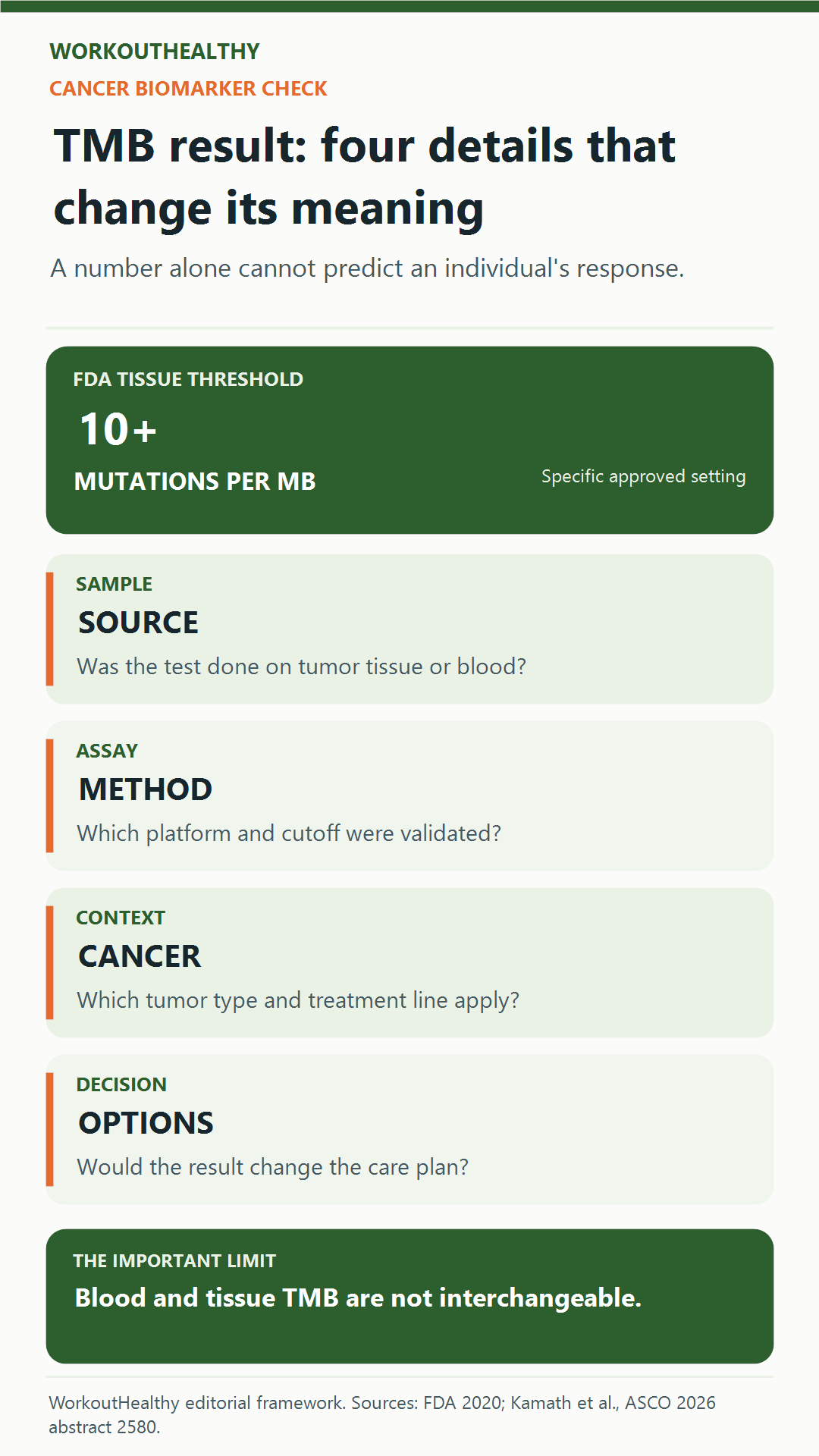
In June 2020, the U.S. Food and Drug Administration granted accelerated approval to pembrolizumab for certain adults and children with unresectable or metastatic solid tumors that are TMB-high at 10 or more mutations per megabase, as determined by an FDA-approved test. These patients must have progressed after earlier treatment and have no satisfactory alternative treatment options. The FDA also approved the FoundationOne CDx tissue assay as a companion diagnostic for this indication. That is a carefully defined treatment setting, not a recommendation to screen healthy people or to start the medicine whenever any TMB report says 10.
The supporting KEYNOTE-158 analysis included 102 patients whose tumors met the TMB-high definition. The observed overall response rate was 29%, with a 95% confidence interval of 21% to 39%. A response means measured tumor shrinkage under study criteria; it is not the same as cure, and 71% did not have a measured response. Some responders had durable benefit. At the same time, pembrolizumab can cause serious immune-mediated inflammation, including in the lungs, bowel, liver, hormone glands, and kidneys. The FDA approval and trial figures frame a discussion with an oncologist; they do not settle an individual’s risk-benefit balance. (FDA, 2020).
Why can blood and tissue TMB disagree?
A tissue biopsy analyzes DNA from a sampled part of a tumor. A blood-based liquid biopsy looks for tumor-derived DNA fragments circulating in plasma. Blood collection is generally less invasive, and it may be useful when tissue is difficult to obtain. But a blood sample can include very little tumor DNA, especially if a cancer sheds poorly into circulation. Different lesions can also carry different mutations. Those differences mean a low blood result need not prove the tumor’s tissue burden is low, and a high blood result need not mean the tissue assay would produce the same number.
Sequencing platforms also differ in which genes and mutations they count. A numeric cutoff established for one validated tissue assay cannot simply be copied onto every blood assay. Researchers are working on calibration and clinical validation, but technical correlation is only one piece. The crucial question is whether a particular test result reliably separates patients who do and do not benefit from a particular treatment in a defined clinical setting. The two samples can be complementary without being equivalent.
The same caution applies to many cancer tests. In our guide to urine cancer tests, a sample can contain useful clues but cannot replace the clinical pathway built for a different purpose. For TMB, the sample source is part of the result’s meaning.
What did the 2026 paired-sample analysis find?
A Cleveland Clinic team presented a retrospective analysis at the 2026 American Society of Clinical Oncology annual meeting. Its abstract reported 221 people with solid tumors who had at least one tissue TMB result and one blood TMB result between 2019 and 2025. Across paired samples, blood TMB ran at a median 2.3 times the tissue value, even though the two measures were correlated. This is a comparison of results obtained in the study population, not a conversion factor to apply to a patient’s report. (Kamath et al., 2026).
Only 80 of the 221 patients received immune checkpoint inhibitors and were included in the treatment-outcome analysis. Importantly, 80 is the treated subgroup, not the number whose blood and tissue tests disagreed. In discordant groups, patients with high tissue TMB and low blood TMB had a reported median time to treatment failure of 21.3 months. The reverse pattern, high blood TMB and low tissue TMB, had a reported median of 7 months. Time to treatment failure records when a treatment is stopped for any reason specified by investigators; it is not identical to overall survival or the chance of response for a new patient.
The researchers also tested a higher blood cutoff. Among patients with low tissue TMB, moving the blood threshold from 10 to 16 mut/Mb improved the reported median time to treatment failure for one comparison from 3.5 to 7 months, but did not make blood TMB outperform the tissue result. These subgroup results are intriguing, yet the abstract does not provide a randomized head-to-head test of treatment strategies. The number in each discordant subgroup, tumor mix, prior therapies, and timing of tests matter when deciding how generalizable the result is.
What can this analysis not establish?
The 2026 finding is a meeting abstract about a retrospective cohort. People were not randomly assigned to base their care on tissue or blood TMB. The patients had several kinds of solid tumor, and testing took place during different periods of treatment. A blood test ordered later in a person’s illness may be compared with tissue collected much earlier. That can introduce confounding unrelated to the intrinsic accuracy of either platform. The treated subgroup was much smaller than the full paired cohort, making discordant-group estimates particularly uncertain.
Therefore, it would overstate the evidence to say that blood TMB is useless, that tissue TMB always predicts response, or that a 21.3-month median tells one patient how long a drug will work. Larger, prospective, cancer-specific validation is needed. The safe interpretation is narrower: a blood TMB result should not be assumed to stand in for the tissue companion diagnostic behind the FDA’s tissue-based indication. If tissue is unavailable, an oncologist can weigh the test’s limitations with the rest of the clinical picture. (Kamath et al., 2026; FDA, 2020).
Where does TMB fit among other biomarkers?
Immunotherapy selection may consider PD-L1 expression, mismatch-repair deficiency, microsatellite instability, particular driver mutations, tumor type, and other factors. Those markers are not interchangeable with TMB either. A person may be eligible for a checkpoint medicine through a different indication even if TMB is low, or may have a TMB-high report while another treatment is more appropriate. The current stage of disease, symptoms, organ function, past treatments, and personal priorities remain central.
Testing also has practical tradeoffs. A tissue biopsy can carry procedural risks and may not always yield enough material. A blood sample is easier to obtain but can miss mutations when little tumor DNA circulates. Insurance coverage, turnaround time, and whether a result will change management are worth discussing before ordering either test. There is no advantage in collecting a biomarker merely because it is available if its answer cannot guide a real decision.
If reading about these odds feels overwhelming, remember that a biomarker result is only one chapter in a longer care story. Our coverage of Cameron Mathison’s kidney cancer experience similarly separates a personal narrative from a universal diagnostic rule. Your own treatment team can relate a report to your specific cancer.
Questions to take to your oncology appointment
- Which sample was tested? Ask whether the reported TMB came from tissue or blood, when the sample was taken, and whether the assay is approved or validated for the decision under discussion.
- What threshold applies here? Ask whether a cutoff comes from evidence for this specific assay, cancer type, and treatment setting, rather than from a different test.
- How strong is the sample? For blood testing, ask whether enough circulating tumor DNA was detected to make a low result informative. For tissue, ask whether the biopsy had adequate tumor content.
- What other options matter? Ask about other biomarkers, available treatments, clinical trials, possible immune-related side effects, and what will happen if a result is inconclusive.
- Will the answer change care? Ask what the team would recommend for each possible result before agreeing to more testing.
Bring the complete report, not a screenshot of a single number. An oncology team can explain how the laboratory defines TMB and whether a repeat or alternate sample is worth the burden. If you are considering a trial, the trial’s own eligibility and assay rules govern enrollment.
The bottom line
Tissue TMB has a defined role in one FDA-approved pembrolizumab pathway for certain previously treated advanced solid tumors. Blood TMB offers a less invasive measurement but should not be treated as a drop-in substitute for that tissue result. The 2026 paired-sample abstract reinforces this caution, while leaving important questions open across cancer types and testing methods. Use the result as a prompt for a precise conversation with your oncologist, not as a stand-alone verdict about treatment.
Medical disclaimer: This article provides general health information, not medical advice. Do not start, stop, or change cancer treatment based on a TMB number or this article. Review your complete test report and options with your oncology care team.
References
- U.S. Food and Drug Administration. (2020, June 16). FDA approves pembrolizumab for adults and children with TMB-H solid tumors.
- Kamath, S., et al. (2026). Tissue versus blood-based tumor mutational burden for predicting immune checkpoint inhibitor outcomes [Conference abstract 2580]. Journal of Clinical Oncology, 44(16_suppl). https://doi.org/10.1200/JCO.2026.44.16_suppl.2580.