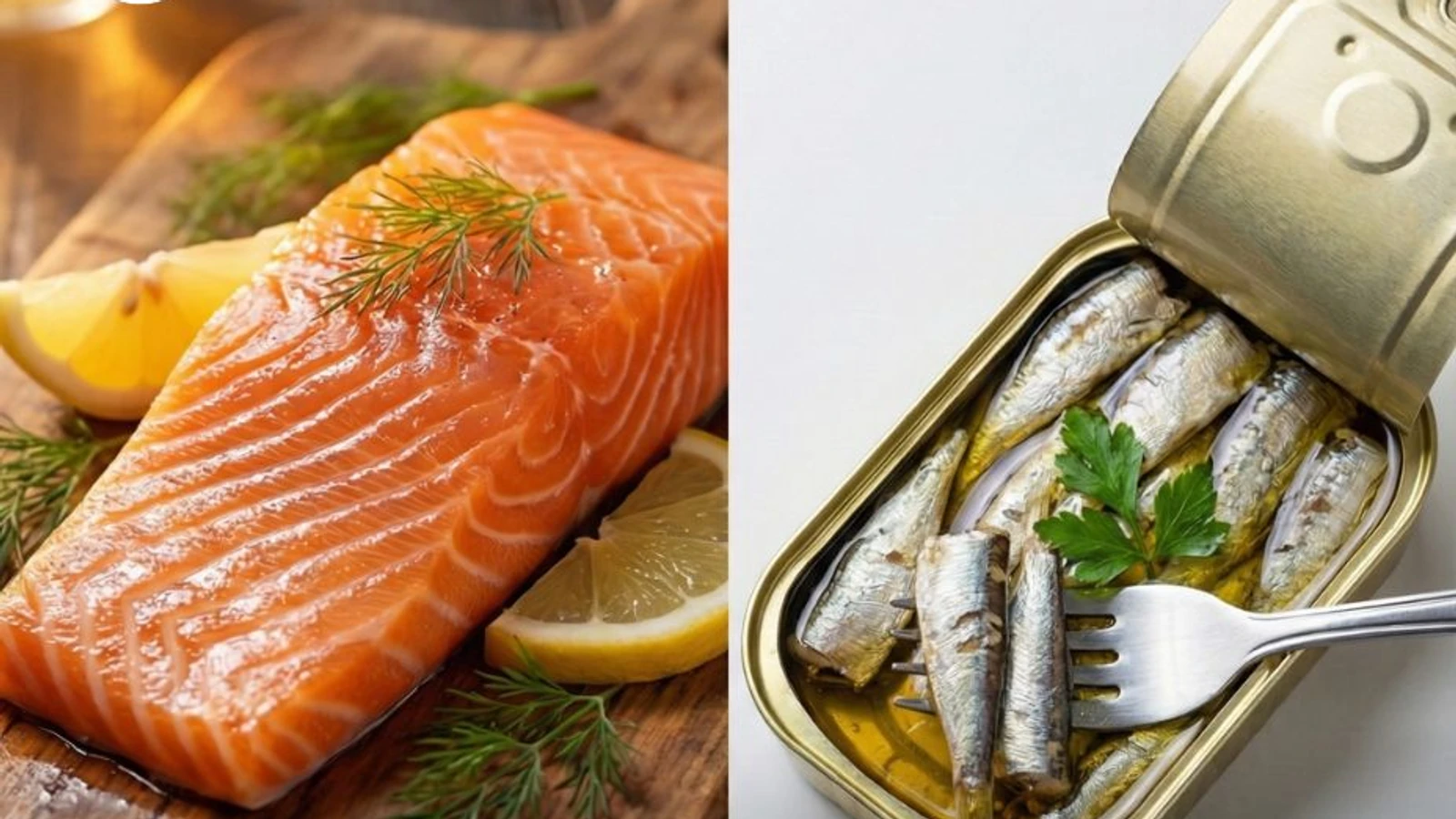

The SMASH fish list is a useful memory aid for sardines, mackerel, anchovies, salmon, and herring.
These oily fish can provide EPA and DHA omega-3 fats, protein, vitamin B12, selenium, and other nutrients.
The acronym is not an official safety standard, and it can hide important differences.
King mackerel is high in mercury, cured fish can be high in sodium, farmed salmon is not automatically inferior, and many fish outside the list are excellent choices.
The Short Answer
Use SMASH as a shopping prompt, not a rigid rule.
Choose the correct mackerel species, rotate seafood, read sodium labels, and follow local advisories for fish caught by family or friends.
For most adults, two fish meals per week is a practical target.
People who are pregnant or breastfeeding and young children should use the FDA and EPA mercury chart for exact serving guidance.
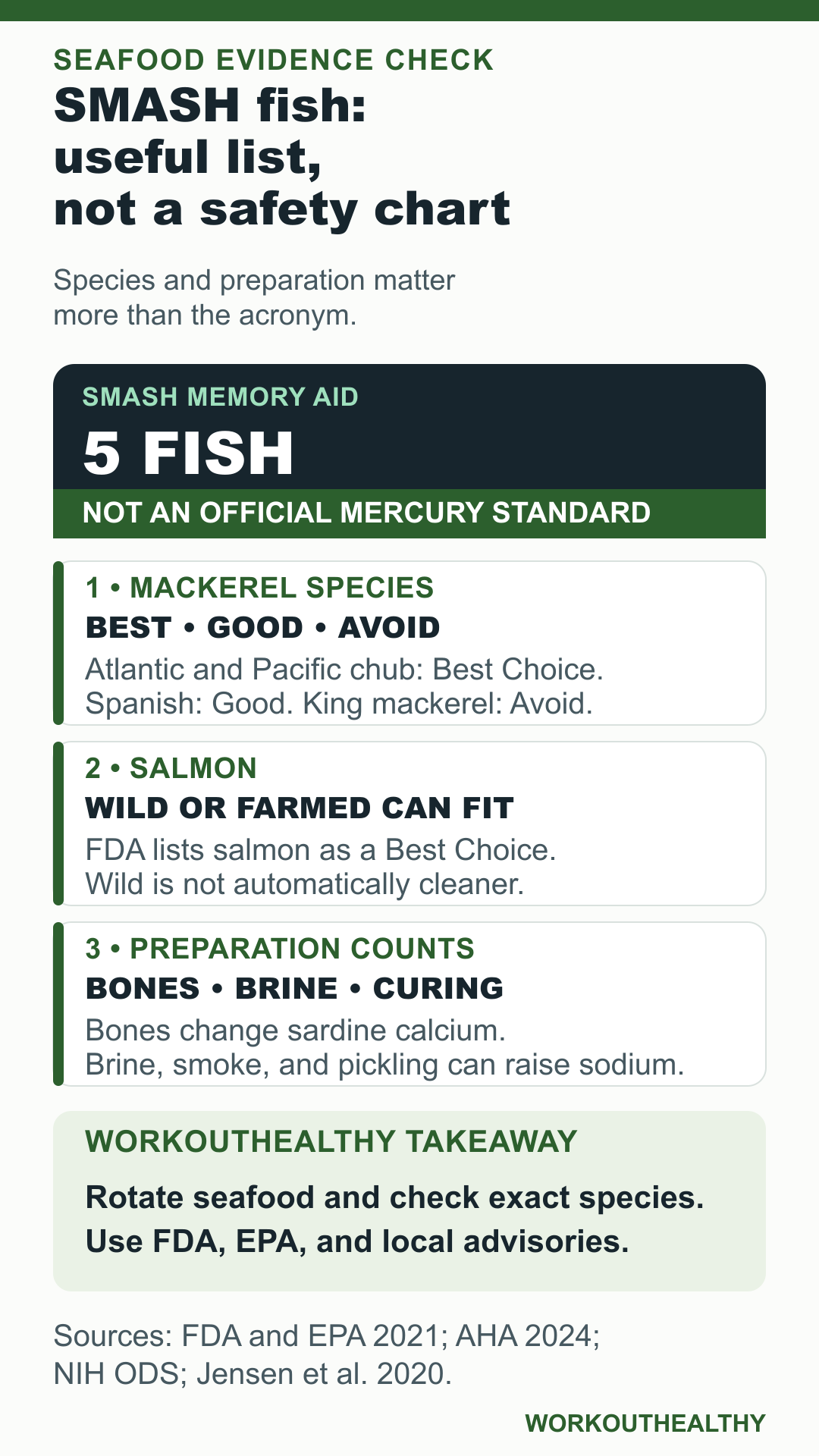
SMASH is a useful shopping prompt. Species, preparation, and variety still decide whether a fish is the right choice.
What SMASH Actually Stands For
- S: Sardines
- M: Mackerel
- A: Anchovies
- S: Salmon
- H: Herring
The social caption lists salmon, sardines, mackerel, and herring but leaves out anchovies.
That missing letter matters because anchovies are one of the FDA’s lower-mercury Best Choices and can be a concentrated source of marine omega-3 fats.
SMASH is popular because most members are oily fish that sit lower in the food web than large predators.
Smaller or shorter-lived fish often accumulate less methylmercury, but size is not enough to identify every safe species.
Fish-by-Fish Claim Checks
The Mackerel Warning the Acronym Needs
Mackerel is not one interchangeable food.
The FDA lists Atlantic mackerel and Pacific chub mackerel among its Best Choices, while Spanish mackerel is a Good Choice with more limited weekly frequency in the pregnancy and child guidance (U.S. Food and Drug Administration [FDA], 2021).
King mackerel is on the Choices to Avoid list because of its high mercury level.
A package or menu that says only mackerel does not give enough information for someone following mercury guidance.
Look for the species or common market name.
If the label is unclear, ask the seller rather than assuming that every mackerel belongs in the same low-mercury bucket.
Salmon: Wild Is Not the Only Healthy Option
Wild salmon can be an excellent choice, but calling it the only gold standard overstates the evidence.
The FDA lists salmon generally among its Best Choices for mercury.
Wild and farmed salmon differ because species, feed, habitat, season, and fat content differ.
A Norwegian comparison found that both wild and farmed Atlantic salmon provided useful EPA and DHA, while contaminant concentrations remained below regulatory limits.
In that study, wild salmon had a higher proportion of long-chain omega-3 within its fat, but farmed salmon had more total fat.
Some measured contaminants were higher in the wild samples, which directly contradicts the idea that wild always means fewer contaminants.
USDA research has also shown that eating farm-raised salmon can raise blood levels of omega-3 fats.
Cost, availability, taste, production practices, and sustainability can guide the final choice without turning farmed salmon into a nutrition failure.
Sardines: Calcium Depends on the Bones
Sardines are small, lower in mercury, and commonly sold in affordable shelf-stable cans.
They provide protein, EPA and DHA, vitamin B12, and selenium.
The calcium claim depends on eating the soft edible bones.
Boneless and skinless sardines will not provide the same calcium amount as whole canned sardines with bones.
Vitamin D also varies by product and serving.
Check the Nutrition Facts panel when calcium or vitamin D is the reason for choosing a particular can.
Sodium can change dramatically with brine, sauce, and preparation.
Draining or choosing a lower-sodium product can help someone managing sodium intake.
Anchovies: Nutrient Dense, Often Salty
Anchovies complete the acronym and appear on the FDA Best Choices list.
Their strong flavor means a small amount can season vegetables, pasta, beans, dressings, or toast.
Most supermarket anchovies are salt-cured or packed in brine or oil.
The fish can fit a healthy diet, but people limiting sodium should compare labels and account for the full dish.
Rinsing may remove some surface salt without making a heavily cured product low in sodium.
Portion and frequency still matter.
Herring: Healthy Fish, Preparation Matters
Herring is another FDA Best Choice for mercury and one of the fatty fish listed by the American Heart Association.
Fresh, frozen, canned, smoked, and pickled versions are nutritionally different meals.
Smoked or pickled herring is not automatically ideal.
Those methods can add substantial sodium, and pickled preparations may add sugar depending on the recipe.
Choose the version you enjoy, then read the label.
A fresh or lower-sodium preparation may suit regular use better for someone with hypertension or a clinician-directed sodium limit.
What Omega-3 Fats Can and Cannot Promise
EPA and DHA have roles in cell membranes and cardiovascular physiology.
The American Heart Association recommends two servings of fish per week, particularly fatty fish, as part of a heart-healthy dietary pattern (American Heart Association, 2024).
NIH concludes that fish and seafood within a balanced diet promote heart health, especially when they replace less healthy foods.
That replacement matters because adding fish without changing the rest of a dietary pattern may not create the same benefit.
The caption’s claim that eating SMASH fish two or three times per week will drastically lower inflammation is too broad.
Omega-3 fats affect inflammatory pathways, but a guaranteed large change in symptoms or laboratory markers cannot be assigned to everyone.
The brain claim also needs restraint.
NIH notes that some, but not all, research links omega-3 intake from food with lower risk of cognitive problems, and more study is needed.
No strong clinical standard says SMASH fish will make skin glow.
Fish can contribute nutrients to an adequate diet, but appearance depends on many factors and was not the outcome behind federal seafood guidance.
White Fish Is Not Bland Nutrition
Cod, pollock, haddock, tilapia, and other lean fish usually contain less EPA and DHA than oily fish.
They can still provide high-quality protein, vitamin B12, selenium, iodine in some species, and a lower-saturated-fat replacement for some meats.
The FDA places many lean fish on its Best Choices list.
A useful seafood plan can include oily fish for omega-3 fats and lean fish for variety, budget, and preference.
WorkoutHealthy’s guide to how much protein people actually need explains why a food’s value should not be judged by one nutrient alone.
Mercury Advice Is About Species and Frequency
Mercury can affect the nervous system, with pregnancy and childhood requiring particular care.
FDA and EPA advise people who are pregnant or breastfeeding to eat two to three four-ounce servings per week from the Best Choices list, or one serving from Good Choices.
Children should eat two age-appropriate servings from Best Choices.
Advice differs for fish caught by family or friends because local waters can have contaminant advisories.
For the general adult population, variety remains a sensible way to obtain nutrients while avoiding repeated high exposure from one source.
The federal chart is more useful than an acronym when a specific fish falls into a higher-mercury category.
Sustainability Cannot Be Reduced to One Species
Sustainability depends on the stock, location, harvest method, bycatch, habitat effects, and management.
A fish name alone cannot answer every environmental question.
NOAA describes sustainable seafood as wild or farmed food produced while allowing populations and ecosystems to remain productive.
U.S. fisheries use regional management, scientific monitoring, and legal standards, but conditions still vary among fisheries.
Check current source information when sustainability is a priority.
Labels, seller details, NOAA resources, and independent seafood guides can help identify the fishery or farm rather than treating every herring or salmon as identical.
Build a fish habit you can repeat: choose two meals, vary the species, and check the details on the label.
A Practical Two-Meal Seafood Plan
- Pick one oily fish meal. Choose salmon, sardines, Atlantic or Pacific chub mackerel, anchovies, or herring.
- Choose a second seafood meal. Use another oily fish or rotate in a lower-mercury lean fish or shellfish.
- Check the exact mackerel. Do not confuse Atlantic or Pacific chub mackerel with king mackerel.
- Read sodium labels. Compare canned, smoked, pickled, and sauce-packed products.
- Use preparation that supports the meal. Bake, grill, steam, or use a modest amount of oil instead of relying on deep frying.
- Pair it with the rest of a healthy pattern. Add vegetables, beans, whole grains, or other minimally processed foods.

Fish works best as part of the whole dietary pattern, not as a rescue ingredient.
The same pattern-first principle appears in WorkoutHealthy’s look at Arnold Schwarzenegger’s plant-forward diet, where the useful change was broader than one food.
Who Needs Individual Advice
People with a fish allergy should avoid the relevant species and discuss cross-contact risks.
Those taking anticoagulant medicine, managing kidney disease, or following a therapeutic sodium or protein plan should ask a clinician or dietitian how seafood fits.
Pregnant or breastfeeding people, young children, and anyone eating locally caught fish should use current FDA, EPA, and local advisories.
Food safety guidance also matters for raw, undercooked, refrigerated smoked, and ready-to-eat seafood.
Bottom Line
SMASH is a handy way to remember five fatty fish, but the safest version is specific: sardines, lower-mercury mackerel species, anchovies, salmon, and herring.
It is not a license to choose king mackerel, ignore sodium, or assume wild salmon is always cleaner and more nutritious.
Aim for variety and about two fish meals per week unless your clinician or life stage calls for different guidance.
Choose fish you can afford and enjoy, then let species, preparation, mercury advice, and the rest of the meal do the real decision-making.
Get the next evidence check.
Five practical fitness stories worth your time, every Friday.
One email a week. No product pitches. Unsubscribe in one click.
References
- U.S. Food and Drug Administration. Advice About Eating Fish. Revised 2021.
- U.S. Food and Drug Administration. Questions and Answers From the FDA and EPA Advice About Eating Fish.
- American Heart Association. Fish and Omega-3 Fatty Acids. Reviewed 2024.
- National Institutes of Health Office of Dietary Supplements. Omega-3 Fatty Acids: Health Professional Fact Sheet.
- Jensen IJ, et al. An Update on Fatty Acids, Dioxins, PCBs and Heavy Metals in Farmed and Wild Atlantic Salmon. Foods. 2020.
- U.S. Department of Agriculture Agricultural Research Service. Farmed Salmon Raises Blood Levels of Omega-3s. 2013.
- U.S. Food and Drug Administration. Mercury Levels in Commercial Fish and Shellfish.
- NOAA Fisheries. Sustainable Seafood.
- NOAA Fisheries. Atlantic Mackerel.
Medical disclaimer: This article is for general information only and is not medical advice. If you have an injury, ongoing pain, or a medical condition, talk to a doctor or physical therapist before you change how you train or eat.