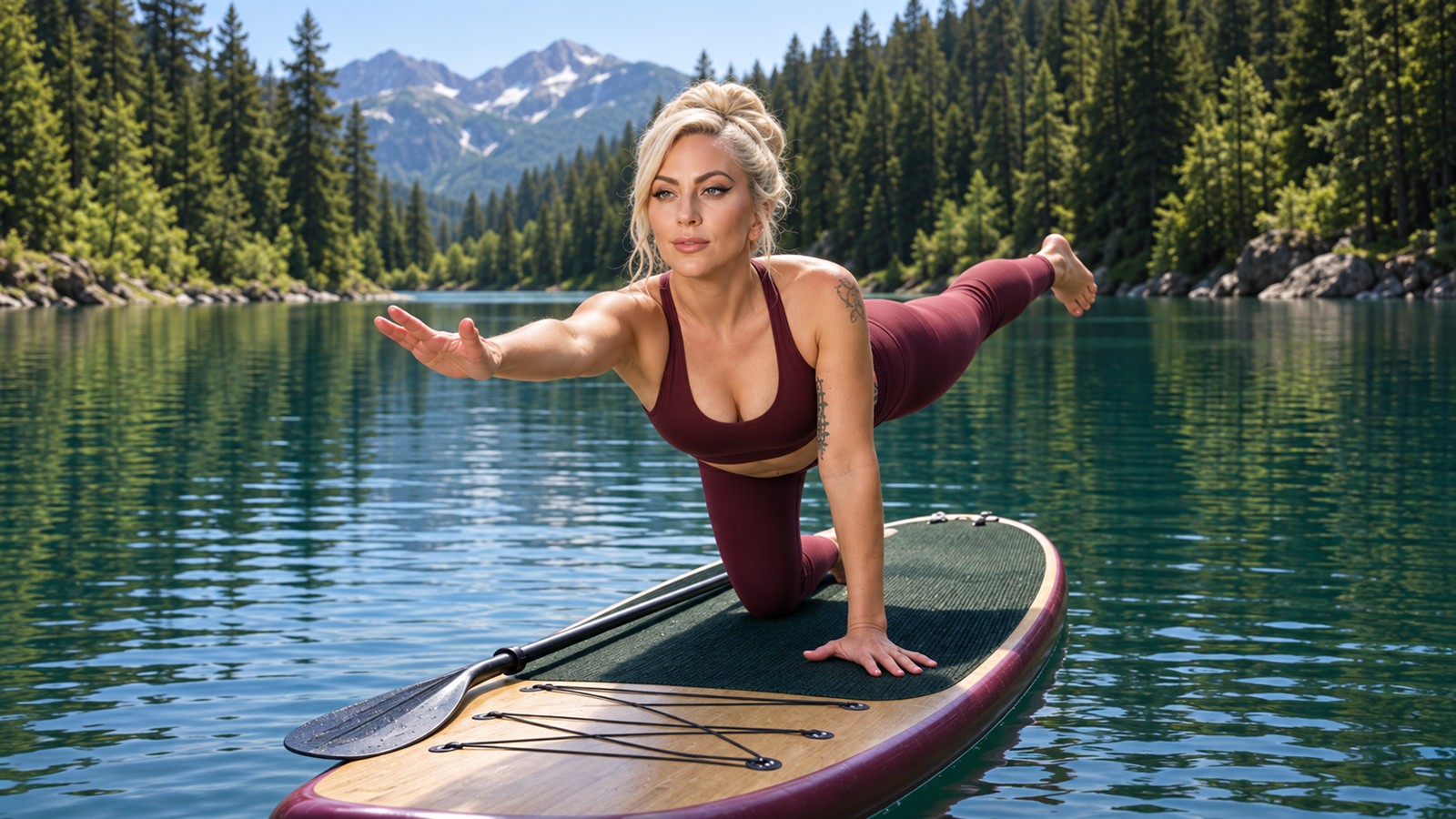

Lady Gaga has built a career around turning familiar ideas into something more theatrical. The same playful instinct shows up in the fitness story circulating about her doing yoga on a paddleboard.
The important part is not that a celebrity found a more dramatic background for a yoga pose. It is that an unstable board changes what the body has to do. Every small shift in the water asks the feet, hips, trunk, and shoulders to make constant corrections.
Gaga’s broader yoga habit is well documented. Women’s Health has reported that she uses yoga for both physical and mental reasons, alongside strength work, Pilates, swimming, and demanding stage rehearsals.
The Verified Part of Lady Gaga’s Yoga Routine
Celebrity workout stories often become more specific every time they are repeated. What can be said with confidence is that Gaga has practiced yoga for years and has shared parts of that practice publicly.
That makes paddleboard yoga believable as one expression of a larger habit, not a secret program responsible for her fitness. Her conditioning also comes from rehearsals, dance, resistance training, recovery work, and professional support.
The useful takeaway is variety. A person can keep a durable movement habit while changing the setting or style enough to stay interested.
Why a Paddleboard Changes Ordinary Yoga
On land, the floor stays still. On a paddleboard, the support surface moves under you. The body responds with many small corrections that are easy to miss but difficult to sustain.
The deep trunk muscles help resist unwanted rotation. The muscles around the ankles and hips make rapid balance adjustments. The shoulders work harder during weight-bearing poses because the hands may press into a surface that shifts with the water.
Balance Work Is More Than Standing Still
Balance is the ability to keep the body’s center of mass controlled over its base of support. On water, that base is constantly changing.
This does not automatically make every pose better. Instability can reduce how much force a person can safely produce, and difficult poses may become more about avoiding a fall than practicing clean alignment.
For someone with solid yoga fundamentals, however, the board can create a fresh coordination challenge. The goal should be control, not proving that a complicated pose can be forced in an unpredictable environment.
The Motivation Benefit May Matter Most
A workout only helps when it is repeated. Enjoyment is not a soft extra; it can be one of the practical reasons a routine survives.
Outdoor movement adds scenery, novelty, and a sense of play. For someone who is bored by repeating the same studio sequence, that change may be enough to restore attention.
The same principle applies on land. A new class, a different walking route, or a short skill goal can refresh a routine without requiring a complete overhaul. Our look at Kerry Washington’s Pilates and yoga practice shows another way celebrities combine consistency with variety.
Who Should Be Careful on the Water
Paddleboard yoga is not the right starting point for everyone. A person should be able to swim, feel calm around open water, and understand basic paddleboard safety before treating the board like a yoga mat.
A personal flotation device, calm water, suitable weather, and an instructor familiar with both paddling and yoga make the experience safer. Beginners should start seated or kneeling near shore and avoid advanced inversions.
People with recent injuries, significant balance problems, or medical conditions affected by heat or exertion should ask a qualified clinician whether this setting makes sense.
A Practical Progression for Beginners
Start on a wide, stable board. Spend a few minutes simply kneeling and noticing how the board responds to breathing and small shifts.
Move to tabletop, child’s pose, or a low lunge before standing. Widen the stance, keep the gaze on a fixed point, and expect to move more slowly than in a studio.
Falling is part of the activity, so learn how to fall away from the board and climb back on. The session is successful when control improves, not when every pose looks like a photograph.
What to Borrow From Gaga’s Example
The strongest lesson is not that paddleboard yoga is superior to ordinary yoga. It is that an established practice can remain playful.
Gaga’s routine is varied and professionally supported, so it should not be copied as a single prescription. But the willingness to combine strength, mobility, performance, and recovery is useful.
If water is not appealing, keep the principle and change the setting. Try a beginner yoga class outdoors, add a simple balance drill, or pair a gentle practice with the low-impact conditioning in our guide to standing cardio without jumping.
The Bottom Line
Lady Gaga’s long-running yoga habit is real. Paddleboard yoga adds instability, coordination, and novelty, but it is not a shortcut or a requirement for better fitness.
For an experienced beginner with water confidence and appropriate supervision, it can turn familiar poses into a memorable balance challenge. For everyone else, the transferable idea is simpler: choose movement you enjoy enough to practice again.