
Training before breakfast has a loyal following.
The idea is simple and appealing.
With no food in your stomach, your body has to burn stored fat instead.
A Colossus Fitness video called “Does Fasted Cardio Burn More Fat?” takes the claim apart, and the research agrees with the skeptics.
The best known trial on this question found no fat loss advantage at all once calories were matched.
Below are eight things fasted cardio will not do for your morning, plus the one thing in that study that did make a measurable difference.
If you like training before you eat, you can keep doing it.
Just do not expect it to do the heavy lifting.
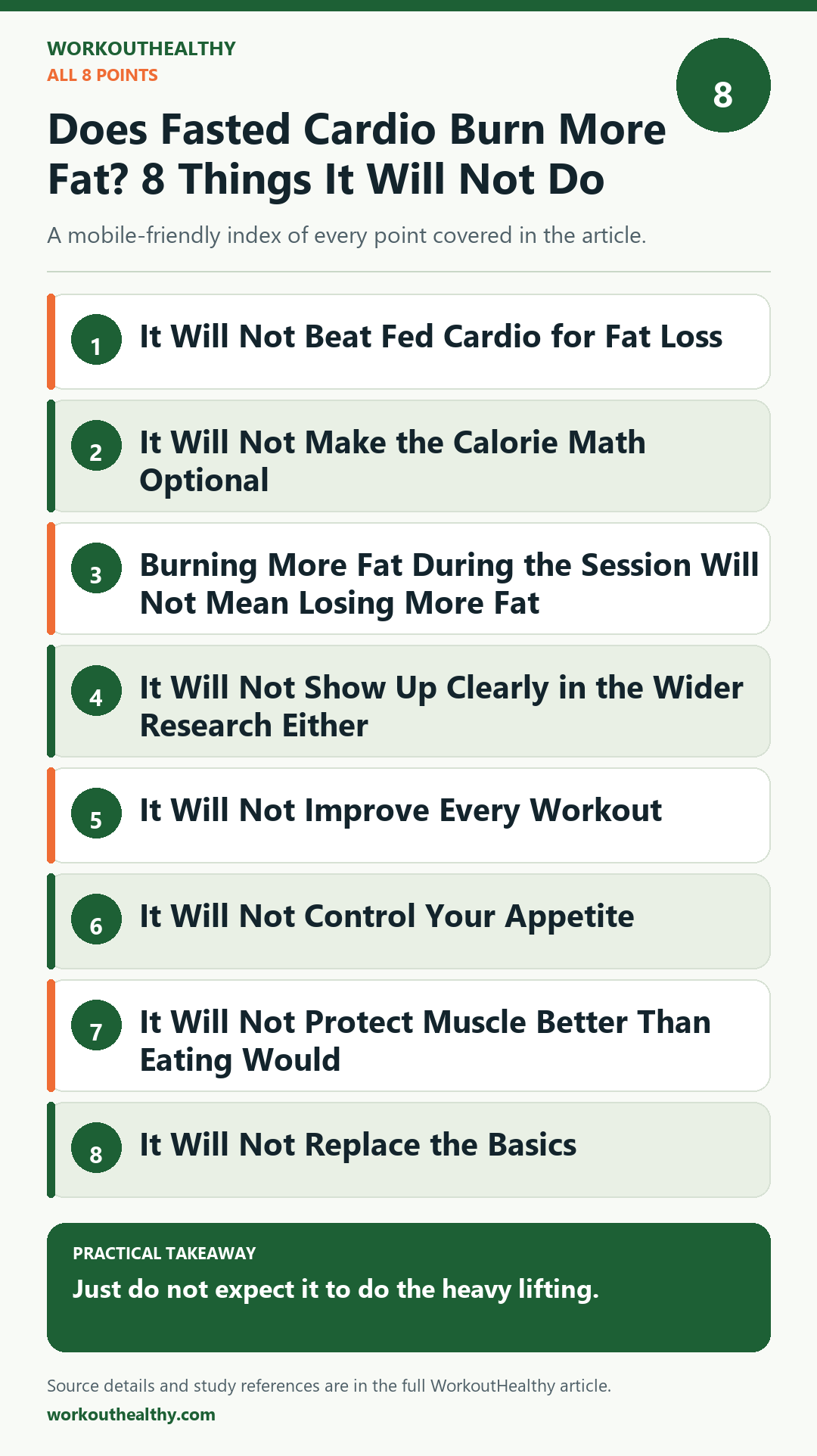
1. It Will Not Beat Fed Cardio for Fat Loss
The clearest test came in 2014, published in the Journal of the International Society of Sports Nutrition.
Twenty healthy young women were randomly assigned to do cardio either after an overnight fast or after a meal.
Both groups did 1 hour of steady cardio, 3 days a week, for 4 weeks.
Both groups followed a customized diet built to create a calorie deficit.
Both groups lost weight and fat mass.
Neither group beat the other on any outcome the researchers measured.
When calories were matched, training on an empty stomach changed nothing about the result.
2. It Will Not Make the Calorie Math Optional
Here is the part the headline usually skips.
Everyone in that study was eating in a calorie deficit.
That deficit is what produced the fat loss, in both groups.
The timing of the pre workout meal was the only thing being tested, and it did not matter.
So the thing that “made a measurable difference” was not the fasting.
It was eating less than they burned, consistently, for four weeks.
3. Burning More Fat During the Session Will Not Mean Losing More Fat

Fasted exercise really can shift the fuel mix toward fat during the workout itself.
That part is real physiology.
The problem is what happens over the next 20 hours.
Your body adjusts fuel use across the whole day, so burning more fat at 6 a.m. often means burning less later.
Fat loss is decided over weeks by total energy balance, not by which fuel you used during one session.
Think of it like a bank account.
What matters at the end of the month is deposits minus withdrawals, not which account the money moved through on Tuesday morning.
4. It Will Not Show Up Clearly in the Wider Research Either
The 2014 trial is small, so it helps to zoom out.
A 2017 systematic review and meta-analysis in the Journal of Functional Morphology and Kinesiology pooled the available studies comparing overnight fasted exercise with fed exercise.
It found only five eligible studies, involving 96 participants in total.
The effects on body mass between fasted and fed exercise were trivial.
Effects on body fat percentage and lean mass were small to trivial as well.
The authors were careful to say the evidence base is thin.
Thin evidence for a small effect is not a reason to build your morning around it.
5. It Will Not Improve Every Workout
For an easy walk or a light jog, training fasted is usually fine.
For long endurance sessions, hard intervals, or heavy lifting, many people simply perform worse without fuel.
A worse session is a real cost, because the quality of your training is what drives results.
If your pace drops, your loads drop, or you cut the workout short, fasting has taken more than it gave.
6. It Will Not Control Your Appetite
Some people finish a fasted session and eat normally.
Others come home ravenous and eat back everything they burned, plus extra.
Neither response is a character flaw, and both are common.
If your breakfast after fasted cardio turns into a second breakfast, the deficit you were chasing disappears.
Watching your intake for a week or two tells you which type you are.
If you are the second type, eating something small before the session often leads to eating less across the whole day.
7. It Will Not Protect Muscle Better Than Eating Would
Fasted training is sometimes sold as the lean, muscle sparing option.
Evidence does not support that framing, and the reverse worry is usually overblown too.
Across studies, what protects muscle is enough total protein, enough calories over time, and continued strength training.
Meal timing sits far below those three in importance.
If you lift in the morning, our guide on lifting and cardio in the same week covers how to order the work so neither one suffers.
8. It Will Not Replace the Basics
Fasted cardio is a schedule choice.
Sleep, steps, protein, training consistency, and total calories are the engine.
When people report big results from fasted cardio, they usually changed several of those at the same time.
The habit gets the credit, but the deficit did the work.
Our deeper evidence review on fasted training and fat loss walks through the broader literature, including time restricted eating.
What Actually Moves Fat Loss in the Morning
If the pre workout meal is not the lever, what is?
The American College of Sports Medicine reviewed this in a 2009 position stand.
About 150 to 250 minutes of moderate activity a week produces only modest weight loss on its own.
More than 250 minutes a week was linked with larger losses and better protection against regaining weight.
Diet does most of the work, and exercise makes the deficit easier to hold.
So the useful morning question is not “did I eat first.”
It is whether the session happened at all, and whether it fits into a week that adds up.
Three Numbers Worth Tracking Instead
Forget the fasting debate for six weeks and watch these.
- Your waist measurement, taken the same way every two weeks.
- Weekly training minutes and strength sessions completed.
- A weekly average of your morning weight, never a single day.
If the waist is shrinking and the sessions are happening, the plan is working.
If nothing moves in six weeks, change one thing: portions, weekly minutes, or how hard the sessions actually are.
Changing the breakfast timing is the last thing on that list, not the first.
So Should You Ever Train Fasted?
Yes, if you like it and it works for you.
Some people feel lighter and less sluggish without food in their stomach.
Some simply prefer not to cook at 5:30 a.m.
Those are perfectly good reasons.
The rule is that it has to pass two tests.
Your session quality stays the same, and your eating the rest of the day does not blow up.
If both hold, train fasted and stop worrying about it.
If either one fails, eat something small first and move on.
No one has ever missed a fat loss goal because they had half a banana at 6 a.m.
What This Evidence Does Not Prove
The 2014 trial was small, 20 participants, all young women, over just 4 weeks.
The 2017 review pooled only five studies and 96 people, and the authors said as much.
None of this research rules out small individual differences.
None of it addresses athletes with specific fueling needs or people using medications that affect blood sugar.
And “no advantage” is not the same as “harmful,” since the fasted groups did fine.
Common Mistakes People Make With Fasted Cardio
- Treating the workout as permission for a bigger breakfast.
- Doing hard intervals fasted, then wondering why the pace fell off.
- Skipping fluids along with food, which makes morning sessions feel much worse.
- Judging progress by one morning’s scale weight.
- Assuming that because a coach or influencer thrives on it, everyone will.
Steady daily movement usually matters more than which hour you train, which is why our look at daily steps and mortality is worth a read.
Who Should Not Train Fasted
- Anyone with diabetes or who uses insulin or blood sugar lowering medication.
- Anyone who is pregnant.
- Anyone with a history of disordered eating.
- Anyone who gets dizzy, shaky, or nauseated without food.
- Anyone recovering from illness or surgery, unless a clinician has cleared it.
Stop the session and eat if you feel faint, confused, or unusually weak.
A Simple Morning Plan That Does Not Depend on Fasting
If you train early and feel good fasted.
Have water and, if you want it, coffee.
Keep the session moderate.
Eat a normal meal with protein afterward.
If you feel flat without food.
Have something small and easy 30 to 60 minutes before, such as toast with yogurt, a banana with a shake, or oatmeal.
Keep it light enough to sit well.
Either way.
Set your total calories and protein for the day first.
Hit your strength sessions twice a week.
Get your steps in.
Judge the plan by your waist measurement and your training log after six weeks, not by how virtuous the morning felt.
Fasted cardio is a preference, not a strategy. The deficit is the strategy.
Watch the Original Video
Want fitness claims checked against the actual studies? Subscribe to WorkoutHealthy Insider for practical explanations behind popular fitness claims.
References
Donnelly, J. E., Blair, S. N., Jakicic, J. M., Manore, M. M., Rankin, J. W., & Smith, B. K. (2009). Appropriate physical activity intervention strategies for weight loss and prevention of weight regain for adults. Medicine & Science in Sports & Exercise, 41(2), 459 to 471. https://doi.org/10.1249/MSS.0b013e3181949333
Hackett, D., & Hagstrom, A. D. (2017). Effect of overnight fasted exercise on weight loss and body composition: A systematic review and meta-analysis. Journal of Functional Morphology and Kinesiology, 2(4), 43. https://doi.org/10.3390/jfmk2040043
Schoenfeld, B. J., Aragon, A. A., Wilborn, C. D., Krieger, J. W., & Sonmez, G. T. (2014). Body composition changes associated with fasted versus non-fasted aerobic exercise. Journal of the International Society of Sports Nutrition, 11(1), 54. https://doi.org/10.1186/s12970-014-0054-7
This article is for general information only and is not medical advice. If you have an injury, ongoing pain, or a medical condition, talk to a doctor or physical therapist before you change how you train or eat.