
“Weakness is a crime; don’t be a criminal.”
That was the motto of Bernarr Macfadden, one of America’s first fitness celebrities.
It is catchy. It is also harsh.
A popular post says he used it to push readers toward daily exercise and healthier habits.
This article looks at where the slogan came from, why it worked as marketing, and why shame is a poor coach.
Did Macfadden Really Use the Slogan?
Yes, though the exact first appearance is hard to pin down.
A 2018 HistoryNet article by Peter Carlson calls it Macfadden’s famous motto and ties it to his magazine, Physical Culture.
A 2009 National Geographic article by Mary Anne Potts says he “shouted out things like” this line.
The phrase also appears in the title of a paper on body images in Physical Culture, held in the University of Texas library repository.
The magazine launched in 1899.
We could not confirm that the motto was printed in the very first issue, so the 1899 date is best read as the magazine’s start, not the slogan’s.
Who Macfadden Was
Macfadden was born on August 16, 1868, in Mill Spring, Missouri.
He died on October 12, 1955, in Jersey City, New Jersey, at age 87.
He even changed his name to sound stronger.
Wikipedia says he felt “Bernarr” sounded like a lion’s roar.
HistoryNet reports that he sold millions of copies of Physical Culture.
He also had a dark side.
He mocked doctors as quacks and crusaded against vaccinations and medicines.
Wikipedia reports that two of his children died for lack of medical care.
Potts, citing biographer Mark Adams, counts his refusal to believe that germs could cause harm among his biggest blunders.
What the Slogan Got Right
The message behind it had a fair core.
Your daily habits affect your health, and you have some control over them.
Macfadden pushed ordinary readers to exercise, get outside, and pay attention to what they ate.
That push reached a huge audience.
National Geographic reports that his magazine reached hundreds of thousands of readers each month.
Tens of thousands more visited his health homes.
So many people clearly responded to his message, at least enough to keep buying.
What we could not find is solid data on whether the slogan itself changed their habits.
Sales show interest. They do not show lasting health changes.
Taking ownership of your health is fair. Treating weakness as a crime is not.
What the Slogan Gets Wrong
Calling weakness a crime puts all the blame on the person.
It ignores things people cannot fully control.
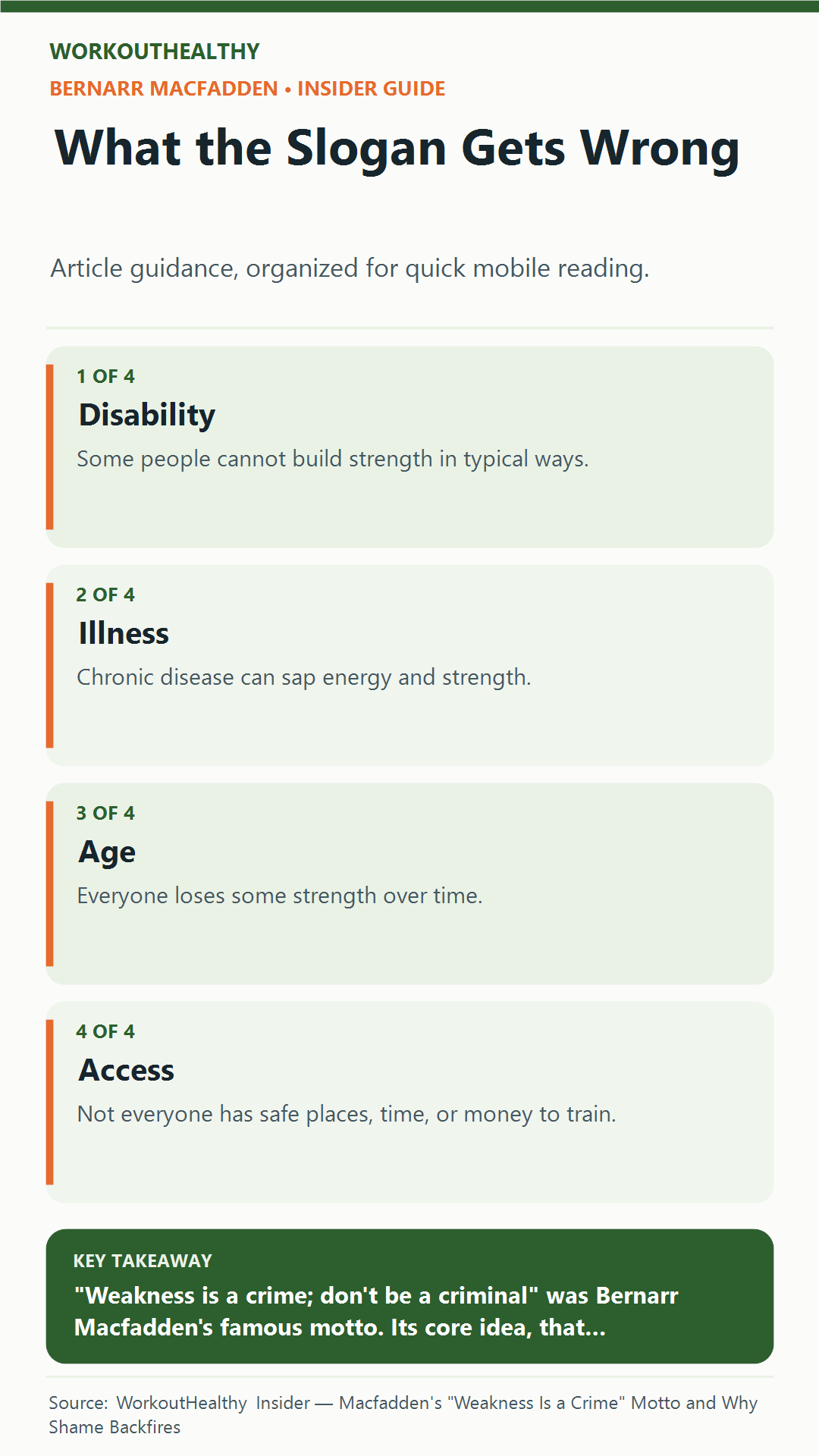
- Disability. Some people cannot build strength in typical ways.
- Illness. Chronic disease can sap energy and strength.
- Age. Everyone loses some strength over time.
- Access. Not everyone has safe places, time, or money to train.
It also treats people who are struggling as wrongdoers.
Think of someone recovering from surgery, caring for a sick parent, or working two jobs.
Calling them criminals does not give them more time, energy, or a safe place to train.
It just adds guilt to a hard situation.
As the research below shows, that framing can backfire.
What Research Says About Shame and Exercise
In 2008, Lenny Vartanian and Jacqueline Shaprow studied weight stigma and exercise.
Their study appeared in the Journal of Health Psychology.
One hundred female college students reported their experiences of weight stigma and their exercise habits.
More stigma was linked with a stronger desire to avoid exercise.
That held even after accounting for body mass index and body dissatisfaction.
Wanting to avoid exercise was in turn linked with less frequent moderate and strenuous exercise.
The authors called it a preliminary study.
Still, it suggests that shaming people about their bodies may push them away from exercise.
What Research Says About Motivation That Lasts
In 2012, Pedro Teixeira and colleagues reviewed 66 studies on exercise and self determination theory.
The theory separates motivation that comes from within from motivation driven by pressure.
The review found consistent support for a link between more autonomous motivation and exercise.
Autonomous means you exercise because you value it or enjoy it.
Intrinsic motivation, or doing it for its own sake, was more predictive of long term exercise.
Feeling competent also predicted more exercise.
Evidence on guilt driven motivation, which the authors call introjected regulation, was mixed.
A slogan built on fear of being a “criminal” leans on that pressure.
It may get some people started, but it is not the kind of motivation most tied to lasting habits.
What This Does Not Prove
The stigma study was small, used only female college students, and measured links, not cause.
Most studies in the motivation review were also non experimental.
Neither study tested Macfadden’s slogan directly.
Some people do say tough talk helps them.
The evidence simply suggests it is a risky default.
A Better Motto for Today
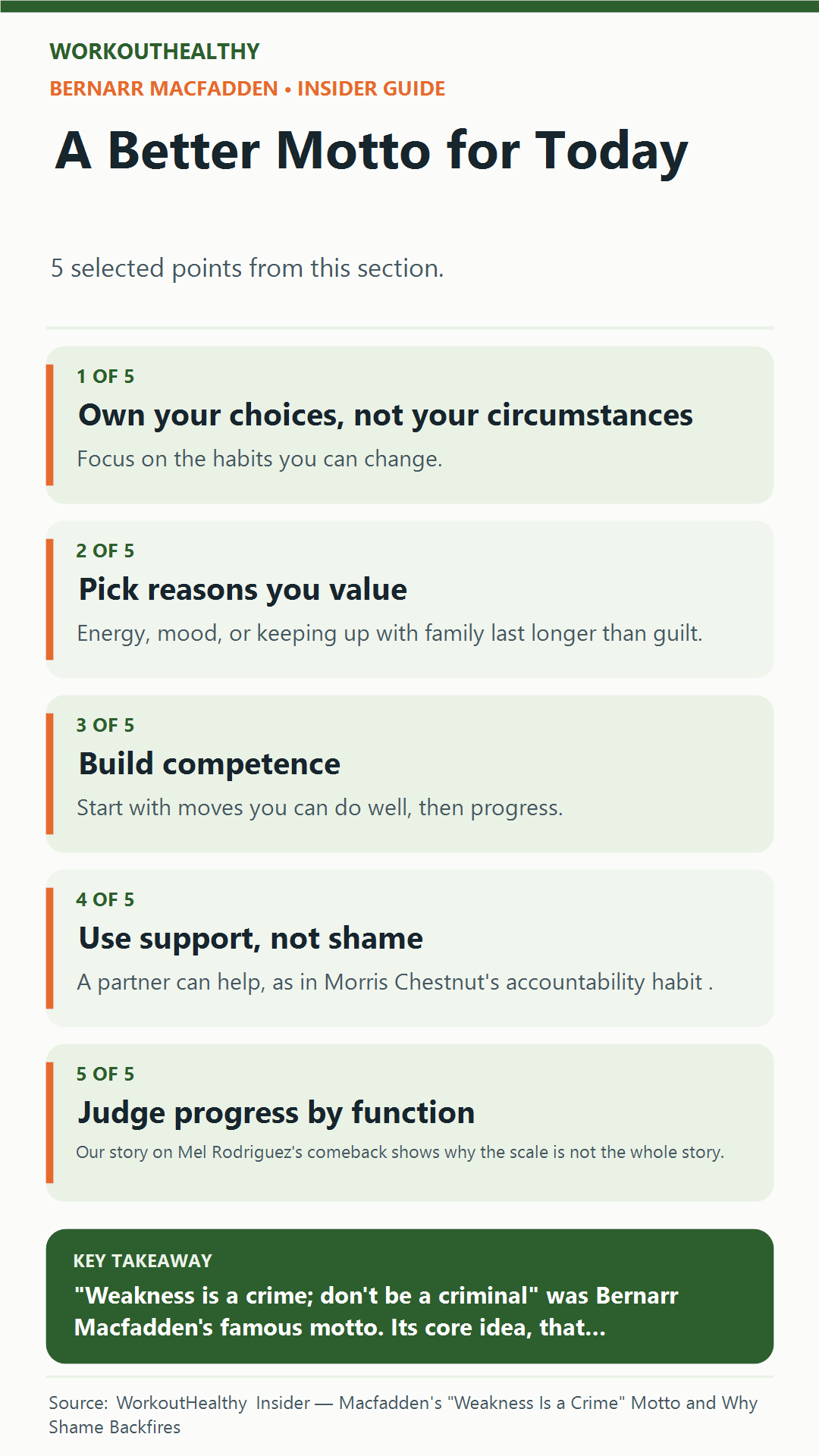
- Own your choices, not your circumstances. Focus on the habits you can change.
- Pick reasons you value. Energy, mood, or keeping up with family last longer than guilt.
- Build competence. Start with moves you can do well, then progress.
- Use support, not shame. A partner can help, as in Morris Chestnut’s accountability habit.
- Judge progress by function. Our story on Mel Rodriguez’s comeback shows why the scale is not the whole story.
- Adapt to your health. See how Christina Applegate keeps moving with MS.
Who Should Be Careful
Anyone with a chronic illness or disability should build a plan with a doctor or physical therapist.
Do not follow Macfadden’s anti medicine views. Get proper medical care when you need it.
If exercise messages make you feel ashamed or anxious, it is fine to tune them out.
The Bottom Line
“Weakness is a crime; don’t be a criminal” was Bernarr Macfadden’s famous motto.
Its core idea, that habits matter, holds up.
Its shaming framing does not, and research suggests stigma and pressure are weak foundations for lasting exercise.
Want more stories like this? Subscribe to WorkoutHealthy Insider for practical explanations behind popular fitness claims.
References
- Carlson, P. (2018). Putting the “fad” in Macfadden. HistoryNet. https://historynet.com/putting-fad-macfadden/
- Potts, M. A. (2009, March 23). Weakness is a crime, and other lessons from America’s first fitness guru. National Geographic. https://www.nationalgeographic.com/adventure/article/weakness-is-a-crime-and-other-ideas-from-americas-first-fitness-guru
- Teixeira, P. J., Carraça, E. V., Markland, D., Silva, M. N., & Ryan, R. M. (2012). Exercise, physical activity, and self-determination theory: A systematic review. International Journal of Behavioral Nutrition and Physical Activity, 9, 78. https://doi.org/10.1186/1479-5868-9-78
- Vartanian, L. R., & Shaprow, J. G. (2008). Effects of weight stigma on exercise motivation and behavior: A preliminary investigation among college-aged females. Journal of Health Psychology, 13(1), 131 to 138. https://doi.org/10.1177/1359105307084318
- Wikipedia contributors. (n.d.). Bernarr Macfadden. In Wikipedia. Retrieved September 16, 2026, from https://en.wikipedia.org/wiki/Bernarr_Macfadden
This article is for general information only and is not medical advice. If you have an injury, ongoing pain, or a medical condition, talk to a doctor or physical therapist before you change how you train or eat.