
Long before boxing gyms and sparring partners, young herders in southern Africa had their own training ground: the open pasture.
A popular post says Nguni herd boys sparred with sticks every day to build reflexes, timing, and courage.
The daily sparring part holds up well in the scholarship.
The “reflexes” part needs a closer look, because research on fighters points to a different skill.
What Nguni Stick Fighting Is
Nguni stick fighting is a traditional martial art of Nguni speaking peoples in South Africa, including Zulu and Xhosa communities.
In Zulu practice, a fighter may use an attacking stick called an isikhwili, a defending stick called an ubhoko, and a shield called an ihawu.
Xhosa styles commonly use two sticks, one for attack and one for defense.
Fighters alternate between attack and defense, and points depend on where a strike lands.
Contests have long been part of weddings and other community gatherings, often under the eye of a referee.
Where the Daily Sparring Claim Comes From
The clearest source is a 2002 article by Marié-Heleen Coetzee, “Zulu Stick Fighting: A Socio-Historical Overview.”
Coetzee writes that very young boys trained with switches or small sticks.
She also writes that sparring “can be a daily occurrence amongst the herd boys.”
That wording matters. It describes a common habit, not a fixed daily schedule every boy followed.
South African History Online adds that boys learned while herding cattle, starting with small shrubs before moving to real sticks.
It says they learned largely by watching and copying older fighters.
How Old Is the Tradition?
Exact origins are hard to pin down.
Coetzee traces one genealogy back to Amalandela, son of Gumede, who lived in the Umhlatuze valley around 1670.
South African History Online also points to “around 1670” or to the era of Shaka Zulu.
So “around the 1670s” is a traditional reference point, not a precise written record of when stick fighting began.
Scholars also note that apartheid era laws on displaying traditional weapons in public limited the practice.
Today it is again drawing crowds in parts of South Africa.
More Than Fighting Practice
Stick fighting was never only about physical skill.
Coetzee describes it as a way for a boy to build courage and to fight his way up to leadership among his peers.
A 2012 paper by Benedict Carton and Robert Morrell in the Journal of Southern African Studies looks at stick fighting, warrior culture, and Zulu masculinity.
As its title says, the paper sets out to reassess both male violence and virtue in South Africa.
The sparring also had limits.
Coetzee notes strict rules during practice, including no head strikes in sparring, and that stabbing is not allowed in a stick fight.
Frequent, controlled practice teaches you to read what is coming, not just to react faster.
What Research Says About Fighters and Reaction Time
Do trained fighters simply have faster reflexes? One well known study suggests the answer is more interesting.
In a 2002 study in Human Movement Science, Mori, Ohtani, and Imanaka compared karate athletes with novices.
On simple reaction time, where people just responded when something started, there was no significant difference between the groups.
On choice reaction time, where people had to judge where an attack was aimed, the athletes were faster.
That gap was larger when the stimulus was video of a real opponent rather than simple dots.
In a second test, video clips were cut off just after an attack began.
The athletes guessed the target correctly more often than novices.
The authors concluded that karate athletes had superior anticipation skills about where an opponent’s attack was headed.
What That Means for the Stick Fighting Claim
The study did not test Nguni stick fighters, so it cannot prove anything about them directly.
It does suggest a useful correction to the popular post.
Regular sparring may not make basic reflexes much quicker.
What it likely sharpens is the ability to read an opponent’s movement early and choose the right response.
That fits a practice where boys faced each other again and again, learning each other’s habits.
Courage is harder to measure, and no study here tests it.
How to Use the Lesson Today
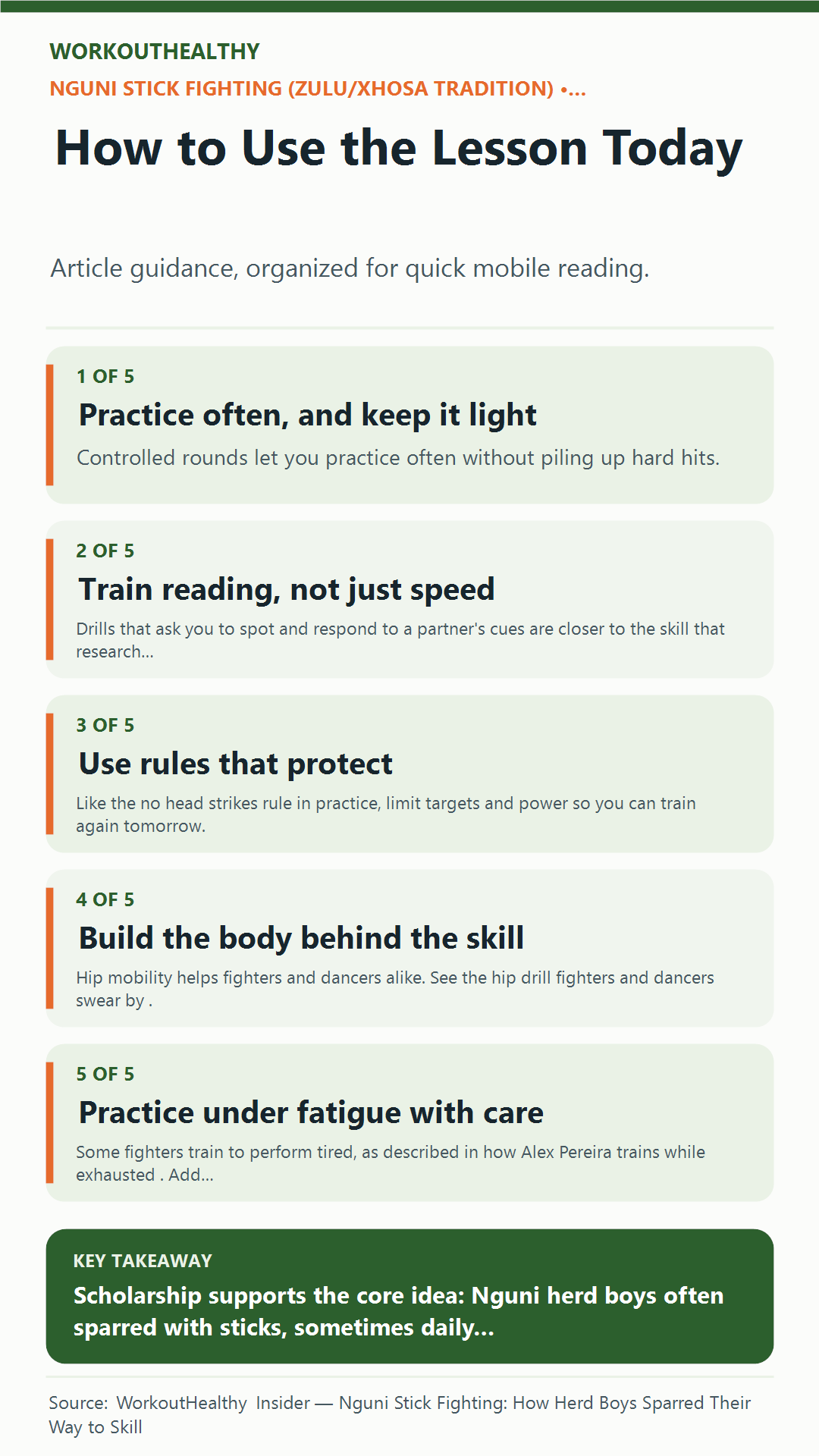
- Practice often, and keep it light. Controlled rounds let you practice often without piling up hard hits.
- Train reading, not just speed. Drills that ask you to spot and respond to a partner’s cues are closer to the skill that research highlights.
- Use rules that protect. Like the no head strikes rule in practice, limit targets and power so you can train again tomorrow.
- Build the body behind the skill. Hip mobility helps fighters and dancers alike. See the hip drill fighters and dancers swear by.
- Practice under fatigue with care. Some fighters train to perform tired, as described in how Alex Pereira trains while exhausted. Add it gradually.
Common Mistakes
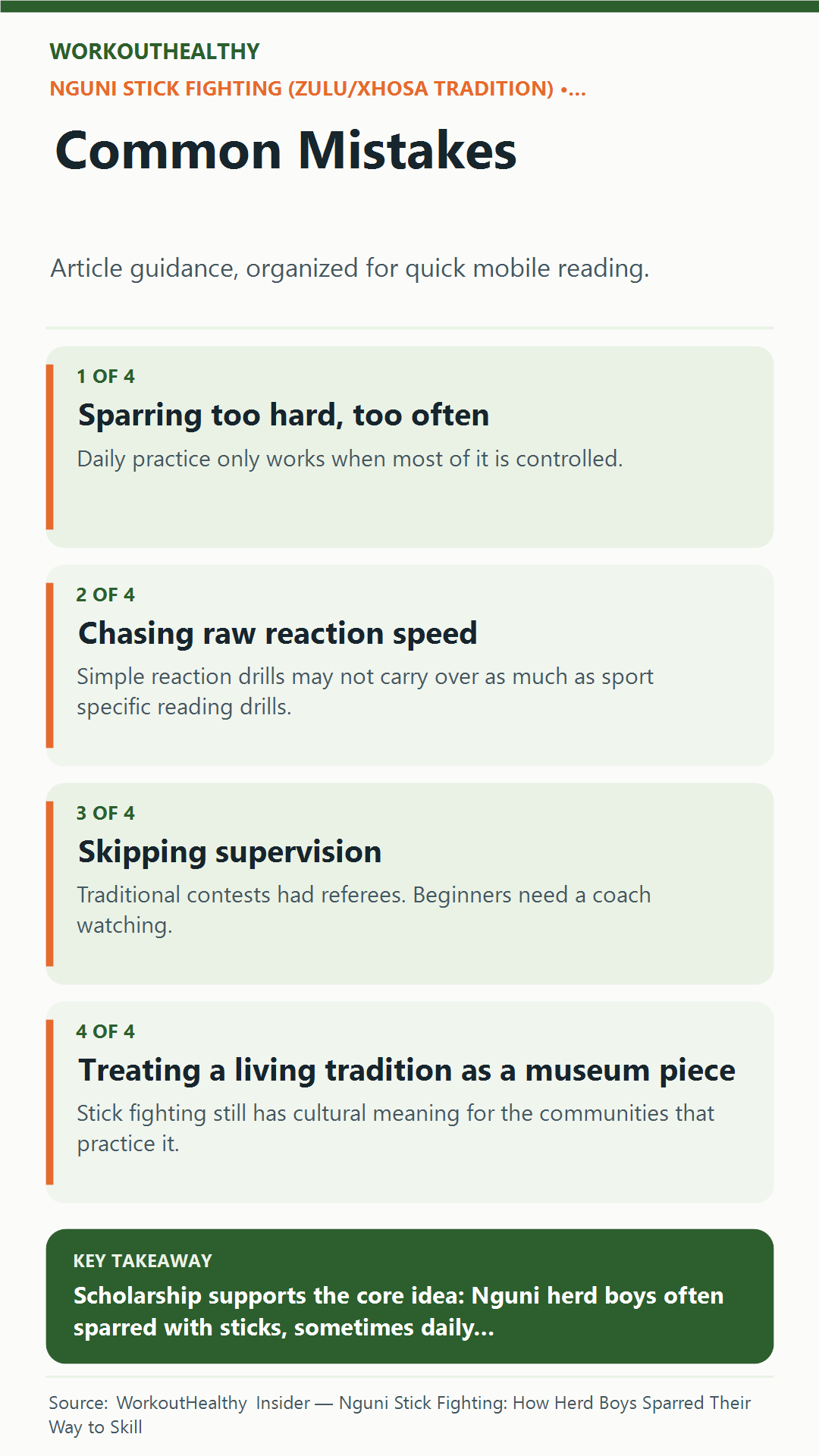
- Sparring too hard, too often. Daily practice only works when most of it is controlled.
- Chasing raw reaction speed. Simple reaction drills may not carry over as much as sport specific reading drills.
- Skipping supervision. Traditional contests had referees. Beginners need a coach watching.
- Treating a living tradition as a museum piece. Stick fighting still has cultural meaning for the communities that practice it.
Who Should Be Careful
Any contact training carries a risk of head, hand, and eye injuries.
Use proper protective gear and a qualified instructor for any stick or weapon sparring.
If you have had a concussion, talk to a doctor before any sparring.
For a look at an older athlete who still trains carefully, see Idris Elba training like a fighter in his fifties.
The Bottom Line
Scholarship supports the core idea: Nguni herd boys often sparred with sticks, sometimes daily, while tending cattle.
That practice built courage, status, and fighting skill within clear rules.
Research on martial artists suggests the main payoff of frequent sparring is better anticipation, not faster basic reflexes.
Frequent, controlled practice with a partner is still one of the best ways to build real skill.
Want more stories like this? Subscribe to WorkoutHealthy Insider for practical explanations behind popular fitness claims.
References
- Carton, B., & Morrell, R. (2012). Zulu masculinities, warrior culture and stick fighting: Reassessing male violence and virtue in South Africa. Journal of Southern African Studies, 38(1), 31 to 53. https://doi.org/10.1080/03057070.2011.640073
- Coetzee, M.-H. (2002, September). Zulu stick fighting: A socio-historical overview. InYo: Journal of Alternative Perspectives. https://ejmas.com/jalt/jaltart_Coetzee_0902.htm
- Mori, S., Ohtani, Y., & Imanaka, K. (2002). Reaction times and anticipatory skills of karate athletes. Human Movement Science, 21(2), 213 to 230. https://doi.org/10.1016/S0167-9457(02)00103-3
- South African History Online. (n.d.). Nguni stick fighting. https://sahistory.org.za/article/nguni-stick-fighting
- Wikipedia contributors. (n.d.). Nguni stick-fighting. In Wikipedia. Retrieved September 16, 2026, from https://en.wikipedia.org/wiki/Nguni_stick-fighting
This article is for general information only and is not medical advice. If you have an injury, ongoing pain, or a medical condition, talk to a doctor or physical therapist before you change how you train or eat.