
Idris Elba turns 54 this month. He is still one of the busiest actors working.
He has a slate of West African action films, new Luther projects, and a Masters of the Universe role all in motion for 2026.
He is also, by his own account, still training like a fighter.
A widely shared WorkoutHealthy Facebook post described Elba’s approach this way. He stays fight ready in his fifties by mixing boxing, strength training, and mobility work.
That is a fair summary. Elba has talked openly about this mix in interviews for years, and the pattern holds up.
He is not the only public figure whose boxing habit has drawn attention. George Foreman’s own comeback story, decades earlier, is one of the sport’s clearest examples of what patient, well managed training can do at an age most people assume is past its window.
From Weekend Hobby to Real Fight Training
Elba did not start boxing recently. He has said he has been kickboxing to stay fit since his twenties.
What changed was intensity. In 2022, at age 40, Elba trained for and completed an actual amateur kickboxing match as part of a documentary project.
That was a different level of commitment than a casual gym session. He described the gap between the two clearly.
Casual kickboxing “to keep fit” is one thing, he has said. Training to “get in the ring and actually fight” is a different experience entirely.
For that fight, Elba trained hard.
He put in at least two hours a day, sometimes twice a day, for roughly nine weeks.
He traveled to train in Thailand, Japan, Cuba, South Africa, France, and Australia.
He worked with coaches in each country’s own combat sport tradition. That gave him exposure to several different striking styles in a short window.
He has not repeated that fight camp intensity every year since. But the underlying habits have stayed part of his routine as he has moved through his fifties.
Those habits are boxing, bodyweight strength work, and running.
What His Weekly Routine Actually Looks Like
Elba has described his general training mix in several interviews. It includes running, bodyweight training, some traditional weight training, skipping rope, and kickboxing.
He has also talked about starting some mornings before sunrise.
Those mornings might include a combination of supplements, kickboxing, or strength work. That is not a single fixed program.
It is a rotation of tools he pulls from depending on the day. One detail stands out because it is so simple.
Elba has repeatedly pointed to the basic bodyweight squat as a foundational movement in his routine.
He has called it “the before-we-were-homo-sapiens squat.”
That phrase frames the squat as one of the oldest, most natural movements a human body can do.
It costs nothing and needs no equipment.
In His Own Words
“I’ve been interested in sports for as long as I can remember. For me, training and keeping fit have always been a part of my life.”
“I’m into running, body weight training, a bit of traditional weight training, skipping, and then kickboxing has been a big thing for me.”
On the difference between training for fun and training to fight, Elba has been direct.
“I’ve been kickboxing to keep fit since my 20s, but to get in the ring and actually fight and train for actually fighting was a different experience,” he said.
He has also spoken about shifting his focus in his fifties. His stated approach now is to stay “strong, stay flexible, and keep moving.”
More attention is going to mobility work than he gave it in his thirties. That shift in emphasis is something trainers who work with aging clients see often.
What the Research Says About Combat Style Training After 50
Elba’s mix of boxing style cardio and strength work is not just a celebrity quirk.
It lines up with a growing body of research on how combat sport training affects older adults.
A 2024 randomized clinical trial looked at this directly. It was published in the journal BMC Cardiovascular Disorders.
Researchers compared twelve weeks of Muay Thai training against standard functional training. The study group had an average age of 66.
Both groups trained regularly. But the Muay Thai group saw a significantly bigger drop in diastolic blood pressure than the functional training group.
That is a meaningful finding. Diastolic blood pressure is the lower number in a blood pressure reading, and it is a real marker of cardiovascular strain.
A striking style workout combines footwork, rotation, and short bursts of intensity. It appears to challenge the heart and blood vessels in a way that produces real, measurable change.
Separate research has looked at boxing style training in even more vulnerable populations. A systematic review and meta-analysis examined boxing interventions in older adults with Parkinson’s disease.
It found consistent improvements in physical fitness and quality of life measures. If boxing based training can help in a population managing a serious neurological condition, it is a reasonable bet that it works well for a healthy, motivated 53 year old without that added challenge.
There is also a simpler explanation for why this combination works so well for someone Elba’s age.
Boxing and kickboxing naturally combine several fitness qualities most people train separately.
A single round on the bag involves cardiovascular conditioning and rotational core strength. It also demands shoulder and hip mobility, hand eye coordination, and balance, all at once.
That is a lot of value packed into one activity. It matters especially for someone whose schedule does not allow for six different specialized workouts a week.
What This Means for the Rest of Us
Most people are not going to fly to Thailand for a professional fight camp. That part of Elba’s story is not the useful takeaway.
The useful part is the underlying pattern. It is a mix of cardio conditioning, basic strength work, and mobility, kept up consistently over years, rather than any single perfect workout.
That pattern matches what exercise scientists generally recommend for healthy aging. It holds true regardless of the specific activity a person chooses.
Combat sports are not the only way to get there. Swimming, cycling, rowing, or a structured strength program can produce similar cardiovascular and muscular benefits.
Boxing and kickboxing offer something some of those alternatives do not. They come with a built in coordination and reaction time challenge, which becomes more valuable, not less, as a person gets older.
The mobility piece matters just as much as the cardio piece. Elba’s own comments about putting more emphasis on flexibility and movement quality in his fifties reflect something real in the research.
Joint range of motion and movement control tend to decline gradually with age. That decline continues unless a person actively works to maintain it.
Common Mistakes People Make Trying This
The biggest mistake is copying the fight camp instead of the routine. Elba’s nine week, twice a day training block was preparation for an actual scheduled bout, supervised by professional coaches.
That intensity is not a template for a beginner’s first month of boxing classes. A second common mistake is skipping instruction entirely.
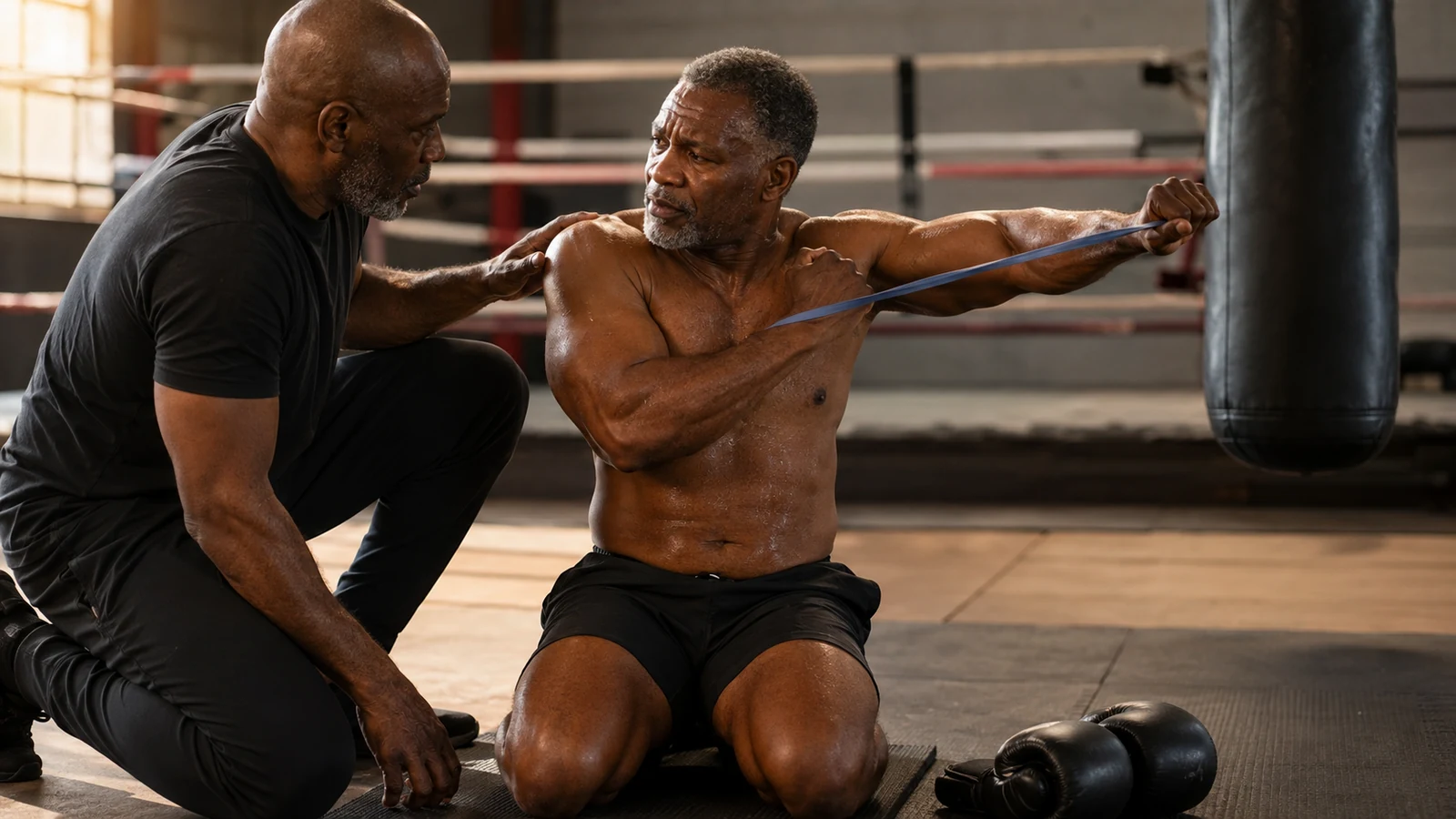
Boxing and kickboxing involve real technique. Poor form under fatigue is a common way people strain their shoulders, wrists, or lower back.
A few sessions with a qualified coach before training alone pays off. A third mistake is ignoring recovery.
Combat sport training is demanding on the joints and nervous system. Adults in their fifties generally need more recovery time between hard sessions than they did in their twenties.
Skipping that recovery is a common way people get hurt or burn out within a few weeks.
Finally, some people treat mobility work as optional or something to add later.
Elba’s own comments suggest the opposite. He has made mobility a bigger, not smaller, part of his routine as he has aged.
Waiting until something feels tight or painful is later than ideal. Elba is far from the only well known figure showing what fitness in your fifties can look like; Gabrielle Union’s own routine at 53 is another real example worth reading.
How to Build a Boxing Inspired Routine at Any Age
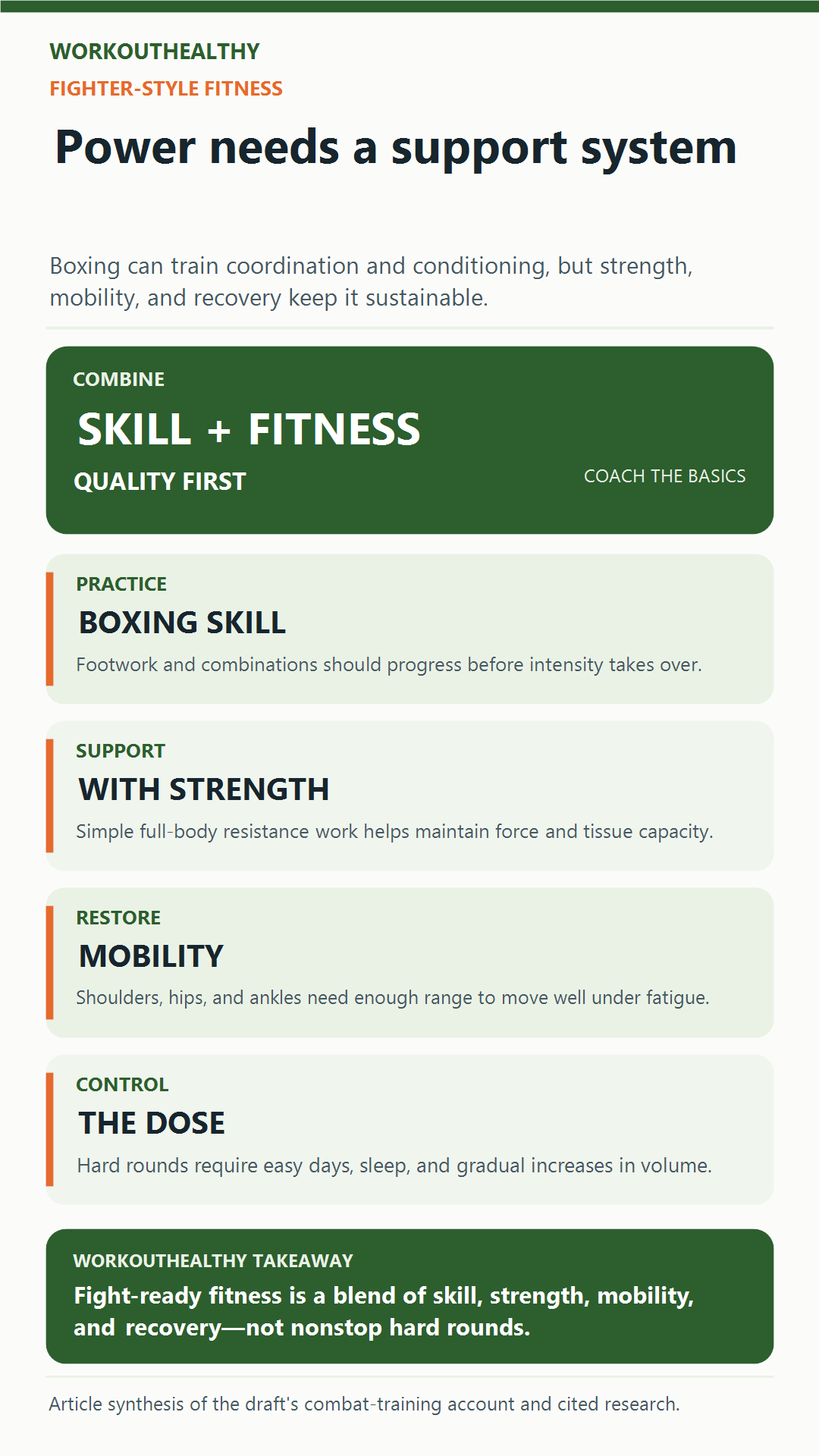
Start with two sessions a week, not five. A new activity that pairs cardio, coordination, and strength all at once creates more overall fatigue than most people expect from their first few sessions.
Book at least one or two sessions with a certified boxing or kickboxing coach before training solo.
If you are unsure how to find one, this guide to hiring a personal trainer covers what to look for.
This is about learning to protect your wrists, your neck, and your lower back under load.
It is not about learning to fight.
Pair every boxing or kickboxing session with a short mobility routine. Ten minutes of hip, shoulder, and thoracic spine mobility work before or after training helps offset the repetitive rotational movement that boxing style training involves.
Add plain bodyweight strength work on the days you are not doing combat training. Squats, push ups, and rows build the base strength that makes boxing technique safer and more effective.
Those are the same basic movements Elba has pointed to as his own foundation.
Track how you recover, not just how hard you train. If a session leaves you sore or fatigued for more than two days, that is useful information, not a sign to push harder next time.
Get medical clearance first if you have a history of heart disease or high blood pressure.
The same goes for anyone with a joint replacement or a recent injury. Combat sport training involves sudden, forceful movements that are not appropriate for every health situation without a doctor’s input.
References
- Men’s Health, “Best Celebrity Workouts” collection, menshealth.com
- TRAIN Magazine, “Idris Elba Kickboxing Interview: Swing When You’re Winning,” trainmag.com
- Men’s Journal, “The 2 Fitness Habits Idris Elba Uses to Stay Strong and Agile After 50,” mensjournal.com
- Saraiva, B.T.C., Franchini, E., et al. (2024). Effects of 12 weeks of functional training vs. Muay Thai on cardiac autonomic modulation and hemodynamic parameters in older adults: a randomized clinical trial. BMC Cardiovascular Disorders, 24, Article 433. DOI: 10.1186/s12872-024-04096-3
- Systematic review and meta-analysis on boxing interventions and physical fitness in older adults with Parkinson’s disease, peer reviewed sports medicine literature
This article is for general information only and is not personal medical or fitness advice. Idris Elba’s routine is described here based on his own public interviews and is not a program designed for any individual reader. Anyone starting a new exercise program, especially one involving combat sports, should talk with a doctor first, particularly if they have an existing health condition, injury, or have been inactive for a long time.