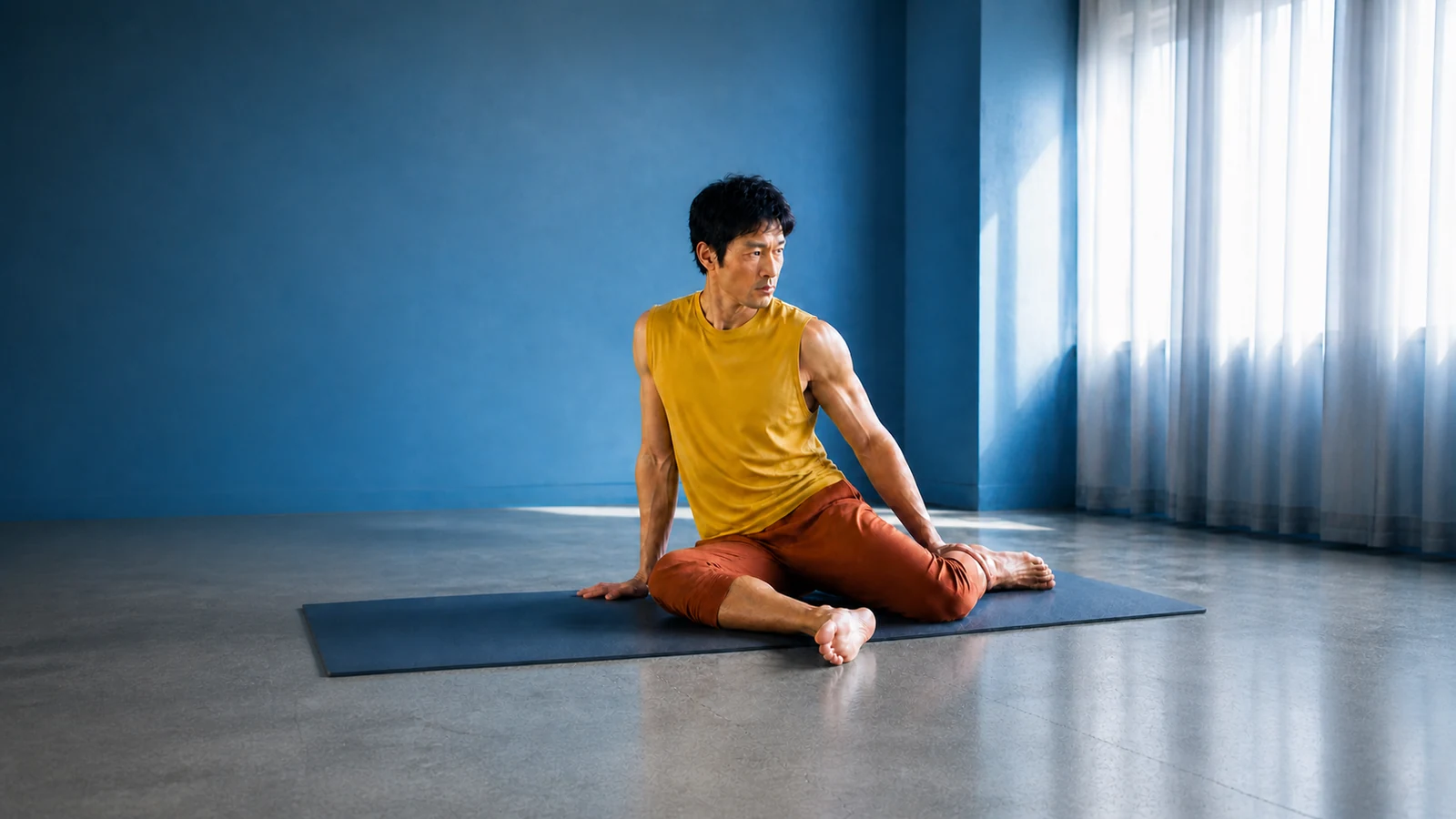

Fighters and dancers spend time in a seated floor position most people never touch outside of it: the shin box, also called the 90/90 position.
It looks simple, but it asks your hips to do something a lot of daily life never demands.
What the Shin Box Actually Trains
In the shin box position, one leg is bent in front of you with the hip turned inward, and the other leg is bent to the side with the hip turned outward.
Holding and moving between these positions loads your hips into internal and external rotation at the same time, on opposite sides.
Most gym training barely touches rotational hip range of motion on purpose.
Squats, lunges, and hinges mostly move the hip forward and back, which is one reason a drill like this can feel oddly difficult the first time.
The Joint Mechanics Behind Hip Rotation
The hip is a ball and socket joint.
The rounded head of the femur sits inside a deep socket in the pelvis called the acetabulum.
That shape allows a lot of motion in a lot of directions, but how much rotation any one person has depends on the exact shape of their socket, how tight the joint capsule is, and how much give the surrounding muscles allow.
A ring of small muscles deep under the glutes, often called the deep hip rotators, cross the joint at an angle that lets them turn the thigh inward or outward.
The bigger glute muscles and hip flexors also play a role, since they cross the joint at different angles and can limit rotation when they are short or stiff.
In the shin box, the front leg asks its deep rotators and hip capsule to shorten into internal rotation while the back leg asks the same tissues to lengthen into external rotation.
Very few everyday movements or gym exercises load both directions on both hips in one position, which is part of why the shin box can expose a rotation limit a person did not know they had.
What Research Says About Hip Rotation Range of Motion
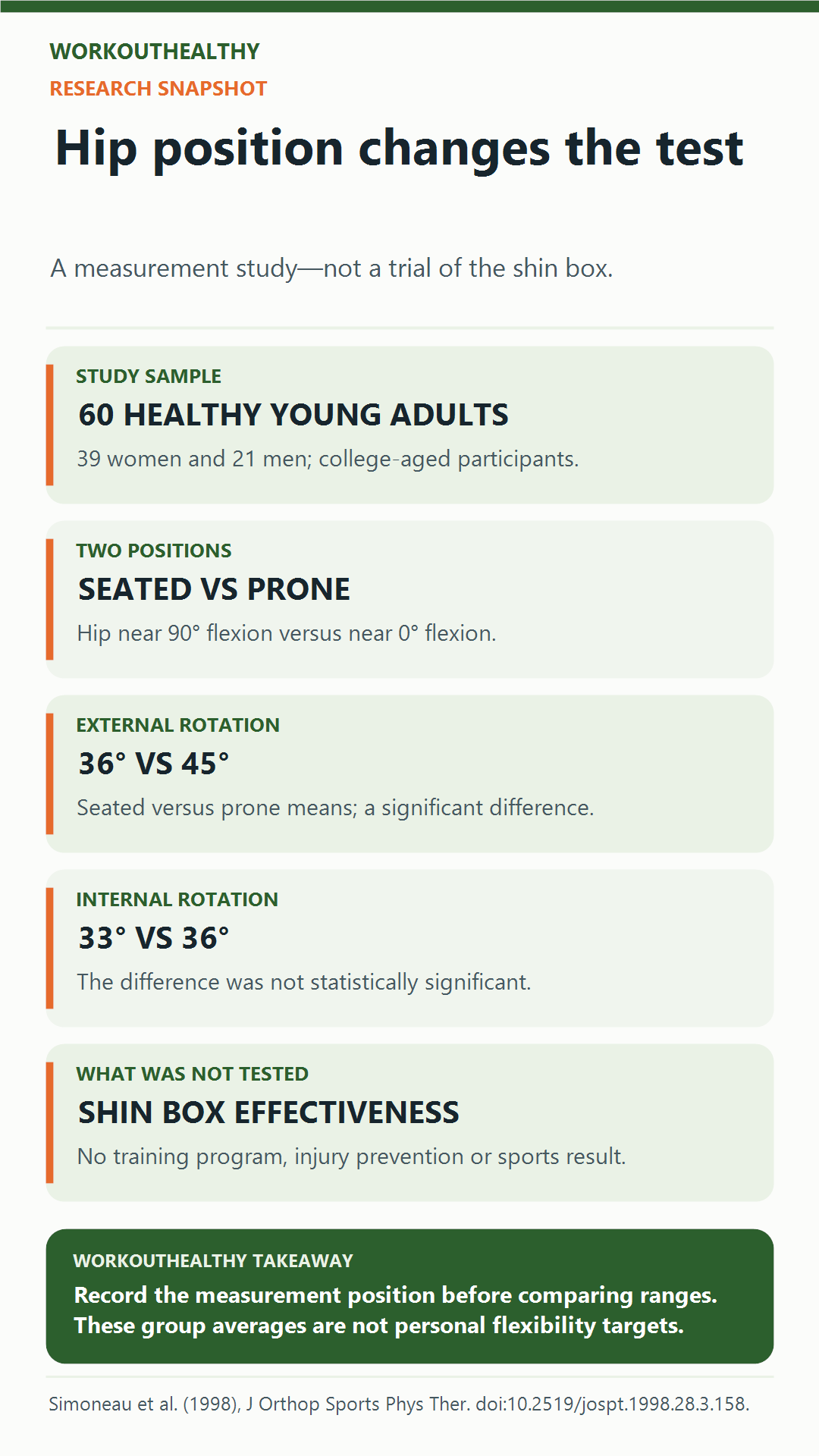
A study measuring active hip rotation in healthy adults found that both hip position and gender affect how far someone can actively rotate their hip inward or outward (Simoneau et al., 1998).
Available rotation range varies noticeably between individuals, which is part of why a drill like the shin box can feel easy for one person and genuinely hard for another.
What the research does not offer is a controlled trial testing the shin box drill itself against a specific injury or performance outcome.
The honest starting point is that hip rotation range of motion is a real, measurable trait, and that fighters, dancers, and other athletes who rotate their hips under load tend to train it deliberately rather than leaving it to chance.
Rotational hip range is not something most training programs build on purpose, which is exactly why it tends to be the first thing that feels stiff.
A Second Look: Does Rotation Range Just Decline With Age?
A large study measured active hip and knee range of motion in more than 1,600 healthy adults across a wide age span, comparing the youngest and oldest groups (Roach & Miles, 1991).
The results were more reassuring than most people expect.
Across most hip and knee motions, the difference between the youngest and oldest groups was small, generally only 3 to 5 degrees.
Hip extension was the one clear exception, dropping by more than 20 percent of its total arc in the oldest group.
Rotation and the other motions did not show that same steep drop.
The researchers made a useful point from this: a real, noticeable loss of hip motion should not be waved away as normal aging.
If a hip has gotten a lot tighter, something specific is usually driving that, whether it is years of sitting, an old injury, or simply not moving that joint through its full range anymore.
Why Sitting Most of the Day Works Against This Range
A day spent mostly sitting keeps the hips in a narrow, forward-facing range for hours at a time.
Rotational positions like the shin box simply do not come up, and range of motion that is not used tends to feel tighter over time.
That is not the same as saying sitting damages your hips.
It is a more modest, defensible point: a joint that only moves one way in daily life will feel unfamiliar the first time you ask it to move a different way.
Combined with the age data above, the more accurate story is that disuse, not the calendar, is usually the bigger factor in a stiff hip.
What This Evidence Does Not Prove
It is worth being precise about the limits here.
The Simoneau study measured how far people can rotate their hips in a lab setting.
It did not test whether practicing the shin box specifically improves that range, and it did not follow anyone over time to see whether more rotation range prevents injury or improves performance in a sport.
The Roach and Miles data is a snapshot of many different people at one point in time, not a record of the same hips getting stiffer year by year.
It also cannot tell us whether a person who took up a rotation drill like the shin box in their thirties would still have better hip rotation decades later.
Both studies describe what hips look like across a population.
Neither one is a clinical trial proving that this specific drill changes an individual outcome.
Common Mistakes People Make With the Shin Box
The most common mistake is forcing depth before the hip is ready.
Dropping hard into the position or pulling on the front shin to sink lower skips past the joint’s own limit and pushes the stretch into the ligaments instead of the muscles.
A second mistake is letting the back knee drift up off the floor to fake more range.
This looks like progress but usually means the pelvis is rotating instead of the hip, which hides the real problem rather than fixing it.
A third mistake is only ever practicing on the easier side.
Most people have a clear favorite hip, and skipping the harder side keeps the gap between the two hips wide instead of closing it.
Who Should Check With a Doctor or Physical Therapist First
Hip rotation asymmetry is not automatically a red flag.
But research comparing healthy adults to people with low back pain found that a specific pattern, where one direction of hip rotation is noticeably larger than the other, showed up more often in the low back pain group (Ellison et al., 1990).
That does not prove the rotation pattern caused the back pain, but it is a reasonable signal that a big, one sided difference in hip rotation is worth having a professional look at, especially if it comes with back pain.
Anyone with a diagnosed labral tear, hip impingement, a hip replacement, or an arthritic hip should get individual clearance before working into end range rotation on either side.
The same goes for anyone who feels a sharp pinch at the front of the hip rather than a stretch through the outer hip or glute.
How to Build the Shin Box Into Your Routine
Start seated on the floor with both knees bent, one leg rotated in front of you and the other to the side.
Keep your hands on the floor for support and simply hold the position.
Your chest should stay tall and your hips should stay squared to the front rather than twisting open.
Once the hold feels controlled and pain free on both sides, move to level two: the same hold, but without your hands on the floor.
This forces your core and hips to stabilize the position instead of your arms.
Level three adds the switch, sometimes called a 90/90 hip switch, where you rotate through the middle to swap which leg is in front.
Move slowly at first.
Lead with your knees rather than yanking your upper body around, and pause briefly in each finished position before switching again.
Level four is a slow, continuous flow between sides, and level five adds light load, like holding a light weight at your chest, once the bodyweight version is smooth and symmetrical on both sides.
Only add speed or load after the basic switch looks the same on your left and your right.
You are doing it right if the movement feels like a stretch through the outer hip or glute, if both hips can reach a roughly similar position, and if your lower back stays relatively still while your hips do the rotating.
You are doing it wrong if you feel a pinch at the front of the hip joint, if one side is dramatically more limited than the other, or if your lower back is doing most of the twisting to make up for a hip that will not rotate.
A hip drill is only useful if it stays pain free. Chasing extra range through joint pain trades one problem for another.
For a related look at how a joint problem is actually resolved and rebuilt over time, see our article on what real hip recovery timelines look like.
Our breakdown of standing versus sitting covers another angle on how daily posture habits add up.
Watch the Original Video
Get the next evidence check. Subscribe to WorkoutHealthy Insider for practical explanations behind popular fitness claims.
References
Ellison, J. B., Rose, S. J., & Sahrmann, S. A. (1990). Patterns of hip rotation range of motion: A comparison between healthy subjects and patients with low back pain. Physical Therapy, 70(9), 537 to 541. https://doi.org/10.1093/ptj/70.9.537
Roach, K. E., & Miles, T. P. (1991). Normal hip and knee active range of motion: The relationship to age. Physical Therapy, 71(9), 656 to 665. https://doi.org/10.1093/ptj/71.9.656
Simoneau, G. G., Hoenig, K. J., Lepley, J. E., & Papanek, P. E. (1998). Influence of hip position and gender on active hip internal and external rotation. Journal of Orthopaedic & Sports Physical Therapy, 28(3), 158 to 164. https://doi.org/10.2519/jospt.1998.28.3.158
This article is for general information only and is not medical advice. If you have an injury, ongoing pain, or a medical condition, talk to a doctor or physical therapist before you change how you train or eat.