
New lifters have a short window where progress comes fast.
Strength coach Mark Rippetoe built a whole beginner system around that window.
His advice is simple: add weight to the bar nearly every session, because novices adapt faster than anyone else.
The research mostly backs him up, with some limits worth knowing.
This article covers what Rippetoe actually teaches, why beginners improve so quickly, and how to run this kind of plan safely.
What the Research Says First
A 2003 meta-analysis by Rhea and colleagues looked at how much training produces the most strength.
A later paper by Peterson, Rhea, and Alvar summarized its main finding.
Untrained people made their biggest strength gains training at about 60 percent of their one rep max, three days a week, with four sets per muscle group.
Trained people did best at about 80 percent, two days a week, with four sets.
In other words, beginners respond to moderate loads that would barely move the needle for an experienced lifter.
A 2021 network meta-analysis by Lopez and colleagues added another piece.
It found that untrained participants showed greater muscle growth effects than trained participants.
For people with training experience, more sessions gave better results.
That matches Rippetoe’s view that novices can progress on a simple plan while advanced lifters need more.
Who Mark Rippetoe Is
Rippetoe is an American strength coach, author, and former powerlifter, born in 1956.
In 1984 he bought a gym in Wichita Falls, Texas, and used it to develop his coaching method.
He co-wrote the first edition of Starting Strength with Lon Kilgore in 2005.
A third edition followed in 2011.
The program centers on the squat, deadlift, press, bench press, and power clean, with a few assistance moves like chin ups.
What He Means by the Novice Effect
In an article on his website, Rippetoe writes that a previously untrained person “gets stronger very quickly at first.”
He says that with proper rest and enough calories and protein, this progress can last for several months.
One example he gives is a young lifter who added 10 pounds to his work sets each session for two weeks.
After that, the lifter moved to 5 pound jumps. His steady linear progress lasted 11 weeks in all.
Rippetoe ties the slowdown to diminishing returns as the body adapts.
The Starting Strength program page describes three sessions a week on nonconsecutive days, such as Monday, Wednesday, and Friday.
Most lifts use three sets of five, and the deadlift uses one set of five.
The page says jumps later shrink to 2.5 pounds or less.
Beginner gains are a gift with an expiration date. Use them well by adding a little, often, and with clean reps.
Why Beginners Improve So Fast
Early strength gains are not all about bigger muscles.
A 2021 review by Škarabot and colleagues says the first increases in force are thought to come mainly from the nervous system.
Your brain and nerves get better at calling on muscle fibers and coordinating the lift.
The same review notes that scientists still cannot pin down exactly where these changes happen.
Skill matters too.
Squatting a bar well is a learned movement, and practice alone improves it for a while.
How Long the Window Lasts
There is no fixed number of weeks.
The Starting Strength program page says its second phase can run from several weeks to several months.
Age, sleep, food, body size, and starting strength all change the timeline.
Each lift can also stall on its own schedule, so track them separately.
A lift that stalls early does not mean the whole plan has stopped working.
When you miss reps at the same weight across several sessions, the novice phase is likely ending.
How to Run a Simple Linear Plan
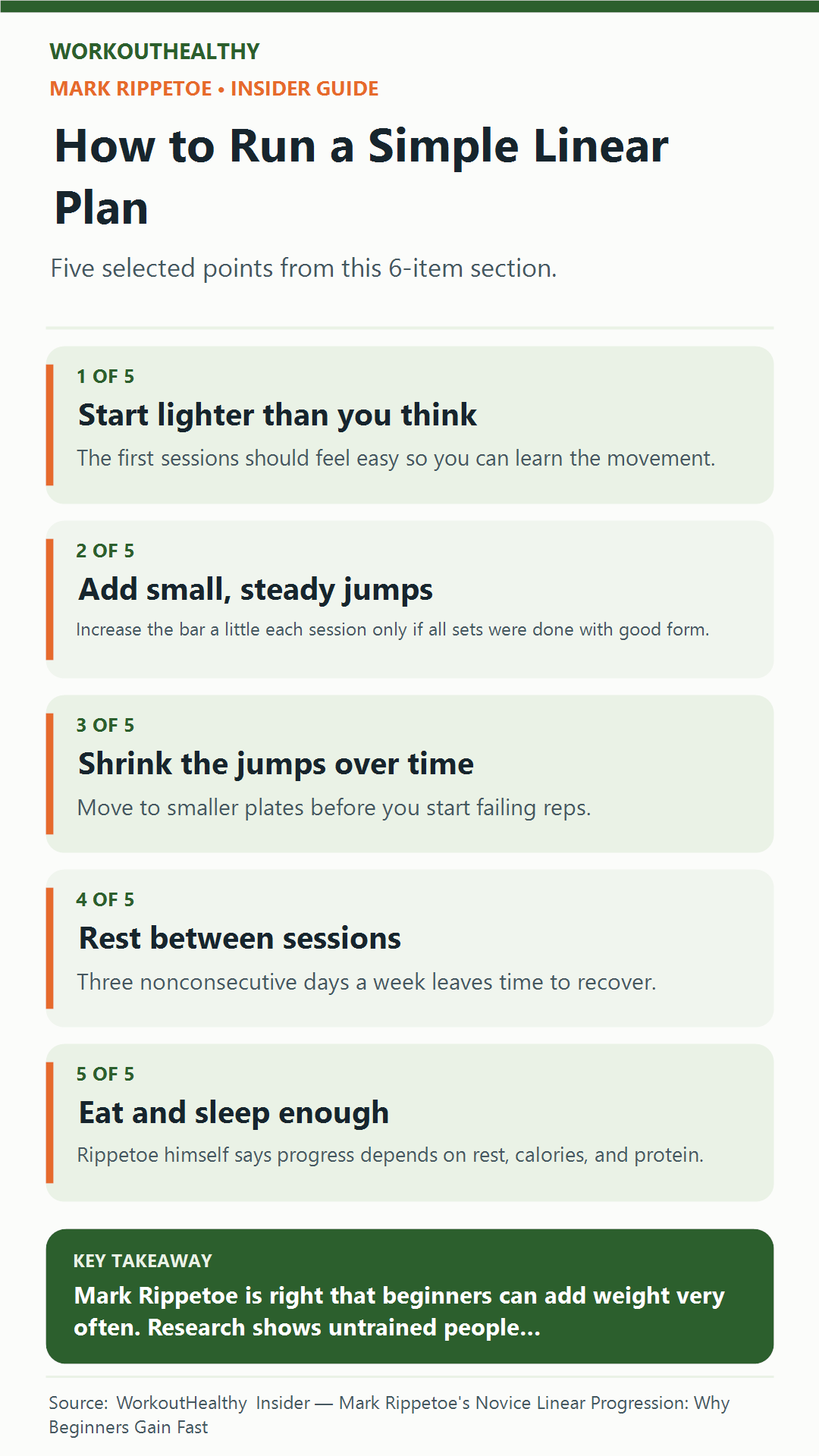
- Start lighter than you think. The first sessions should feel easy so you can learn the movement.
- Add small, steady jumps. Increase the bar a little each session only if all sets were done with good form.
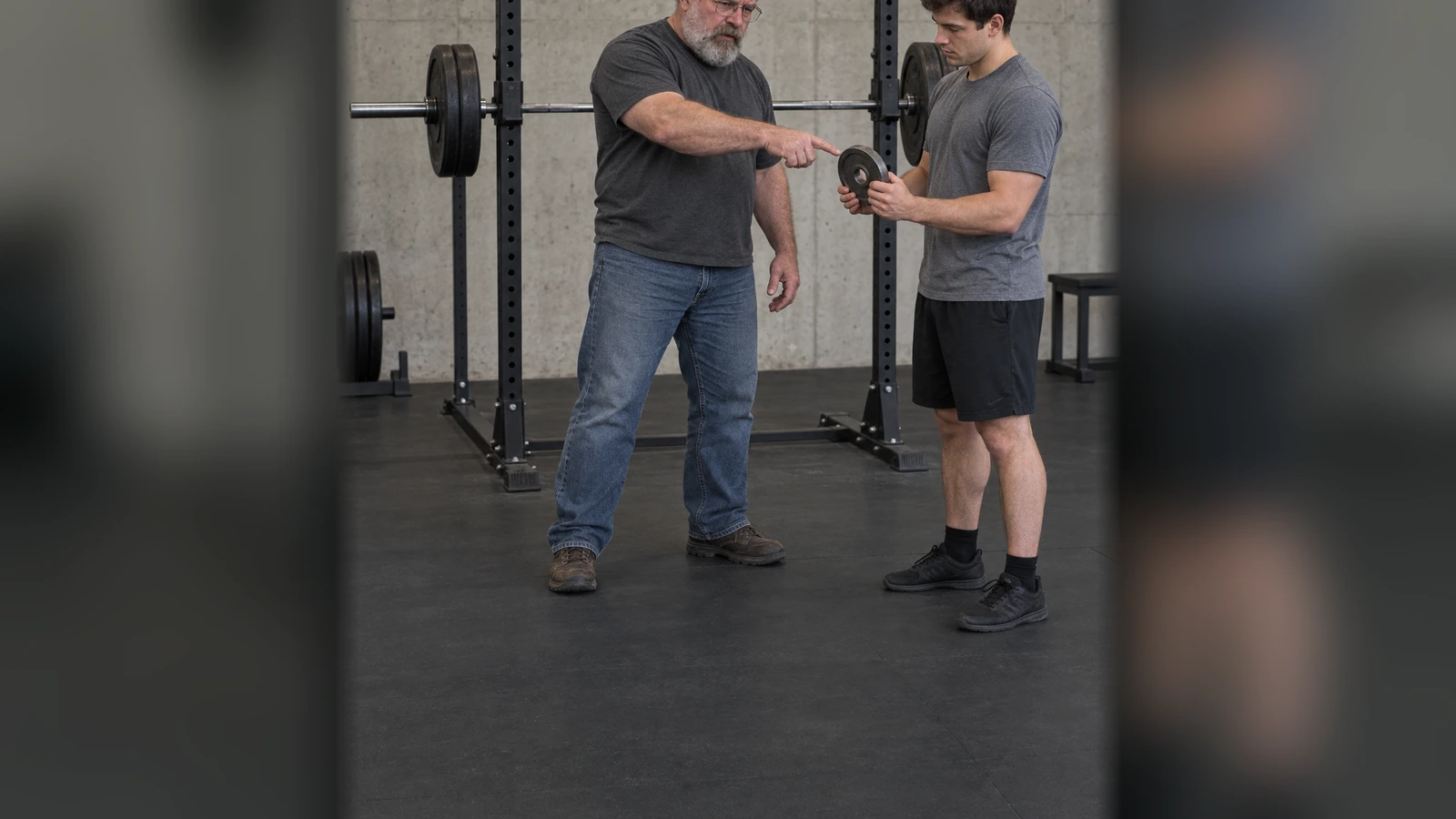
- Shrink the jumps over time. Move to smaller plates before you start failing reps.
- Rest between sessions. Three nonconsecutive days a week leaves time to recover.
- Eat and sleep enough. Rippetoe himself says progress depends on rest, calories, and protein.
- Log every session. Write down weights and reps so each jump is planned, not guessed.
Adults starting later in life can adapt this approach using our strength plan for your 40s.
If the deadlift worries you, read our guide to deadlifting after 50.
And for whether women should train differently on a plan like this, see do men and women need different workouts.
What the Evidence Does Not Show
The research does not prove that one specific program beats all others for beginners.
Many simple plans work well in the first months because almost any sensible training helps a novice.
It also does not mean you must add weight every single session.
Adding a rep, a set, or cleaner technique is also progress.
Some weeks, simply matching last week’s numbers with better form is a win.
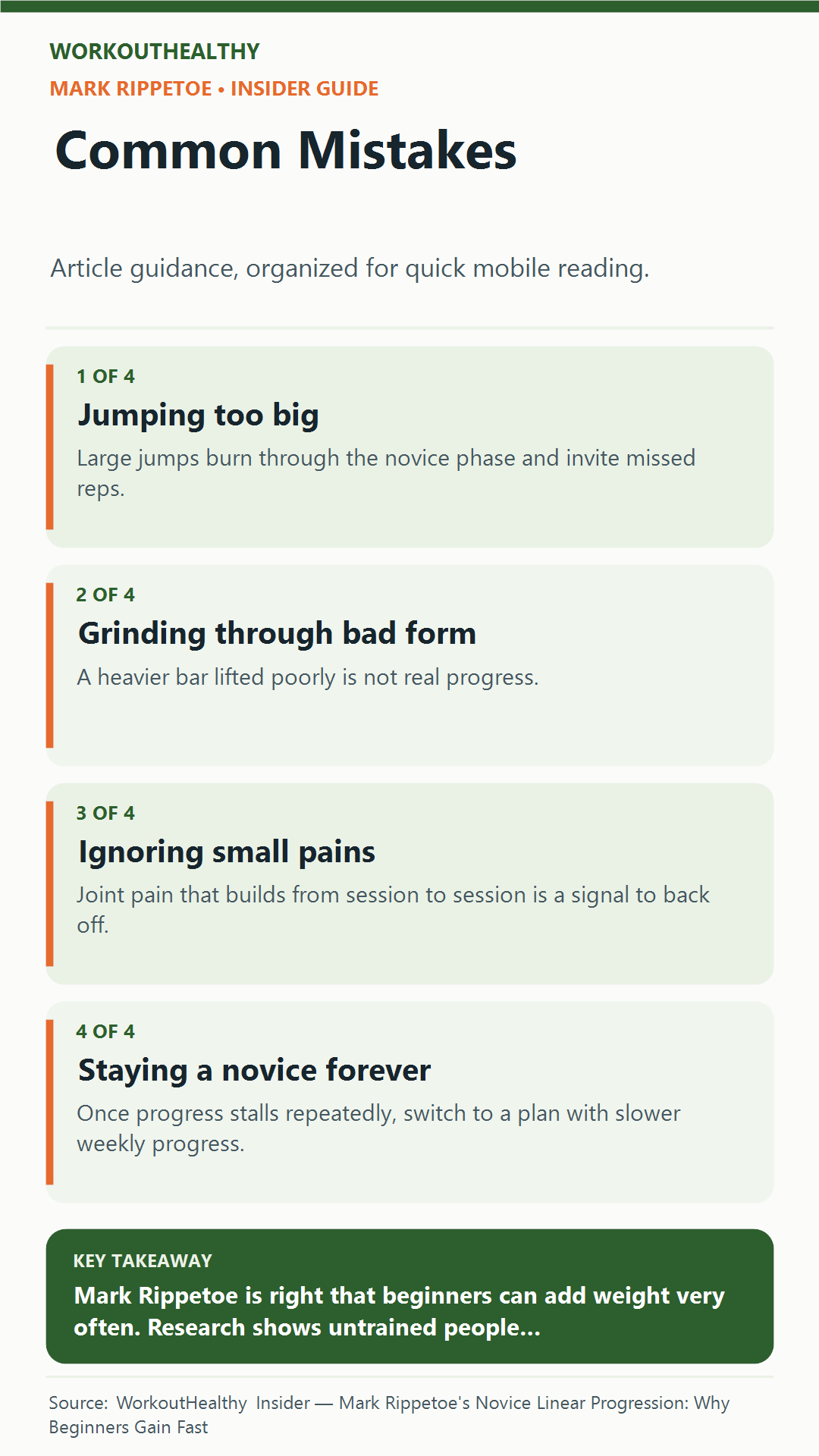
Common Mistakes
- Jumping too big. Large jumps burn through the novice phase and invite missed reps.
- Grinding through bad form. A heavier bar lifted poorly is not real progress.
- Ignoring small pains. Joint pain that builds from session to session is a signal to back off.
- Staying a novice forever. Once progress stalls repeatedly, switch to a plan with slower weekly progress.
Who Should Be Careful
People with past back, hip, knee, or shoulder injuries should get coaching before loading barbell lifts.
Anyone with heart disease or high blood pressure should talk to a doctor before heavy lifting.
Teens can lift safely with supervision and good technique, but should not rush the weight.
The Bottom Line
Mark Rippetoe is right that beginners can add weight very often.
Research shows untrained people respond strongly to moderate training, much of it from nervous system changes.
The window is real but temporary, so use small jumps, clean reps, and good recovery to stretch it out.
Want more stories like this? Subscribe to WorkoutHealthy Insider for practical explanations behind popular fitness claims.
References
- Lopez, P., Radaelli, R., Taaffe, D. R., Newton, R. U., Galvão, D. A., Trajano, G. S., Teodoro, J. L., Kraemer, W. J., Häkkinen, K., & Pinto, R. S. (2021). Resistance training load effects on muscle hypertrophy and strength gain: Systematic review and network meta-analysis. Medicine & Science in Sports & Exercise, 53(6), 1206 to 1216. https://doi.org/10.1249/MSS.0000000000002585
- Peterson, M. D., Rhea, M. R., & Alvar, B. A. (2004). Maximizing strength development in athletes: A meta-analysis to determine the dose-response relationship. Journal of Strength and Conditioning Research, 18(2), 377 to 382.
- Rhea, M. R., Alvar, B. A., Burkett, L., & Ball, S. (2003). A meta-analysis to determine the dose response for strength development. Medicine & Science in Sports & Exercise, 35(3), 456 to 464. https://doi.org/10.1249/01.MSS.0000053727.63505.D4
- Rippetoe, M. (n.d.). The novice effect. Starting Strength.
- Rippetoe, M. (2011). Starting strength (3rd ed.). The Aasgaard Company.
- Škarabot, J., Brownstein, C. G., Casolo, A., Del Vecchio, A., & Ansdell, P. (2021). The knowns and unknowns of neural adaptations to resistance training. European Journal of Applied Physiology, 121(3), 675 to 685. https://doi.org/10.1007/s00421-020-04567-3
This article is for general information only and is not medical advice. If you have an injury, ongoing pain, or a medical condition, talk to a doctor or physical therapist before you change how you train or eat.