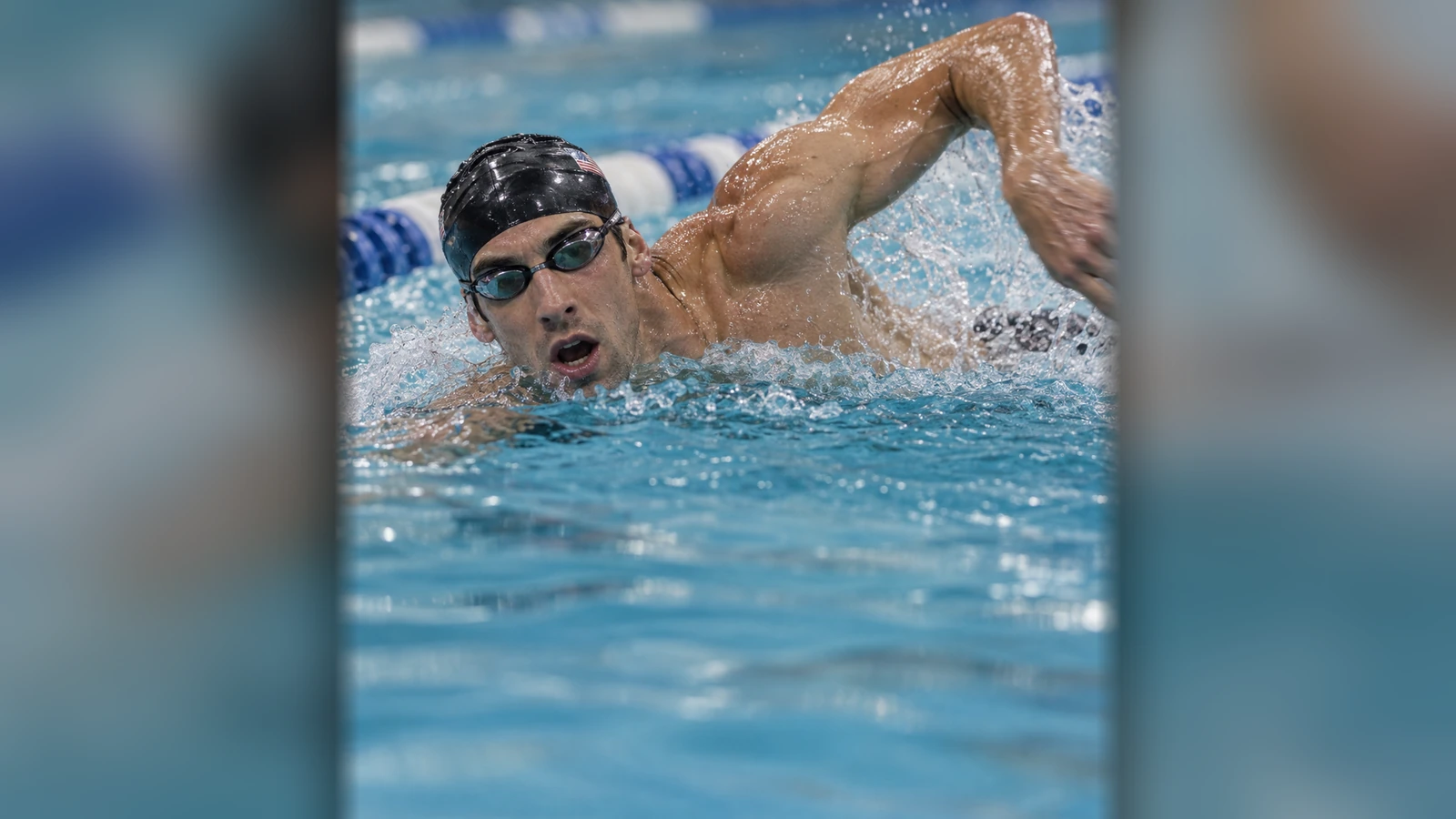

Michael Phelps won 28 Olympic medals, 23 of them gold.
One story about how he got there gets shared again and again.
He reportedly trained every single day for years, with no break for holidays.
That streak says a lot about commitment. It also raises a fair question about rest.
This article looks at what Phelps said, what the streak was meant to build, and what sports medicine says about training with no days off.
What Phelps and Bowman Actually Said
The streak is not just a quote passed between fitness sites. In a 2008 televised interview with Anderson Cooper, coach Bob Bowman said that Phelps had gone about five years without a day off. Bowman specifically confirmed training on Christmas and on Phelps’s birthday. Phelps explained the motivation as not wanting to lose and wanting to achieve something no one else had done.
A separate 2008 interview with Phelps gives an important limit to the story. Asked about a five-year period without missing a day before Athens, he acknowledged that he had been more intense then. After Beijing, he said he had spent months away from the pool and was returning gradually. That is direct evidence against the common version claiming that he never took a break across his whole Olympic career.
Neither interview supplies a day-by-day training diary. Bowman’s estimate was about five years, not a verified count of every practice, and the interviews do not reveal the intensity of each day. The defensible statement is that Phelps and Bowman described an extraordinary multiyear streak during one phase of his career. It should not be stretched into a claim that every session was maximal or that he never recovered.
The context also matters. Bowman was an elite coach planning for a swimmer with exceptional ability, resources, and competitive goals. The fact that Phelps completed the streak and later won more medals does not prove the same schedule would help another athlete. It tells us what this pair reported doing, not the minimum dose required for success.
Who Michael Phelps Is
Phelps was born in 1985.
He swam at his first Olympics in 2000, at age 15.
He went on to compete in five Olympic Games, finishing at Rio in 2016.
He announced his retirement after those Games.
Bowman coached him through that career, and their early training was known for high volume.
Swimming World reported that in one fall training block, Bowman described Phelps swimming 70,000 to 80,000 yards and meters per week.
Why the Streak Made Sense to Them
The logic behind training every day is simple math.
If a rival takes Sundays and holidays off, a swimmer who never stops gets dozens of extra sessions each year.
Over several years, those sessions add up.
The streak also built a habit that did not depend on mood, weather, or the calendar.
For a young swimmer with a clear goal and expert coaching, that kind of routine removed daily decisions.
There was never a question of whether practice was happening.
Consistency is the part worth copying. A streak with no recovery is the part that needs a second look.
What Sports Medicine Says About Rest
Doctors have a name for what can happen when training outpaces recovery.
A 2012 review by Jeffrey Kreher and Jennifer Schwartz describes overtraining syndrome.
They call it a maladapted response to excessive exercise without adequate rest.
It can disturb many body systems, and it remains a clinical diagnosis made by a doctor.
In 2016, the International Olympic Committee published a consensus statement on training load and injury, led by Torbjørn Soligard.
It says large week to week jumps in intensity, duration, or frequency put athletes at a significantly higher risk of injury.
It also tells coaches to schedule adequate recovery.
That includes sleep and rest, active rest, nutrition, relaxation, and emotional support, especially after hard training blocks, competitions, and travel.
How a Daily Streak Can Still Include Recovery
A streak of daily training does not have to mean daily hard training.
Many training plans mix very hard days with easier technical or aerobic days.
A swimmer can spend an easy day on drills, starts, and turns. That still counts as practice, but it asks far less of the body.
The consensus statement lists active rest as a form of recovery, which means easy movement can still count.
We could not confirm how Bowman structured easy and hard days during the no days off years, so this is a general point, not a description of their plan.
What we can say is that the risk comes from load that climbs too fast or never eases, not from showing up daily.
Why a Calendar Streak Is Not a Training Plan
Counting days answers one question: whether a person attended practice. It does not tell us the distance swum, the pace, the number of hard sets, the sleep between sessions, or how the athlete felt. Two swimmers can both mark seven sessions on a calendar while carrying very different physical loads. A short technical session and a long race-pace workout are not interchangeable merely because each counts as one day.
The IOC consensus statement asks coaches to consider total load and recovery, not just attendance. Competition, travel, illness, sleep, and psychological stress can alter what an athlete can tolerate. It also warns against sharp changes in load. That is why a coach may keep a familiar daily routine while changing the difficulty inside it, or may prescribe an actual break after a demanding block.
For a recreational swimmer, the practical comparison is not whether a missed Sunday makes a rival stronger. It is whether the next session can be completed with good technique and whether training is improving over weeks without persistent pain, illness, or exhaustion. A rest day does not erase adaptation. It may protect the ability to train consistently for months. Phelps’s later gradual return to the pool after time away is itself a reminder that even elite routines change with the season and the person.
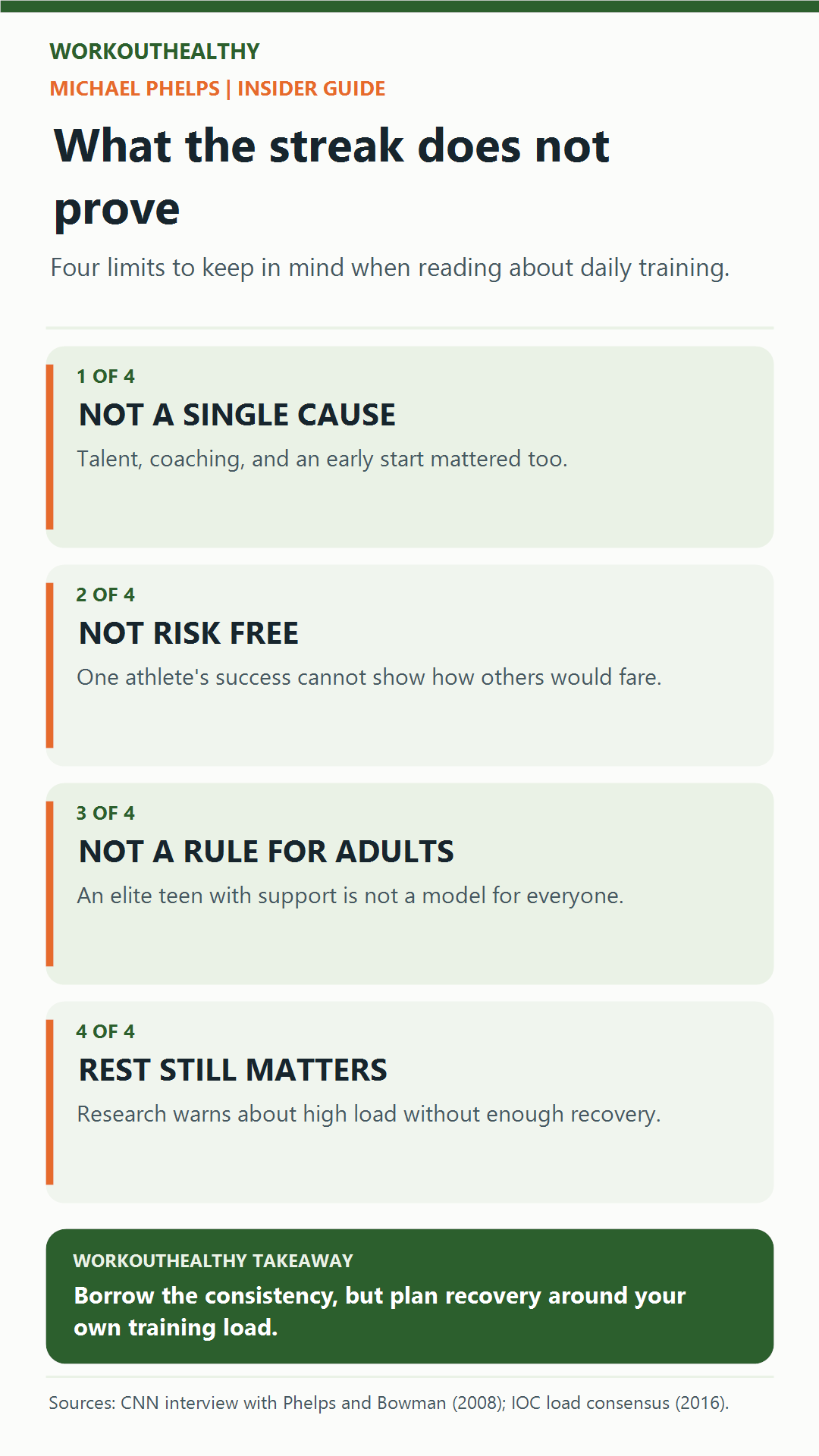
What This Story Does Not Prove
- It does not prove daily training made Phelps great. His size, talent, coaching, and early start all mattered too.
- It does not show the streak was risk free. One athlete’s success does not tell us how many others burned out on similar plans.
- It does not set a rule for adults. A teen prodigy with a full support team is not a model for most people.
- The research does not ban daily exercise. It warns against too much load without enough recovery.
How to Build Consistency Without Burning Out
- Move daily, train hard a few days. Keep two or three demanding sessions a week and make other days easy.
- Raise load slowly. Avoid big jumps in weekly time, distance, or weight.
- Plan easy weeks. A lighter week every so often gives the body a chance to catch up.
- Watch for warning signs. Poor sleep, a rising resting heart rate, low mood, or stalled progress can mean you need more rest.
- Protect sleep and food. These are listed recovery tools, not optional extras.
- Keep holidays flexible. A short walk or swim can keep a habit alive without adding stress.
Our piece on how Bella Hadid learned when to push and when to rest shows the same balance from a different angle.
And if a program just ended, our guide on what to do after a workout program ends can help you keep momentum without piling on load.
Who Should Be Careful
Young athletes are still growing and can be more prone to overuse injuries.
Parents and coaches should make sure kids have real breaks from a single sport.
Adults returning from injury or illness need a gradual plan, not a daily streak.
Anyone with ongoing fatigue, frequent illness, or pain that keeps getting worse should see a doctor.
The Bottom Line
Bob Bowman described roughly five years without a day off; Phelps later described a long break after Beijing. The cited interviews do not document a continuous six-year streak.
That streak built a powerful habit and a large training base.
Sports medicine research says recovery still has to be planned, and fast jumps in load raise injury risk.
Borrow the consistency, keep most days manageable, and treat rest as part of the plan.
Want more stories like this? Subscribe to WorkoutHealthy Insider for practical explanations behind popular fitness claims.
References
- Kreher, J. B., & Schwartz, J. B. (2012). Overtraining syndrome: A practical guide. Sports Health, 4(2), 128 to 138. https://doi.org/10.1177/1941738111434406
- Soligard, T., Schwellnus, M., Alonso, J. M., et al. (2016). How much is too much? (Part 1) International Olympic Committee consensus statement on load in sport and risk of injury. British Journal of Sports Medicine, 50(17), 1030 to 1041. https://doi.org/10.1136/bjsports-2016-096581
- CNN. (2008, December 12). Anderson Cooper interview with Michael Phelps and Bob Bowman, transcript. https://transcripts.cnn.com/show/acd/date/2008-12-12/segment/02
- McRae, D. (2008, December 11). Interview with Michael Phelps. The Guardian. https://www.theguardian.com/sport/2008/dec/11/michaelphelps-olympics2008
- Swimming World. Throwback Thursday: The early training that led Michael Phelps and Bob Bowman to Hall of Fame. https://www.swimmingworldmagazine.com/news/throwback-thursday-the-early-training-that-led-michael-phelps-and-bob-bowman-to-hall-of-fame-sample-sets/
This article is for general information only and is not medical advice. If you have an injury, ongoing pain, or a medical condition, talk to a doctor or physical therapist before you change how you train or eat.