
Cristiano Ronaldo is known for goals, trophies, and a body that has lasted deep into his thirties and beyond.
Former teammates often point to something less flashy: he did more work than the schedule asked for.
The popular version says he arrived early, stayed late, and used that time for extra solo practice.
That story holds up. But the lesson is not simply to train more.
Extra work only pays off when your body can recover from it.
What His Teammates Actually Said
Jonathan Spector played with Ronaldo at Manchester United early in Ronaldo’s career.
In a 2020 Bleacher Report story, Spector said Ronaldo “was one of the first to arrive at the training ground and the last to leave.”
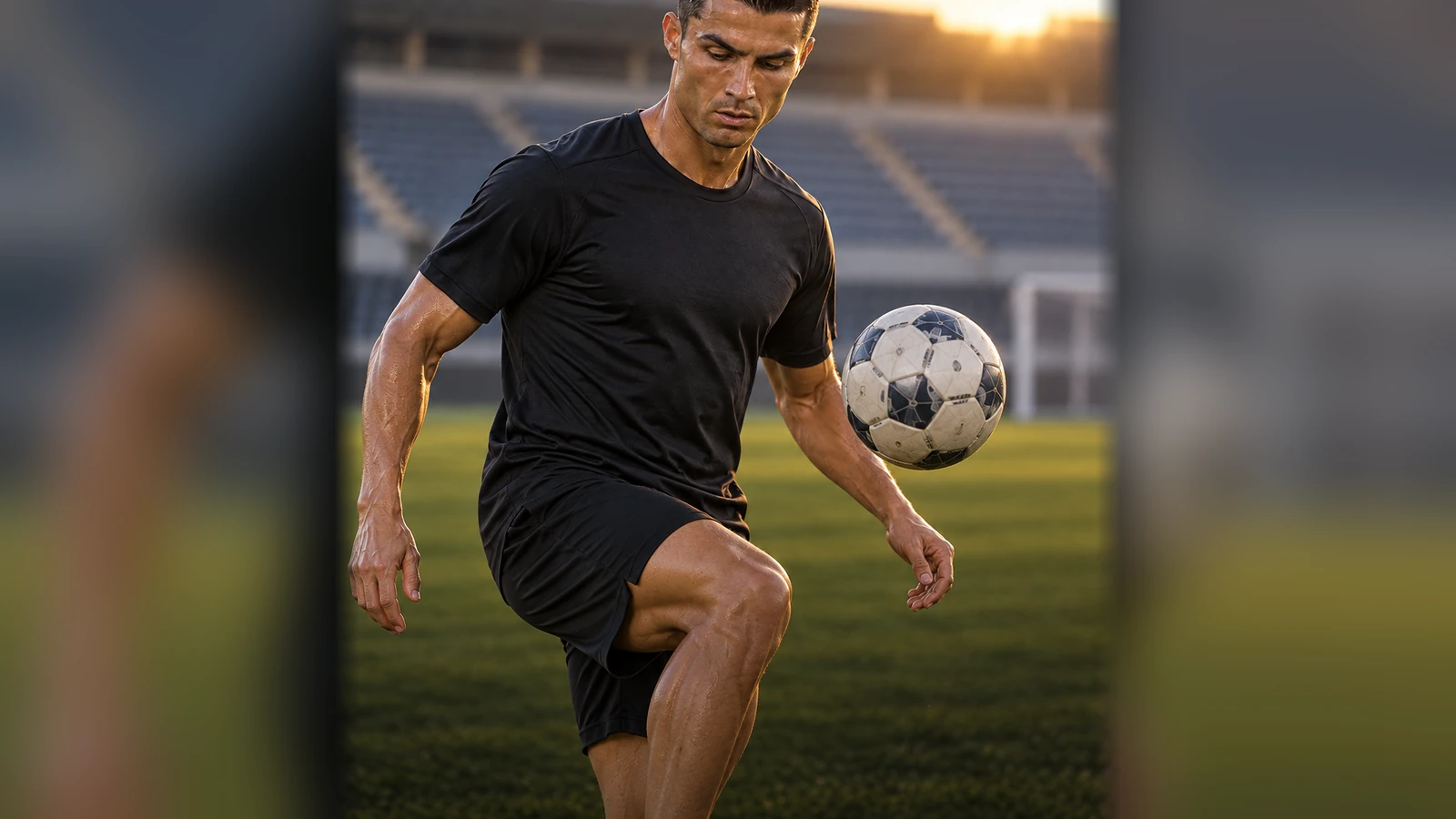
Spector also described Ronaldo spending 30 to 40 minutes alone with a ball, working on stepovers and dribbling.
The article does not say exactly when that solo work happened in the day.
Edwin van der Sar, United’s goalkeeper in that era, has told a related story.
Speaking with Rio Ferdinand, he said Ronaldo would ask him to stay after training so Ronaldo could practice free kicks.
When van der Sar suggested a backup goalkeeper, Ronaldo reportedly said he wanted to score against the best.
Some posts also cite Guillem Balagué’s 2015 biography of Ronaldo. We relied on teammate accounts instead of that book’s text.
What the Extra Work Looked Like
The accounts describe two main kinds of extra practice.
One was ball skill work, done alone, with a lot of repetition.
The other was set piece practice, especially free kicks against a top goalkeeper.
Spector also said Ronaldo worked very hard in the gym to add muscle to a thin frame.
None of these accounts describe endless running or random extra fitness work.
The extra time went to specific skills that decide matches.
That matters, because short and focused skill work is usually easier to recover from than extra hard conditioning.
It also adds up. A few short sessions each week become many hours over a season.
Extra work is only extra if you can recover from it. Otherwise it is just the start of an injury.
Why More Is Not Always Better
Sports scientists have spent years studying how training load relates to injuries.
A 2016 review by Tim Gabbett in the British Journal of Sports Medicine is one of the best known papers on this topic.
Gabbett wrote that high chronic workloads have been shown to decrease injury risk.
In plain terms, athletes who build up to a lot of work over time tend to be more resilient.
He also wrote that excessive and rapid increases in training load are likely behind many non contact soft tissue injuries.
So the danger is not hard work itself. The danger is piling on new work too fast.
From the accounts, Ronaldo’s extra work looks like a long habit, not a sudden spike.
Sleep Is the Other Half of the Deal
Extra practice also cuts into time, and sleep is often what gets squeezed.
A 2014 study by Milewski and colleagues surveyed 112 middle and high school athletes.
Athletes who slept less than eight hours a night were 1.7 times more likely to have had an injury.
That study was small and looked back in time, so it shows a link, not proof of cause.
Still, it fits a simple rule. If extra training steals your sleep, it may cost more than it gives.
The teammate accounts above do not describe Ronaldo’s sleep around those extra sessions.
So the safe takeaway is general. Extra practice should fit around enough sleep, not replace it.
What This Does Not Prove
Ronaldo’s work ethic helped him. It does not explain everything about his success.
He also had rare talent, elite coaching, and top level medical and nutrition support.
Most people who copy his schedule will not get his results, and some will get hurt.
The research above is about injury risk and load in general, not about Ronaldo himself.
How to Add Extra Practice the Smart Way
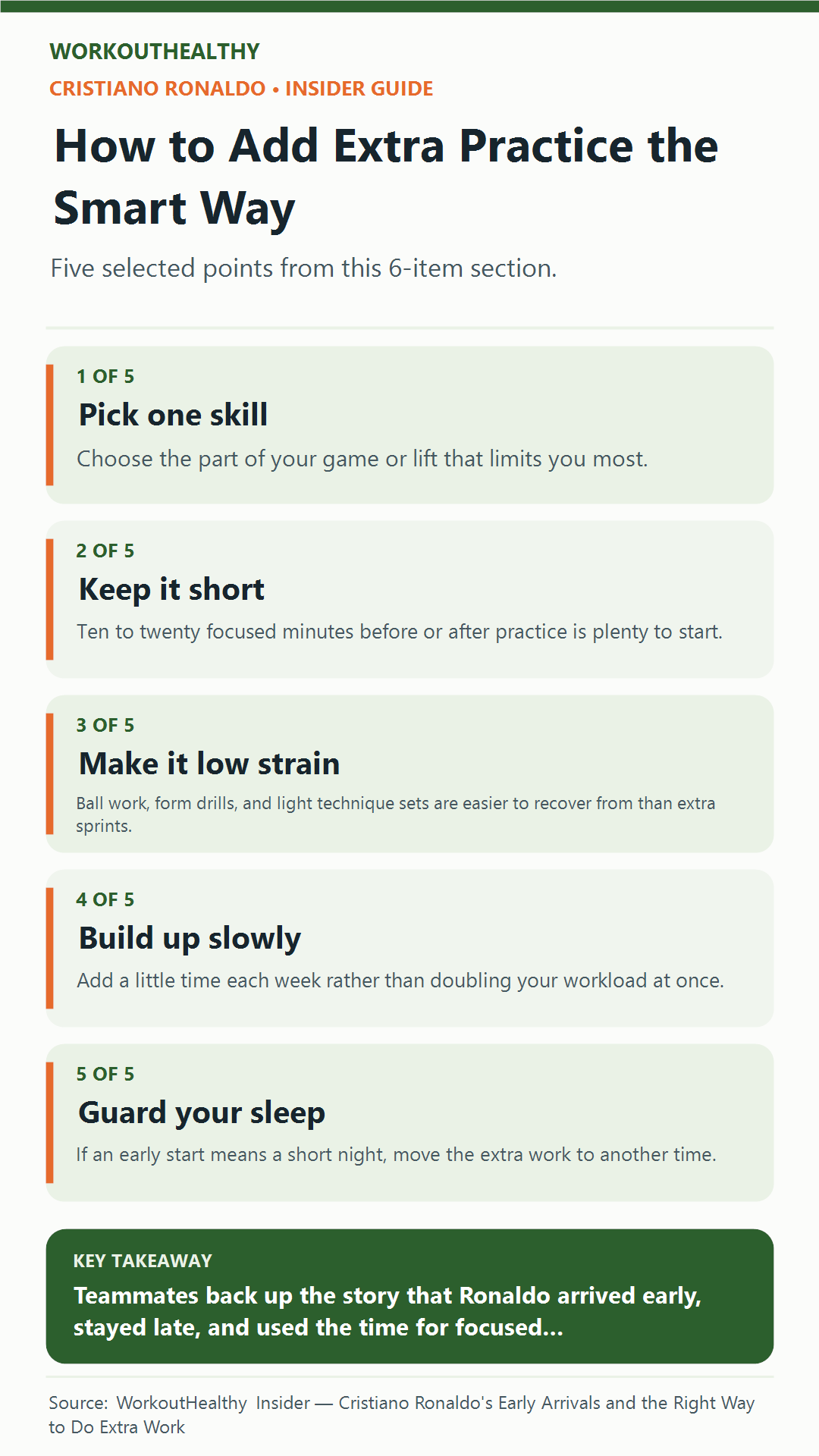
- Pick one skill. Choose the part of your game or lift that limits you most.
- Keep it short. Ten to twenty focused minutes before or after practice is plenty to start.
- Make it low strain. Ball work, form drills, and light technique sets are easier to recover from than extra sprints.
- Build up slowly. Add a little time each week rather than doubling your workload at once.
- Guard your sleep. If an early start means a short night, move the extra work to another time.
- Watch for warning signs. Lingering soreness, poor sleep, and slower times mean it is time to back off.
Small daily habits can protect a long career too, as our look at Stephen Curry’s daily ankle routine shows.
Common Mistakes
- Doing extra conditioning instead of skill work. More running on tired legs rarely helps.
- Copying a pro’s volume on day one. Ronaldo built his habits over many years.
- Ignoring the rest of your life. School, work, and stress also count as load.
- Staying late to prove something. Extra time should have a clear goal, not just look tough.
Who Should Be Careful
Young athletes are still growing, and heavy training loads carry extra risk for them.
Parents and coaches should keep extra practice short, fun, and focused on skill.
Athletes coming back from injury should follow their medical team’s plan before adding any extra work.
Adults with busy jobs may find that one extra focused session a week is the right amount.
Even elite players adjust their training with age, as our story on David Beckham’s training after retirement shows.
The Bottom Line
Teammates back up the story that Ronaldo arrived early, stayed late, and used the time for focused practice.
Research suggests extra work helps most when it builds slowly and does not cut into sleep.
Copy the focus and the consistency, not the hours.
A little extra skill work, done often and recovered from well, is the part of his habit most people can use.
Want more stories like this? Subscribe to WorkoutHealthy Insider for practical explanations behind popular fitness claims.
References
- Balagué, G. (2015). Cristiano Ronaldo: The biography. Orion.
- Fitzpatrick, R. (2020, April 21). Playing with Cristiano Ronaldo: Former team-mates recall their experiences. Bleacher Report. https://bleacherreport.com/articles/2887536-playing-with-cristiano-ronaldo-former-team-mates-recall-their-experiences
- Gabbett, T. J. (2016). The training-injury prevention paradox: Should athletes be training smarter and harder? British Journal of Sports Medicine, 50(5), 273 to 280. https://doi.org/10.1136/bjsports-2015-095788
- Milewski, M. D., Skaggs, D. L., Bishop, G. A., Pace, J. L., Ibrahim, D. A., Wren, T. A. L., & Barzdukas, A. (2014). Chronic lack of sleep is associated with increased sports injuries in adolescent athletes. Journal of Pediatric Orthopaedics, 34(2), 129 to 133. https://doi.org/10.1097/BPO.0000000000000151
This article is for general information only and is not medical advice. If you have an injury, ongoing pain, or a medical condition, talk to a doctor or physical therapist before you change how you train or eat.