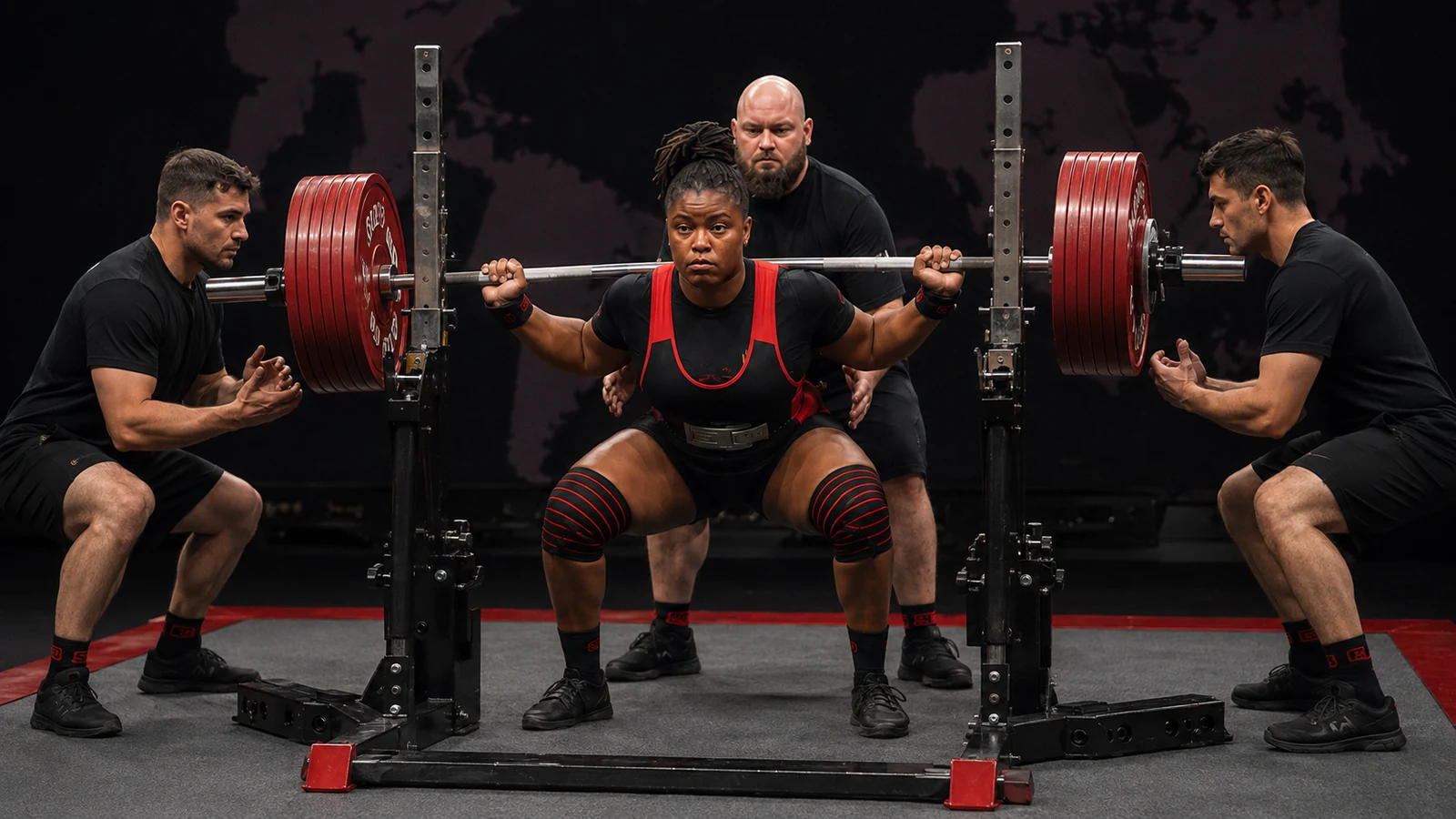

Sonita Muluh squats weight that most trained men will never touch.
Then she comes back later and beats her own number.
In June 2024, the Belgian powerlifter loaded a bar to 311 kilograms and stood up with it at the IPF World Classic Powerlifting Championships in Druskininkai, Lithuania.
That converts to 685.64 pounds, more weight than three average adult men combined.
It set the raw squat world record in the women’s 84-kg-plus class, the heaviest weight category the sport recognizes for women.
Muluh did not stop there.
She broke her own squat world record three more times over the following 18 months, most recently with a 318.5-kilogram lift in January 2026.
This article checks both numbers against the federation that actually certifies them, traces every record she has set in between, and looks at what it takes to keep adding weight once you already hold the heaviest squat in your sport.
What Happened in Druskininkai
The 2024 IPF World Classic Powerlifting Championships ran from June 15 through June 23 in Druskininkai, a spa town in southern Lithuania that has hosted multiple IPF world championship events.
Muluh competed in the women’s 84-kg-plus category, known in IPF terms as the superheavyweight class.
According to BarBend’s competition coverage, her squat that day was 31 kilograms heavier than anyone else’s in the entire contest.
She needed three attempts to get there.
FitnessVolt’s meet report describes her third and final squat coming out to 311 kilograms, with the crowd erupting once she locked it out at full depth.
The lift alone was historic, but it was also part of a bigger day.
Muluh went on to total 731 kilograms across the squat, bench press, and deadlift, which the IPF also recognized as a new world record total for the class.
It was her first world championship victory, and it qualified her for the 2025 World Games in Chengdu, China.
Who Actually Verifies a Number Like This
A claim this large deserves a name, not just a number.
The organization behind Muluh’s records is the International Powerlifting Federation, usually shortened to IPF, the sport’s primary drug-tested governing body.
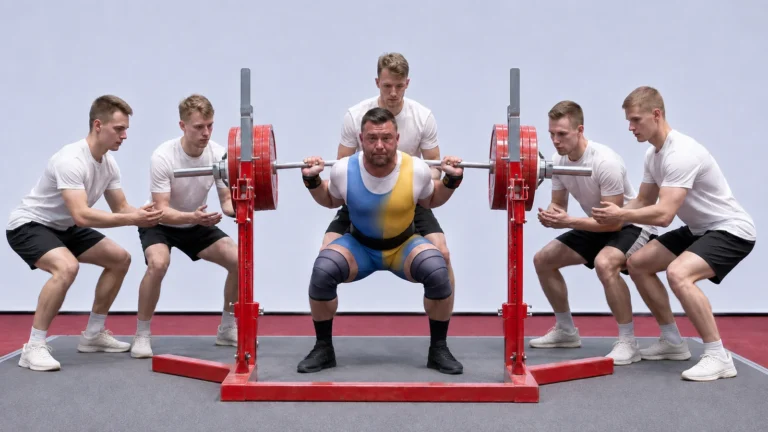
The IPF requires athletes to pass a strict depth standard on the squat, meaning the hip joint must drop below the top of the knee before the lifter stands back up, and three judges independently signal whether that happened on each attempt.
Research on powerlifting judging backs up why that standard matters so much for a fair record.
A 2020 study in the Journal of Strength and Conditioning Research built and tested a formal scoring protocol for evaluating squat and deadlift technique in competition, precisely because subtle differences in depth and bar path can change whether a lift should count (Sjöberg et al., 2020).
Muluh also competes in a tested federation, meaning she is subject to doping controls in a way that many viral training clips circulating online are not, which is part of why federation attribution matters when comparing two different “world record” claims.
A Record She Keeps Breaking Herself
The 311-kilogram lift in Lithuania was not Muluh’s first world record, and it was far from her last.
Her official IPF record history reads like a staircase.
She first set the record at 285.5 kilograms at the 2023 IPF World Classic Championships.
In February 2024, she became the first woman in sanctioned powerlifting history to squat more than 300 kilograms, locking out 300.5 kilograms at the IPF Sheffield Powerlifting Championships.
Four months later came the 311-kilogram lift in Druskininkai.
Less than a year after that, she pushed it to 313 kilograms at the January 2025 Sheffield Championships, then to 318 kilograms two months later at the 2025 EPF European Classic Championships in Malaga, Spain, a lift FitnessVolt’s coverage called the first raw squat over 700 pounds by a woman in powerlifting history.
The current record stands at 318.5 kilograms, or 702.17 pounds, set on January 31, 2026, at the SBD Sheffield Powerlifting Championships.
That is six official IPF world records in under three years, five of them replacing a number she had set herself.
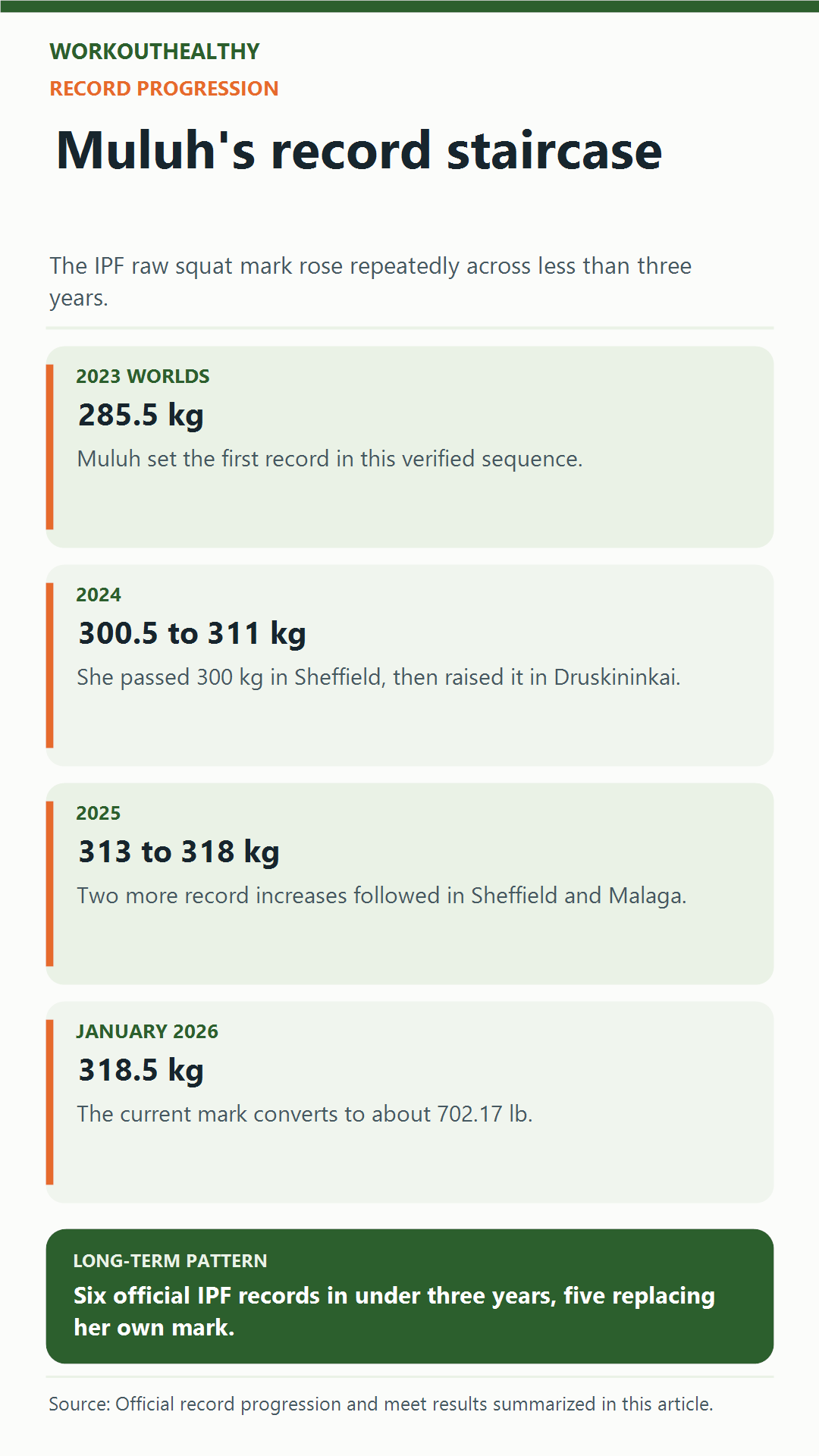
Six world records in under three years is not one breakthrough. It is a pattern of small jumps, each one built on the last.
What It Takes to Add Weight at the Top
Progressing from novice to intermediate lifter is mostly a matter of consistency.
Progressing from world record holder to a heavier world record holder is a different problem entirely.
There is no bigger lifter’s program left to copy and no obvious technical flaw left to fix, so the gains have to come from smaller, harder won places.
Those places include bar speed off the bottom of the squat, hip and ankle mobility that lets the same body reach IPF depth with less wasted motion, and recovery capacity that lets a 126-plus-kilogram frame absorb repeated near-maximal training, the same recovery-first logic explored in our breakdown of Mike Mentzer’s Heavy Duty training system.
A 2022 case series in the Journal of Strength and Conditioning Research tracked elite weightlifters’ training load and force-velocity profiles over multiple years and found that continued progress at an elite level depended on carefully managed, individualized load rather than simply adding more volume (Sandau & Granacher, 2022).
That pattern shows up in Muluh’s own numbers.
The size of her jumps between records has generally shrunk as the record itself has gotten heavier, from a 15-kilogram gain between her first two official records down to a half-kilogram gain for her most recent one, which is roughly the pattern you would expect as a lifter closes in on the outer edge of what her body can currently do.
A 2026 analysis in Frontiers in Physiology modeled this kind of slowdown directly, describing an “allometric decay” in which the rate of performance improvement shrinks as athletes approach the physiological limits of their weight class, with the effect measurably sharper at the elite end of the sport than in the general lifting population (Montenegro, Wicker, & Donath, 2026).
In plain terms, the closer a lifter gets to their own ceiling, the smaller and harder each new pound becomes.
The Record Today, and What Nearly Changed It
As of this writing, the officially recognized IPF raw squat world record in the women’s 84-kg-plus class is Muluh’s 318.5-kilogram lift from the January 2026 Sheffield Championships.
That lift was not simple, either.
FitnessVolt’s coverage of the meet notes the attempt was first ruled a failed lift on the platform, then overturned in Muluh’s favor after a jury of international judges reviewed it.
Five months later, she came close to moving the number again.
At the June 2026 World Classic Powerlifting Championships in Lithuania, Muluh attempted 334.5 kilograms, more than 16 kilograms above her standing record.
The lift did not count.
A spotter on the platform interfered with the bar during the attempt, and the Lithuanian Powerlifting Federation later disqualified the result and banned the spotter for life after an investigation into his conduct.
So the 318.5-kilogram mark from Sheffield remains the current record, not the 334.5-kilogram attempt that made headlines for the wrong reason.
It is a reminder that even at the sport’s highest level, a lift only becomes a record once the whole system around it, judges, spotters, and federation review, confirms it.
What This Record Does Not Prove
A number this large is easy to overinterpret, so a few limits are worth stating plainly.
Only sanctioned, judged competition attempts count toward an official IPF world record.
FitnessVolt has reported several heavier squats from Muluh in training, including a 340-kilogram lift in June 2026, but training lifts are not judged for depth by an independent panel and are never entered into the record book, no matter how impressive the video looks.
The record also does not prove that raw strength scales in a simple way across bodyweight.
Muluh competes in the heaviest class the sport has, which carries a different body of research than lighter classes.
A 2012 biomechanical comparison in the Journal of Strength and Conditioning Research found that squat kinematics, including bar path and joint loading, differ meaningfully depending on a lifter’s limb proportions and bodyweight, which is part of why the sport is organized into weight classes in the first place rather than one open ranking (Swinton et al., 2012).
Finally, an IPF world record says nothing about how a lift would compare to unsanctioned, untested numbers from other federations.
A separate 2026 analysis of IPF participation data found that classic, unequipped lifting under drug-tested conditions has become the dominant form of competitive powerlifting worldwide, rising from about 12 percent of entries in 2010 to more than 93 percent by 2025 (Renner, 2026).
That trend is worth knowing before treating any single federation’s record as the last word on the sport.
Common Mistakes People Make Reading a Number Like This
The most common mistake is treating a headline weight as if it directly measured the athlete’s bodyweight-adjusted strength.
Muluh’s own bodyweight has been reported at roughly 126 to 127 kilograms in competition, so her squat is well over double her own bodyweight.
Still, she is not necessarily lifting proportionally more than every smaller lifter in the sport, since pound-for-pound rankings in powerlifting typically favor lighter classes rather than heavier ones.
A second mistake is confusing kilograms and pounds once the numbers get this large.
A 311-kilogram lift is 685.64 pounds, not 311 pounds, and the gap between those two numbers is the difference between an all-time world record and an ordinary training weight for a strong lifter.
A third mistake is treating a training video and a competition lift as the same kind of claim.
Muluh has posted unofficial training squats heavier than her competition record more than once, and the outlets covering those clips are usually careful to label them “unofficial,” a distinction that matters and is easy to miss while scrolling past a headline.
Who Should Be Cautious Chasing Heavy Squats
Nothing about Muluh’s records is a training template for the average gym member, and it should not be treated as one.
She has competed in more than 20 sanctioned meets over roughly a five-year career, building toward these numbers gradually under coaching and federation oversight.
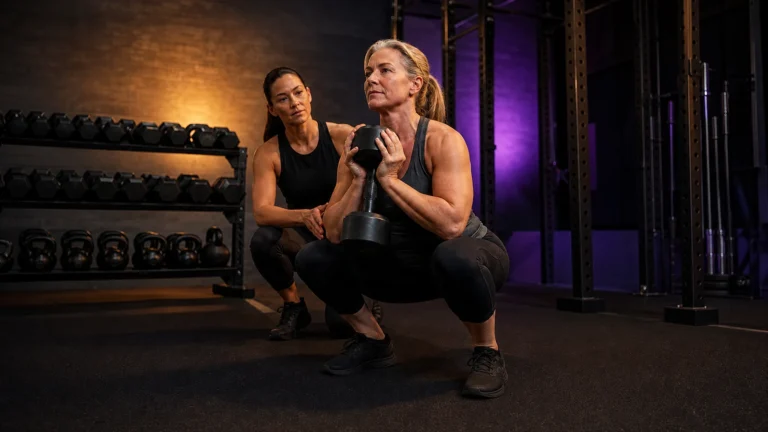
Anyone newer to squatting heavy, especially near a one-rep max, should have a qualified spotter or training partner present, the same principle covered in more everyday detail in our piece on workout partner benefits.
Lifters with a history of hip, knee, or lower back injury should get clearance from a doctor or physical therapist before loading a squat anywhere near their limits.
People managing high blood pressure or a cardiovascular condition should also check with a doctor first, since heavy lower-body lifts create a real, brief spike in blood pressure during the hardest part of the rep.
None of this means heavy squatting is unsafe for healthy, trained lifters.
It means the jump from a gym personal record to a competition-style maximal attempt should happen with preparation, not as an impulsive one-off.
A Practical Way to Apply Her Approach
Most readers will never squat 300 kilograms, but the pattern behind Muluh’s progress still applies at any weight.
Small, consistent jumps beat occasional dramatic ones.
Her own record increases generally got smaller as she got closer to her limits, and that is a normal, expected part of long-term strength training, not a sign that something has gone wrong.
A useful approach for an intermediate lifter is to track competition-style attempts separately from training-only personal records, the same distinction that matters when reading headlines about Muluh’s own lifts.
Depth and technique standards are worth practicing before chasing a new number, since a heavier squat that misses depth is not actually a heavier squat by any judged standard.
The hardest reps near a true limit are also the ones lifters most often misjudge, a point covered directly in our look at Arnold Schwarzenegger’s famous rep quote.
Recovery between hard attempts matters as much as the attempt itself, especially as the weight gets close to a true limit.
For lifters who want more structured guidance on any of this, working with a qualified coach can help separate a safe, well-planned attempt from a reckless one, a decision our guide on whether you need a personal trainer walks through in more detail.
Watch the Original Video
Want more verified strength stories like this one? Subscribe to WorkoutHealthy Insider for practical explanations behind popular fitness claims.
This article is for general information only and is not medical advice. If you have an injury, ongoing pain, or a medical condition, talk to a doctor or physical therapist before you change how you train or eat.
References
- Montenegro, S., Wicker, P., & Donath, L. (2026). An allometric large-scale analysis of the observed performance limits and sex differences in elite powerlifting. Frontiers in Physiology, 17, Article 1847605. https://doi.org/10.3389/fphys.2026.1847605
- Renner, A. (2026). Classic and equipped powerlifting in the International Powerlifting Federation: Participation and performance trends from 2010 to 2025. International Journal of Sports Science & Coaching. https://doi.org/10.1177/17479541261467968
- Sandau, I., & Granacher, U. (2022). Long-term monitoring of training load, force-velocity profile, and performance in elite weightlifters: A case series with two male Olympic athletes. Journal of Strength and Conditioning Research, 36(12), 3446 to 3455. https://doi.org/10.1519/jsc.0000000000004228
- Sjöberg, H., Aasa, U., Rosengren, M., & Berglund, L. (2020). Content validity index and reliability of a new protocol for evaluation of lifting technique in the powerlifting squat and deadlift. Journal of Strength and Conditioning Research, 34(9), 2528 to 2536. https://doi.org/10.1519/jsc.0000000000002791
- Swinton, P. A., Lloyd, R., Keogh, J. W. L., Agouris, I., & Stewart, A. D. (2012). A biomechanical comparison of the traditional squat, powerlifting squat, and box squat. Journal of Strength and Conditioning Research, 26(7), 1805 to 1816. https://doi.org/10.1519/jsc.0b013e3182577067