
Recommended exercise after stopping Ozempic should be part of a plan reviewed with your prescribing team. Research supports discussing ongoing aerobic and strength activity, but it does not establish one post-Ozempic routine that prevents weight regain.
This guide separates general activity recommendations, medication-withdrawal findings and actual exercise research. It also provides a way to check whether a proposed plan addresses the transition you are facing.
The featured squat scene is an editorial illustration, not a technique demonstration, identified patient or study result. Neither it nor the food illustration establishes a suitable exercise load, nutrition target or medication decision.
What Exercise Guidance Is Actually Available?
The CDC’s general adult guidance includes 150 minutes of moderate-intensity activity and two days of muscle-strengthening activity each week. It advises people with chronic conditions, including diabetes, to discuss appropriate types and amounts with their doctor.
These are population reference points, not a tested prescription for preventing regain after Ozempic. They do not determine your starting workload, appropriate movements or progression after a treatment change.
- Aerobic activity: Discuss an appropriate activity you can sustain, such as walking or cycling, rather than treating intensity as a way to compensate for stopping medication.
- Strength activity: Discuss resistance work suited to your function, experience and any limitations, with the selected movements demonstrated when needed.
- Participation: Consider access, preferences and the support needed to continue the agreed activities; a list of exercises alone leaves those decisions open.
The useful question is which parts of an existing plan remain appropriate and which need review. A medication transition is not evidence that everyone should suddenly add harder exercise.
The Exercise Study Had Three Different Phases
| Phase | What actually happened | Why it matters |
|---|---|---|
| Before randomization | Eight-week diet-induced loss. | Adults with obesity, without diabetes. |
| Weeks 0 to 52 | Randomized: liraglutide, supervised exercise, both, or placebo/usual activity. | Cycling, circuits and individual activity; not resistance-only. |
| Weeks 52 to 104 | Assigned interventions ended. | No newly assigned exercise program. |
Of 166 treatment-year completers, 109 returned; returners had better prior responses. Missing-data models require assumptions.
What the Follow-Up Does and Does Not Establish
Jensen’s liraglutide follow-up suggests lasting benefits, not a guaranteed post-Ozempic regimen.
Combination versus liraglutide alone yielded 5.1 kilograms lower weight across weeks 0 to 104. The off-year contrast’s confidence interval included no difference; 5.1 kilograms was not off-year regain prevented.
Weight and body-fat-percentage comparisons missed the prespecified false-discovery threshold for multiple comparisons.
Activity was higher near follow-up, not assigned or tracked throughout the off-year; no personal dose or transfer to another drug, population or newly started exercise was established.
Semaglutide and Tirzepatide Studies Asked Different Questions
Medication-withdrawal studies explain why the transition deserves attention. They do not automatically establish which exercise program changes its outcome.
| Research | Medication and support | Exercise conclusion it cannot supply |
|---|---|---|
| STEP 1 extension | Semaglutide 2.4 mg or placebo and structured lifestyle support ended after 68 weeks; a subset was followed further. | It did not randomize post-withdrawal strength training or compare exercise routines. |
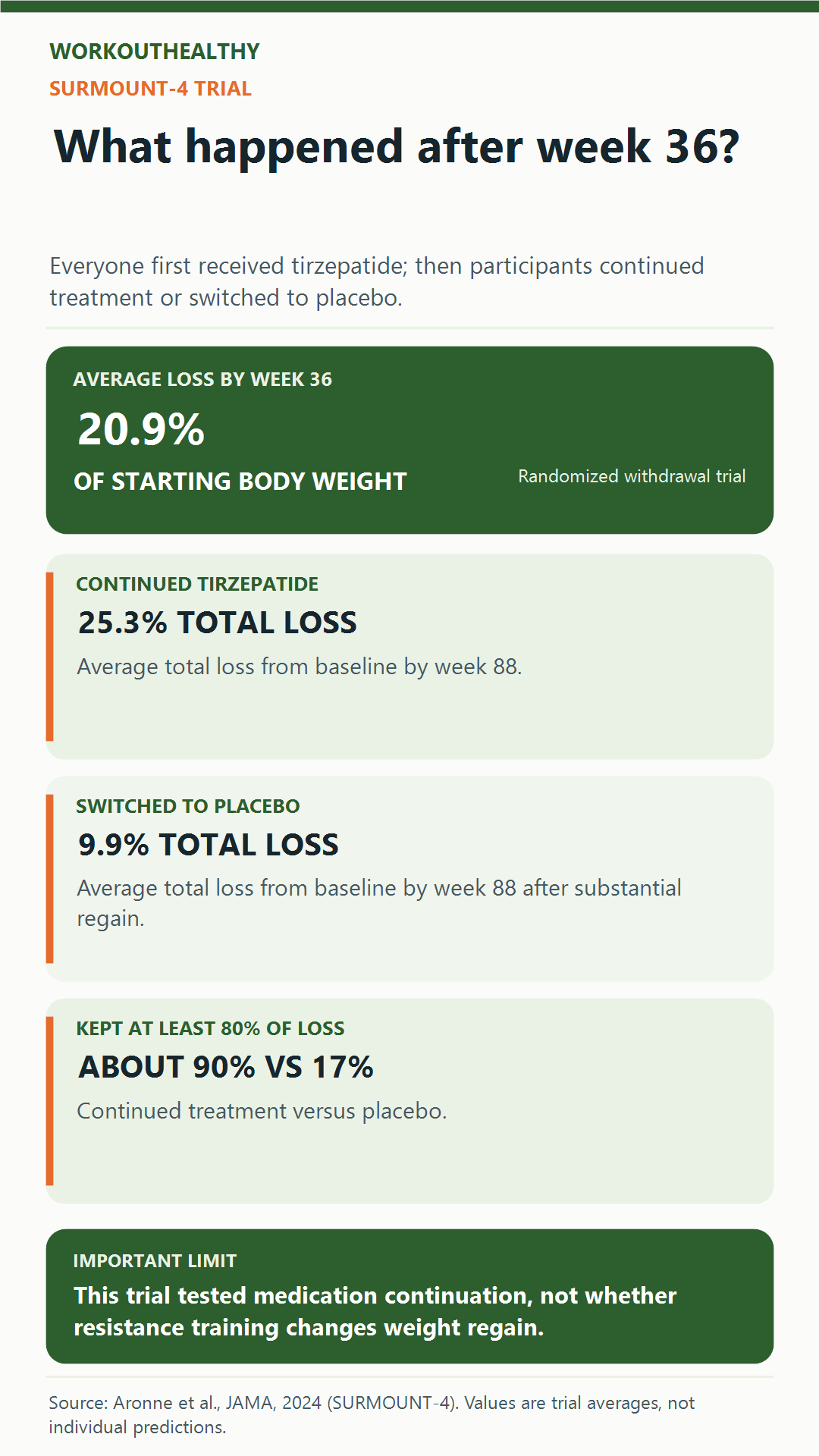
| SURMOUNT-4 | Tirzepatide continuation versus placebo; lifestyle counseling in both groups. | No exercise-program comparison. |
| Danish follow-up | Liraglutide/exercise. | No new post-semaglutide assignment. |
In the STEP 1 extension, participants regained about two-thirds of their prior semaglutide-associated weight loss on average during the off-treatment year. This was an exploratory subset analysis, not proof that a lack of exercise caused the regain.
Structured lifestyle support also stopped, and participation in other lifestyle interventions was not recorded. That makes “stopping the medicine” and “testing an effective exercise alternative” different questions.
The study used a weight-management semaglutide regimen in people without diabetes. It should not be relabeled as an exercise trial of Ozempic treatment for type 2 diabetes.
Keep the Outcome Separate From the Explanation
Lower body weight, lower body-fat percentage, preserved lean tissue and improved strength are different outcomes. One favorable measure cannot establish all the others or prove a mechanism for keeping weight off.
A claim that lifting prevents rebound through muscle preservation therefore needs more evidence than a withdrawal trial’s weight results. The studies above do not isolate that pathway.
For the separate on-treatment question, our exercise-on-Ozempic guide explains activity guidance and exercise planning. Our muscle-gain evidence guide explains why lean-mass scans and strength tests are different.
Here, the distinct issue is whether a claim concerns exercise during treatment, after treatment or both. Keeping that timeline attached prevents an on-treatment observation from becoming an untested off-treatment promise.
A Transition Check That Does Not Prescribe a Workout
A useful next discussion connects the medication decision to the activities you can actually sustain. The following three-part check organizes that discussion without choosing your treatment, exercise dose or weight target.
1. Identify the part of the plan that is changing
Is the change medication access, the prescribed treatment, supervised exercise support or several things together? Describe that change rather than assuming every study’s withdrawal situation matches yours.
2. Separate what you already do from what is proposed
List activities you currently perform comfortably and any symptoms or access problems that interrupt them. Then identify which new activities, workload changes or support arrangements need professional review.
For example, losing access to a supervised class creates a support question even if the exercise category stays the same. The useful response might involve arranging a suitable alternative, not automatically increasing effort.
3. Agree what will be followed up
Ask which outcomes matter in your situation, including relevant medical measures, daily function and ability to participate. Clarify who will review concerns and what instructions already apply if symptoms occur.
This check is an editorial communication aid, not a validated risk assessment or a guarantee against regain. It also cannot decide whether medication should be stopped, restarted, tapered or replaced.
Why the Prescribing Team Still Matters
The FDA Ozempic label includes type 2 diabetes-related treatment indications. A change in treatment may therefore concern more than body weight, and exercise is not a substitute for an agreed medical plan.
Tell the team about trouble eating adequately, persistent symptoms or a change in ability to exercise. Keep medication and glucose-monitoring decisions with the professionals who know your condition and other treatments.

Weight regain in a study is not a measure of someone’s discipline. The useful goal is a realistic follow-up plan supported by accurate evidence, rather than a promise that one exercise removes the consequences of treatment withdrawal.
Medical disclaimer: This article provides general information about fitness and weight-management research, not personal medical, medication, nutrition or exercise advice. Discuss treatment changes and an appropriate activity plan with a qualified healthcare professional who knows your health history.
References
Jensen, S. B. K., et al. (2024). [Post-treatment analysis]. eClinicalMedicine, 69, 102475. Read the paper.
Wilding, J. P. H., et al. (2022). Weight regain and cardiometabolic effects after withdrawal of semaglutide: The STEP 1 trial extension. Diabetes, Obesity and Metabolism, 24(8), 1553 to 1564. Read the original extension.
Aronne, L. J., et al. (2024; online 2023). [SURMOUNT-4 trial]. JAMA, 331(1), 38 to 48. Read the trial.
Centers for Disease Control and Prevention. (2025). Adding physical activity as an adult. Read the general guidance.
US Food and Drug Administration. (2026). Ozempic injection prescribing information, revised May 2026. Read the official label.