
A 331 kg squat is a heavy lift by any measure. What made this one unusual was who lifted it, and when.
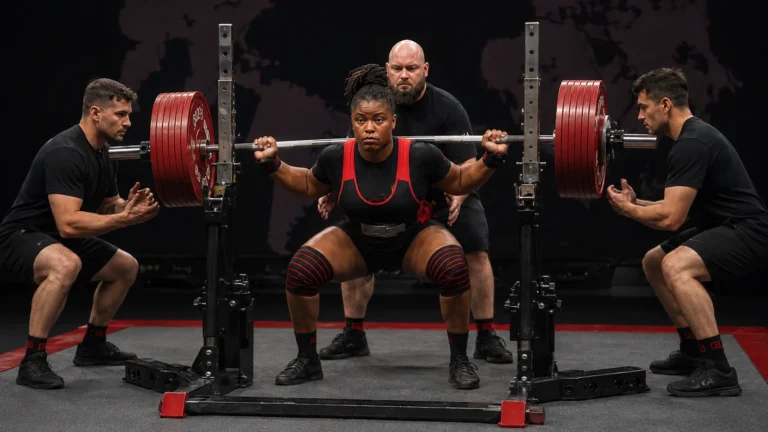
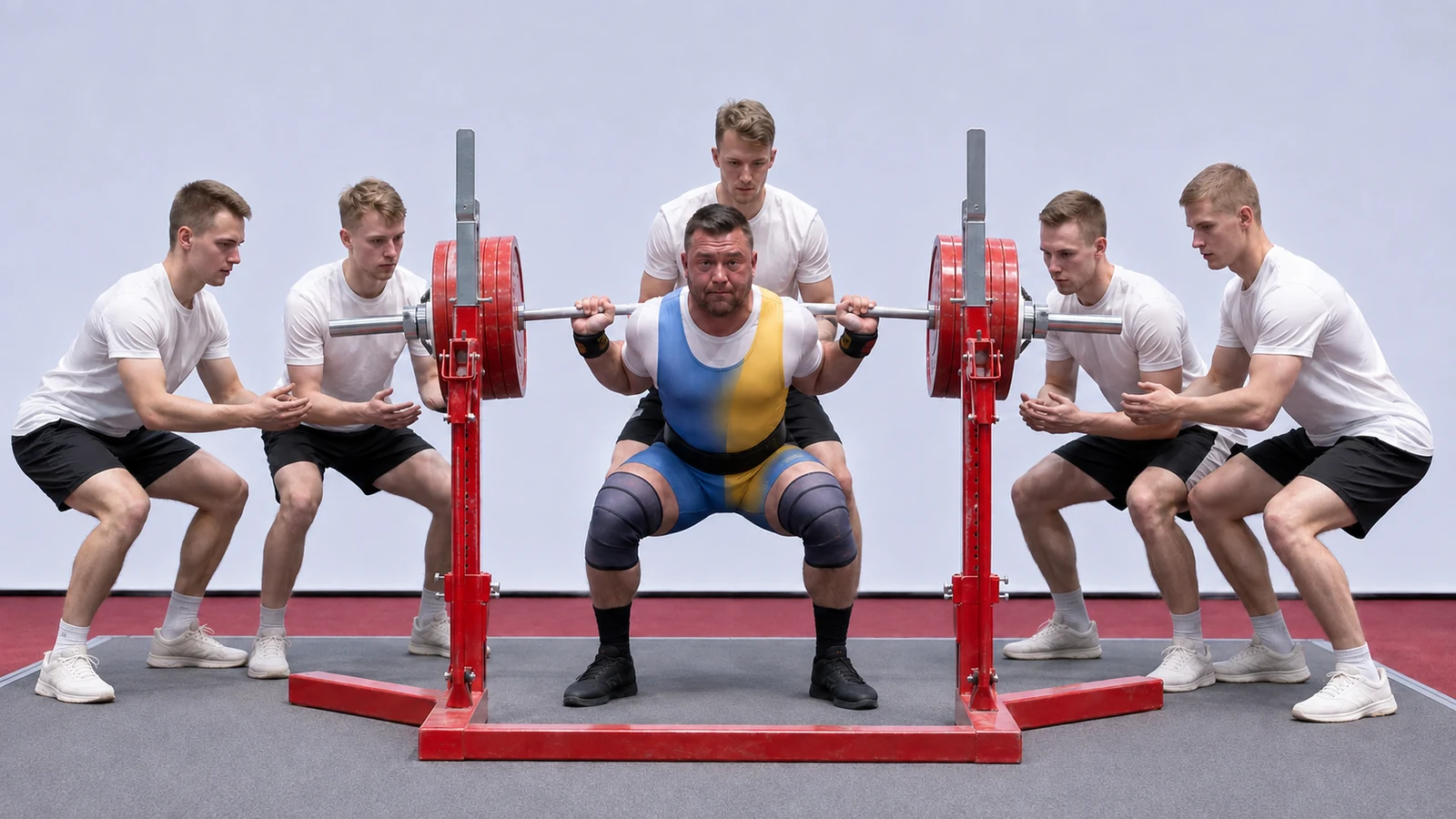
In November 2019, Ukrainian powerlifter Anatolii Novopismennyi squatted 331 kg, 729.73 lb, at the European Classic Powerlifting Championships in Lithuania.
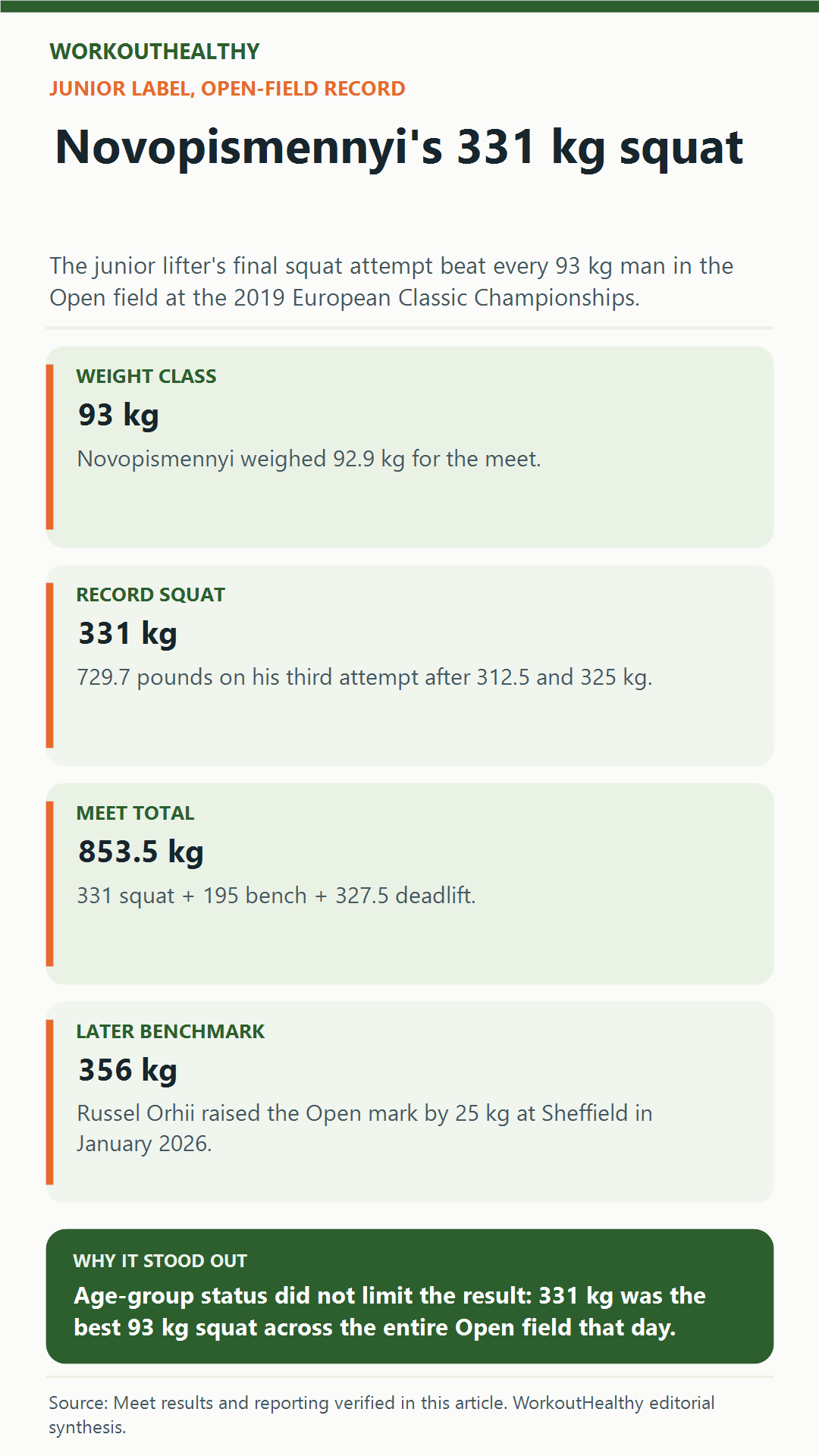
He was 92.9 kg on the scale, competing in the 93 kg raw class. The number itself would have been notable on its own.
What made it a story worth revisiting is that he set it in the Open division, the category that includes every eligible lifter regardless of age, not a junior-only bracket.
A young lifter beat the entire open field in his weight class, at a stage in his career when he had only recently aged out of, or was still near, junior competition.
That distinction between a junior record and an open record matters more than it sounds like it should.
It is also the reason this lift keeps surfacing years later, including in official replays from the International Powerlifting Federation’s own channels, which billed him at the time simply as “junior Anatolii Novopismennyi.”
What Actually Happened
The meet was the EPF European Classic Powerlifting Championships, held in Lithuania in late November 2019.
EPF is the European regional federation under the IPF umbrella, and results from EPF-sanctioned continental championships feed into the same drug-tested, unequipped “Classic” record book that the IPF itself recognizes worldwide.
Novopismennyi competed in the men’s 93 kg class, raw, Open division.
His squat attempts climbed from 312.5 kg to 325 kg and finished at 331 kg on his third and final attempt.
That converts to 729.73 lb, exactly matching the figure that circulated with the original footage.
The squat was part of a full meet.
He also benched 195 kg and pulled 327.5 kg in the deadlift, for a total of 853.5 kg at a bodyweight of 92.9 kg.
This was not his first appearance on an international platform.
Competition records show him lifting in the Juniors division of the IPF World Classic Championships in 2016, at the same 93 kg class, with a 302.5 kg squat at that meet.
Three years later, the 331 kg mark in Lithuania represented roughly a 28.5 kg improvement on his own squat, and it came while he was competing against the full Open field rather than an age-restricted bracket.
Some lifters wait until their thirties to challenge an open world record. Novopismennyi did it while the sport’s own federation was still introducing him as a junior.
Junior Lifter, Open Record: Why the Distinction Matters
Most strength sports separate athletes by age as well as by bodyweight.
The IPF runs Sub-Junior, Junior, Open, and Masters categories, each with its own set of recognized records.
A Junior record only has to beat other lifters in that same age bracket.
An Open record has to beat everyone.
That includes the newest 20 year old on the platform and the veteran who has spent a decade refining the same lift.
Novopismennyi’s 331 kg squat was logged under the Open division at that meet, not a separate Juniors category.
That means his number had to stand on its own against the entire 93 kg field that day, with no age-based cushion.
It is genuinely rare for a young lifter to do this.
Most Open records in a competitive federation like the IPF are set by athletes well into their late twenties or thirties, after years of accumulated training age on top of physical maturity.
A lifter still early in a competitive career topping that list, even briefly, is the kind of result that gets replayed by the federation itself rather than filed away as one line in a results sheet.
The Mechanics Behind a 331 kg Squat
A raw, unequipped squat at this weight is not just about maximal strength.
It is a test of how efficiently a lifter’s whole system, from bar position to hip and ankle mobility to bracing technique, converts strength into a lift a judge will approve under strict depth and control standards.
Sports science research on elite strength athletes consistently finds that maximal strength is the foundation nearly everything else in athletic performance is built on.
That same research treats developing it as a long-term, structured process, not a single trait some athletes simply have (Suchomel et al., 2016).
Anthropometry plays a real role too.
Limb length relative to torso length changes how far the bar has to travel and how the load distributes across the hips, knees, and lower back.
Lifters with favorable leverages for the squat are not guaranteed a big number, but they need less brute strength to hit the same weight as a lifter built less favorably for the movement.
Coaching matters just as much as leverage.
A federation-level Classic squat has to pass strict depth and bar-control rules to count.
Reaching legal depth at 331 kg without losing tightness through the hips takes years of technical refinement, not just raw force production.
What This Kind of Record Does Not Prove
It is tempting to read a result like this as proof that young lifters can simply out-train age and experience.
That reading goes further than the evidence supports.
Novopismennyi did not appear at this meet from nowhere.
His own competition history shows a documented progression, from a 240 kg squat in a domestic Ukrainian meet in 2014, through Junior-division competition in 2015 and 2016, up to the 331 kg Open result in 2019.
That is roughly five years of recorded, sanctioned competition before this lift, not a sudden breakthrough.
One Open record in one weight class also does not mean junior-age lifters routinely outperform older, more experienced competitors.
It means one lifter, with a specific combination of training history, coaching, and body mechanics, did it once, under strict competition rules, on one day.
Generalizing from a single elite outlier to “age does not matter” would be overstating what a single competition result can show.
It is also worth being precise about what “junior” means here.
IPF divisions are set by age bracket, and Novopismennyi is shown in Juniors-division results as recently as 2016.
By the time of the 331 kg lift in late 2019, competition records list him in the Open division for that specific meet.
Whether he was still inside the IPF’s junior age window on that exact date cannot be confirmed from public results alone.
What is well documented is that the federation’s own broadcast of the lift described him as a junior lifter.
His career, both before and after this meet, also tracks a young athlete still early in his competitive arc.
Common Mistakes Lifters Make Chasing a Number Like This
Young, ambitious lifters watching a result like Novopismennyi’s often make a specific set of mistakes trying to replicate it.
The most common is skipping the years of base-building that came before the headline number.
His federation results show steady, multi-year progression, not a single dramatic jump.
A second mistake is chasing depth and bar speed at the expense of bracing.
A squat that looks fast out of the hole but loses core tightness through the middle of the rep is far more likely to end in a missed lift, or an injury, than one built on a slower, more controlled base.
A third is ignoring recovery.
Federation-level lifters build toward a peak meet across a training cycle that includes planned lighter weeks.
Training maximally every session without that structure is a common way lifters plateau or get hurt long before they ever approach a number like 331 kg.
Who Should Be Cautious With Heavy Squat Training
Nothing about this record is a suggestion that untrained lifters, especially younger athletes, should rush toward maximal loads.
The International Consensus statement on youth resistance training, endorsed by sports medicine and pediatric organizations, found that structured resistance training can be safe and effective for younger athletes.
That same statement is clear it only holds under qualified supervision, with technique prioritized well before heavy loading (Lloyd et al., 2014).
It also found that most reported injuries in youth resistance training came from poor technique, inadequate supervision, or equipment misuse, not from the act of lifting weights itself.
Anyone recovering from a back, hip, or knee injury should get individual clearance from a doctor or physical therapist before loading a squat heavily.
The same goes for anyone new to the lift entirely.
A federation-level Classic squat like this one comes after years of coached technical work, not a shortcut any lifter can take safely on their own.
Building Toward Serious Squat Strength: A Practical Approach
Most readers will never chase a 331 kg squat, and that is fine. The same principles that built Novopismennyi’s number scale down to any lifter trying to squat more safely.
Start with depth and bracing before load.
A squat that reaches proper depth with a tight core at a lighter weight will build a more durable base than a heavier squat cut short.
Progress the weight gradually across weeks, not sessions. Federation lifters plan training cycles months in advance for a reason.
Build in lighter weeks on purpose.
Recovery is not wasted training time; it is what lets the next hard week actually register as progress.
Get a second set of eyes on technique periodically, whether that is a coach, a training partner who understands the lift, or video review against a known depth and bracing standard.
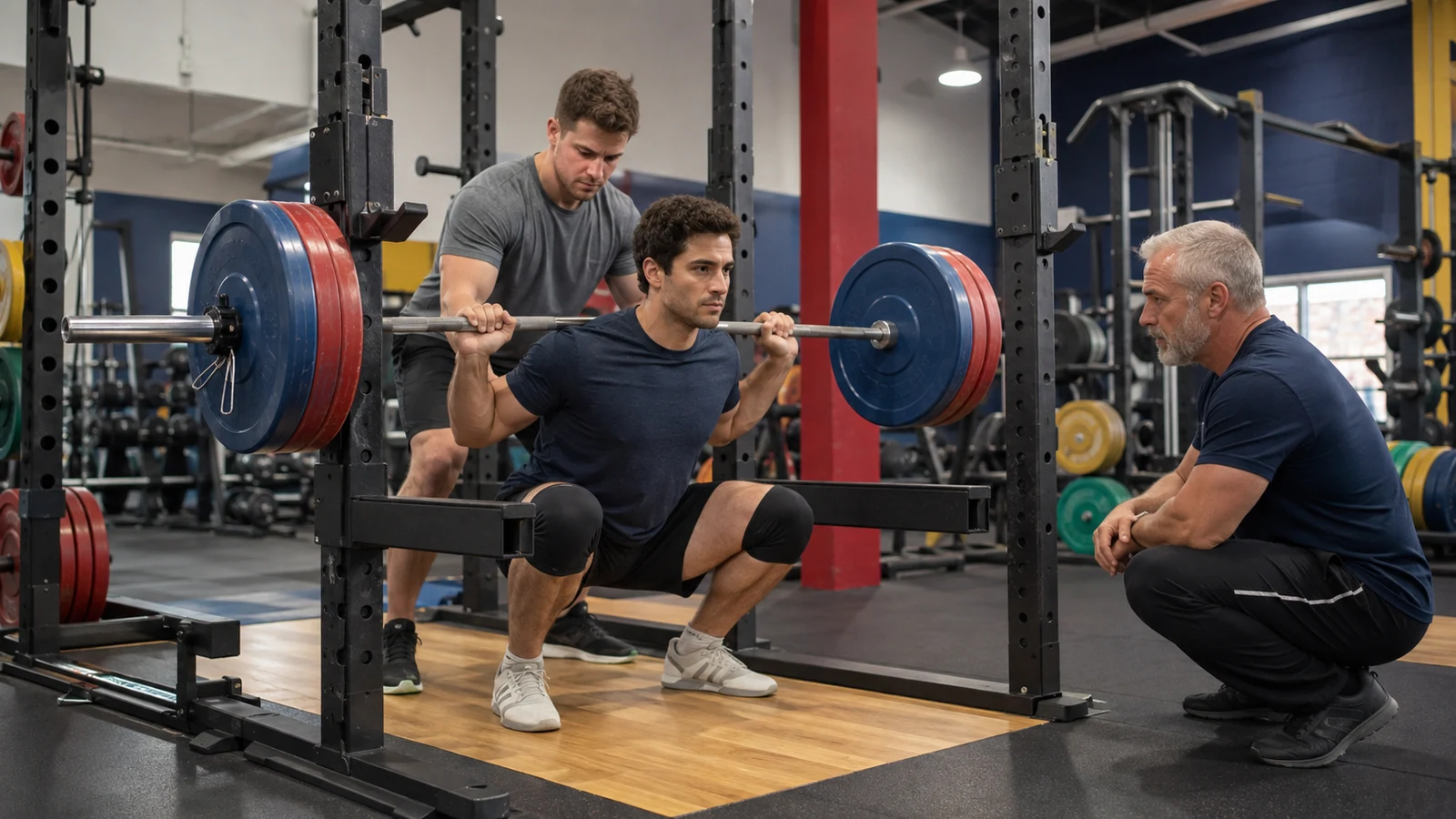
Treat any sharp or localized pain, especially in the knees, hips, or lower back, as a stop signal rather than something to push through.
How Long the Record Stood, and What Happened Next
Records like this rarely stand forever, and this one did not either.
Russel Orhii, another elite raw powerlifter, spent years building his own reputation in the 83 kg class before moving up to 93 kg.
Competition results show him squatting 321 kg at 83 kg in mid-2024 and 338 kg at 83 kg in January 2025.
He then appeared in the 93 kg class by that July, where he squatted 355.5 kg at the Pan-American Championships.
At the Sheffield Powerlifting Championships in January 2026, Orhii squatted 356 kg, 784.85 lb, in the 93 kg raw class.
That is 25 kg beyond Novopismennyi’s 2019 mark in the same weight class and equipment category.
Based on the competition results this research could independently verify, Orhii’s 356 kg is the higher confirmed squat in the men’s 93 kg raw division, and it supersedes Novopismennyi’s 2019 result.
This research could not access the IPF’s own formal record ledger directly to confirm the exact date the record book was updated.
That specific administrative detail is not independently confirmed here, even though the underlying competition data is clear and consistent across sources.
Orhii’s own path through the 83 kg class, including how his squat there climbed year over year before his move up in weight, is covered in a separate WorkoutHealthy Insider article.
What both records share is the same underlying pattern.
Neither lifter arrived at their number in one session. Novopismennyi’s 331 kg came after five documented years of competition.
Orhii’s 356 kg came after building one of the class’s best totals at 83 kg first, then adding size and continuing to progress at the heavier weight.
Raw strength like this is built, year over year, not discovered overnight.
A world record is rarely the end of a story. It is usually just the moment someone else’s training cycle had not caught up yet.
For readers who want the full context on strength and age, our breakdown of Edith Connor’s Guinness World Record looks at the opposite end of that same question, an athlete who built elite strength well into her seventies.
The push-up world record set by DonnaJean Wilde is another example of what verified, federation-tracked records can and cannot tell us about human performance.
If you are working with a coach toward your own strength goals, our guide on deciding whether you need a personal trainer covers what to look for.
And for a look at how much technical language around lifting gets repeated without checking the source, see our piece fact-checking Arnold Schwarzenegger’s famous rep quote.
Watch the World Record Squat
Want more verified strength stories like this one? Subscribe to WorkoutHealthy Insider for practical explanations behind popular fitness claims.
References
Lloyd, R. S., Faigenbaum, A. D., Stone, M. H., Oliver, J. L., Jeffreys, I., Moody, J. A., Brewer, C., Pierce, K. C., McCambridge, T. M., Howard, R., Herrington, L., Hainline, B., Micheli, L. J., Jaques, R., Kraemer, W. J., McBride, M. G., Best, T. M., Chu, D. A., Alvar, B. A., & Myer, G. D. (2014). Position statement on youth resistance training: The 2014 International Consensus. British Journal of Sports Medicine, 48(7), 498-505. https://doi.org/10.1136/bjsports-2013-092952
Suchomel, T. J., Nimphius, S., & Stone, M. H. (2016). The importance of muscular strength in athletic performance. Sports Medicine, 46(10), 1419-1449. https://doi.org/10.1007/s40279-016-0486-0
This article is for general information only and is not medical advice. If you have an injury, ongoing pain, or a medical condition, talk to a doctor or physical therapist before you change how you train or eat.