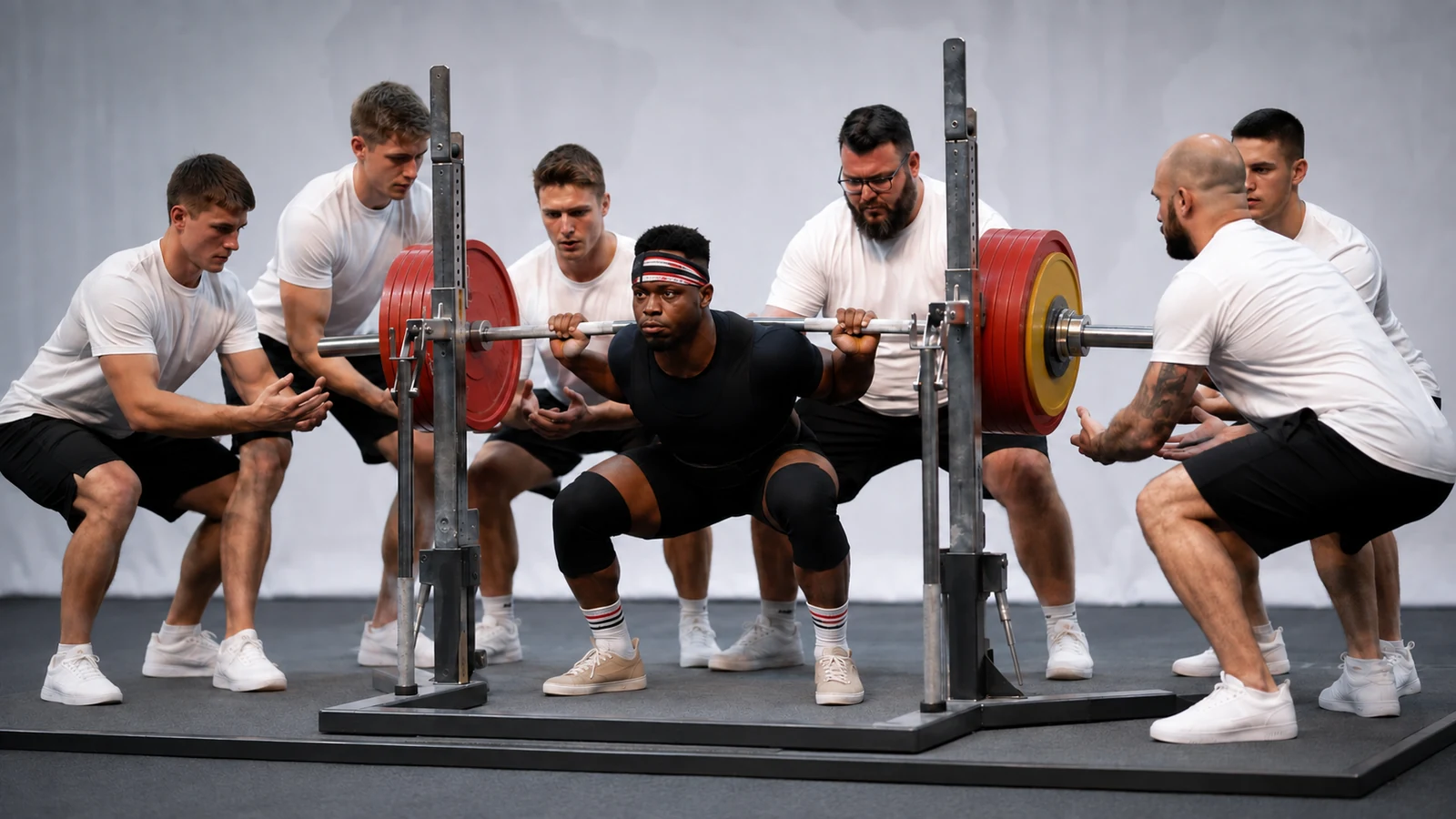

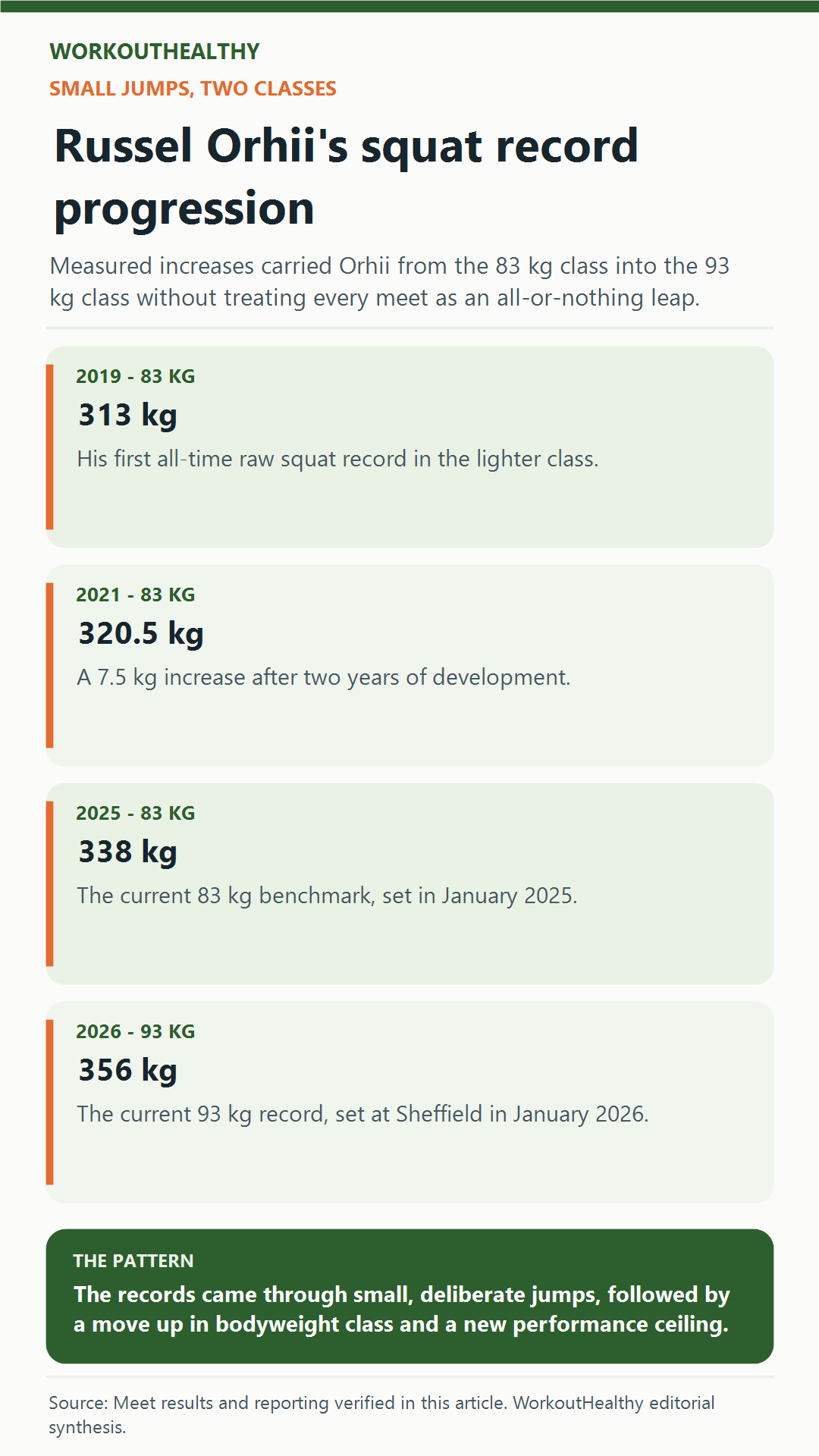
Russel Orhii squatted 313 kilograms at the 2019 IPF World Classic Powerlifting Championships.
That converts to 690.05 pounds.
He weighed 82.2 kilograms at the time, comfortably inside the men’s 83 kilogram class, itself equal to about 182.98 pounds.
The lift won him a gold medal and set a new world record in that weight class.
It was not his only world record squat, and it was not even his biggest.
Over the next six years Orhii broke his own squat record three more times, always in small, deliberate jumps rather than one dramatic leap.
Then he moved up an entire weight class and kept doing it.
Here is what independent verification found about a record that has only ever changed hands to the same man.
The Record, Verified
The 2019 IPF World Classic Powerlifting Championships were held in Sweden.
Orhii competed in the men’s 83 kilogram Classic Raw division, the category that allows a belt and knee sleeves but nothing more supportive than that.
His winning squat of 313 kilograms is recorded on OpenPowerlifting, the sport’s independent public results archive.
Goodlift, the International Powerlifting Federation’s own affiliated records database, lists the same 313 kilogram figure for that meet.
Wikipedia’s own summary of Orhii’s career independently corroborates the claim, describing the lift as a squat world record set at the IPF World Championships that year.
He also bench pressed 195 kilograms and deadlifted 325 kilograms that day, for a winning total of 833 kilograms.
Three separate sources agreeing on the same number, the same date, and the same meet is about as solid as verification gets for a competitive lifting record.
A Record He Kept Breaking Himself
Most world records eventually get broken by someone else.
Orhii’s has only ever been broken by Orhii.
Two years after the 2019 lift, at another IPF World Classic Championships, he squatted 320.5 kilograms.
That converts to 706.58 pounds, a jump of a little more than seven kilograms over his own prior mark.
Three years after that, at the 2024 World Classic Championships in Lithuania, he pushed the number to 321 kilograms, or 707.68 pounds.
Each jump was small on purpose.
Then, on January 26, 2025, at an IPF-sanctioned meet in Sheffield, England, he squatted 338 kilograms.
That converts to 745.16 pounds.
Coverage of that Sheffield meet describes Orhii breaking his own world record twice within the same competition, meaning an earlier attempt that day also passed his old mark before the final 338 kilogram lift closed it out.
Goodlift’s own records page still lists that 338 kilogram lift as the current world record in the men’s 83 kilogram Classic Raw squat.
Nobody else has touched it since, largely because Orhii had already left the weight class by the time anyone else got the chance.
The workbook behind this article flagged the original 2019 mark as historical and superseded, and that classification holds up exactly as written: superseded, but only by its own owner.
What Classic Raw Actually Means
IPF competition splits into equipment categories, and the difference changes what a number like 338 kilograms actually represents.
Equipped lifting allows a supportive squat suit, thick multi-ply fabric built to store and return energy at the bottom of the movement.
Classic Raw, the category Orhii competes in, allows only a belt, knee sleeves, and a singlet.
No wraps.
No suit.
No bar bend built into the equipment to help the lift out of the bottom.
That distinction matters because a 338 kilogram Classic Raw squat and an equipped squat of the same number are not the same feat, even though both would casually get called a world record.
Orhii’s records sit in the stricter category, the one most fans picture when they imagine a raw powerlifting meet.
The Biomechanics of a Squat That Deep
A competition squat has to break parallel, the hip crease dropping below the top of the knee, or the lift does not count at all.
Research measuring muscular effort at different squat depths has found that a full, below-parallel squat demands meaningfully more from the hip and knee extensors than a partial one, because the working muscles lose leverage as the joint angles close (Bryanton, Kennedy, Carey, & Chiu, 2012).
That same research found relative muscular effort keeps climbing as the bar gets heavier and the squat gets deeper, which is exactly the combination a world record attempt demands.
A lifter cannot make up for a shallow squat with extra weight on the bar.
The depth requirement is fixed, and it is the harder half of the equation, not the easier one.
That is part of why 338 kilograms below parallel is a different feat than 338 kilograms in a partial range machine press.
A shallow squat can hide a lot of missing strength. A full one has nowhere to hide it.
Why Comparing Weight Classes Is Not Simple Math
Orhii’s 313 kilogram squat came from an 82.2 kilogram body.
His later 356 kilogram squat, set in the 93 kilogram class, came from a body closer to 92 kilograms.
A heavier lifter can usually move more absolute weight, so comparing the two numbers directly overstates how much stronger he actually got.
Powerlifting has a standard tool for this exact problem.
The Wilks formula, developed to let coaches and federations compare lifters of different bodyweights on level footing, adjusts a raw total using a validated statistical curve built from historical results (Vanderburgh & Batterham, 1999).
Federations have since layered newer formulas like DOTS on top of the same basic idea.
Orhii’s own competition scores show his bodyweight-adjusted strength score climbing alongside his raw numbers across his career, not just riding along with added bodyweight.
That is the more honest way to read a strength career that spans two weight classes.
Building a Career Instead of Chasing One Lift
Sport scientists who study long-term strength development describe exactly the pattern Orhii’s results show.
Training reviews on long-term strength progression emphasize that durable increases in maximal strength come from years of consistent, appropriately dosed overload, not from isolated maximal attempts (Suchomel, Nimphius, Bellon, & Stone, 2018).
A six-kilogram jump, then a half-kilogram jump, then a seventeen-kilogram jump, is not a random sequence.
It is what steady, well-managed progressive overload looks like when it is plotted out over six years instead of six months.
Lifters who chase one heroic single attempt often burn out, get hurt, or simply never build the base a genuine world record requires.
Orhii’s numbers suggest the patient approach worked better for him.
Moving Up a Weight Class on Purpose
On July 27, 2025, Orhii competed in the 93 kilogram class for the first time in years, at the NAPF Pan-American Championships.
He weighed 91.8 kilograms that day, about nine kilograms heavier than his last 83 kilogram meet.
His squat there was 355.5 kilograms, or 783.74 pounds, and he won the meet outright.
Gaining that much bodyweight on purpose, without losing the strength or technique built over a decade in a lighter class, is its own skill.
Sports nutrition guidelines for strength athletes describe a deliberate approach to weight gain built around a modest calorie surplus and enough protein to support the added muscle a heavier class rewards, rather than simply eating more of everything (Slater & Phillips, 2011).
Done carelessly, a fast weight class jump adds fat without adding useful strength.
Orhii’s results after the move suggest his did not.
Where the Record Stands Today
On January 31, 2026, Orhii competed again at an IPF-sanctioned meet in Sheffield, this time in the 93 kilogram class.
He weighed 92.4 kilograms.
His squat that day was 356 kilograms, or 784.85 pounds.
Goodlift’s own IPF records database lists that lift as the current world record in the men’s 93 kilogram Classic Raw squat, dated January 31, 2026, in Sheffield, Great Britain.
OpenPowerlifting’s independent results archive shows the same meet, the same bodyweight, and the same number.
Two separate sources, one the federation’s own database and one an independent public archive, agreeing on a lift barely a month old at the time of this writing is a strong verification signal.
A different lifter, Anatolii Novopismennyi, held an earlier mark in that same weight class, a 331 kilogram squat set at a 2019 European championship.
His story, and the fuller detail on how that class’s record changed hands, is told in a separate article on this site.
For the 83 kilogram class Orhii left behind, his 338 kilogram squat from January 2025 still stands as of this writing, untouched since he moved on.
He now holds, or has held, the top squat mark in two different weight classes within the same federation, a rare outcome even among elite powerlifters.
The Cost of a Decade Under Heavy Weight
None of this happens without physical cost.
A review of injuries in competitive powerlifting found the knee, shoulder, and lower back are the joints most commonly affected, with overuse injuries built up over years of maximal training far more common than sudden acute ones (Siewe et al., 2011).
A career built on repeated near-maximal squats across a decade carries real cumulative load on exactly those joints.
Careful programming, planned lighter training blocks, and enough recovery time between heavy competition cycles are part of what lets a lifter stay competitive for years instead of one standout season.
Orhii’s own six-year timeline, with each new record spaced a year or more apart, fits a program built around that kind of restraint rather than constant maximal testing.
Readers managing their own long-term training around joint concerns may also want our comparison of the floor press and the bench press, which covers how a shorter range of motion changes joint stress in a different lift entirely.
A world record is not proof a lifter’s story is finished. It is proof that, for one day, nobody had gone further yet.
Who Should Be Extra Careful
Nobody reading this needs to squat anywhere close to 313 kilograms, let alone 356.
Anyone with an existing knee, hip, or lower back injury should get medical clearance before adding heavy squat work to a routine.
The same caution applies to anyone considering a significant, fast weight gain to move up a competitive class, since rapid weight change carries its own metabolic and joint-loading tradeoffs.
New lifters should build squat depth and technique at light weight before adding heavy load, not the other way around.
Pain during a squat is a signal to stop and get it checked, not a signal to push through for one more rep.
Readers newer to structured strength training may find it useful to also look at our guide on deciding whether to hire a personal trainer, since coaching feedback matters most in exactly this kind of depth and technique work.
Watch the Record
The International Powerlifting Federation’s own Facebook page filmed and published the original footage of Orhii’s 313 kilogram world record squat.
Want more world records explained like this one? Subscribe to WorkoutHealthy Insider for practical explanations behind popular fitness claims.
References
Bryanton, M. A., Kennedy, M. D., Carey, J. P., & Chiu, L. Z. F. (2012). Effect of squat depth and barbell load on relative muscular effort in squatting. Journal of Strength and Conditioning Research, 26(10), 2820–2828. https://doi.org/10.1519/JSC.0b013e31826791a7
Siewe, J., Rudat, J., Röllinghoff, M., Schlegel, U. J., Eysel, P., & Michael, J. W. P. (2011). Injuries and overuse syndromes in powerlifting. International Journal of Sports Medicine, 32(9), 703–711. https://doi.org/10.1055/s-0031-1277207
Slater, G., & Phillips, S. M. (2011). Nutrition guidelines for strength sports: Sprinting, weightlifting, throwing events, and bodybuilding. Journal of Sports Sciences, 29(sup1), S67–S77. https://doi.org/10.1080/02640414.2011.574722
Suchomel, T. J., Nimphius, S., Bellon, C. R., & Stone, M. H. (2018). The importance of muscular strength: Training considerations. Sports Medicine, 48(4), 765–785. https://doi.org/10.1007/s40279-018-0862-z
Vanderburgh, P. M., & Batterham, A. M. (1999). Validation of the Wilks powerlifting formula. Medicine & Science in Sports & Exercise, 31(12), 1869–1875. https://doi.org/10.1097/00005768-199912000-00027
This article is for general information only and is not medical advice. If you have an injury, ongoing pain, or a medical condition, talk to a doctor or physical therapist before you change how you train or eat.