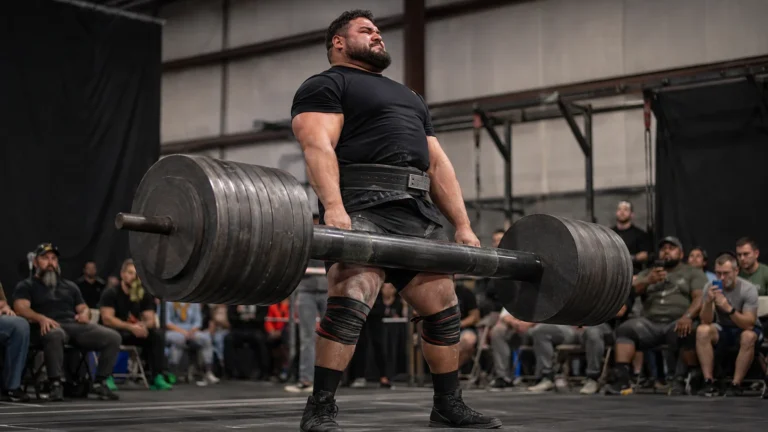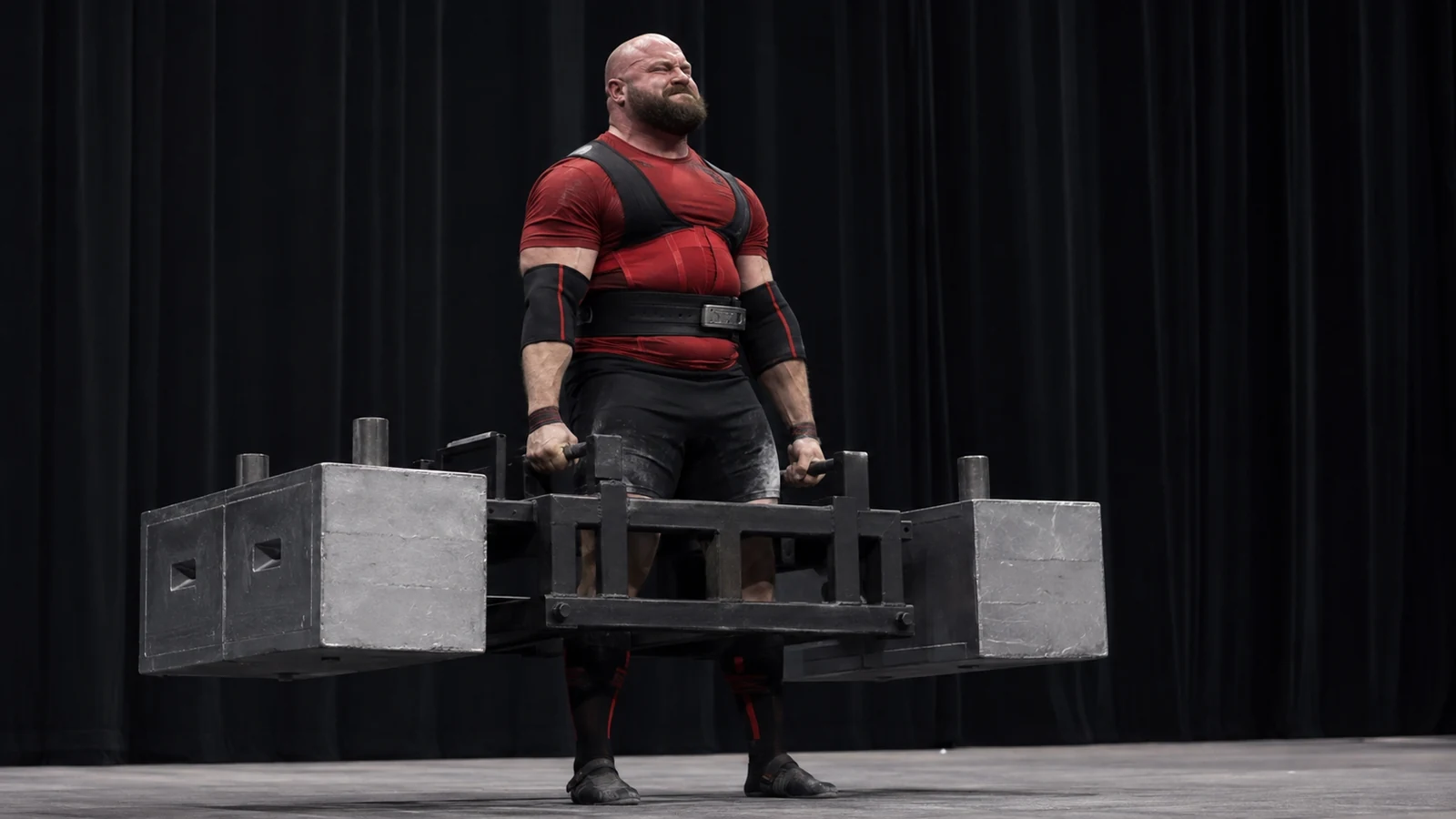

Rauno Heinla set the silver dollar deadlift world record on June 4, 2022, in Viljandi, Estonia.
He pulled 580 kilograms, or roughly 1,278.7 pounds, off blocks raised 18 inches from the floor.
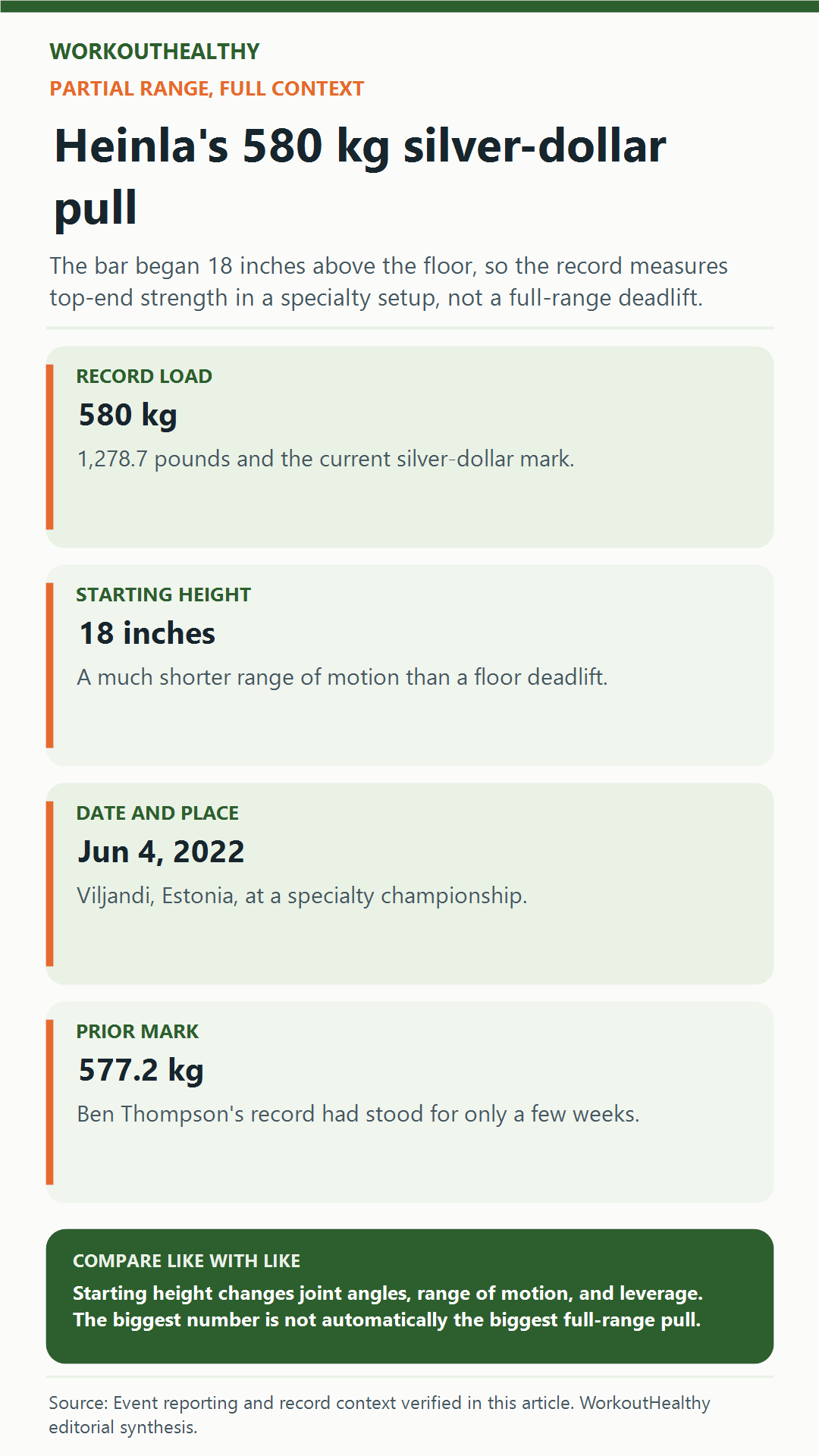
That is still the heaviest silver dollar deadlift ever recorded, and as of this writing, nobody has publicly topped it.
The number alone makes it sound like Heinla out-deadlifted every powerlifter and strongman on earth.
He did not, and understanding why takes a closer look at what a silver dollar deadlift actually tests.
What Happened in Viljandi
The lift came at the 2022 Silver Dollar Deadlift Estonian Championship, a specialty strongman event built around exactly one lift.
Heinla was chasing a record that had changed hands just weeks earlier.
American strongman Ben Thompson had set the previous mark, 577.2 kilograms, on May 7, 2022, barely a month before Heinla’s attempt.
Heinla added 2.8 kilograms to that number and locked the bar out at 580 kilograms.
Footage of the lift shows him wearing a weightlifting belt and figure-eight straps, but no deadlift suit.
Because the bar started well above the floor, the pull to lockout was short, and reporting on the lift specifically noted how little distance he had to travel to finish it.
What a Silver Dollar Deadlift Actually Is
A standard deadlift starts with the bar resting on the floor.
A silver dollar deadlift starts with the bar resting on raised blocks, set here at 18 inches, which lands somewhere around mid-shin to knee height depending on the lifter’s height.
The name comes from strongman slang for a big, round weight plate, not from any literal silver dollar coin used in the setup.
Because the bar starts higher, the lifter skips the bottom portion of the pull entirely and only performs the top portion, from roughly the knee to full lockout.
That single change is the biggest reason the number on the bar can climb so high.
A shorter range of motion does not mean a shorter list of demands. It removes the hardest part of the lift and asks the body to express raw force through the part that was already easiest.
Why Shortening the Range Changes the Number
Every lift has a strength curve, the pattern of how hard or easy each portion of the movement feels as the bar travels.
In a conventional deadlift, the toughest point is usually near the floor, where the back and hips sit in their most disadvantaged position and there is no momentum built up yet to help.
A 2016 review by researchers Justin Kompf and Ognjen Arandjelović, published in Sports Medicine, examined how sticking points form across the bench press, squat, and deadlift, and found they are shaped by shifting joint angles and changing leverage as a lift progresses (Kompf & Arandjelović, 2016).
Their follow-up analysis looked specifically at how the deadlift’s sticking point differs from the squat and bench press, tracing it to how hip and knee leverage change through the pull (Kompf & Arandjelović, 2017).
A silver dollar deadlift removes that difficult early section by design.
The lifter starts in the strong, close-to-lockout position and only has to finish a portion of the range that was never the limiting factor to begin with.
That is why 580 kilograms from blocks and 580 kilograms from the floor are not remotely the same test, even though a scale would read the two as identical.
How 580 kg Compares to a Full-Range Deadlift
For scale, the raw powerlifting deadlift world record, pulled from the floor with no straps or suit, has stood at 460.4 kilograms since 2011, set by Icelandic lifter Benedikt Magnusson.
Heinla’s 580 kilograms is nearly 120 kilograms heavier than that mark, and the gap is not a sign that partial deadlifts are simply an easier lift in some general sense.
It reflects how much load the body can move once the floor-level portion of the pull is taken out of the equation.
This is the same logic behind the floor press, a bench press variation that shortens the range from the opposite end of a different lift.
Removing part of a lift’s range changes what that lift actually measures, whether the missing portion comes off the top or the bottom.
None of this makes 580 kilograms an easy number to move.
It still demands enormous grip, back, and hip strength to lock out, just concentrated into a narrower window of the pull.
Where Specialty Deadlifts Fit in Strongman
Strongman competition has built an entire tradition around swapping the standard barbell for something stranger.
The elephant bar deadlift uses a thick, flexible bar that bends and stores energy through the pull.
The hummer tire deadlift and axle deadlift each change the grip and bar diameter instead of the range of motion.
The silver dollar deadlift belongs to a different branch of that same tradition, one that changes the range instead of the implement.
Promoters favor these formats because a single, focused lift can produce a dramatic number that a mixed strongman event rarely delivers.
That is part of why a 580-kilogram lift makes headlines even though it is not directly comparable to a standard deadlift record.
Who Actually Tracks a Record Like This
Records like the standard competition deadlift usually sit inside federations such as the IPF or USAPL, with defined rules, drug testing, and certified judges.
A silver dollar deadlift has no equivalent body.
There is no international federation that standardizes block height, bar type, or judging criteria across every silver dollar deadlift event.
What exists instead is consensus among strongman media outlets, event organizers, and reference sites that track the lift over time, including BarBend, the outlet that first reported Heinla’s 580-kilogram pull.
That is a meaningfully different process than a Guinness World Records claim, which requires a formal application and an adjudication step before the record counts.
Records like Edith Connor’s Guinness title for oldest competitive female bodybuilder and DonnaJean Wilde’s push-up world record went through that formal process, and Heinla’s silver dollar deadlift did not.
Neither path makes a record more or less real, but the two are not interchangeable, and it is worth knowing which kind of “world record” a given story is describing.
Rauno Heinla’s Strongman Background
Heinla is an Estonian strongman built around one specialty: pulling more weight off the ground, or near it, than almost anyone else in the sport.
In 2019 he won the World’s Ultimate Deadlift Championships, a format that tests maximum deadlift strength directly, with a winning pull of 450 kilograms.
In 2020 he beat fellow deadlift specialist Jerry Pritchett in a head-to-head deadlift showdown, another event built entirely around one lift.
2022 was a mixed year for him outside that deadlift-specialist world.
He withdrew from that year’s World’s Strongest Man, and also withdrew from Europe’s Strongest Man because of injury.
The silver dollar deadlift record landed in the middle of that stretch, a specialty-lift win during a year when his full strongman-competition results did not go his way.
What This Record Does Not Prove
A 580-kilogram lockout says a great deal about Heinla’s top-end pulling strength and comparatively little about his strength through a full range of motion.
Strength built in one narrow joint-angle window does not automatically transfer to the rest of a lift’s range.
Bazyler and colleagues, in a 2014 study on partial squat training published in the Journal of Strength and Conditioning Research, found that heavy partial-range training builds strength that peaks at the trained joint angle and does not carry over equally to a lift’s full range (Bazyler et al., 2014).
The same logic applies to a deadlift trained or tested from raised blocks.
None of this takes anything away from the lift itself.
It simply means 580 kilograms is measuring one specific capability, not general deadlift strength.
Common Mistakes When Programming Partial Deadlifts
The biggest mistake lifters make with partial deadlifts is treating the number on the bar as equivalent to a full-range personal record.
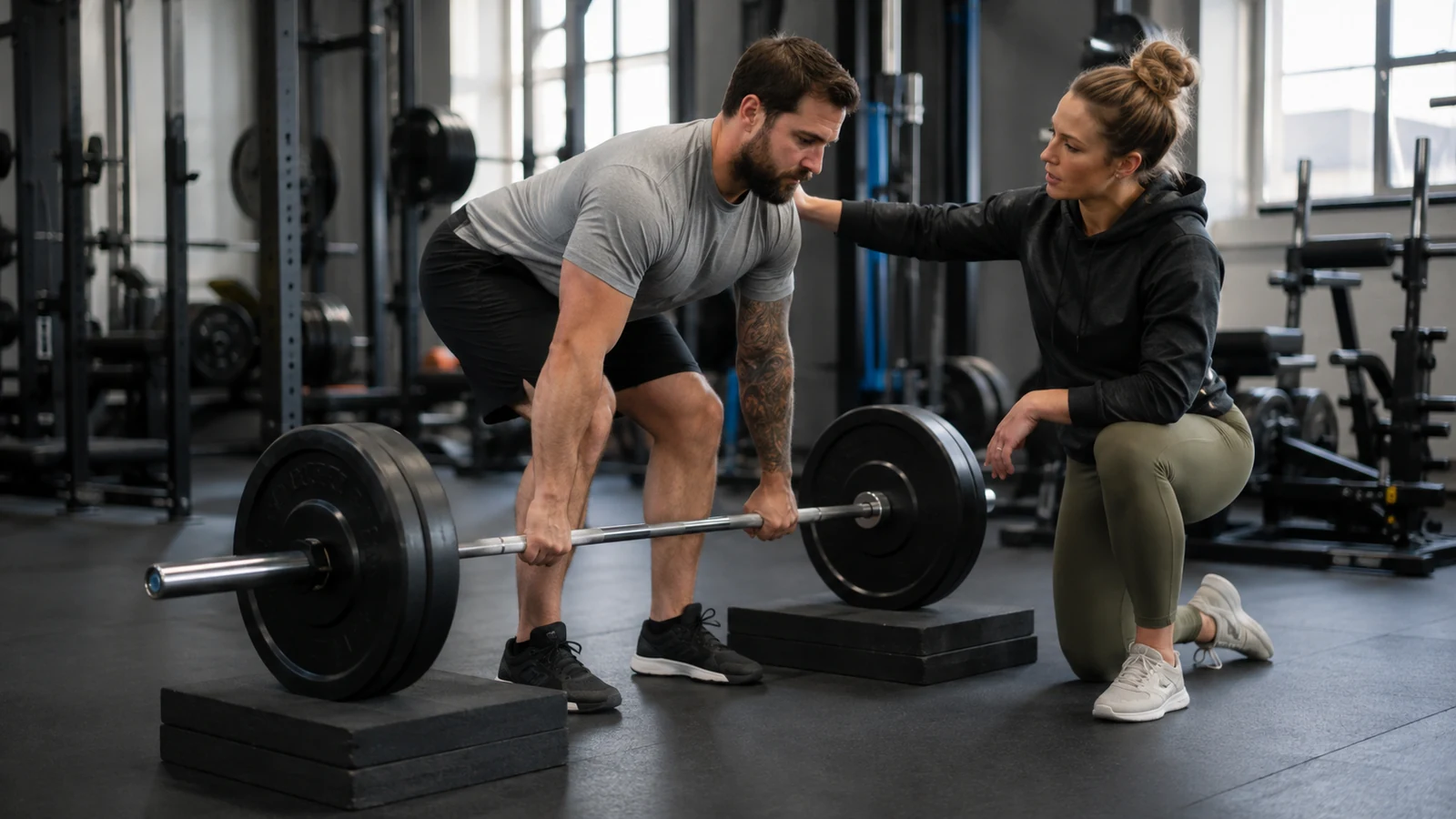
It is not, and comparing the two leads to badly miscalibrated training percentages down the line.
A second common mistake is skipping the setup work a partial deadlift still requires.
A shorter range does not mean a shorter warm-up or a looser brace.
Lifters also tend to round the back at lockout once the weight gets heavy, because the ego wants the rep to count even after the form has broken down.
That habit carries real injury risk no matter how short the range of motion is.
Many lifters also add partials to a program without a clear reason for doing so, instead of using them to target one specific sticking point.
Another mistake is chasing a new partial-deadlift max every few weeks, which piles on fatigue without adding much toward a full-range goal.
Grip is often the first thing that gives out on a heavy partial pull, so lifters who skip grip work tend to stall well below what their back and hips could otherwise handle.
Who Should Be Cautious, and How to Try a Lighter Version
Partial deadlifts are not a beginner exercise, and most lifters chasing general strength or muscle do not need them at all.
Anyone with a current lower back injury, a disc issue, or uncontrolled blood pressure should check with a doctor or physical therapist before loading a heavy partial pull.
For lifters who are cleared to try one, a safer entry point starts with pins in a power rack or a set of low blocks, not a full 18-inch elevation on day one.
Start with a weight close to a normal working set, not a near-maximal single.
Keep the spine braced and the bar close to the body through the entire short range, exactly as in a full deadlift.
Add load gradually across several weeks rather than chasing a heavy single in the first session.
Most lifters get more out of using partials as an occasional lockout-strength tool than as a regular replacement for full-range pulling.
A reasonable starting scheme is two or three sets of two to three reps, once every seven to ten days, not a daily or twice-weekly habit.
Anyone new to the movement should spend several sessions at a moderate weight before testing anything close to a true maximum.
Watch the Original Video
Want more verified record breakdowns like this one? Subscribe to WorkoutHealthy Insider for practical explanations behind popular fitness claims.
References
Bazyler, C. D., Sato, K., Wassinger, C. A., Lamont, H. S., & Stone, M. H. (2014). The efficacy of incorporating partial squats in maximal strength training. Journal of Strength and Conditioning Research, 28(11), 3024–3032. https://doi.org/10.1519/JSC.0000000000000465
Kompf, J., & Arandjelović, O. (2016). Understanding and overcoming the sticking point in resistance exercise. Sports Medicine, 46(6), 751–762. https://doi.org/10.1007/s40279-015-0460-2
Kompf, J., & Arandjelović, O. (2017). The sticking point in the bench press, the squat, and the deadlift: Similarities and differences, and their significance for research and practice. Sports Medicine, 47(4), 631–640. https://doi.org/10.1007/s40279-016-0615-9
This article is for general information only and is not medical advice. If you have an injury, ongoing pain, or a medical condition, talk to a doctor or physical therapist before you change how you train or eat.