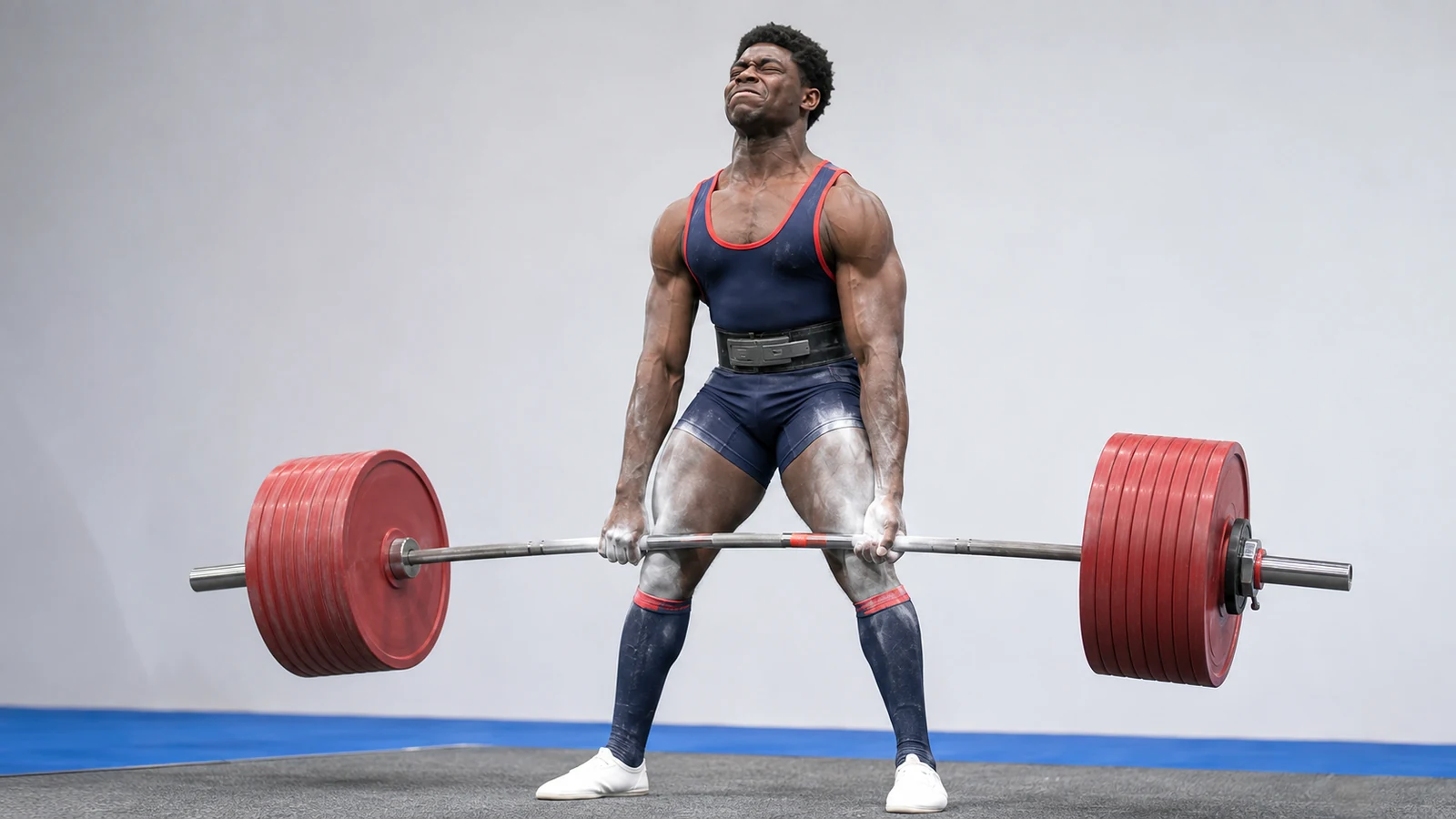

Most 19 year olds are still figuring out how to do their own laundry.
Nonso Chinye spent the summer of 2024 loading a barbell with more weight than most grown men will ever pull off the floor.
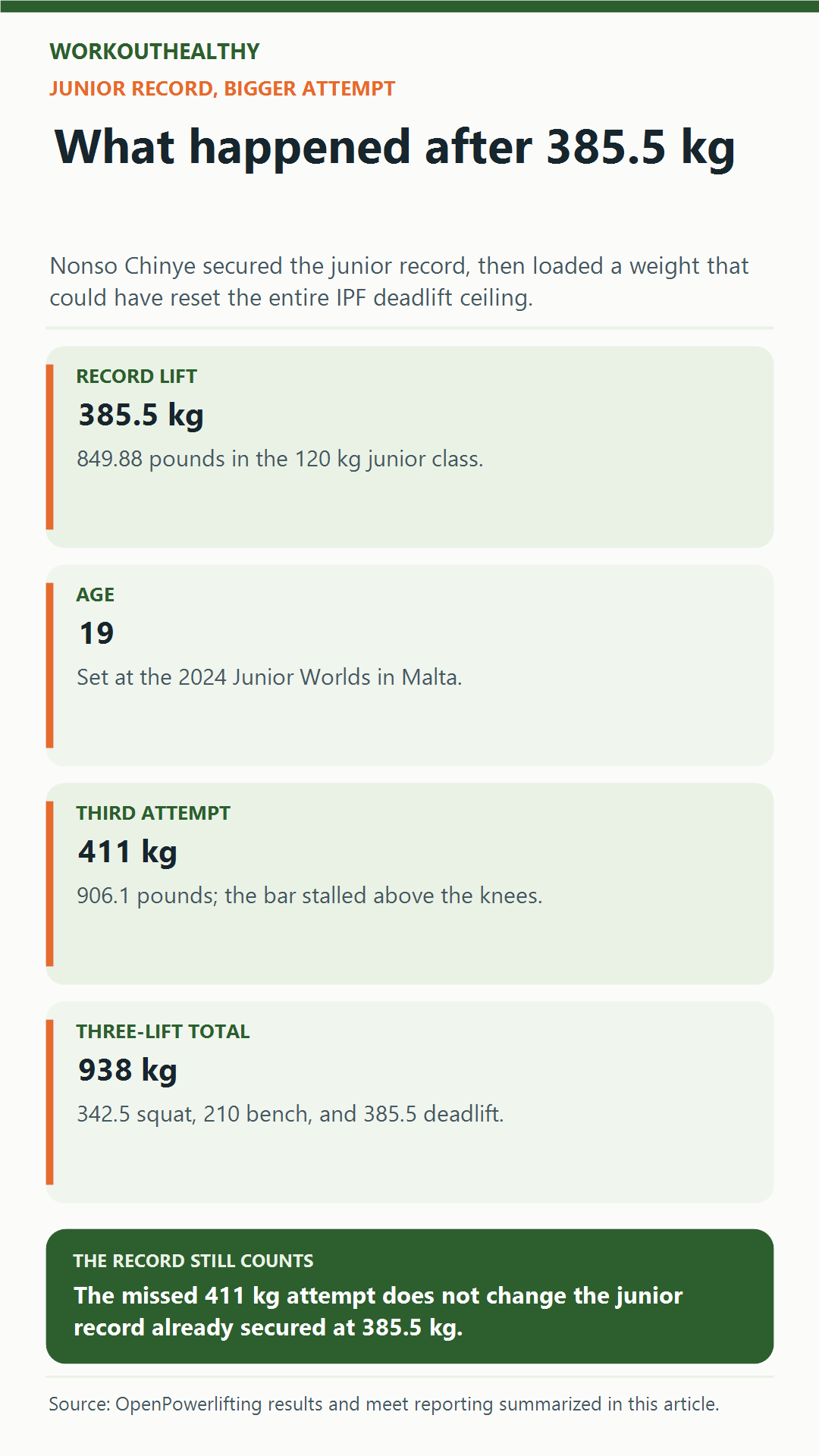
Competing for Great Britain at the 2024 IPF World Junior and Sub-Junior Powerlifting Championships in Malta, Chinye locked out a 385.5 kilogram deadlift.
That is 849.88 pounds, and it set a new IPF junior world record in the 120 kilogram class.
He then asked for 411 kilograms on his third attempt.
That is 906.1 pounds, a number that would not just have broken a junior record.
It would have set the heaviest raw deadlift in International Powerlifting Federation history, at any age, in any weight class.
He missed it, the bar stalling just above his knees.
He still won his class by more than 35 kilograms on total, about 77.16 pounds, a gap most competitors never open on a single lift, let alone an entire meet.
What makes Chinye’s story worth following is not just that single afternoon in Malta.
It is what came after.
Within a year, competing as an open lifter against grown men with no age bracket to soften the field, he pulled past the number he had missed as a teenager.
What Actually Happened at the 2024 Junior Worlds
The meet was the IPF World Junior and Sub-Junior Powerlifting Championships, held in Malta in August 2024.
Chinye competed in the men’s 120 kilogram class at a bodyweight of 118.3 kilograms.
His full set of competition lifts, verified through OpenPowerlifting’s public results database, looked like this: a 342.5 kilogram squat, a 210 kilogram bench press, and the 385.5 kilogram deadlift.
That gave him a 938 kilogram total, itself an IPF classic junior world record.
He had not arrived at that meet out of nowhere.
Chinye had already been climbing through British and European junior and sub-junior competitions for two years before Malta, moving up a weight class along the way.
But Malta was the first time his numbers stopped reading like a promising junior and started reading like a future open champion.
The Third Attempt That Almost Rewrote the Record Book
Junior world records were not the ceiling Chinye was reaching for that day.
After his second deadlift secured the junior record, his team called for 411 kilograms on the third and final attempt.
At the time, the standing record for the heaviest raw deadlift ever recorded in IPF competition, across every weight class and every age division, sat at 410.5 kilograms.
A successful 411 kilogram pull would have broken it.
Chinye got the bar moving.
It stalled near his knees, the point in a deadlift where the bar has left the floor but the hips have not yet finished driving through, and he could not lock it out.
The attempt was ruled a miss.
The all-time IPF record stayed where it was, at least for another year.
What the miss did not change was the meet result.
His 938 kilogram total still stood more than 35 kilograms, or roughly 77.16 pounds, ahead of the next competitor in his class.
A missed lift on a scoreboard and a missed lift on a career are two different things. One cost Chinye a record that day. The other never happened.
Why a Deadlift That Heavy Is So Hard to Finish
The sticking point Chinye hit, right around the knees, is one of the most studied moments in the entire lift.
A 2020 systematic review of deadlift electromyography research, published in PLOS ONE, found that muscle activity in the lift changes sharply as the bar passes the knees (Martín-Fuentes, Oliva-Lozano, & Muyor, 2020).
Below the knee, the lift leans heavily on the quadriceps and the muscles around the ankle and hip to break the bar off the floor.
Above the knee, the glutes, hamstrings, and the entire posterior chain of the lower back take over to finish the hip extension.
That handoff between muscle groups is exactly where near-maximal deadlifts tend to stall.
A lifter can have plenty of strength to start the pull and still run out of finishing power at the exact moment Chinye’s did.
It is also why elite deadlifters spend so much training time on lockout-specific work, not just pulling from the floor.
Similar joint-angle tradeoffs show up in other lifts too, which is part of why small setup changes can shift how much weight a lifter can move, the way this site’s comparison of the floor press and bench press lays out for the upper body.
From Junior Record to Open Competition
Junior lifters in the IPF system stay junior-eligible from 19 through 23 years old.
Chinye still had years of that window left after Malta.
What he did with that time was skip past waiting for it to run out.
By March 2025, competing at the European Open Classic Powerlifting Championship, still just 20 years old, Chinye deadlifted 400 kilograms.
That is 881.85 pounds, and it was ratified as an official IPF world record in the 120 kilogram class, open division, no age bracket attached.
Three months later, in June 2025, he competed at the IPF World Classic Powerlifting Championships, the senior world championship rather than a junior event, and pulled 390 kilograms.
Then in October 2025, at the Avancus Houston Primetime meet, he deadlifted 415.5 kilograms.
That converts to 916.02 pounds, more than the 906.1 pounds he had missed in Malta fourteen months earlier.
Reporting on that Houston pull has described it as an unofficial world record rather than a ratified one, since the meet was not held under the IPF’s own sanctioning.
The number stands regardless of the paperwork.
A lift that would have been the heaviest in IPF history in August 2024 was a number he cleared, at a different meet, before his 21st birthday.
What This Progress Does Not Prove
It is worth being precise about what one strong year does and does not establish.
A string of personal bests across different federations and meets is not the same as a single, continuously verified world record climbing in a straight line.
The 400 kilogram European pull carries official IPF ratification.
The 415.5 kilogram Houston pull, by most reporting, does not yet carry that same status.
Weight classes, meet sanctioning, and equipment rules also differ slightly between federations, which is part of why the sport tracks records the way it does.
This site has covered that kind of verification question before, including how a title like Edith Connor’s Guinness World Record for oldest female bodybuilder depended on specific, checkable competition documentation rather than a claim alone.
None of that erases what Chinye has done.
It just means the fairest way to describe his 2025 numbers is as verified competition results, some officially ratified and some still pending that process, rather than as a single unbroken record streak.
It is also fair to note that early-career trajectories like this do not guarantee continued improvement at the same rate.
Research analyzing thousands of USA Powerlifting results found that competitive strength in the deadlift tends to keep rising through the mid to late twenties before plateauing for most lifters (Ball & Weidman, 2018).
Chinye is still years away from that typical peak, which is part of why his current numbers matter so much for what they suggest about where his ceiling might eventually sit.
How Young Is Too Young to Chase Numbers Like This
A 19 year old pulling 849 pounds understandably raises a question for parents and coaches watching from outside the sport: is this actually safe?
The short answer, based on the research, is that supervised resistance training for teenagers is not inherently dangerous.
The National Strength and Conditioning Association’s position statement on youth resistance training concluded that a properly designed and supervised program does not stunt growth or damage growth plates, and can meaningfully reduce injury risk in youth sports when it includes progressive overload and qualified coaching (Faigenbaum et al., 2009).
A separate review in ACSM’s Health and Fitness Journal reached a similar conclusion, noting that the biggest risk factors in youth strength training are poor supervision, unrealistic loading jumps, and inadequate technique instruction, not the presence of heavy lifting itself (Myer, Lloyd, Brent, & Faigenbaum, 2013).
Chinye’s own competition history supports that picture rather than contradicting it.
His numbers climbed gradually across five years of documented meets, moving through sub-junior, junior, and now open competition rather than arriving at a heavy single overnight.
That kind of multi-year build is the difference between a supervised athletic career and the kind of ego-driven max attempt that actually does put a young lifter at risk.
Common Mistakes Lifters Make Chasing a Max Deadlift
Watching a 411 kilogram attempt on video tends to make lifters want to test their own ceiling immediately.
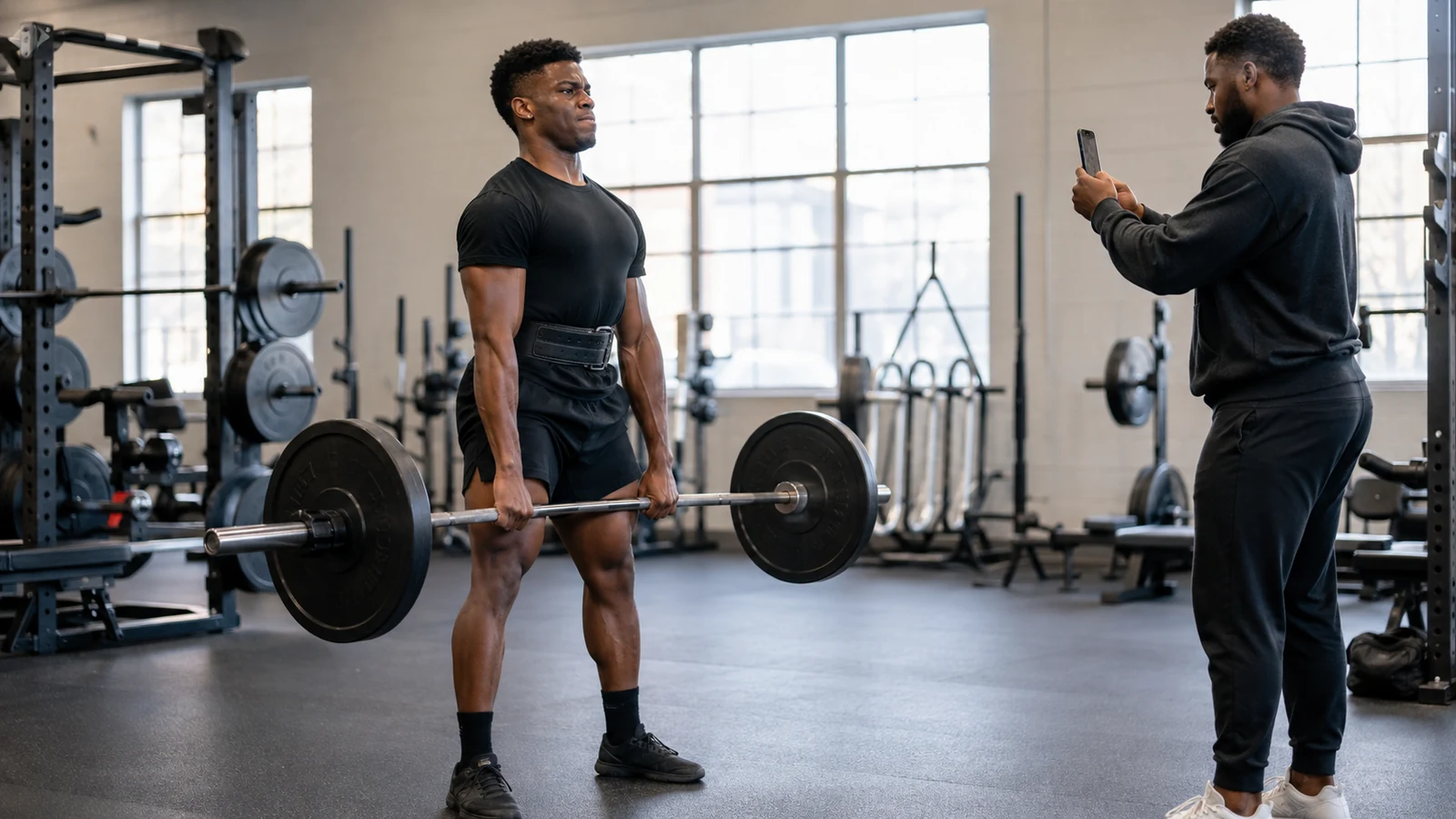
That instinct causes most of the injuries connected to heavy deadlifting.
The first common mistake is skipping a real warm-up ramp.
Elite lifters like Chinye work through a long sequence of increasing weights before touching a true near-maximal attempt, not a handful of loose reps.
The second is losing a neutral spine under load.
A rounding lower back at heavy weight shifts stress toward the spine’s passive structures instead of the muscles built to handle it.
The third is chasing weight before technique.
Bar path, hip hinge sequencing, and grip all need to be automatic before a lifter adds meaningful load, not figured out under a personal record attempt.
The fourth is training every session at or near a one-rep max.
Chinye’s meet history shows planned peaks a handful of times a year, not maximal singles every week.
The fifth is ignoring recovery between heavy pulls.
A true maximal deadlift is taxing enough on the nervous system that most programs build in several easier days afterward.
Want more stories like this one? Subscribe to WorkoutHealthy Insider for practical explanations behind popular fitness claims.
What Everyday Lifters Can Take From This
Nobody reading this needs to pull 900 pounds to benefit from how Chinye trains.
The most transferable part of his story is the pacing.
He did not jump from a junior total to a near-record attempt in one meet.
He built through smaller, verified increases across roughly a dozen documented competitions over five years.
That same principle applies at any strength level.
Progressive overload, adding small amounts of weight or volume once a lift is truly mastered, remains one of the most consistent findings in strength training research.
Strength training also carries benefits that have nothing to do with a scoreboard.
Research on resistance training in older adults has linked consistent lifting to measurable cognitive benefits, not just muscle and bone, which this site’s look at whether lifting weights keeps your brain young covers in more detail.
For most people, the practical lesson is not to copy a 411 kilogram attempt.
It is to copy the years of unglamorous, incremental work that made that attempt possible in the first place.
Watch the Original Video
References
Ball, R., & Weidman, D. (2018). Analysis of USA Powerlifting Federation data from January 1, 2012-June 11, 2016. Journal of Strength and Conditioning Research, 32(7), 1843-1851. https://doi.org/10.1519/JSC.0000000000002103
Faigenbaum, A. D., Kraemer, W. J., Blimkie, C. J. R., Jeffreys, I., Micheli, L. J., Nitka, M., & Rowland, T. W. (2009). Youth resistance training: Updated position statement paper from the national strength and conditioning association. Journal of Strength and Conditioning Research, 23(5 Suppl), S60-S79. https://doi.org/10.1519/JSC.0b013e31819df407
Martín-Fuentes, I., Oliva-Lozano, J. M., & Muyor, J. M. (2020). Electromyographic activity in deadlift exercise and its variants. A systematic review. PLOS ONE, 15(2), e0229507. https://doi.org/10.1371/journal.pone.0229507
Myer, G. D., Lloyd, R. S., Brent, J. L., & Faigenbaum, A. D. (2013). How young is “too young” to start training? ACSM’s Health & Fitness Journal, 17(5), 14-23. https://doi.org/10.1249/FIT.0b013e3182a06c59
This article is for general information only and is not medical advice. If you have an injury, ongoing pain, or a medical condition, talk to a doctor or physical therapist before you change how you train or eat.